On 18 November 2026 the Union Health Ministry opened the national observance of World Antimicrobial Resistance (AMR) Awareness Week, whose theme this year is One Health, One Action: Prevent AMR Now. The Health Secretary urged the public to stop self-medicating with antibiotics and named hygiene, sanitation, safe water, safe food and vaccination among the ways to prevent infection, because every infection prevented is one less course of antibiotics. The meeting noted that more than half of antimicrobial sales in India happen without a prescription. The simplest tool for hygiene is soap, and the chemistry of how soap works appears in the science paper almost every year. This article covers how soap is made, how it cleans, why hard water spoils it and what detergents changed.
One Molecule, Two Personalities
By Abhishek Thakur · Science faculty, The Cavalier · 15 years teaching NDA and CDS Science
A soap is the sodium or potassium salt of a long-chain fatty acid, for example sodium stearate, C17H35COONa. The molecule has two ends that behave in opposite ways.
- The head is the ionic carboxylate group, –COO−. It is hydrophilic: it likes water and dissolves in it.
- The tail is a long hydrocarbon chain of 11 to 17 carbon atoms. It is hydrophobic (water-hating) and lipophilic (oil-loving): it dissolves in grease, not in water.
Molecules like this gather at the surface of water and lower its surface tension, so the solution wets surfaces better and foams. They are called surface-active agents or surfactants. Synthetic detergents are surfactants too. They differ only in the head group, which is a sulphate or sulphonate in place of the carboxylate.
CDS 2026-I offered the statement "the hydrophilic part of soap is oil and it dissolves in water". It is false. The water-loving part is the ionic head. Oil sits with the tail, never the head.
Saponification: Fat Plus Alkali
Oils and fats are esters of the alcohol glycerol (three –OH groups) with long-chain fatty acids. Boiling them with a strong alkali breaks the ester bond. This alkaline hydrolysis is called saponification (from the Latin sapo, soap).
Compare it with esterification, the reverse direction in the laboratory. An acid and an alcohol form an ester and water, and concentrated sulphuric acid acts as both catalyst and dehydrating agent. Saponification is effectively one-way because the soap formed is a salt, which cannot easily turn back into the ester.
- Sodium hydroxide gives hard bar soaps. Potassium hydroxide gives soft soaps, which are paste-like and kinder to the skin, as used in shaving creams and liquid soaps. UPSC has asked both facts.
- At the factory scale, the hot mixture is treated with common salt (salting out). Soap is less soluble in brine, so it separates as a layer and the glycerol stays in the water below.
- Glycerol is a valuable by-product, used in cosmetics and medicines and in making nitroglycerine.
- Liquid vegetable oils are turned into solid fats for soap and vanaspati by hydrogenation over a nickel catalyst.
Tristearin (molar mass 890 g/mol) is saponified with NaOH (40 g/mol). Find the NaOH needed for 89 g, and the soap and glycerol formed. Sodium stearate = 306 g/mol; glycerol = 92 g/mol.
How a Micelle Lifts Grease Off Cloth
Dirt on skin and cloth is held there by a thin film of grease, and water alone cannot lift grease. Soap works in three steps, which make the figure below.
- The hydrocarbon tails push into the grease because oil dissolves in oil. The ionic heads stay in the water.
- Rubbing or stirring breaks the grease into tiny droplets. Each droplet is ringed by tails pointing in and heads pointing out.
- These coated droplets form micelles. Their charged surfaces repel each other, so they stay dispersed in the water instead of settling or joining up, and the rinse carries them away.
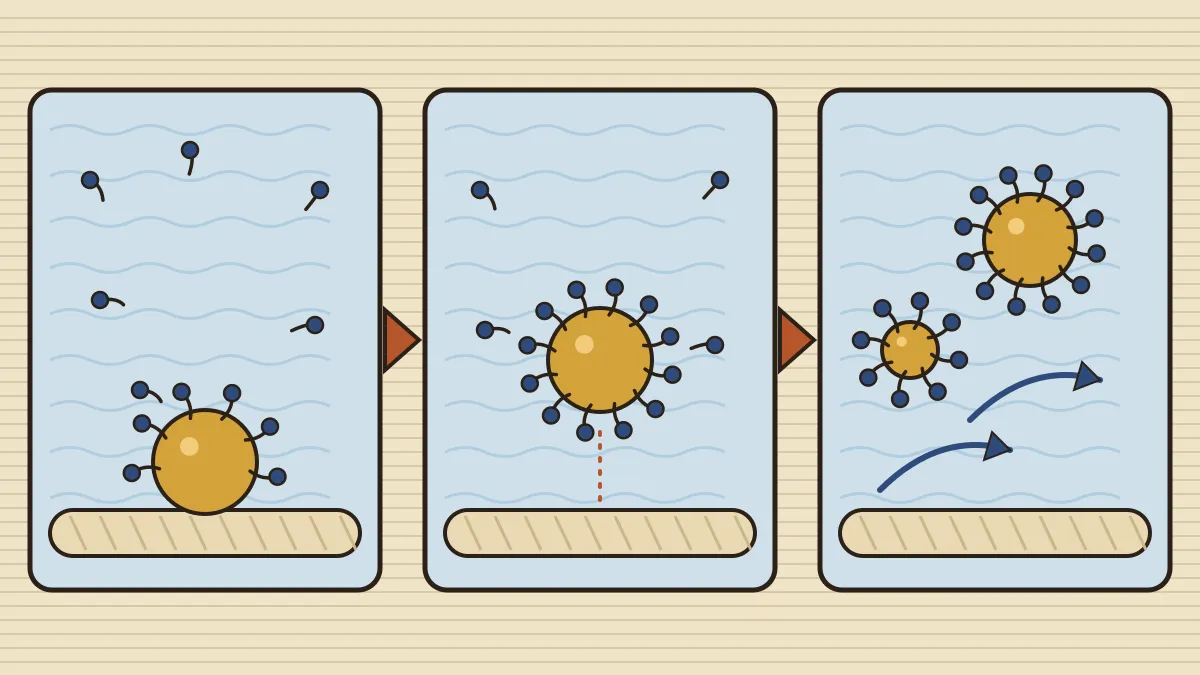
Three side-facts follow from this picture, and all of them have been asked.
- Grease collects in the centre of the micelle. The ionic end faces outwards, towards water.
- Micelles are large enough to scatter light, which is why a soap solution looks cloudy. This is the Tyndall effect, as in any colloid.
- A soap solution is alkaline to litmus. A turmeric stain on cloth turns reddish-brown when rubbed with soap, because turmeric changes colour in a base.
The same two-ended structure explains a medical point. Many viruses and all animal cells are wrapped in a lipid membrane. Soap and detergent molecules push into that membrane and dissolve it. Human red blood cells placed in a 2% detergent solution lyse, meaning they burst open. Hand-washing therefore does not only dislodge germs; for membrane-wrapped microbes it also breaks them apart. Antibiotic resistance arises from the misuse of antibiotics in medicine, farming and animal feed. Soap prevents infections without driving resistance, which is exactly the point of AMR week. For the biology of resistance and of useful microbes, see our microbes page, and for how India's seafood exports are tied to AMR rules, see our article on India and the EU authorised list.
Hard Water, Scum and the Arrival of Detergents
Hard water carries dissolved calcium and magnesium ions. Our water-hardness page explains temporary and permanent hardness. Here the point is what those ions do to soap. They swap places with sodium and form an insoluble salt of the fatty acid, the grey curd called scum.
Scum does two harms. It wastes soap, because soap is used up before it can lather, and it sticks to cloth and leaves it dull.
A bucket holds 20 litres of water with a hardness of 200 mg/L as CaCO3. How much sodium stearate (306 g/mol) is wasted as scum?
Soap also fails in acidic water, because the acid turns the soap back into the fatty acid, which precipitates. Synthetic detergents solve both problems. They are the sodium salts of long-chain alkyl hydrogen sulphates (such as sodium lauryl sulphate) or of alkylbenzene sulphonic acids. The calcium and magnesium salts of these acids are soluble, so detergents lather even in hard water.
| Feature | Soap | Synthetic detergent |
|---|---|---|
| Chemical nature | Sodium or potassium salt of a fatty acid (carboxylate) | Sodium salt of an alkyl sulphate or alkylbenzene sulphonate |
| Raw material | Fats and oils plus alkali | Petroleum-based hydrocarbons treated with sulphuric acid |
| In hard water | Forms insoluble scum | Calcium and magnesium salts stay dissolved |
| In acidic water | Fails (fatty acid separates) | Still works |
| Solution | Alkaline | Close to neutral |
| Biodegradability | Fully biodegradable | Depends on the chain (see below) |
Detergents are classed by the charge on the head.
- Anionic: negative head, such as sodium lauryl sulphate and the alkylbenzene sulphonates. This is the most common type and the base of washing powders.
- Cationic: positive head, usually a quaternary ammonium group, as in cetyltrimethylammonium bromide. These are germicidal and are used in hair conditioners and fabric softeners.
- Non-ionic: no charge, for example esters of polyethylene glycol. They foam less and are used in liquid dish-washing preparations.
Early detergents used branched alkyl chains. Bacteria cannot break them down easily, so foam piled up on rivers. Switching to linear alkylbenzene sulphonate, which bacteria digest much better, partly solved the problem. The NIOS table gives soaps as fully biodegradable (100%), linear alkylbenzene sulphonate about 90% and the branched kind only 50-60%. Phosphate "builders" in washing powder also feed algae and contribute to eutrophication. For the washing-soda and salt chemistry, see our salts page.
How UPSC Has Asked It: Past Papers Solved
These are actual CDS and NDA questions since 2019. The topic is a favourite because it tests five short facts: the structure, the maker (saponification), the micelle, hard water and the detergent classes.
Which one among the following statements regarding micelles is not correct?
(a) Soap molecules are sodium or potassium salts of long-chain carboxylic acids. (b) Micelles precipitate out of solution because of ion-ion repulsion. (c) Grease gets collected in the centre of the micelle. (d) Soap micelles scatter light.
Answer: (b). Micelles do not precipitate. Their charged surfaces repel one another, and that repulsion keeps them dispersed. The other three statements are standard facts.
Consider the following statements: 1. Concentrated H2SO4 is used as a dehydrating agent in esterification reaction. 2. The hydrophilic part of soap is oil and it dissolves in water. 3. Nickel is used as a catalyst in converting vegetable oil into fat. Which of the statements given above are correct?
(a) 1, 2, 3 and 4 (b) 1 and 2 only (c) 2 and 3 only (d) 1 and 3 only
Answer: (d). Statements 1 and 3 are correct. Statement 2 is false: the water-loving part is the ionic head, while the oily part is the tail. Option (b) tempts those who remember the esterification fact but miss the false statement about the hydrophilic part.
Which one of the following statements about the cleansing action of soap is not true?
(a) The oil and dirt gets collected in the centre of the micelle. (b) Soap micelles scatter light. (c) Soaps are ammonium salts of long chain carboxylic acids. (d) Soap forms insoluble precipitates with the calcium and magnesium ions in hard water.
Answer: (c). Soaps are sodium or potassium salts, not ammonium salts. Option (d) tempts because scum sounds like a fault, but it is a true statement.
Which one of the following statements is NOT correct?
(a) The molecules of soap are sodium or potassium salts of long chain fatty acids (b) The molecules of soap contain both hydrophobic and hydrophilic ends (c) Detergents are more effective than soaps in hard water (d) In micelles the ionic-end of the molecules is towards oil droplet while the other end faces outside
Answer: (d). It is reversed. The ionic end faces the water, outside, and the hydrocarbon end faces the oil droplet inside.
What is the specific purpose of using potassium hydroxide during the saponification process?
(a) To obtain soaps which are hard on the skin (b) To obtain soaps which are soft on the skin (c) To obtain natural fragrance (d) To make the saponification very economical
Answer: (b). Potassium soaps are soft. Sodium hydroxide gives the hard bar. Potassium hydroxide is in fact dearer than sodium hydroxide, so (d) is wrong.
Which one of the following is NOT a synthetic detergent?
(a) CH₃(CH₂)₁₀CH₂OSO₃⁻Na⁺ (b) [CH₃(CH₂)₁₅–N(CH₃)₃]⁺Br⁻ (c) CH₃(CH₂)₇COO⁻Na⁺ (d) CH₃(CH₂)₇COO(CH₂CH₂O)ₙCH₂CH₂OH
Answer: (c). Option (c) is a carboxylate salt, which is the soap type. (a) is an anionic sulphate, (b) a cationic quaternary ammonium salt and (d) a non-ionic ester, so all three are detergents.
Soap solution used for cleaning purpose appears cloudy. This is due to the fact that soap micelles can
(a) refract light (b) scatter light (c) diffract light (d) polarize light
Answer: (b). Micelles are colloidal in size and scatter light, the Tyndall effect. A cloudy look comes from scattering, not from refraction.
If human blood is placed in a 2% detergent solution, what will happen to the RBC?
(a) The RBC will shrink. (b) The RBC will swell and become turgid. (c) The RBC will swell and burst. (d) The RBC will lyse.
Answer: (d). Detergent dissolves the lipid membrane, so the cells lyse. Option (c) describes osmosis in pure water, a different process, which is the tempting error.
Almost every question is a true-or-false on the micelle: ionic head outside, grease inside, light scattered, no precipitation. Add the soap facts (sodium or potassium salt; KOH for soft soap) and the detergent contrast (works in hard water), and you have covered the whole set.
Practice MCQs (with answers)
- Saponification is the
- hydrolysis of a fat or oil with an alkali to give soap and glycerol
- hydrogenation of vegetable oil over nickel
- reaction of an alcohol with an acid
- polymerisation of ethene
- Soft soaps are made using
- sodium hydroxide
- calcium hydroxide
- potassium hydroxide
- magnesium hydroxide
- In a soap micelle in water, the part facing the water is
- the hydrocarbon tail
- the carboxylate head
- glycerol
- the calcium ion
- Soap forms scum with hard water because
- soap is acidic
- hard water is acidic
- soap molecules break down
- calcium and magnesium ions form insoluble salts of the fatty acid
- Which one of these is a synthetic detergent?
- Sodium lauryl sulphate
- Sodium palmitate
- Potassium oleate
- Sodium stearate
- The by-product of soap making, used in cosmetics and medicines, is
- ethanol
- methanol
- acetic acid
- glycerol
- The NaOH needed to saponify 178 g of tristearin (molar mass 890; NaOH 40) is
- 12 g
- 24 g
- 36 g
- 72 g
- Cationic detergents, used in hair conditioners, have
- a sulphonate head
- no biodegradable chain
- a positively charged head, often a quaternary ammonium group
- no charge at all
1-a, 2-c, 3-b, 4-d, 5-a, 6-d, 7-b, 8-c. Q5: sodium palmitate, potassium oleate and sodium stearate are all carboxylate salts, so they are soaps. Q7: 178 ÷ 890 = 0.2 mol of fat; 3 mol of NaOH per mole of fat gives 0.6 mol; 0.6 × 40 = 24 g. Q8: non-ionic detergents have no charge and anionic ones have a negative head, so the positive head marks the cationic type.
Quick Revision
- Soap = sodium or potassium salt of a long-chain fatty acid (RCOONa), 11 to 17 carbons in R. Head = ionic, hydrophilic. Tail = hydrocarbon, hydrophobic, lipophilic.
- Saponification: fat or oil + alkali → soap + glycerol. NaOH = hard soap, KOH = soft soap. Salting out with NaCl separates the soap.
- Esterification: acid + alcohol → ester + water (conc. H₂SO₄ catalyst and dehydrating agent). Vegetable oil → fat by hydrogenation over nickel.
- Micelle: tails in (grease at the centre), ionic heads out. Charges repel, so micelles stay dispersed and do not precipitate. They scatter light, so the solution is cloudy. Soap is alkaline.
- Hard water: Ca²⁺ and Mg²⁺ + soap → insoluble scum. Soap also fails in acids. Detergents form soluble Ca and Mg salts and work in hard water.
- Detergents: anionic (sodium lauryl sulphate, alkylbenzene sulphonate), cationic (quaternary ammonium, germicidal, conditioners), non-ionic (polyethylene glycol esters). Linear chains biodegrade better than branched ones.
- Detergent lyses red blood cells by dissolving the membrane. World AMR Awareness Week: 18–24 November; theme 2026 "One Health, One Action: Prevent AMR Now".
Frequently asked questions
What is saponification?
Saponification is the alkaline hydrolysis of a fat or oil. Heating a fat with sodium hydroxide or potassium hydroxide splits it into the sodium or potassium salt of a fatty acid, which is soap, and glycerol. Sodium hydroxide gives hard soap and potassium hydroxide gives soft soap.
How does soap clean?
A soap molecule has an ionic head that likes water and a hydrocarbon tail that likes grease. In water the tails bury themselves in a grease droplet while the heads face outwards, forming a micelle. Rubbing breaks the grease into droplets, and the charged micelles stay dispersed and are rinsed away.
Why does soap not work well in hard water?
Hard water contains calcium and magnesium ions. These react with soap to form insoluble calcium and magnesium salts of the fatty acid, called scum. The soap is used up before it can form micelles, so it lathers poorly.
What is the difference between soap and detergent?
Soap is a sodium or potassium salt of a fatty acid, made from fats and alkali. A synthetic detergent is a sodium salt of an alkyl sulphate or alkylbenzene sulphonate, made from petroleum products. Detergents form soluble calcium and magnesium salts, so they work in hard water and in acidic water, where soap fails.
Why does a soap solution look cloudy?
Soap micelles are colloidal in size, so they scatter light passing through the solution. This is the Tyndall effect. The scattering makes the clear solution look cloudy.
Related CDS / OTA Science topics
Science is a third of the CDS GS paper
Cavalier's CDS/OTA batches teach physics, chemistry and biology from first principles, with numericals and weekly PYQ tests.