The Central Bureau of Narcotics (CBN) celebrated its 77th Foundation Day on 6 November 2026 at its headquarters in Gwalior. The Press Information Bureau's note recalls that the CBN was formed on 6 November 1950 by merging regional opium administrations. It also reports that between 2022 and October 2026 the Bureau booked over 1,000 cases, arrested 1,325 people, and in July 2026 seized 12 crore Tramadol tablets in Delhi, a haul the note puts at about 100 tonnes. The slogan for the year is "Nasha Mukt Yuva for Viksit Bharat". Every one of these lines rests on a single law, the Narcotic Drugs and Psychotropic Substances (NDPS) Act, 1985. UPSC asks about it as a Directive Principle, a statute, an agency and an international treaty, and this article takes the four in order.
Article 47 and the Birth of the 1985 Act
By Aditya Tiwari · Polity faculty, The Cavalier · Lawyer, 10 years teaching law and Polity
The Constitution gives India's drug policy its moral starting point in Article 47, a Directive Principle. It says the State shall regard the raising of the level of nutrition, the standard of living and the improvement of public health as among its primary duties. In particular it shall endeavour to bring about prohibition of the consumption, except for medicinal purposes, of intoxicating drinks and of drugs which are injurious to health. It is classed among the Gandhian principles. Our page on the Directive Principles of State Policy shows where it sits in Part IV. A Directive Principle is not enforceable in court, so a law is needed to give it force.
Before 1985, Indian drug law was a patchwork of colonial statutes: the Opium Act, 1857, the Opium Act, 1878 and the Dangerous Drugs Act, 1930. They did not cover synthetic drugs or international trafficking, and their punishments were light. Parliament therefore passed the NDPS Act, 1985, which came into force on 14 November 1985 and replaced all three. It does two jobs at once. It is a penal law that bans the production, possession, sale, transport and use of narcotic drugs and psychotropic substances, except for medical and scientific purposes, and it is a regulatory law that licenses the legal growing of opium and the trade in medicinal drugs. Its constitutional hooks are Entry 59 of the Union List (cultivation, manufacture and sale for export of opium) and Entry 19 of the Concurrent List (drugs and poisons, subject to Entry 59 for opium). That is why both Parliament and the states have a say in drug matters, but opium belongs to the Centre.
| Term in the Act | What it covers |
|---|---|
| Narcotic drugs | Coca leaf and cocaine, cannabis (hemp), opium, poppy straw and manufactured drugs such as heroin and morphine |
| Psychotropic substances | Mind-altering drugs listed in the schedule, such as LSD, MDMA and many synthetic tablets |
| Controlled substances | Precursor chemicals used to make drugs (precursor control came with the 1988 amendment) |
The Act's definition of cannabis covers charas and ganja (the resin and the flowering tops), but it leaves out the seeds and leaves. That is why bhang, made from leaves, is regulated by state excise laws and not by the NDPS Act. Questions that say "all products of the cannabis plant are banned under the NDPS Act" are wrong.
Small, Commercial and the Three Amendments
The Act punishes by quantity. Since the amendment of 2001 it has three bands, and the Central Government notifies the weights drug by drug. The more a person is caught with, the heavier the sentence, and above a small quantity the offence is also harder to get bail for.
| Band | Punishment (for the main offences, such as Section 21) |
|---|---|
| Small quantity | Rigorous imprisonment up to 1 year, or a fine up to ₹10,000, or both |
| Between small and commercial (intermediate) | Rigorous imprisonment up to 10 years and a fine up to ₹1 lakh |
| Commercial quantity | Rigorous imprisonment of 10 to 20 years and a fine of ₹1 lakh to ₹2 lakh (the court can go higher) |
| Drug | Small quantity | Commercial quantity |
|---|---|---|
| Heroin | 5 g | 250 g |
| Cocaine | 2 g | 100 g |
| Charas (hashish) | 100 g | 1 kg |
| Ganja | 1 kg | 20 kg |
| Opium | 25 g | 2.5 kg |
The more potent the drug, the lower the threshold.
| Amendment | Main change |
|---|---|
| 1988 (in force 1989) | Death penalty (Section 31A) for repeat offences involving large quantities; forfeiture of property from drug money (Chapter VA); control of precursor chemicals; controlled delivery; immunity for addicts who come forward for treatment (Section 64A) |
| 2001 | Punishment tied to small, intermediate and commercial quantities, replacing a flat 10-year minimum; the quantity table was notified in October 2001 |
| 2014 | New category of essential narcotic drugs (such as morphine) to ease access for pain relief and palliative care; the death sentence under Section 31A made discretionary rather than mandatory |
| 2021 | A drafting error in Section 27A (financing and harbouring) corrected |
A few other sections are worth knowing by number. Section 8 is the general prohibition. Section 27 punishes consumption, but an addict who volunteers for treatment is shielded from prosecution by Section 64A. Section 27A punishes those who finance trafficking or harbour offenders, with 10 to 20 years' imprisonment. Section 37 makes serious offences non-bailable unless the court is satisfied on two conditions: that the accused is not guilty, and that he is not likely to offend again on bail. Section 50 protects the accused during a personal search, giving the right to be taken before a gazetted officer or magistrate. In Tofan Singh v. State of Tamil Nadu (2020), the Supreme Court held that a confession made to narcotics officers cannot be used as evidence against the accused.
Who Enforces It: NCB versus CBN
The NDPS Act does not belong to one ministry, which is a favourite source of confusion. Two bodies sit at the centre, and the first is the older one.
| Central Bureau of Narcotics (CBN) | Narcotics Control Bureau (NCB) | |
|---|---|---|
| Created | 6 November 1950 (from the All-India Narcotics Board of 1949) | 17 March 1986, under Section 4(3) of the NDPS Act |
| Ministry | Department of Revenue, Ministry of Finance | Ministry of Home Affairs |
| Headquarters | Gwalior (moved from Shimla in 1960) | New Delhi |
| Main job | Licit opium: licences, weighing, procurement; import-export of narcotic and psychotropic drugs and precursors; also intelligence-based enforcement | Apex coordinating and enforcement agency for drug law; liaison with states and foreign agencies |
| Under the UN conventions | India's Competent National Authority for licit drug trade | Liaison with foreign agencies, INTERPOL and UNODC |
Customs, the Directorate of Revenue Intelligence (also under the Department of Revenue), the Border Security Force, the Coast Guard and the state police's anti-narcotics task forces all enforce the Act as well. For the Centre-state picture, the Narco Coordination Centre (NCORD) created by the Home Ministry in 2016 brings these agencies to one table at the Centre, state and district levels. The same Department of Revenue also houses the Directorate of Enforcement, another favourite in the CDS paper. The 10th NCORD apex meeting in June 2026 and the Home Minister's "Drug-Free India by 2029" roadmap are covered in our current-affairs pieces on the NCORD vision document and the four-pillar roadmap.
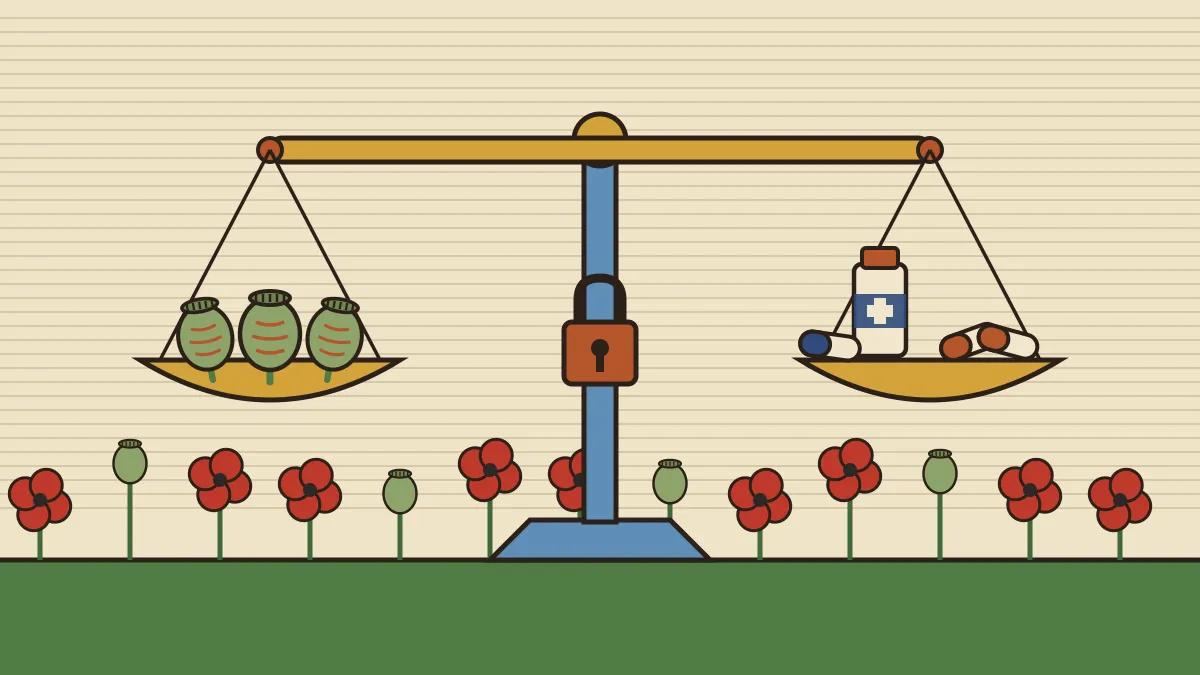
Licit opium: the other half of the law. India does not ban the poppy. It is one of the few countries that allow licensed cultivation, because opium yields morphine and codeine for painkillers. Farming is allowed only under a CBN licence, in notified tracts of Madhya Pradesh, Rajasthan and Uttar Pradesh. The farmer must hand the opium over to the government, and an embezzling licence-holder is punished under the Act. It is then processed at the two Government Opium and Alkaloid Works at Neemuch (Madhya Pradesh) and Ghazipur (Uttar Pradesh). The 2026 PIB note shows the link: 2,535 kg of high-purity opium seized from illegal channels was sent to the Neemuch works to be turned into medicinal alkaloids.
The World Framework: Conventions and Trafficking Routes
India made its law to meet three UN treaties, and examiners test them by year:
| Treaty | What it does |
|---|---|
| Single Convention on Narcotic Drugs, 1961 (amended 1972) | Merges earlier treaties; controls opium, coca and cannabis and limits them to medical and scientific use |
| Convention on Psychotropic Substances, 1971 | Extends control to synthetic mind-altering drugs such as LSD |
| UN Convention against Illicit Traffic in Narcotic Drugs and Psychotropic Substances, 1988 | Targets trafficking: precursors, money laundering, extradition and confiscation of drug proceeds |
The treaties are watched by the International Narcotics Control Board (INCB) in Vienna and the UN Office on Drugs and Crime (UNODC), with the UN Commission on Narcotic Drugs setting policy. The UN General Assembly chose 26 June as the International Day against Drug Abuse and Illicit Trafficking in 1987. In South Asia, the leaders at the SAARC Male summit of 1990 signed a regional convention on narcotic drugs and psychotropic substances.
Geography explains why India's laws are so strict. The world's two big opium regions lie on either side of it. The Golden Crescent is Afghanistan, Pakistan and Iran, to India's north-west. The Golden Triangle is Myanmar, Laos and Thailand, to its north-east. After the Taliban banned poppy growing in April 2022, UNODC reported that Afghan cultivation fell by about 95%, and in 2023 Myanmar overtook Afghanistan as the world's top opium producer. Both regions have also grown into sources of synthetic drugs.
The Crescent curves in the west (Afghanistan, Pakistan, Iran). The Triangle points to the east (Myanmar, Laos, Thailand). UPSC often swaps the two lists in a statement question.
Detention, Treatment and Demand Reduction
The NDPS Act is only one prong. The Prevention of Illicit Traffic in NDPS Act, 1988 (PIT-NDPS) is a preventive detention law: a habitual trafficker can be detained without trial to stop him from trafficking again. Like all such laws it is bound by Article 22, which sets out the safeguards: the grounds must be told to the detained person, and any detention beyond three months needs the approval of an Advisory Board of High Court judges. The ordinary period under the Act is twelve months, which may extend to two years in specified cases. Our page on fundamental rights: liberty, life and education explains Articles 21 and 22.
The Act also follows the money. Chapter VA allows the forfeiture of property acquired from drug trafficking, including property held in a relative's name, and Section 71 allows governments to set up treatment and rehabilitation centres. The social side of drug control lies with the Ministry of Social Justice and Empowerment, not the Home Ministry. It launched the Nasha Mukt Bharat Abhiyaan on 15 August 2020 in 272 vulnerable districts and has since extended it to every district. The Home Ministry's MANAS helpline, 1933, launched on 18 July 2024, takes anonymous tips and requests for help. Injecting drug use is also a route for HIV, which is why harm reduction sits alongside enforcement; see our page on HIV and the immune system.
(1) CBN is under Finance; NCB is under Home. (2) Supply control (NDPS Act, NCB, CBN) is separate from demand reduction (Social Justice Ministry). (3) 26 June is the anti-drug day; 12 August is International Youth Day, as CDS 2020-II tested.
How UPSC Has Asked It: Past Papers Solved
The NDPS Act itself is rarely asked directly, so these are the nearest actual questions: dates, institutions and the constitutional links around the Act.
August 12 is celebrated as
(a) World Elephant Day (b) World No-Tobacco Day (c) International Day against Drug Abuse and Illicit Trafficking (d) International Youth Day
Answer: (d). 12 August is International Youth Day. The anti-drug day is 26 June, and World No-Tobacco Day is 31 May, so option (c) is the trap.
Match List-I (Training Institute) with List-II (Location). A. National Academy of Customs, Indirect Taxes and Narcotics; B. LBS National Academy of Administration; C. National Academy of Audit and Accounts; D. All India Institute of Local Self Government. 1. Mussoorie, 2. Shimla, 3. Mumbai, 4. Palasamudram.
(a) A-3, B-2, C-1, D-4 (b) A-3, B-1, C-2, D-4 (c) A-4, B-1, C-2, D-3 (d) A-4, B-2, C-1, D-3
Answer: (c). NACIN, the training academy of the customs and narcotics services, is at Palasamudram in Andhra Pradesh. LBSNAA is at Mussoorie, the audit academy at Shimla and the All India Institute of Local Self Government at Mumbai. Options (a) and (b) place NACIN in Mumbai, which is wrong.
Which one of the following is not correct in respect of Directorate of Enforcement?
(a) It is a specialized financial investigation agency under the Department of Revenue, Ministry of Finance (b) It enforces the Foreign Exchange Management Act, 1999 (c) It enforces the Prevention of Money Laundering Act, 2002 (d) It enforces the Prohibition of Benami Property Transaction Act, 1988
Answer: (d). The Enforcement Directorate enforces FEMA and the PMLA. The Benami Act is enforced by the Income Tax Department. Like the CBN, the ED sits in the Department of Revenue.
Which one of the following is not a correct statement with reference to the Constitution of India?
(a) The Constitution (Eighty-Fifth) Amendment Act has inserted the 'Right to Education' under Article 21A (b) Article 22 talks about preventive detention (c) Right to Constitutional Remedies is in Part-III of the Constitution (d) Writ jurisdiction of High Courts is wider than the Supreme Court of India
Answer: (a). Article 21A was inserted by the Eighty-sixth Amendment (2002), not the Eighty-fifth. Statement (b) is the link to PIT-NDPS, and (d) is right because Article 226 reaches ordinary legal rights while Article 32 covers only Fundamental Rights.
Which one of the following Directive Principles was inserted by the Constitution (42nd Amendment) Act, 1976?
(a) The State shall minimise inequalities in income (b) Equal justice and free legal aid (c) Promotion of co-operative societies (d) Provision for early childhood care
Answer: (b). Article 39A (equal justice and free legal aid) came in 1976. Article 38(2) on income inequalities is from the 44th Amendment (1978), the co-operative societies principle (43B) from the 97th Amendment, and early childhood care (Article 45) was rewritten in 2002. Article 47, on drugs, was original to 1950.
UPSC tests the surroundings of the NDPS Act: the agency's ministry, the Directive Principle, a UN day, a preventive-detention article. Learn those links and you will get the one-mark questions that the topic produces.
Practice MCQs (with answers)
- Which Article of the Constitution directs the State to bring about prohibition of the consumption of intoxicating drugs injurious to health, except for medicinal purposes?
- Article 39
- Article 47
- Article 43
- Article 51
- The NDPS Act, 1985 replaced which of the following?
- Dangerous Drugs Act, 1930 and the Opium Acts of 1857 and 1878
- Drugs and Cosmetics Act, 1940
- Indian Penal Code, 1860
- Excise Act, 1944
- Which agency, formed in 1950, licenses opium cultivation in India and has its headquarters at Gwalior?
- Narcotics Control Bureau
- Directorate of Revenue Intelligence
- Central Bureau of Narcotics
- Central Bureau of Investigation
- The Narcotics Control Bureau was constituted in 1986 under
- Section 4(3) of the NDPS Act
- Section 31A of the NDPS Act
- Article 47 of the Constitution
- the PIT-NDPS Act, 1988
- Which of the following is NOT a processing centre of the Government Opium and Alkaloid Works?
- Neemuch
- Ghazipur
- Gwalior
- None of these
- Under the NDPS Act, as amended in 2014, the death sentence for repeat commercial offences is
- mandatory
- abolished
- limited to foreigners
- discretionary
- The Golden Triangle comprises
- Afghanistan, Pakistan and Iran
- Myanmar, Laos and Thailand
- Nepal, Bhutan and Bangladesh
- Vietnam, Cambodia and Malaysia
- PIT-NDPS, 1988 is a law concerned with
- forfeiture of property of drug traffickers only
- licensing of opium farmers
- treatment of addicts in prisons
- preventive detention of habitual drug traffickers
1-b, 2-a, 3-c, 4-a, 5-c, 6-d, 7-b, 8-d. Q3: the NCB (1986) is under the Home Ministry and works from Delhi; the CBN (1950) is under Finance. Q5: Gwalior is the CBN headquarters, and the two alkaloid works are at Neemuch and Ghazipur. Q6: the 2014 amendment replaced the mandatory sentence with a discretionary one. Q8: forfeiture is in the NDPS Act, Chapter VA, not in PIT-NDPS.
Quick Revision
- Article 47 (Part IV, Gandhian): prohibition of intoxicating drinks and injurious drugs, except for medicine. Entry 59, Union List (opium); Entry 19, Concurrent List (drugs and poisons).
- NDPS Act, 1985 (in force 14 November 1985) replaced the Opium Acts of 1857 and 1878 and the Dangerous Drugs Act, 1930. Amended 1989, 2001, 2014 (and 2021).
- Bands: small (up to 1 year), intermediate (up to 10 years), commercial (10 to 20 years). Heroin 5 g / 250 g; ganja 1 kg / 20 kg; charas 100 g / 1 kg. Bhang (leaves, seeds) is outside the Act.
- Key sections: 8 (prohibition), 27 (consumption), 27A (financing), 31A (death penalty, discretionary since 2014), 37 (bail), 50 (search), 64A (immunity), Chapter VA (forfeiture).
- CBN: 6 November 1950, Finance Ministry, Gwalior, licit opium. NCB: 17 March 1986, Home Ministry, Delhi. Opium works at Neemuch and Ghazipur; licit tracts in MP, Rajasthan, UP.
- UN conventions: 1961 (narcotics), 1971 (psychotropics), 1988 (trafficking). INCB in Vienna. 26 June anti-drug day (since 1987). Golden Crescent = Afghanistan, Pakistan, Iran; Golden Triangle = Myanmar, Laos, Thailand.
- PIT-NDPS, 1988: preventive detention under Article 22. Nasha Mukt Bharat Abhiyaan: 15 August 2020, Social Justice Ministry. MANAS helpline 1933: 18 July 2024.
Frequently asked questions
What is the NDPS Act, 1985?
The Narcotic Drugs and Psychotropic Substances Act, 1985 is India's main drug law. It prohibits the production, possession, sale, transport and consumption of narcotic drugs and psychotropic substances except for medical and scientific purposes. It came into force on 14 November 1985 and replaced the older Opium Acts and the Dangerous Drugs Act, 1930.
What is the difference between small and commercial quantity under the NDPS Act?
The Central Government notifies a small and a commercial quantity for each drug, and punishment rises with the quantity. A small quantity carries up to one year of rigorous imprisonment, while a commercial quantity carries 10 to 20 years. For heroin the thresholds are 5 grams and 250 grams.
What is the difference between the NCB and the CBN?
The Central Bureau of Narcotics was formed in 1950, works under the Finance Ministry from Gwalior, and regulates licit opium cultivation and the trade in narcotic drugs. The Narcotics Control Bureau was constituted in 1986 under the NDPS Act, works under the Home Ministry from Delhi, and coordinates drug law enforcement across agencies.
Does India allow opium cultivation?
Yes, but only under licence from the Central Bureau of Narcotics, in notified tracts of Madhya Pradesh, Rajasthan and Uttar Pradesh. The opium goes to the government alkaloid works at Neemuch and Ghazipur, where it is made into medicines such as morphine and codeine. Any other cultivation is illegal under the NDPS Act.
Which constitutional provision relates to drug control in India?
Article 47, a Directive Principle in Part IV, asks the State to work towards prohibiting the consumption of intoxicating drinks and drugs harmful to health, except for medicinal purposes. Drugs and poisons are on the Concurrent List, and opium cultivation falls under the Union List. Preventive detention of traffickers under PIT-NDPS is governed by Article 22.
Related CDS / OTA Polity topics
Polity and governance are a core part of the CDS GS paper
Cavalier's CDS/OTA batches teach the Constitution and laws through acts, agencies and past papers, not through rote lists.