India marks Constitution Day (Samvidhan Divas) on 26 November, the day in 1949 when the Constituent Assembly adopted the Constitution. The government began observing it as a national day in 2015. In October 2026 Parliament hosted the 12th BRICS Parliamentary Forum under the theme "Strengthening Parliaments for People-Centric Development", announced by Lok Sabha Speaker Om Birla (PIB, 22 October 2026). The same Speaker's office decides whether a legislator has defected. The Tenth Schedule holds that anti-defection law, and the questions on it are almost always factual: which amendment, which grounds, who decides, what the court said.
From "Aya Ram, Gaya Ram" to the 52nd Amendment
By Aditya Tiwari · Polity faculty, The Cavalier · Lawyer, 10 years teaching law and Polity
After the fourth general election (1967), legislators began changing parties again and again for office or money, and several state governments fell. A Haryana MLA, Gaya Lal, became famous for changing his party three times in a single day, and the phrase "Aya Ram, Gaya Ram" entered politics. On 8 December 1967 the Lok Sabha unanimously asked for a high-level committee. It became the Y.B. Chavan Committee, named after the Union Home Minister who chaired it. Action came only in 1985. The 52nd Amendment Act, 1985 added the Tenth Schedule and changed Articles 101, 102, 190 and 191, which deal with vacating of seats and disqualification of members of Parliament and the state legislatures. Rajiv Gandhi called it the "first step towards cleaning up public life".
The Constitution began with eight Schedules. Four were added later: Ninth (1st Amendment, 1951), Tenth (52nd Amendment, 1985), Eleventh (73rd, 1992) and Twelfth (74th, 1992). Our page on special provisions and Schedules lists all twelve. This article goes deep on the Tenth alone.
Who Is Disqualified, and When
The law applies to members of both Houses of Parliament and both Houses of every state legislature. What counts as defection depends on what kind of member you are.
| Type of member | Disqualified if |
|---|---|
| Party member (elected on a party ticket) | (a) He voluntarily gives up membership of his party; or (b) he votes or abstains in the House against the party's direction (whip) without prior permission, and the party does not condone it within 15 days |
| Independent member | He joins any political party after the election |
| Nominated member | He joins a party after six months from taking his seat. Within the six months he may join one freely |
| Presiding officer (Speaker, Deputy Speaker, Chairman, Deputy Chairman) | Exempt. He may give up his party on being elected to the chair, and rejoin it after leaving office |
Three points are tested again and again. First, "voluntarily gives up membership" is wider than formally resigning. In Ravi S. Naik (1994) the Supreme Court held that it can be inferred from conduct, such as openly working against the party. Second, the whip matters only in the House vote, and the Schedule does not reach what a member does outside the House. An expelled member continues to be treated as belonging to the party for the purposes of the Schedule. Third, the Presiding Officer cannot act on his own. He takes up a case only on a complaint from a member, must give the accused member a chance to explain, and may refer the matter to the committee of privileges.
The different treatment of independent and nominated members is a standard criticism of the law: an independent who joins a party is disqualified at once, but a nominated member has six months. Rajya Sabha has 12 nominated members, and the CDS 2026 paper tested the nominated-member rule (see below).
A member can speak and write against his party's policy. The Schedule bites only on voting or abstaining against the whip in the House, or on giving up membership.
Merger, Split and the 91st Amendment
The 1985 law allowed two exceptions to disqualification, and later amendment removed one of them.
| Exception | 1985 text | After 91st Amendment (2003) |
|---|---|---|
| Merger | Safe if the original party merges with another and the member goes along. A merger is deemed to have happened when two-thirds of the legislature party agree | Retained. Members who do not accept the merger and choose to function as a separate group are also protected |
| Split | Safe if one-third of the legislature party broke away | Deleted. Defectors have no protection on grounds of a split |
| Presiding officer | Exempt | Retained |
A party has 36 MLAs in the Assembly. How many must agree for a valid merger? What if it had 40?
Remember the phrase "two-thirds of the legislature party", not two-thirds of the whole party organisation. The 1985 law was criticised for banning "retail defections" while legalising "wholesale" ones. The 91st Amendment Act of 2003 closed the split loophole after the Dinesh Goswami Committee on Electoral Reforms (1990), the Law Commission's 170th Report (1999) and the National Commission to Review the Working of the Constitution (2002) had all recommended deleting it. The same amendment did three more things, and the first is a favourite:
- The Council of Ministers at the Centre, and in each state, cannot exceed 15% of the strength of the Lok Sabha or Assembly. A state must have at least 12 ministers (which matters for small Assemblies). Our page on the Council of Ministers covers the ministry itself.
- A member disqualified for defection cannot be appointed a minister until re-elected or until the term ends.
- He also cannot hold any remunerative political post, meaning a salaried office under the government or a government-owned body, with the same limit.
The Speaker, the Courts and Three Landmark Cases
Under paragraph 6, any question of disqualification is decided by the Speaker (Lok Sabha and Assemblies) or the Chairman (Rajya Sabha and Legislative Councils), not by the President, the Governor or the Election Commission. The original paragraph 7 said no court could question that decision. Courts soon had to rule on both.
| Case | Year | What the Supreme Court held |
|---|---|---|
| Kihoto Hollohan v. Zachillhu | 1992 (reported 1993) | A five-judge bench, by a 3:2 majority, upheld the Tenth Schedule but struck down paragraph 7, the bar on judicial review, because it had not been ratified by half the states as Article 368 requires. The Speaker acts as a tribunal, so his decision can be reviewed for mala fides, perversity, violation of natural justice or the constitutional mandate. The Court rejected the argument that giving the power to a Speaker is by itself invalid for political bias |
| Keisham Meghachandra Singh v. Speaker, Manipur | 2020 | A three-judge bench said a Speaker should ordinarily decide a petition within three months and asked Parliament to consider an independent permanent tribunal headed by retired judges instead of the Speaker |
| Subhash Desai v. Principal Secretary, Governor of Maharashtra | 2023 | A five-judge bench held that the Speaker's recognition of a whip other than the one chosen by the political party was contrary to law, and referred the 2016 Nabam Rebia ruling (on a Speaker deciding disqualification while a notice to remove him is pending) to a seven-judge bench. It declined to restore the earlier government |
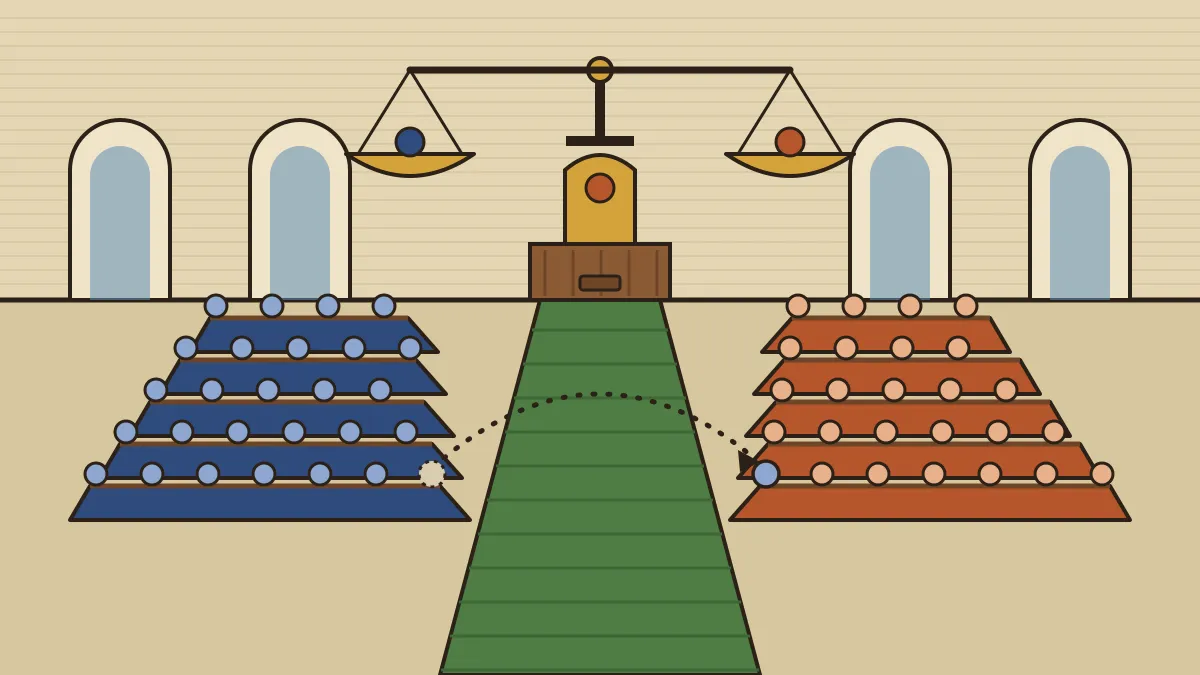
The cases pull two ways. Kihoto accepted the Speaker's discretion. Keisham added the court's duty to check delay: a Speaker who sits on a petition for years can decide the outcome by letting the House's term run out. Remember that the Speaker's own office has rules too: he may resign by writing to the Deputy Speaker, not to the President, and he can be removed only by a resolution passed by a majority of all the then members of the House. Our page on parliamentary composition gives the full picture of the House and its officers, and the page on Article 368 and amendment procedure explains the ratification rule that brought down paragraph 7.
For: stable governments, less horse-trading, constitutional recognition of political parties (the Tenth Schedule was the first time the Constitution treated parties as parties). Against: it limits conscience and dissent, treats independents and nominated members differently, gives a partisan Speaker the final word, and made "wholesale" defection easier until 2003.
How UPSC Has Asked It: Past Papers Solved
UPSC asks the Tenth Schedule as straight facts. These are real CDS and NDA questions since 2018.
The anti-defection provisions were incorporated in the Constitution through which one of the following Constitutional Amendments ?
(a) 50th Amendment (b) 52nd Amendment (c) 58th Amendment (d) 61st Amendment
Answer: (b). The 52nd Amendment (1985) added the Tenth Schedule. The 91st (2003) later tightened the law.
In which Schedule of the Constitution of India, provisions as to disqualification on grounds of defection are given?
(a) Ninth Schedule (b) Tenth Schedule (c) Eleventh Schedule (d) Sixth Schedule
Answer: (b). The Eleventh lists Panchayat subjects and the Sixth covers tribal areas of the north-east.
Any question pertaining to the disqualification of a member of the Lok Sabha on the ground of defection is decided by:
(a) The President of India (b) The Speaker of the Lok Sabha (c) The Supreme Court of India (d) The concerned Political Party
Answer: (b). The Speaker decides under paragraph 6 (the Chairman in Rajya Sabha). The Supreme Court can only review his decision, as Kihoto Hollohan held. The President decides other MP disqualifications, which is why (a) tempts.
Which one of the following Amendments to the Constitution of India has prescribed that the Council of Ministers shall not exceed 15 percent of total number of members of the House of the People or Legislative Assembly in the States?
(a) 91st Amendment (b) 87th Amendment (c) 97th Amendment (d) 90th Amendment
Answer: (a). The 91st (2003) fixed the 15% ceiling and the minimum of 12 ministers for a state. The 97th is the cooperative societies amendment (2011).
As regards the 'disqualification on ground of defection' as per the Constitution of India, which of the following statements is/are correct? 1. Disqualification on ground of defection does not apply to any nominated member of a House 2. Disqualification on ground of defection does not apply to a member of a House if she/he does not accept the merger of her/his original political party into another and opts to function as a separate group
(a) 1 only (b) 2 only (c) Both 1 and 2 (d) Neither 1 nor 2
Answer: (b). Statement 1 is wrong: a nominated member who joins a party after six months is disqualified. Statement 2 is correct under the merger exception, which also protects members who refuse the merger and form a separate group.
Which one of the following statements about the Speaker of Lok Sabha is not correct?
(a) He shall vacate his office if he ceases to be a member of the House of the People. (b) He may, at any time, resign by writing his resignation to the President of India. (c) He may be removed from his office by a resolution of the House of the People passed by majority of all the then members of the House. (d) While the office of the Speaker is vacant, the duties of the office shall be performed by the Deputy Speaker.
Answer: (b). The Speaker resigns by writing to the Deputy Speaker, not the President. (The Vice-President is the one who writes to the President.)
The older questions test numbers and labels (52nd, 91st, Tenth, 15%). The CDS 2026 paper moved to fine print (nominated members, merger). Expect the next question to probe the 2003 changes, so know what the 91st Amendment added and deleted.
Practice MCQs (with answers)
- The provision for a split in the legislature party, which gave protection to one-third of its members, was deleted by the
- 42nd Amendment
- 52nd Amendment
- 73rd Amendment
- 91st Amendment
- A nominated member of Rajya Sabha is disqualified on the ground of defection if he joins a political party
- on the day he takes his seat
- after six months of taking his seat
- after one year of taking his seat
- at any time before the next election
- In Kihoto Hollohan, the Supreme Court struck down
- the whole of the Tenth Schedule
- paragraph 7, which barred judicial review
- the 15-day condonation period
- the Speaker's power to decide disqualification
- Which case asked Parliament to consider an independent tribunal in place of the Speaker and set a three-month limit for deciding petitions?
- Keisham Meghachandra Singh (2020)
- Subhash Desai (2023)
- Kesavananda Bharati (1973)
- Minerva Mills (1980)
- A party has 45 members in a Legislative Assembly. What is the minimum number that must agree to a merger for the exception to apply?
- 15
- 22
- 30
- 32
- Which of the following is NOT a result of the 91st Amendment, 2003?
- Council of Ministers capped at 15% of the House
- A state must have at least 12 ministers
- Defectors cannot become ministers
- The Election Commission decides defection cases
- An independent member elected to the Lok Sabha who later joins a political party
- is disqualified
- is protected for six months
- is protected if two-thirds of independents agree
- is expelled by the President
- A member elected on a party ticket abstains from voting against the party whip, but the party condones it within 15 days. The member is
- disqualified, because abstention is always defection
- disqualified, if the Speaker dislikes it
- not disqualified on that ground
- disqualified after the next session
1-d, 2-b, 3-b, 4-a, 5-c, 6-d, 7-a, 8-c. Q5: two-thirds of 45 is exactly 30, so 30 members. Q6: the Speaker or Chairman decides, not the Election Commission. Q8: the Schedule says the act must be "condoned by the party within 15 days" for it not to count, so condonation removes the ground. Q1 trap: the 52nd Amendment created the split clause, and the 91st deleted it.
Quick Revision
- 52nd Amendment, 1985 added the Tenth Schedule; changed Articles 101, 102, 190, 191. Fourth general election 1967, Gaya Lal, Chavan Committee. Eight original Schedules; Ninth (1951), Tenth (1985), Eleventh and Twelfth (1992) added.
- Grounds: party member gives up membership voluntarily or defies the whip (15 days to condone); independent joins a party; nominated member joins after six months. Presiding officers are exempt.
- Exceptions: merger (two-thirds of the legislature party); presiding officer. Split (one-third) deleted by the 91st Amendment, 2003.
- 91st also: ministers capped at 15% (minimum 12 in a state); defectors cannot be ministers or hold remunerative political posts. Recommended by Dinesh Goswami Committee (1990), Law Commission 170th Report (1999), NCRWC (2002).
- Deciding authority: Speaker or Chairman (paragraph 6). Acts only on a member's complaint. Paragraph 7 (no court review) struck down in Kihoto Hollohan (1992); decision reviewable.
- Keisham Meghachandra (2020): three-month limit, suggested independent tribunal. Subhash Desai (2023): party's whip prevails; Nabam Rebia sent to seven judges. Ravi S. Naik (1994): giving up membership can be inferred from conduct.
- Constitution Day: 26 November (since 2015). Speaker resigns to the Deputy Speaker.
Frequently asked questions
What is the anti-defection law in India?
The anti-defection law is the Tenth Schedule of the Constitution, added by the 52nd Amendment Act of 1985. It disqualifies a member of Parliament or a state legislature who gives up his party's membership or votes against its whip, subject to exceptions such as a merger. The Speaker or Chairman decides the case.
Who decides whether a legislator is disqualified for defection?
The Speaker of the Lok Sabha or Assembly, or the Chairman of the Rajya Sabha or Council, decides under paragraph 6 of the Tenth Schedule. The Supreme Court held in Kihoto Hollohan that this decision can be reviewed by the courts. In Keisham Meghachandra Singh (2020) it said Speakers should ordinarily decide within three months.
Can a party merge to avoid disqualification?
Yes, if two-thirds of the members of the legislature party agree to the merger of their original party with another party. Members who do not accept the merger and choose to function as a separate group are also protected. The older exception for a split of one-third was deleted by the 91st Amendment in 2003.
How does the anti-defection law treat independent and nominated members?
An independent member who joins any political party after the election is disqualified. A nominated member may join a party within six months of taking his seat without penalty, but is disqualified if he joins after that period.
What did the 91st Amendment Act of 2003 change?
It deleted the split exception, capped the Council of Ministers at 15 per cent of the strength of the Lok Sabha or the Assembly (with a minimum of 12 ministers in a state), and barred disqualified defectors from being ministers or holding remunerative political posts. It followed recommendations of the Dinesh Goswami Committee, the Law Commission and the NCRWC.
Related CDS / OTA Polity topics
Polity is a steady scorer in CDS and NDA
Cavalier's CDS/OTA batches teach Polity article by article, with case-law tables and weekly PYQ tests.