On 24 November 2026, the full moon of Kartik, India marked Guru Nanak Dev Ji's Parkash Purab. The Prime Minister's greeting, released by the Press Information Bureau, spoke of "kindness, togetherness and the welfare of all", and called his teachings timeless. Those three words sum up a whole school of medieval thought. Guru Nanak belongs to the nirguna sants, the poet-saints of north India who worshipped a God without form, rejected caste and ritual, and sang in the language of ordinary people. Kabir, Ravidas, Dadu and Namdev stand beside him. UPSC asks about them nearly every year: "which saint was not a nirguna bhakta", "what is sant bhasha", "who was Mirabai's guru".
Nirguna and Saguna: Two Ways of Loving God
By Narendra Singh · GS faculty, The Cavalier · 15 years teaching GS
Bhakti means loving devotion to God. The question is what God looks like. Saguna bhakti worships God with attributes, in a form: Vishnu and his avatars, Rama, Krishna, Shiva, the Goddess. Nirguna bhakti worships God without attributes: formless, genderless, beyond images. The two are not rival religions. They are two temperaments inside the same movement.
| Saguna | Nirguna | |
|---|---|---|
| God is | A person with form and qualities | Formless, "nirakar", the unseen "alakh" |
| Worship | Temples, images, festivals, songs to a deity | Repeating the Name (nam simaran), singing hymns, a guru's guidance; no images |
| Main figures | Alvars (Vishnu) and Nayanars (Shiva) in the Tamil country; Tulsidas (Rama); Surdas, Mirabai, Chaitanya (Krishna) | Kabir, Guru Nanak, Ravidas, Dadu, and Namdev's later hymns |
| Attitude to caste and ritual | Varies; many accepted existing social order | Sharp rejection of caste, priests and empty ritual |
The south had its devotional poets first: the 12 Alvars (Vishnu) and 63 Nayanars (Shiva), whose Tamil hymns the Cholas later placed in their temples (see our page on the Imperial Cholas). In north India, historians find nothing like those compositions until about the fourteenth century. They give three reasons. Rajput states were run with Brahmanas in key posts, so nobody challenged them directly. Wandering Naths, Jogis and Siddhas, many of them weavers and artisans, questioned the Vedas and spoke in everyday languages. And the Delhi Sultanate (thirteenth century) weakened the old courts, while Sufis arrived with their own ideas of devotion. The nirguna sants grew out of this meeting of Nath yoga, Vedanta and Sufism, with the crafts and towns of a busier economy behind them. For the Sufi background, read our page on the Delhi Sultanate.
Chaitanya is saguna, a devotee of Krishna in Bengal. Mirabai and Surdas are saguna too. Do not file them under Kabir and Nanak. NDA 2023-II asked this as "While Tulsidas represented devotion with attributes, Kabir followed devotion without attributes".
Kabir: One God, Many Names
Kabir lived in Banaras in the fourteenth-fifteenth century. The traditional dates 1398-1518 are not secure. Tradition makes him a weaver (julaha) from a recently converted Muslim family. Hagiographies that argue over whether he was born a Hindu or a Muslim were written from the seventeenth century, about two hundred years after he lived. The verses ascribed to him survive in three overlapping collections:
- the Bijak, kept by the Kabirpanth in Varanasi and Uttar Pradesh;
- the Kabir Granthavali, linked with the Dadupanth in Rajasthan;
- a large share of the hymns in the Adi Granth of the Sikhs.
His poems are in the special language of the nirguna poets, sant bhasha, a mixed speech drawing on several regional dialects such as Bhojpuri and Awadhi. Some are ulatbansi ("upside-down sayings"), in which everyday meanings are turned inside out: "the lotus which blooms without flower", "the fire raging in the ocean". They hint that the Ultimate Reality cannot be put into ordinary words.
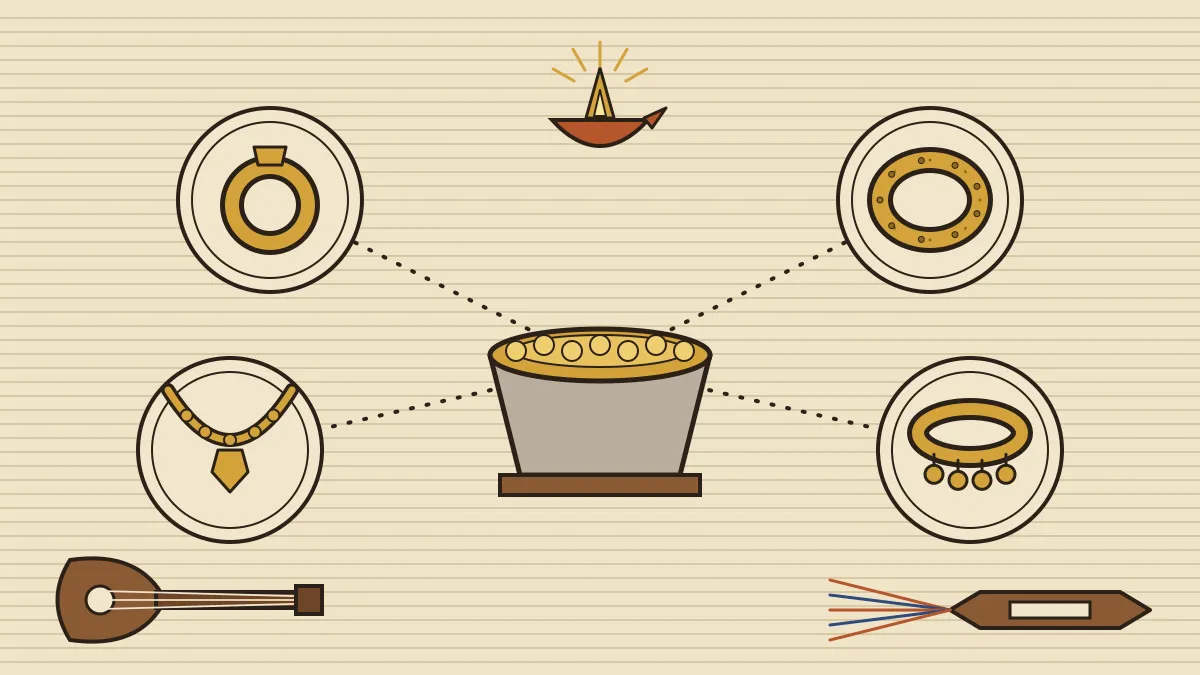
Kabir borrowed his vocabulary from three traditions at once. From Islam he took Allah, Khuda, Hazrat, Pir. From Vedanta he took alakh, nirakar, Brahman, Atman. From yoga he took shabda (sound) and shunya (emptiness). His best-known argument is that Ram and Rahim are two names for one God: gold can be shaped into rings and bangles, and it is gold all the same. He attacked the Brahmin's rituals and the mullah's loud call alike, and he said that neither side had found the only Ram.
In his verses Kabir speaks of the guru and satguru in general terms, and does not clearly name a human teacher. The story that Ramananda initiated him is a later tradition, and it is hard to square with the dates unless both men lived very long lives. Ramananda himself was a devotee of Rama who taught in the vernacular and, as tradition has it, accepted disciples from all castes. Do not label him a nirguna saint, and do not match him with Kevaladvaita: he followed Ramanuja's Vishishtadvaita (NDA 2018-II). Kabir's followers formed the Kabirpanth, a separate community that survives today.
Guru Nanak: From the Ravi to the Adi Granth
Guru Nanak (1469-1539) was born in a Hindu merchant family at Nankana Sahib (then Rai Bhoi di Talwandi) on the Ravi, in a Punjab where most people were Muslim. He trained as an accountant, learned Persian, and worked in the office of the local governor Daulat Khan Lodi. But he spent his time among Sufis and bhaktas and left his job to travel widely. He finally settled at Kartarpur on the Ravi, where he died in 1539. The Kartarpur Corridor, opened on 9 November 2019 for the 550th anniversary of his birth, now links the shrine with Dera Baba Nanak in Gurdaspur.
His message is in his hymns, called shabads, composed in Punjabi and sung to ragas while his companion Mardana played the rabab. The core of it can be set out as follows:
- One formless God (the opening Ik Onkar), with no gender and no image. Nanak rejected sacrifices, ritual baths, image worship, austerities and the scriptures of both Hindus and Muslims as the way to God.
- Remember the Name. Repeating the Divine Name, under the guidance of a guru, is the simple road to the Divine.
- Honest work and sharing. The tradition sums it up as nam japna (remember the Name), kirat karni (earn honestly) and vand chhakna (share with others).
- No caste at the table. The langar (community kitchen) and pangat (sitting in a row) put everyone on the same floor, and women joined the gatherings.
Nanak organised his followers into a community. He set up rules for congregational worship, the sangat, with collective recitation, and named his disciple Angad as his successor, a practice that continued until the tenth Guru, Gobind Singh, in the early eighteenth century. It appears that Nanak did not mean to found a new religion. After his death, his followers consolidated their own practices and set themselves apart from both Hindus and Muslims. The sequence from there is on our page on the ten Sikh Gurus. Here is the part about texts:
| Step | Who | What |
|---|---|---|
| Hymns of Guru Nanak | Guru Angad compiled them in Gurmukhi (tradition) | The first written collection |
| 1604 | Guru Arjan | Compiles the Adi Granth: hymns of Nanak and his four successors plus poets such as Baba Farid, Ravidas and Kabir |
| Early 18th century | Guru Gobind Singh | Adds the compositions of the ninth Guru, Tegh Bahadur; the scripture is then called the Guru Granth Sahib |
| 1708 | Guru Gobind Singh | Declares the scripture the eternal Guru |
Ravidas, Namdev, Dadu and the Other Voices
The Adi Granth holds the words of fifteen bhagats (non-Sikh saints) beside the Gurus' own, an unusual act of inclusion. They include Kabir, Ravidas, Namdev, Ramananda (one hymn), Jaidev, Trilochan, Dhanna, Pipa, Sain and the Chishti Sufi Baba Farid. They came from different regions, castes and faiths.
| Saint | Region and background | What to remember |
|---|---|---|
| Namdev | Maharashtra; a tailor; thirteenth-fourteenth century | Remembered as a devotee of Vithoba of Pandharpur, but the hymns of his that appear in the Adi Granth (about sixty) speak of a formless God |
| Ravidas (Raidas) | Banaras; a leatherworker | About forty hymns in the Adi Granth; imagined Begumpura, a city without sorrow or tax; some traditions call him the guru of Mirabai |
| Dadu Dayal | Born 1544 in Ahmedabad, settled in Rajasthan; died c. 1603 at Naraina | Founder of the Dadupanth; verses in the Dadu Vani; tradition says he discussed religion with Akbar at Fatehpur Sikri |
| Sain, Dhanna, Pipa | A barber, a Jat farmer, a Rajput chief who gave up his kingdom | Show that the nirguna call crossed every caste line |
Mirabai deserves a note because the exam links her to this group. She was a Rajput princess of Merta, married into the Sisodia house of Mewar, who defied her family and sang to Krishna, a saguna god. NCERT adds that, according to some traditions, her preceptor was Raidas, a leatherworker, which would show her defiance of caste (NDA 2021-I). She founded no sect, but her songs are still sung in Gujarat and Rajasthan, especially by those of the lower castes.
The Sants Beside the Sufis
The sants and the Sufis learned from each other. Both used a master-disciple chain: the Sufi silsila means "chain", a link from master to disciple back to the Prophet, along which spiritual power is passed (CDS 2018-I). Both used repetition of the Divine Name: the Sufi zikr, the sant nam simaran. Both used the language of love: Sufi ishq, the sant's prem. Both opened an open kitchen: the Chishti khanqah's langar and the Sikh langar. And both spoke the local tongue: Chishtis in Delhi conversed in Hindavi, and Baba Farid's verses entered the Guru Granth Sahib. Our page on bhakti and Sufi movements gives the wider background.
| Chishti teacher | Died | Dargah |
|---|---|---|
| Shaikh Muinuddin Sijzi (Chishti) | c. 1235-36 | Ajmer |
| Khwaja Qutbuddin Bakhtiyar Kaki | 1235 | Delhi |
| Shaikh Fariduddin Ganj-i Shakar (Baba Farid) | 1265 | Ajodhan (Pakistan) |
| Shaikh Nizamuddin Auliya | 1325 | Delhi |
| Shaikh Nasiruddin Chiragh-i Dehli | 1356 | Delhi |
The Sufis stayed inside Islam and worked within the shari'a, often through a hospice. The sants rejected the external practices of every religion: Kabir and Nanak spoke against both temple ritual and formal prayer. Nanak's followers later set up a distinct community. The Kabirpanth and the Dadupanth also became separate groups.
How UPSC Has Asked It: Past Papers Solved
UPSC asks about this topic as a sorting exercise: saguna or nirguna, which saint and which text. Read the options before the question's key word.
Which one of the following pairs denoting various forms of 'Bhakti' is not correctly matched?
(a) Saguna: Belief in Gods with attributes (b) Nirguna: Belief in Gods without attributes (c) Alvars: Believed in devotion of Shakti (d) Nayanars: Believed in devotion of Shiva
Answer: (c). The Alvars were devotees of Vishnu, not Shakti. The Nayanars worshipped Shiva, so (d) is correct.
Which one of the following statements about the Bhakti movement is NOT correct?
(a) The Bhakti movement avoided traditions that promoted diversity (b) In northern India, the Bhakti movement revolved around the worship of Rama and Krishna (c) The Bhakti movement relied on the devotion of God, both with and without attributes (d) While Tulsidas represented the tradition of devotion with attributes, Sant Kabir followed the path of devotion without attributes
Answer: (a). The movement welcomed diversity of languages, castes and forms of worship. Options (b), (c) and (d) are all correct.
Which of the following statements about Saguna bhakti traditions is/are correct? 1. Saguna bhakti traditions focus on the worship of specific deities such as Vishnu or his avatars. 2. In Saguna bhakti traditions, Gods and Goddesses are conceptualised in anthropomorphic forms.
(a) 1 only (b) 2 only (c) Both 1 and 2 (d) Neither 1 nor 2
Answer: (c). Saguna means worship of God with attributes, in a human-like form such as Rama or Krishna, so both statements hold.
Who among the following was considered to be the preceptor of Mirabai?
(a) Dadu (b) Raidas (c) Ramanand (d) Surdas
Answer: (b). According to some traditions, her preceptor was Raidas (Ravidas), a leatherworker. Dadu lived later than Mirabai, and the sources do not link her to Ramanand or Surdas.
Which one of the following pairs is correctly matched? Bhakti Saint : Philosophy (a) Shankara : Avadhuta (b) Ramananda : Kevaladvaita (c) Ramanuja : Vishishtadvaita (d) Chaitanya : Advaita
Answer: (c). Ramanuja taught qualified non-dualism, Vishishtadvaita. Shankara taught Advaita, and Chaitanya's school is Achintya Bhedabheda. Ramananda belonged to Ramanuja's line, not to Kevaladvaita.
Around twelfth century, Sufi Silsilas began to crystallize in different parts of the Islamic world to signify: 1. Continuous link between the master and disciple 2. Unbroken spiritual genealogy to the Prophet Muhammad 3. The transmission of spiritual power and blessings to devotees
(a) 1 and 2 only (b) 2 only (c) 1 and 3 only (d) 1, 2 and 3
Answer: (d). The word silsila means a chain. All three statements describe it.
Four of these six questions test classification (saguna or nirguna, which philosophy). Build a one-line tag for every saint: Kabir, Nanak, Dadu = nirguna; Chaitanya, Surdas, Mirabai, Tulsidas = saguna.
Practice MCQs (with answers)
- Which scripture was compiled by Guru Arjan in 1604 and carries hymns of Kabir, Ravidas and Baba Farid?
- Adi Granth
- Dasam Granth
- Bijak
- Kabir Granthavali
- The Bijak, a collection of verses attributed to Kabir, is preserved by the
- Dadupanth in Rajasthan
- Kabirpanth in Varanasi
- Chishti silsila
- sangat of Punjab
- Which of the following saints is NOT a nirguna poet?
- Dadu
- Ravidas
- Surdas
- Kabir
- "Ulatbansi" verses are those in which
- the Divine Name is chanted in a fixed order
- praise is offered to the king
- the verses are set to Persian metres
- everyday meanings are inverted to hint at the Ultimate Reality
- Ravidas, who imagined the city of Begumpura, belonged traditionally to the community of
- leatherworkers
- weavers
- tailors
- barbers
- Guru Nanak spent his last years and died at
- Nankana Sahib
- Kartarpur
- Anandpur
- Amritsar
- The Kabir Granthavali is associated with the
- Kabirpanth
- Khalsa Panth
- Dadupanth
- Chishti silsila
- Whose verses, belonging to a Sufi order, were included in the Guru Granth Sahib?
- Amir Khusrau
- Nizamuddin Auliya
- Muinuddin Sijzi
- Baba Farid
1-a, 2-b, 3-c, 4-d, 5-a, 6-b, 7-c, 8-d. Q1: the Dasam Granth is a separate work, and the Bijak and the Granthavali are Kabir collections. Q3: Surdas worshipped Krishna with form. Q6: Nankana Sahib is his birthplace and Kartarpur his settlement on the Ravi. Q8: Baba Farid (Fariduddin Ganj-i Shakar) was a Chishti shaikh. Amir Khusrau and Nizamuddin Auliya are the later Chishti circle of Delhi.
Quick Revision
- Nirguna = God without attributes (Kabir, Nanak, Ravidas, Dadu). Saguna = God with form (Alvars, Tulsidas, Surdas, Mirabai, Chaitanya). South first (12 Alvars, 63 Nayanars); north from about the 14th century.
- Background in the north: Naths, Jogis and Siddhas; Delhi Sultanate; Sufis; artisans and towns.
- Kabir: weaver of Banaras, 14th-15th century. Bijak (Kabirpanth), Kabir Granthavali (Dadupanth), Adi Granth. Sant bhasha, ulatbansi. Ram and Rahim are one. Ramananda link is tradition only.
- Guru Nanak (1469-1539): Nankana Sahib; Daulat Khan Lodi; Mardana's rabab; sangat, langar, pangat; Kartarpur; Angad as successor. Kartarpur Corridor opened 9 Nov 2019.
- Adi Granth 1604 (Guru Arjan); Guru Granth Sahib after Tegh Bahadur's hymns were added; eternal Guru 1708. Fifteen bhagats, including Baba Farid.
- Ravidas: leatherworker, Begumpura, Mirabai's preceptor by tradition. Namdev: tailor, Maharashtra. Dadu: born 1544 Ahmedabad, Naraina, Dadupanth.
- Chishti teachers: Muinuddin c. 1235-36 (Ajmer), Bakhtiyar Kaki 1235, Baba Farid 1265, Nizamuddin Auliya 1325, Chiragh-i Dehli 1356. Silsila = chain.
- Philosophy tags: Ramanuja = Vishishtadvaita; Shankara = Advaita; Ramananda followed Ramanuja's line.
Frequently asked questions
What is the difference between nirguna and saguna bhakti?
Saguna bhakti worships God with attributes and form, such as Vishnu, Rama or Krishna, often through images and temples. Nirguna bhakti worships a formless God without attributes and rejects images and ritual. Tulsidas is the standard saguna example and Kabir the standard nirguna one.
What is sant bhasha?
Sant bhasha is the special language of the nirguna poets, a mixed vernacular that draws on several north Indian dialects. Kabir's verses are the best-known example. Some of his poems are also ulatbansi, or upside-down sayings, in which ordinary meanings are inverted.
Where are Kabir's verses preserved?
They survive in three overlapping collections: the Bijak, kept by the Kabirpanth in Varanasi, the Kabir Granthavali, associated with the Dadupanth in Rajasthan, and a large number of hymns in the Adi Granth of the Sikhs. All these collections were compiled long after his death.
Why are the hymns of Kabir and Ravidas in the Guru Granth Sahib?
Guru Arjan compiled the Adi Granth in 1604 and included not only the Gurus' hymns but also those of fifteen bhagats, among them Kabir, Ravidas, Namdev and the Sufi Baba Farid, because their teachings on one formless God agreed with Guru Nanak's. Guru Gobind Singh later added the hymns of Guru Tegh Bahadur.
When is Guru Nanak's Parkash Purab observed?
It falls on the full moon of the month of Kartik, so the date changes each year. In 2026 it was observed on 24 November, and the Prime Minister sent greetings the same day. It marks the birth of Guru Nanak (1469) at Nankana Sahib.
Related CDS / OTA History topics
History rewards the saints who changed society
Cavalier's CDS/OTA batches teach medieval history theme by theme, with timelines, maps and weekly PYQ tests.