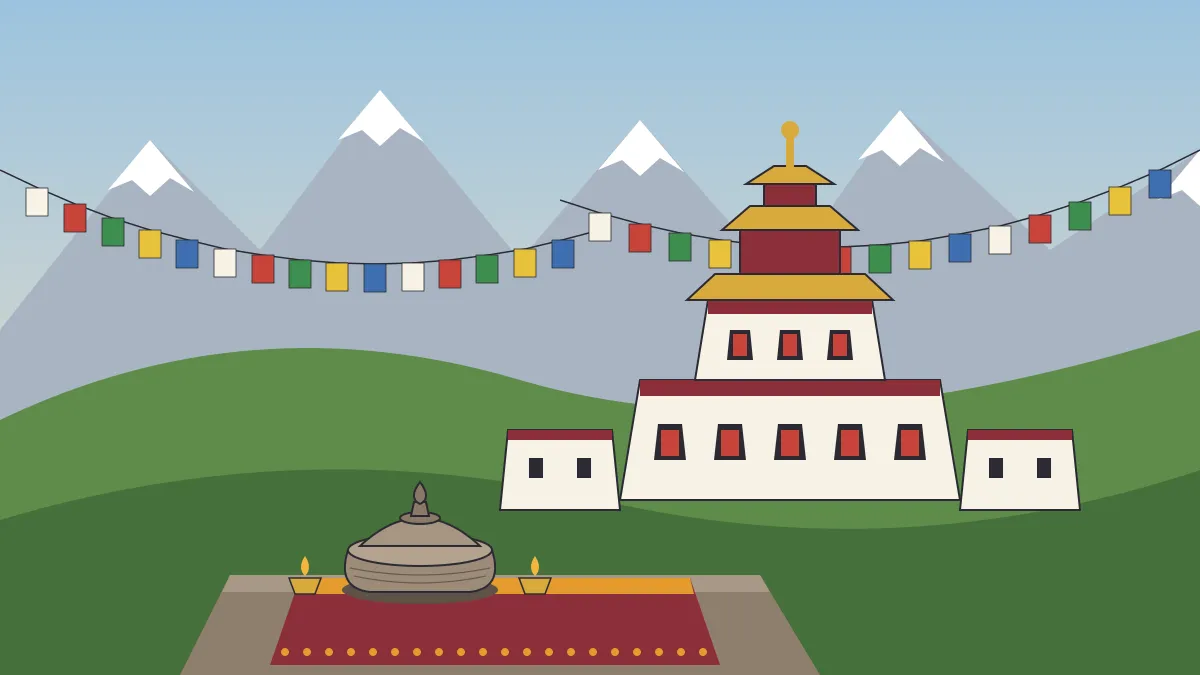
The holy relics of the Buddha from Piprahwa will be displayed for public veneration in Arunachal Pradesh from 31 October to 21 November 2026. The Ministry of Culture announced the exposition on 30 October 2026.
The relics are kept at the National Museum, New Delhi. They will be shown at three centres of Buddhist faith in the State: Tawang, Bomdila and Namsai. The Union Minister of Culture and Tourism, Gajendra Singh Shekhawat, is to attend the inaugural ceremony at Tawang Monastery on 31 October. A further inaugural function on 1 November will have Chief Minister Pema Khandu as chief guest.
The Ministry of Culture is organising the exposition with the Government of Arunachal Pradesh, the International Buddhist Confederation (IBC) and the National Museum. The relics will travel by a special Indian Air Force aircraft from Air Force Station Palam to Air Force Station Borjhar in Guwahati, and then by helicopter to Tawang.
The opening coincides with Lhabab Düchen, a festival of Tibetan Buddhism that marks the Buddha's descent from heaven.
The schedule
| Dates | Venue | Programme |
|---|---|---|
| 31 October | Gaden Namgyal Lhatse (Tawang Monastery) | Arrival, reception and inaugural ceremony |
| 1-7 November | Tawang Monastery | Public darshan and exposition |
| 8-13 November | TGL Monastery (Lower Gompa), Bomdila | Public darshan and exposition |
| 14-20 November | Golden Pagoda, Namsai | Public darshan and exposition |
| 21 November | Namsai - Tezu - New Delhi | Ceremonial return to the National Museum |
The National Museum is the nodal agency for the technical and conservation side: handling, transport, installation and safe return. The State Government handles venues, security and crowds. The IBC handles religious coordination, the accompanying exhibition and a conference.
What the Piprahwa relics are
Piprahwa is a village in Siddharthnagar district, Uttar Pradesh, close to the Nepal border. The site is associated with ancient Kapilavastu, the capital of the Shakya clan into which Siddhartha Gautama was born.
The site was excavated twice.
1898: Peppé's excavation
In 1898, William Claxton Peppé, a British estate manager, excavated a stupa on his land at Piprahwa. Inside, he found reliquaries containing bone fragments and a large hoard of gems, jewels and other precious offerings.
One vase carried a short Brahmi inscription. It is generally read as recording that the relics were those of the Buddha, enshrined by the Shakyas, his kinsmen. Its exact date and reading are still debated by scholars, but it remains among the earliest inscriptions found in India.
Most of the bone relics found in 1898 were handed over in 1899 to an envoy of King Chulalongkorn (Rama V) of Siam, present-day Thailand. Much of the remaining material went to the Indian Museum in Kolkata, but the Peppé family kept a share of the jewels. That share returned to the news in 2025.
1971-77: the ASI excavation
Between 1971 and 1977, the Archaeological Survey of India dug deeper at Piprahwa under K.M. Srivastava. At lower levels, it found two more reliquary caskets containing ancient bone relics:
| Casket | Bone relics |
|---|---|
| Larger casket | 12 |
| Smaller casket | 10 |
| Total | 22 |
Of these, 20 are kept at the National Museum, New Delhi and 2 at the Indian Museum, Kolkata. The relics going to Arunachal are from this National Museum collection.
The Kapilavastu question
The same excavations found terracotta sealings of the Kushana period that refer to the community of monks of Kapilavastu. On this evidence, many scholars identify the Piprahwa area with ancient Kapilavastu.
Nepal, however, identifies Kapilavastu with Tilaurakot, in its own Kapilvastu district, a short distance across the border. The two identifications compete, and the question remains open among historians. In an exam, Piprahwa is "associated with Kapilavastu", not "proven to be" Kapilavastu.
Why a Shakya stupa would hold relics
According to the Mahaparinibbana Sutta, after the Buddha's Mahaparinirvana at Kushinagar his remains were divided into eight shares. Each share went to a group that built a stupa over it. One share went to the Shakyas of Kapilavastu.
The Piprahwa inscription and stupa fit this account, which is why the site is so important. Buddhist tradition adds that Ashoka later opened the original stupas and redistributed the relics into many more. For the wider background, see our notes on Buddhism and Jainism.
The jewels that came home in 2025
In 2025, part of the jewel collection from Peppé's 1898 find was offered for auction at Sotheby's in Hong Kong by his descendants.
The Ministry of Culture objected. It said these were sacred religious objects, not commercial property, and the sale was halted. The jewels came back to India on 30 July 2025, about 127 years after the excavation. A private initiative by the Godrej Industries Group secured them, working with the Ministry.
The PIB release notes that the return renewed public interest in Piprahwa. The exhibition with this exposition, "Unearthing the Sacred Piprahwa: The Story of the Holy Buddha Relics and Their Discovery", will tell that story at all three venues.
Why these three places
Arunachal Pradesh is one of the few parts of India where two major branches of Buddhism live side by side.
| Region | Tradition | Venue |
|---|---|---|
| West (Tawang, West Kameng) | Mahayana and Vajrayana (Himalayan Buddhism) | Tawang Monastery; Bomdila |
| East (Namsai) | Theravada, followed by the Tai Khamti and other communities | Golden Pagoda, Namsai |
Taking the relics to both regions brings them to communities of both traditions.
Tawang Monastery
Tawang Monastery is known in Tibetan as Gaden Namgyal Lhatse. Merak Lama Lodre Gyatso founded it in 1680-81, at the wish of the Fifth Dalai Lama. It belongs to the Gelug school and is often described as the largest monastery in India.
The Sixth Dalai Lama, Tsangyang Gyatso, was born near Tawang in 1683. Tawang lies high in the mountains near the Line of Actual Control, and the road journey is long and difficult. The Ministry of Culture has asked the Ministry of Defence and the IAF for aircraft and helicopters for that reason.
Lhabab Düchen
Lhabab Düchen falls on the 22nd day of the ninth Tibetan month, usually in October or November. It marks the Buddha's return from the Heaven of the Thirty-Three (Trayastrimsa), where tradition says he spent three months teaching his mother.
Buddhist tradition places his descent at Sankassa (Sankisa), in Farrukhabad district of Uttar Pradesh. Sankassa is counted among the eight great places of Buddhist pilgrimage.
Relic diplomacy: the recent record
India regularly sends relics abroad for veneration, as a form of cultural diplomacy. The release lists the recent expositions:
| Year | Exposition |
|---|---|
| 2022 | Holy Relics of the Buddha in Mongolia |
| 2024 | Relics of the Buddha and his disciples Sariputta and Mahamoggallana in Thailand: Bangkok, Chiang Mai, Ubon Ratchathani and Krabi |
| 2025 | Relics in Vietnam for Vesak; expositions also in Kalmykia (Russia) and Bhutan |
| February 2026 | Devnimori relics in Sri Lanka |
| May 2026 | Relics of the Buddha in Ladakh |
| May-June 2026 | Relics of Sariputta and Mahamoggallana from Sanchi at Gandan Tegchenling Monastery, Ulaanbaatar |
Devnimori is a Buddhist site in Aravalli district, Gujarat. The relics of the two disciples were found at Sanchi by Alexander Cunningham in 1851. We covered their Mongolia visit in our article on the disciples' relics returning from Mongolia.
The Arunachal exposition follows the Ladakh one in May 2026. Both bring relics to Buddhist communities in India's own Himalayan regions.
The conference at Tawang
The IBC and the State Government will hold an international conference on "Buddhism: Dissemination in the Himalayan Region and Beyond" at the Kalawangpo Convention Hall, Tawang, on 2 November 2026. Monks, scholars and delegates are expected from India, Nepal, Sri Lanka, Myanmar, Malaysia, Indonesia and Germany.
It has three themes:
- Carrying forward the Buddha's legacy after the Mahaparinirvana: the Four Noble Truths, conservation, institutions and relic expositions.
- Historical and doctrinal continuity: textual and monastic lineages, with particular reference to Arunachal Pradesh.
- Buddhism and right livelihood: Nalanda's intellectual tradition, pilgrimage, sustainable livelihoods and consumerism.
The International Buddhist Confederation is a Buddhist umbrella body headquartered in New Delhi. It grew out of the Global Buddhist Congregation held in Delhi in November 2011, was registered in 2012, and works closely with the Ministry of Culture.
🔑 Revision block
The event. Piprahwa relics of the Buddha exposed in Arunachal Pradesh, 31 October - 21 November 2026: Tawang (to 7 Nov), Bomdila (8-13 Nov), Namsai (14-20 Nov); return to the National Museum on 21 Nov.
Organisers. Ministry of Culture, Govt of Arunachal Pradesh, IBC, National Museum (nodal agency); IAF transport via Palam and Borjhar.
Piprahwa. Siddharthnagar, UP; associated with Kapilavastu and the Shakyas; 1898 Peppé (inscribed vase, bone relics, jewels); 1971-77 ASI, K.M. Srivastava: 22 relics (12 + 10), 20 National Museum, 2 Indian Museum.
Kapilavastu debate. Kushana sealings name Kapilavastu at Piprahwa; Nepal identifies Tilaurakot.
Jewels. Proposed Sotheby's Hong Kong sale (2025) halted; returned 30 July 2025 after about 127 years.
Places. Tawang = Gaden Namgyal Lhatse, 1680-81, Merak Lama Lodre Gyatso, Gelug; Namsai = Theravada, Tai Khamti; Lhabab Düchen = descent from Trayastrimsa, at Sankassa.
Relic diplomacy. Mongolia 2022; Thailand 2024; Vietnam, Kalmykia, Bhutan 2025; Devnimori to Sri Lanka Feb 2026; Ladakh May 2026; Sanchi disciples' relics to Ulaanbaatar May-June 2026.
🎯 Practice MCQs
Q1. Which of the following venues is NOT part of the 2026 exposition of the Piprahwa relics in Arunachal Pradesh? (a) Tawang Monastery (b) TGL Monastery, Bomdila (c) Golden Pagoda, Namsai (d) Rumtek Monastery
→ (d) Rumtek is in Sikkim.
Q2. The ASI excavations at Piprahwa in 1971-77 were supervised by: (a) Alexander Cunningham (b) K.M. Srivastava (c) John Marshall (d) B.B. Lal
→ (b) They found two caskets with 22 bone relics.
Q3. Of the 22 bone relics found at Piprahwa in 1971-77, how many are kept at the National Museum, New Delhi? (a) 20 (b) 12 (c) 10 (d) 22
→ (a) The other two are at the Indian Museum, Kolkata.
Q4. According to Buddhist tradition, after the Mahaparinirvana at Kushinagar, the Buddha's remains were divided into: (a) Two shares, for the Shakyas and the Mallas (b) Four shares, one for each direction (c) Eight shares, one of which went to the Shakyas of Kapilavastu (d) 84,000 shares, enshrined by Ashoka
→ (c) The 84,000 figure belongs to the later tradition of Ashoka's redistribution.
Q5. Tawang Monastery belongs to which school of Tibetan Buddhism? (a) Nyingma (b) Kagyu (c) Gelug (d) Sakya
→ (c) It was founded in 1680-81 at the wish of the Fifth Dalai Lama, who headed the Gelug school.
Q6. The Buddhist tradition followed by the Tai Khamti community of Namsai is: (a) Theravada (b) Vajrayana (c) Zen (d) Mahayana
→ (a) Western Arunachal, including Tawang, follows the Mahayana and Vajrayana traditions.
Q7. Lhabab Düchen commemorates: (a) The Buddha's first sermon at Sarnath (b) The Buddha's enlightenment at Bodh Gaya (c) The Buddha's birth at Lumbini (d) The Buddha's descent from the Heaven of the Thirty-Three
→ (d) Tradition places the descent at Sankassa in Uttar Pradesh.
Q8. The relics of the Buddha's disciples Sariputta and Mahamoggallana, taken to Mongolia in 2026, were originally found at: (a) Piprahwa (b) Sanchi (c) Devnimori (d) Vaishali
→ (b) Alexander Cunningham found them at Sanchi in 1851.
Q9. Consider the following statements: 1. Piprahwa is in Siddharthnagar district of Uttar Pradesh. 2. Nepal identifies ancient Kapilavastu with Tilaurakot. Which of the statements given above is/are correct? (a) 1 only (b) 2 only (c) Neither 1 nor 2 (d) Both 1 and 2
→ (d) The identification of Kapilavastu is still debated between the two sites.
Q10. The International Buddhist Confederation is headquartered in: (a) New Delhi (b) Bodh Gaya (c) Dharamshala (d) Colombo
→ (a) It grew out of the Global Buddhist Congregation held in Delhi in 2011.
📋 How this gets asked (PYQ pattern)
Buddhist sites and heritage are among the most regular items in the CDS history section. A relic exposition in the news brings out four kinds of question.
The first is the site-matching question: which event of the Buddha's life is linked to which place (Lumbini, Bodh Gaya, Sarnath, Kushinagar, Sankassa), or which State a site is in. Piprahwa, Sanchi, Devnimori, Tawang and Rumtek are all candidates for a "which is wrongly matched" item.
The second is the excavation question: who excavated a site and when. Peppé (1898), Srivastava (1971-77) and Cunningham at Sanchi (1851) are the names to know.
The third is the schools question: Theravada versus Mahayana versus Vajrayana, and the schools of Tibetan Buddhism. Tawang being Gelug and Namsai being Theravada is exactly the kind of contrast the examiner uses.
The fourth is the heritage question: the return of antiquities, such as the Piprahwa jewels in 2025, and India's relic diplomacy.
Preparing for CDS? Keep a one-page map of Buddhist sites: the eight great pilgrimage places, the main stupas and monasteries, and the State each is in. Add Piprahwa, Tawang and Namsai to it this week. Build the base with our CDS/OTA history notes, follow the daily CDS current affairs, and train with serving-standard faculty in the upcoming Cavalier courses in Delhi.
Source: PIB / Ministry of Culture, "Holy Relics of Lord Buddha to be Exposed for Public Veneration in Arunachal Pradesh from 31 October to 21 November 2026", 30 October 2026. The 1898 excavation, the transfer to Siam, the Kapilavastu sealings, the 2025 return of the jewels, Tawang Monastery and Lhabab Düchen cross-checked with ASI and museum records and independent reporting.
✍️ Written by Hitendra Deswal — Polity & current-affairs faculty at The Cavalier. Reviewed by the Cavalier Faculty Desk.