3 December is the birth anniversary of Khudiram Bose, born in 1889 in a village of Midnapore district, Bengal. He was hanged on 11 August 1908, aged eighteen, for the Muzaffarpur bomb. His short life marks the start of a movement that ran for nearly three decades, from the Anushilan Samiti of 1902 to the Chittagong Armoury Raid of 1930. For a defence-exam candidate it is a high-yield strand, because it is full of dates, groups, newspapers and names that are easy to swap. The trick is to keep Anushilan and Jugantar apart and then lay the events along one timeline.
Two Groups, One Mood: Anushilan and Jugantar
By Narendra Singh · GS faculty, The Cavalier · 15 years teaching GS
The Moderates' prayers and petitions had brought little by 1900. Curzon's partition of Bengal in 1905 (see our page on the Swadeshi Movement and the partition of Bengal) then showed that protest alone would not change British policy. A section of educated young men concluded that the British would have to be driven out by force. After the Barisal Conference of April 1906 broke up under police batons, the paper Yugantar wrote that force must be answered by force. These youths did not plan a mass uprising. They modelled themselves on Irish nationalists and Russian revolutionaries and chose to strike at unpopular officials.
The Anushilan Samiti began in Calcutta on 24 March 1902 as a physical-culture club, with Satish Chandra Basu and the barrister Pramathanath Mitra as its leading figures and Aurobindo Ghose as a patron. The word "anushilan" (practice, or cultivation) is taken from the essays of Bankim Chandra Chattopadhyay, who wrote about training body and character. The young men learned lathi, wrestling and drill, and read the Gita and Bankim's novels. The group's greatest growth came in Dacca (Dhaka), where Pulin Behari Das built a branch that overshadowed the parent society. Its Dacca section alone had about 500 branches.
Jugantar ("new age") grew around a Bengali weekly of that name launched in 1906 by Barindra Kumar Ghosh (Aurobindo's younger brother), Bhupendranath Datta (Swami Vivekananda's younger brother) and Abinash Bhattacharya. The paper preached open revolt and was prosecuted for sedition. Behind it stood a secret group, the Jugantar party, which collected arms and bomb-makers.
| Anushilan Samiti | Jugantar | |
|---|---|---|
| Began | Calcutta, 24 March 1902 | Weekly paper and secret group, 1906 |
| Key names | Pramathanath Mitra, Satish Chandra Basu; Pulin Behari Das (Dacca) | Barindra Kumar Ghosh, Bhupendranath Datta, Ullaskar Datta, Hemchandra Kanungo; later Bagha Jatin |
| Strongest in | Dacca and East Bengal | Calcutta and West Bengal; the Chittagong branch under Surya Sen |
| Style | Gymnasium and drill first, then secret cells and dacoities | Newspaper propaganda, bomb factory, plots against officials |
| Fate | Dacca wing crushed by wartime arrests by 1916 | Formally dissolved in 1938 |
Abhinav Bharat (1904) was V.D. Savarkar's society in Maharashtra, and the Ghadar Party (1913) was founded in America. Neither is a Bengal society. The Dacca Anushilan broke away from the Calcutta group because Dacca wanted immediate action and the Calcutta group wanted a slower build-up.
The Printing Press and the Bomb Factory
The Bengal revolutionaries fought with paper as much as with powder. Aurobindo's pamphlet Bhawani Mandir (1905) proposed a secret order devoted to the Mother, and the papers Sandhya (Brahmabandhab Upadhyay), Yugantar and the English daily Bande Mataram carried the message to thousands of readers. Bhupendranath Datta was tried for sedition for what Yugantar printed. Printing presses were raided, editors jailed, and the next issue appeared from another hiding place. The authorities' answer was a series of laws on the press, covered on our page on the Indian press under British rule.
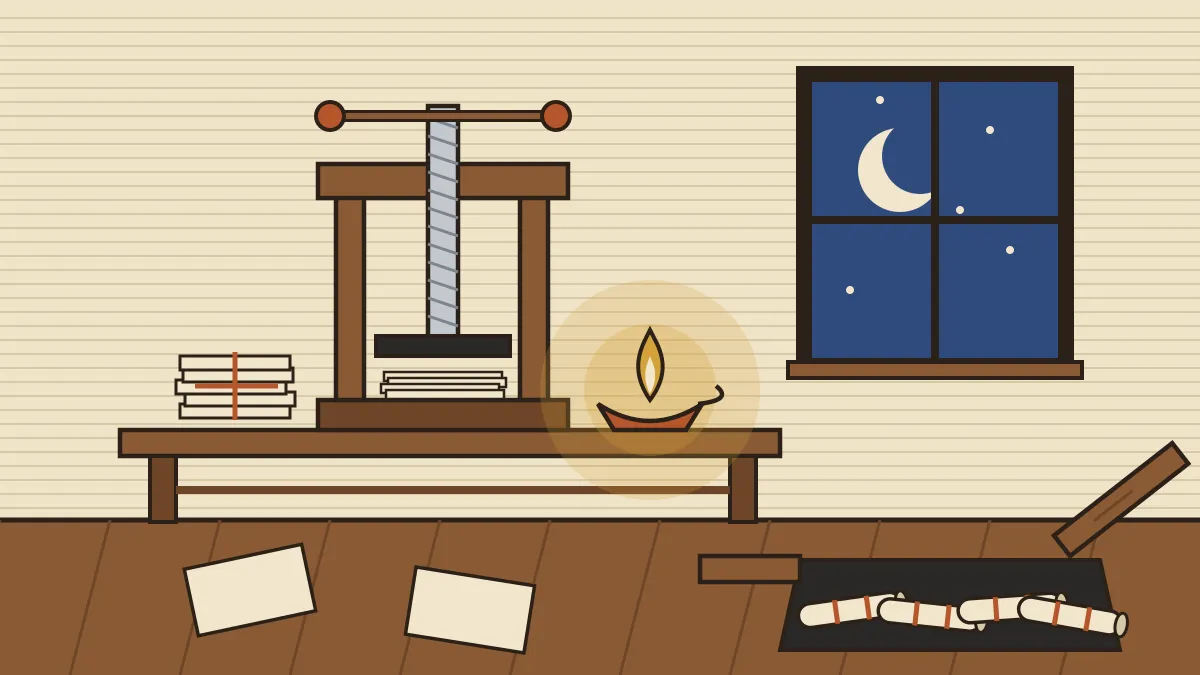
The second workshop was physical. Hemchandra Kanungo, who had gone abroad to learn bomb-making, helped set up a bomb factory in a garden house at Maniktala, a suburb of Calcutta, under Barindra Ghosh. In December 1907 the group tried to kill the Lieutenant-Governor of Bengal, who escaped. The Muzaffarpur bomb followed nearly five months later.
Muzaffarpur to Alipore: The 1908 Chain
The sequence of 1908 is a favourite for chronological questions, so memorise the chain below.
| Date | Event |
|---|---|
| 30 April 1908 | Muzaffarpur (Bihar). Khudiram Bose and Prafulla Chaki throw a bomb at a carriage they believe carries Kingsford, a magistrate hated for severe sentences on young nationalists. It carries two English women, who are killed. |
| May 1908 | Chaki shoots himself when cornered. Khudiram is arrested. Police raid the Maniktala garden and arrest Barindra, Ullaskar Datta and others. Aurobindo Ghose is arrested in Calcutta. |
| 11 August 1908 | Khudiram Bose is hanged, aged 18. His death makes him a folk hero of Bengal, and a song about him is still sung. |
| 31 August 1908 | In the Alipore jail, Kanailal Datta and Satyendranath Bose shoot the approver Naren Goswami, a witness for the Crown. Both are hanged in November. |
| 6 May 1909 | Alipore Bomb Case verdict. Aurobindo is acquitted; Barindra and Ullaskar are sentenced to death, later commuted to transportation for life to the Andamans. |
The defence of Aurobindo in the Alipore Bomb Case was led by Chittaranjan Das, who gave up a lucrative practice for it and became a national figure. After his acquittal Aurobindo withdrew from politics. In 1910 he left Bengal for Pondicherry, then French territory, and turned to spiritual work. The Alipore case shows how a conspiracy trial can become a stage: the defence presented Aurobindo as a poet and educator and the court could not link him to the bomb. Historians' verdict on this phase is that terrorism could not by itself drive out the British, but the revolutionaries restored a sense of pride and courage and became immensely popular, even among people who disagreed with their methods.
Our page on the revolutionary struggle and the Indian National Army carries the wider all-India picture, including the London group of Shyamji Krishnavarma, Savarkar and Madame Cama.
Delhi 1912 and the War Years: Rash Behari Bose and Bagha Jatin
After 1909 repression thinned the Bengal groups, but the idea survived. On 23 December 1912 a bomb was thrown at Viceroy Lord Hardinge as he rode in state on an elephant through Chandni Chowk, Delhi, to mark the transfer of the capital from Calcutta. Hardinge was wounded and an attendant was killed. The plot was headed by Rash Behari Bose, a Bengali who worked at the Forest Research Institute in Dehradun and had ties with the Bengal groups and with revolutionaries in Punjab and Uttar Pradesh. The bomb is usually said to have been thrown by Basanta Kumar Biswas, who was hanged in 1915. Rash Behari evaded arrest for three years, took part in planning the Ghadar uprising set for 21 February 1915, and escaped to Japan that year. In 1943 he handed the Indian Independence League to Subhas Chandra Bose, a link that connects Bengal's early revolutionaries to the INA.
In Bengal the First World War revived the hope of help from outside. Jatindranath Mukherjee, known as Bagha Jatin ("Tiger Jatin", after a story of his fighting a tiger), became the Jugantar leader. Through agents abroad he planned to receive German arms and to rise while troops were busy in Europe, the plan called the German plot or Indo-German conspiracy. The police learned of it. In September 1915, Jatin and four comrades fought a running battle with armed police near the Buri Balam river at Balasore, Orissa. He was wounded and died the next day. The Defence of India Act, 1915, gave the police wide powers against such groups.
1902 Anushilan, 1906 Jugantar paper, 1908 Muzaffarpur and Alipore, 1912 Delhi bomb, 1915 Balasore, 1930 Chittagong, 1932 Pritilata and Bina Das, 1934 Surya Sen hanged.
Chittagong 1930: The Last Great Raid
When Gandhi's Non-Cooperation Movement began in 1920, many Bengal revolutionaries joined the Congress for a time. Within weeks of the Dandi march that opened Civil Disobedience, on 18 April 1930, the revolutionaries struck at Chittagong. Under Surya Sen ("Master Da"), a schoolteacher who led the Jugantar branch in Chittagong, a group calling itself the Indian Republican Army (Chittagong branch) attacked the police armoury and the auxiliary force armoury at the same time and cut the telegraph and rail links. They captured the weapons but could not find the ammunition. At the police armoury they hoisted the national flag and announced a provisional revolutionary government. Pursued into the Jalalabad hills on 22 April, they fought the army and about a dozen youths were killed. Surya Sen was arrested in February 1933 and hanged in January 1934.
What made Chittagong different was the part played by women, as historians stress. Pritilata Waddedar, a graduate and teacher, led an attack on the Pahartali European Club in September 1932 and took poison when wounded, to avoid capture. She was twenty-one. Kalpana Dutta was a member of Surya Sen's group and was sentenced to life imprisonment. In Calcutta, Bina Das fired at the Governor of Bengal, Stanley Jackson, at the Calcutta University convocation on 6 February 1932. She missed and was jailed. The same period saw the HSRA of Bhagat Singh in the north, covered in our page on the Gandhian phase of the national movement. Several of those northern revolutionaries had Bengal links: Sachindranath Sanyal, author of Bandi Jivan, was a disciple of Rash Behari Bose.
The Chittagong Armoury Raid (1930) was not part of Gandhi's Civil Disobedience Movement. It was a separate armed plan by Surya Sen's group, which came weeks after the Dandi march. Bagha Jatin (Jatindranath Mukherjee, died 1915) is also not Jatin Das (the HSRA prisoner who died after a 63-day fast in September 1929).
How UPSC Has Asked It: Past Papers Solved
These are actual CDS and NDA questions since 2018. Questions on this theme are mostly "who with what": a man and an act, a book, a society or a newspaper. One adjoining set asks about the Swadeshi background.
Who among the following had organised, in 1904, a secret society of revolutionaries named Abhinav Bharat?
(a) Khudiram Bose (b) Shyamji Krishna Verma (c) Har Dayal (d) V. D. Savarkar
Answer: (d). Savarkar founded Abhinav Bharat in Maharashtra. Khudiram Bose, the tempting option, belonged to the Bengal movement of 1908.
During the Swadeshi movement, a National College was started in Calcutta under the principalship of
(a) Rabindranath Tagore (b) Aurobindo Ghosh (c) Rajani Kant Sen (d) Syed Abu Mohammad
Answer: (b). Aurobindo became the first principal of the Bengal National College in 1906, before turning to politics and the Alipore trial. Tagore is tied to Shantiniketan, not this college.
Match List-I with List-II. List-I (Journal/Newspaper/Pamphlet): A. Kudi Arasu, B. Kisan Bulletin, C. Bombay Chronicle, D. Bhawani Mandir. List-II (Founder/Editor/Author): 1. Aurobindo Ghosh, 2. Pherozeshah Mehta, 3. Indulal Yagnik, 4. E.V. Ramaswami Naicker. Code: A B C D
(a) 4 3 2 1 (b) 4 2 3 1 (c) 1 3 2 4 (d) 1 2 3 4
Answer: (a). Kudi Arasu was Periyar's paper, the Kisan Bulletin was Indulal Yagnik's, the Bombay Chronicle was founded by Pherozeshah Mehta, and the pamphlet Bhawani Mandir (1905) was Aurobindo's. For this chapter, D–1 (Bhawani Mandir–Aurobindo) matters; A–4 and D–1 leave (a) or (b), and B–3 then settles it as (a).
With reference to the Swadeshi Movement, consider the following statements: 1. The Swadeshi Movement had its genesis in the Anti-Partition movement, which was started to oppose the British decision to partition Bengal. 2. Aurobindo Ghosh was in favour of extending the movement to the rest of India and carrying it beyond the programme of just Swadeshi and Boycott to a full-fledged political mass struggle.
(a) 1 only (b) 2 only (c) Both 1 and 2 (d) Neither 1 nor 2
Answer: (c). Both are correct. The Extremists, with Aurobindo as a leading voice, wanted to carry the boycott into passive resistance and a wider political struggle, which is also how the revolutionaries read the moment.
Who among the following is the author of the book Bandi Jivan?
(a) Rash Behari Bose (b) Veer Savarkar (c) Aruna Asaf Ali (d) Sachindranath Sanyal
Answer: (d). Bandi Jivan ("A Life of Captivity") is Sanyal's account of his imprisonment. Sanyal, a lieutenant of Rash Behari Bose, later helped found the Hindustan Republican Association.
The headquarters of Ghadar Movement/Party were at
(a) San Francisco (b) Stanford University (c) Portland (d) Florida
Answer: (a). The Ghadar Party of Indians in North America worked from San Francisco, in a building known as Yugantar Ashram, named after the Bengal journal. The link shows how widely the Bengal idea travelled.
Who among the following wrote The Philosophy of the Bomb?
(a) Sukhdev (b) Chandrashekhar Azad (c) Bhagwati Charan Vohra (d) Bhagat Singh
Answer: (c). Bhagwati Charan Vohra of the HSRA wrote it in 1930, as a reply to Gandhi's article "The Cult of the Bomb". Bhagat Singh is the tempting wrong option.
UPSC rarely asks the date alone. It asks who did what, so learn each name with one deed: Savarkar-Abhinav Bharat, Aurobindo-Bhawani Mandir, Khudiram-Muzaffarpur, Rash Behari-Hardinge bomb, Surya Sen-Chittagong, Sanyal-Bandi Jivan.
Practice MCQs (with answers)
- The Anushilan Samiti was founded in Calcutta in
- 1897
- 1905
- 1908
- 1902
- The weekly Jugantar was launched by a group that included
- Barindra Kumar Ghosh and Bhupendranath Datta
- Pulin Behari Das and Surya Sen
- Savarkar and Madame Cama
- Bagha Jatin and Rash Behari Bose
- In April 1908 Khudiram Bose and Prafulla Chaki threw a bomb at a carriage at
- Dacca
- Muzaffarpur
- Alipore
- Chittagong
- Who led the defence of Aurobindo Ghose in the Alipore Bomb Case?
- Motilal Nehru
- Tej Bahadur Sapru
- Chittaranjan Das
- Bipin Chandra Pal
- The 1912 bomb attack on Viceroy Hardinge in Delhi was headed by
- Rash Behari Bose
- Bagha Jatin
- Surya Sen
- Barindra Ghosh
- Bagha Jatin died in 1915 after a battle with the police at
- Chittagong
- Calcutta
- Muzaffarpur
- Balasore
- Pritilata Waddedar led an attack in 1932 on
- the Writers' Building, Calcutta
- the Pahartali European Club, Chittagong
- the Governor's carriage, Calcutta
- Dacca Jail
- The Chittagong Armoury Raid took place in
- 1919
- 1922
- 1930
- 1942
1-d, 2-a, 3-b, 4-c, 5-a, 6-d, 7-b, 8-c. Q1: 1897 is the year of the Chapekar assassinations in Poona. Q5: Bagha Jatin led Jugantar in the war years, but the Delhi plot is Rash Behari's. Q7: the Writers' Building was attacked by other Bengal revolutionaries in 1930, not by Pritilata. Q8: it came weeks after the Dandi march of 1930, but it was a separate armed plan.
Quick Revision
- Anushilan Samiti: Calcutta, 24 March 1902; Pramathanath Mitra, Satish Chandra Basu; Dacca branch under Pulin Behari Das, about 500 branches; name from Bankim.
- Jugantar: weekly of 1906 (Barindra Ghosh, Bhupendranath Datta, Abinash Bhattacharya); Maniktala bomb factory; Bagha Jatin leads it in 1915; Surya Sen leads the Chittagong branch.
- Muzaffarpur, 30 April 1908: Khudiram Bose (hanged 11 August 1908) and Prafulla Chaki (shot himself). Alipore case: Aurobindo acquitted 1909 (defended by C.R. Das); Barindra and Ullaskar transported for life.
- Delhi bomb, 23 December 1912: Hardinge wounded; Rash Behari Bose heads the plot, Basanta Kumar Biswas hanged in 1915; Rash Behari escapes to Japan (INA link).
- Balasore, September 1915: Bagha Jatin, German plot, Defence of India Act.
- Chittagong Armoury Raid, 18 April 1930: Surya Sen, Indian Republican Army; Pritilata Waddedar (Pahartali Club, 1932); Bina Das fires at Stanley Jackson (6 February 1932); Surya Sen hanged January 1934.
- Not Bengal: Abhinav Bharat (Savarkar, Maharashtra, 1904); Ghadar (San Francisco, 1913).
Frequently asked questions
What was the Anushilan Samiti?
The Anushilan Samiti was a revolutionary society founded in Calcutta on 24 March 1902 as a physical-culture club and later a secret society. Its Dacca branch under Pulin Behari Das grew to about 500 branches. The name, meaning practice or cultivation, comes from Bankim Chandra Chattopadhyay's writings.
What is the difference between Anushilan Samiti and Jugantar?
Anushilan began in 1902 as a gymnasium society and was strongest in Dacca and East Bengal. Jugantar grew around a weekly paper launched in 1906 by Barindra Kumar Ghosh and Bhupendranath Datta, and was strongest in Calcutta and West Bengal. Surya Sen of Chittagong and Bagha Jatin belonged to the Jugantar tradition.
Why were Khudiram Bose and Prafulla Chaki famous?
On 30 April 1908 they threw a bomb at a carriage at Muzaffarpur that they believed carried the magistrate Kingsford. Prafulla Chaki shot himself when cornered, and Khudiram Bose was hanged on 11 August 1908 at the age of eighteen, which made him a folk hero of Bengal.
What happened in the Chittagong Armoury Raid?
On 18 April 1930 Surya Sen's group, the Chittagong branch of the Indian Republican Army, attacked the police and auxiliary force armouries at Chittagong, cut communications and proclaimed a provisional revolutionary government. They fought the army at Jalalabad hills on 22 April. Surya Sen was arrested in 1933 and hanged in 1934.
Why is Khudiram Bose remembered on 3 December?
Khudiram Bose was born on 3 December 1889 in the Midnapore district of Bengal. He was hanged on 11 August 1908 for the Muzaffarpur bomb, when he was eighteen, and is remembered as one of the youngest martyrs of the freedom struggle.
Related CDS / OTA History topics
Modern history is a quarter of the CDS GS paper
Cavalier's CDS/OTA batches teach modern history as a connected story with timelines, maps and weekly PYQ tests.