On 7 November 2026 India closes a year-long commemoration of 150 years of Vande Mataram, which began on 7 November 2025. Bankim Chandra Chattopadhyay is believed to have written the song in 1875, but it became a national slogan only thirty years later. In 1905, crowds singing it marched against Lord Curzon's partition of Bengal. That agitation, the Swadeshi Movement, invented the tools Indians would use against the Raj for the next forty years: boycott, national schools, home-made goods and passive resistance. UPSC keeps returning to it, through its leaders, its institutions, its art and its slogans.
Curzon's Partition: The Line and the Logic
The Bengal Presidency of 1903 included Bihar and Orissa and held about 78 million people. Administrators had long called it too large to govern. When the plan to divide it was made public in December 1903, however, the line drawn showed another motive. The Home Secretary, H.H. Risley, wrote in 1904 that "Bengal united is a power; Bengal divided will pull several different ways".
- Announced: 19 July 1905, under Viceroy Lord Curzon.
- In force: 16 October 1905.
- Eastern Bengal and Assam: a new province with its capital at Dacca. It had about 31 million people, with a Muslim majority.
- Bengal: the western remainder, still including Bihar and Orissa. Bengali speakers became a minority in their own province.
Nationalists read the scheme as an attack on two things at once. It weakened Bengali political consciousness, centred on Calcutta, the capital of British India. It also split Hindus and Muslims by promising Muslims a province of their own. Curzon's other measures had already angered the educated class: the Calcutta Corporation Act (1899), the Indian Universities Act (1904) and the Official Secrets Act (1904).
From Petitions to Boycott: How the Movement Grew
From 1903 to mid-1905 the protest was moderate. Leaders such as Surendranath Banerjea, Krishna Kumar Mitra and Prithwishchandra Ray held meetings, sent petitions and campaigned in newspapers such as Bengalee, Hitabadi and Sanjibani. The government ignored them, and the movement changed character.
| Date | Event |
|---|---|
| 7 August 1905 | Calcutta Town Hall meeting passes the boycott resolution, the formal start of Swadeshi. India now marks this date as National Handloom Day. |
| 16 October 1905 | Partition takes effect. Bengal observes a day of mourning: no cooking (arandhan), a bath in the Ganga, and Tagore's idea of Raksha Bandhan, Hindus and Muslims tying rakhis on each other. Tagore's Amar Sonar Bangla, now Bangladesh's national anthem, was written for the movement. |
| December 1905 | Benares Congress, under Gokhale, supports the boycott in Bengal, though the Moderates hesitate to extend it. |
| 15 August 1906 | National Council of Education set up. Bengal National College opens with Aurobindo Ghosh as principal. |
| December 1906 | Calcutta Congress, under Dadabhai Naoroji, declares Swaraj the goal and passes resolutions on Swadeshi, boycott and national education. The Muslim League is founded at Dacca on 30 December. |
| December 1907 | Surat split: Moderates and Extremists part ways. |
| 12 December 1911 | At the Delhi Durbar, King George V announces that the partition is annulled and the capital is moving to Delhi. |
The Four Strands of Swadeshi
The historian Sumit Sarkar showed that "Swadeshi" was really several movements running side by side. Exam statements often describe one strand and test whether you can name it.
- The Moderate trend. Petitions and press campaigns aimed at getting the partition reversed by persuasion.
- Constructive Swadeshi. Self-help through Indian industry, national schools and village work, without confronting the government head-on. Its voice was Rabindranath Tagore, who called it atmashakti (self-strengthening). Satish Chandra Mukherjee's Dawn Society was its laboratory.
- Political Extremism. Associated with Aurobindo Ghosh, Bipin Chandra Pal, Bal Gangadhar Tilak and Lala Lajpat Rai. They wanted to turn boycott into passive resistance: boycott government schools, courts, titles and services until the administration stopped working. Aurobindo argued for carrying the movement beyond Bengal, which is exactly statement 2 of the CDS 2026-I question below.
- Revolutionary terrorism. This strand grew as open agitation was crushed. The Anushilan Samiti (founded in 1902, with a powerful Dacca branch under Pulin Behari Das) and the Jugantar group turned to the bomb. On 30 April 1908 at Muzaffarpur, Khudiram Bose and Prafulla Chaki attacked a carriage they thought was carrying the judge Kingsford.
Volunteer bodies (samitis) did the movement's groundwork. They enforced boycott, ran schools, organised relief and drilled young men. The most famous was Ashwini Kumar Dutt's Swadesh Bandhab Samiti in Barisal. The government deported Dutt in 1908 under Regulation III of 1818.
What Swadeshi Built: Schools, Industry, Art and Song
National education
Students led the boycott of government schools, so the movement had to give them an alternative. The National Council of Education (1906) ran the Bengal National College and School, with Aurobindo as principal, and the Bengal Technical Institute. The Council's line of descent leads to today's Jadavpur University. Tagore's school at Santiniketan (1901) belonged to the same idea of teaching in the mother tongue.
Swadeshi enterprise
- Textile mills, soap and match factories, tanneries, banks and insurance companies sprang up across Bengal.
- Acharya P.C. Ray's Bengal Chemicals became the movement's showpiece.
- In the south, V.O. Chidambaram Pillai founded the Swadeshi Steam Navigation Company at Tuticorin in 1906, challenging British shipping.
Art and literature
Swadeshi was also a cultural revolt.
- Abanindranath Tagore painted Bharat Mata (1905). With E.B. Havell and others, he made Calcutta the centre of the Bengal School. The Indian Society of Oriental Art (1907), founded by Abanindranath and his brother Gaganendranath, grew out of it (CDS 2020-I, below).
- Rabindranath Tagore, Rajanikanta Sen, D.L. Roy and Syed Abu Mohammad wrote the songs.
- Mukunda Das took the message to villages through jatra folk theatre.
- Science joined in, with J.C. Bose and P.C. Ray held up as proof of Indian ability.
Vande Mataram: from novel to slogan
Vande Mataram is believed to have been written on 7 November 1875 (Akshaya Navami). It appeared in Bankim's novel Anandamath (1882), set during the Sannyasi rebellion. The novel pictures the motherland in three images: the Mother as she was, as she is and as she will be (CDS 2025-II, below).
- Rabindranath Tagore sang it at the Calcutta Congress of 1896.
- In the Swadeshi years it became a war cry, and the government tried to ban it in public.
- Bipin Chandra Pal launched an English daily named Bande Mataram in 1906, which Aurobindo edited.
- On 24 January 1950, President Rajendra Prasad announced in the Constituent Assembly that the song would be honoured equally with Jana Gana Mana, as India's national song.
Beyond Bengal, and Why It Faded
The Extremists carried the movement beyond Bengal:
- Maharashtra: Tilak.
- Punjab: Lajpat Rai and Ajit Singh, both deported to Mandalay in May 1907 after the agrarian agitation there.
- Delhi: Syed Haider Raza.
- Madras: Chidambaram Pillai and Subramania Bharati.
- Andhra: Bipin Pal's tour of 1907 set off a "Vande Mataram movement".
Read our profile of Lokmanya Tilak and "Swaraj is my birthright" for the Maharashtra side, and Sri Aurobindo as revolutionary and editor for the Bengal leadership.
By 1908 the open movement had run down. The reasons are a classic short-answer list:
- Repression. The Seditious Meetings Act (1907), the Newspapers (Incitement to Offences) Act (1908) and the Explosive Substances Act (1908) gave the government new powers. Tilak was sentenced to six years in Mandalay in 1908. Aurobindo was tried in the Alipore bomb case, and after his acquittal he withdrew to Pondicherry in 1910.
- The Surat split (1907) divided the Congress at the very moment it needed unity.
- No mass base among the peasantry. The movement drew students, women, the urban middle class and some zamindars, but it barely touched the peasant. In eastern Bengal, many of the peasants were Muslim and many of the landlords Hindu.
- Communal division. Nawab Salimullah of Dacca backed the partition, and the Muslim League (1906) and the separate electorates of the Morley–Minto Reforms (1909) widened the gap. A few Muslim leaders, such as Abdul Rasul and Liaqat Husain, stayed with Swadeshi.
- Leaderless after 1908. Tilak was in jail, Aurobindo in Pondicherry, Pal out of politics and Lajpat Rai abroad.
At the Delhi Durbar of 12 December 1911, King George V announced that the partition was annulled. The same announcement moved the capital from Calcutta to Delhi. Bihar and Orissa became a separate province, and Assam went back to being a chief commissioner's province. Bengal was reunited, but Calcutta lost its place as the imperial capital.
Why the Swadeshi Years Still Matter
Gandhi wrote in Hind Swaraj (1909) that the real awakening came after the partition of Bengal. The debt is easy to trace:
- Boycott of foreign cloth, national schools, the bonfire of foreign goods and the shift from petition to self-reliance all reappeared, on a much larger scale, in Non-Cooperation (1920–22).
- Non-Cooperation added what Swadeshi lacked: a peasant base and an organisation reaching down to the village. That is why UPSC likes to set the two movements side by side (CDS 2019-II and 2021-II, below).
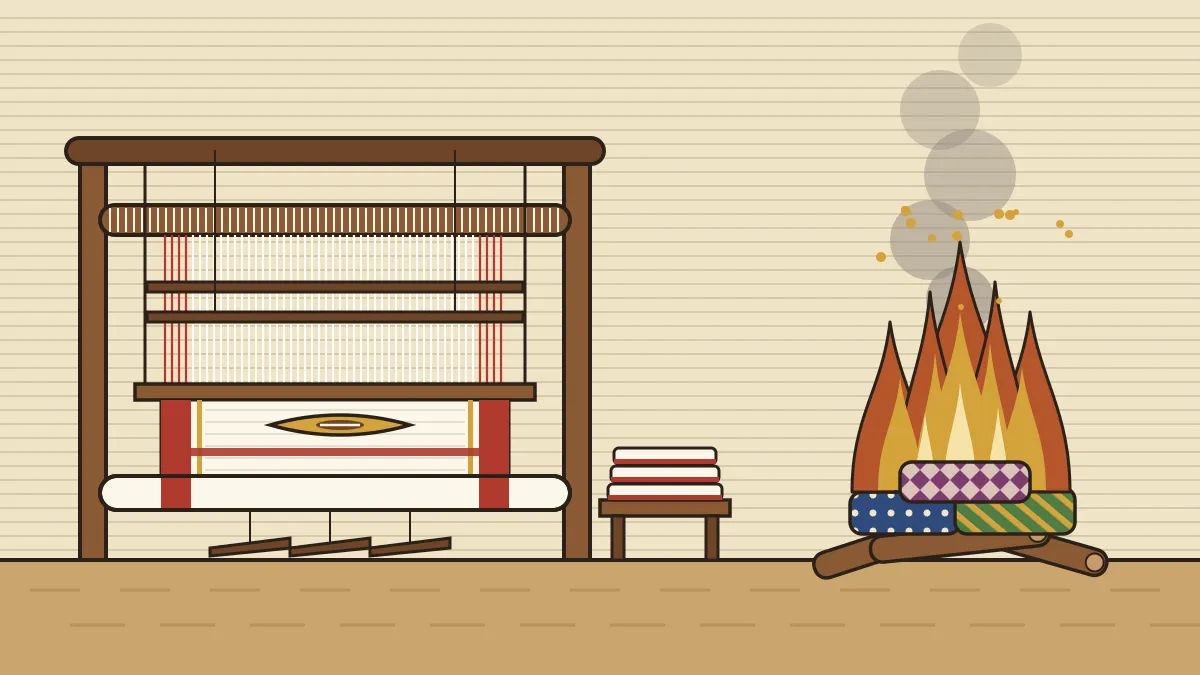
- Handloom revival began here. National Handloom Day falls on 7 August for that reason; see our article on India's handloom heritage.
- Art in the national idiom began here too, and the revolutionary groups formed in these years carried the struggle into the 1930s.
The wider arc, from the Moderates to the Extremists, is on our page on the early phase of the national movement.
How UPSC Has Asked It: Past Papers Solved
These are actual CDS and NDA questions on the Swadeshi years since 2018. Notice how often the examiner tests the people and institutions rather than dates.
With reference to the Swadeshi Movement, consider the following statements: 1. The Swadeshi Movement had its genesis in the Anti-Partition movement, which was started to oppose the British decision to partition Bengal. 2. Aurobindo Ghosh was in favour of extending the movement to the rest of India and carrying it beyond the programme of just Swadeshi and Boycott to a full-fledged political mass struggle.
(a) 1 only (b) 2 only (c) Both 1 and 2 (d) Neither 1 nor 2
Answer: (c). Swadeshi grew directly out of the anti-partition agitation of 1903–05. Aurobindo, the leading Extremist in Bengal, wanted passive resistance spread across India. Both statements describe the movement accurately.
During the Swadeshi movement, a National College was started in Calcutta under the principalship of
(a) Rabindranath Tagore (b) Aurobindo Ghosh (c) Rajani Kant Sen (d) Syed Abu Mohammad
Answer: (b). The Bengal National College (1906) opened under the National Council of Education with Aurobindo as principal. The other three options are all Swadeshi figures (Tagore and Rajanikanta Sen as poets, Abu Mohammad as a songwriter and organiser), which makes the options deliberately plausible.
Who among the following was one of the founders of the Indian Society of Oriental Art?
(a) Rabindranath Tagore (b) Abanindranath Tagore (c) Dwarakanath Tagore (d) Bankim Chandra Chattopadhyaya
Answer: (b). Abanindranath, the painter of Bharat Mata, founded the Society in 1907 with his brother Gaganendranath. It was the institutional home of the Bengal School. Expect the other Tagores as distractors whenever Swadeshi art is asked.
Which of the following books portrays three images of the Mother Goddess: "Mother as she was", "Mother as she is" and "Mother as she will be"?
(a) Durgeshnandini (b) Kapalkundala (c) Anandamath (d) Devi Chaudhurani
Answer: (c). All four options are Bankim's novels. Anandamath (1882) is the one that carries Vande Mataram and the image of the motherland in three forms.
Statement I: The United Provinces during Non-Cooperation became one of the strongest bases of the Congress. Statement II: The literary outcrop of Non-Cooperation in Bengal was quite meagre compared to the days of the Swadeshi agitation.
(a) Both true, II explains I (b) Both true, II does not explain I (c) I true, II false (d) I false, II true
Answer: (b). Both are true, but they are about different regions, so II cannot explain I. Swadeshi's literary richness (Tagore, Rajanikanta Sen, D.L. Roy) is the fact being tested.
The call for "renunciation of (all) voluntary associations with the (British) Government" was given during
(a) Non-Cooperation Movement (b) Civil Disobedience Movement (c) Quit India Movement (d) Protest against partition of Bengal
Answer: (a). This was the phrase of the Non-Cooperation programme of 1920. Option (d) is the trap: Swadeshi boycotted goods and schools, but the formal call to renounce every voluntary association came with Gandhi's movement.
Practice MCQs (with answers)
- The boycott resolution that formally launched the Swadeshi Movement was passed at
- the Benares Congress, December 1905
- the Calcutta Town Hall, 7 August 1905
- Dacca, 30 December 1906
- Barisal, April 1906
- Who was the Viceroy when the partition of Bengal came into force?
- Lord Minto
- Lord Ripon
- Lord Curzon
- Lord Hardinge
- The Swadesh Bandhab Samiti of Barisal is associated with
- Ashwini Kumar Dutt
- Pulin Behari Das
- Satish Chandra Mukherjee
- Krishna Kumar Mitra
- At which session did the Congress first declare Swaraj as its goal?
- Benares, 1905
- Surat, 1907
- Lucknow, 1916
- Calcutta, 1906
- The Swadeshi Steam Navigation Company was founded at Tuticorin by
- Subramania Bharati
- V.O. Chidambaram Pillai
- C. Rajagopalachari
- Syed Haider Raza
- Consider: 1. The annulment of partition was announced at the Delhi Durbar of 1911. 2. The same announcement shifted the capital to Delhi. Which is/are correct?
- 1 only
- 2 only
- Both 1 and 2
- Neither 1 nor 2
- Tagore's idea of self-strengthening through constructive work during Swadeshi was called
- atmashakti
- satyagraha
- sarvodaya
- swaraj
- The Vande Mataram was given equal status with Jana Gana Mana on
- 15 August 1947
- 26 November 1949
- 26 January 1950
- 24 January 1950
1-b, 2-c, 3-a, 4-d, 5-b, 6-c, 7-a, 8-d. Q2: Curzon's term ran until November 1905, so he was Viceroy on 16 October 1905. Minto, who followed him, faced the movement's peak. Q8: Rajendra Prasad's announcement in the Constituent Assembly on 24 January 1950, two days before the Constitution came into force.
Quick Revision
- Partition: plan public December 1903; announced 19 July 1905; in force 16 October 1905 (mourning, Raksha Bandhan, Amar Sonar Bangla). New province: Eastern Bengal and Assam, capital Dacca.
- 7 August 1905: boycott resolution, Calcutta Town Hall (now National Handloom Day).
- Congress: Benares 1905 (Gokhale) backs the Bengal boycott; Calcutta 1906 (Naoroji) declares Swaraj; Surat split 1907. Muslim League: Dacca, 30 December 1906.
- Four strands (Sumit Sarkar): Moderate, constructive (Tagore's atmashakti), Extremist passive resistance (Aurobindo, Pal, Tilak, Lajpat Rai), revolutionary (Anushilan, Jugantar; Muzaffarpur, 30 April 1908).
- Institutions: National Council of Education (15 August 1906) and Bengal National College (Aurobindo); Swadesh Bandhab Samiti (Ashwini Kumar Dutt); Swadeshi Steam Navigation Co. (VOC, Tuticorin, 1906); Bengal Chemicals (P.C. Ray).
- Art: Abanindranath's Bharat Mata; Indian Society of Oriental Art (1907). Vande Mataram from Anandamath (1882); national song from 24 January 1950.
- Decline: repression, Surat split, no peasant base, communal divide. Annulled at the Delhi Durbar, 12 December 1911; capital to Delhi.
Frequently asked questions
Why did Lord Curzon partition Bengal in 1905?
The official reason was that the Bengal Presidency, with about 78 million people, was too large to govern. Nationalists saw a political motive: to weaken Bengali nationalism centred on Calcutta and to divide Hindus and Muslims by creating a Muslim-majority province, Eastern Bengal and Assam, with Dacca as its capital.
When did the Swadeshi Movement start?
It was formally launched on 7 August 1905, when a meeting at the Calcutta Town Hall passed the boycott resolution. The partition took effect on 16 October 1905, which was observed as a day of mourning across Bengal.
What is the link between Vande Mataram and the Swadeshi Movement?
Bankim Chandra Chattopadhyay's song, published in his novel Anandamath in 1882, became the slogan of the anti-partition protests of 1905. Crowds sang it in the streets, and an English daily named Bande Mataram began in 1906. It was adopted as India's national song on 24 January 1950.
When was the partition of Bengal annulled?
King George V announced the annulment at the Delhi Durbar on 12 December 1911. The same announcement moved the capital of British India from Calcutta to Delhi. Bihar and Orissa were made a separate province.
Why did the Swadeshi Movement decline after 1908?
Harsh repression, the arrest or exile of its main leaders, the Moderate-Extremist split at Surat in 1907, the failure to reach the peasantry and the growing communal divide all wore it down. Its methods returned on a far larger scale in Gandhi's Non-Cooperation Movement.
Related CDS / OTA History topics
Modern History is the CDS paper's biggest history block
Cavalier's CDS/OTA batches teach the national movement phase by phase, with tests drawn from 30 years of UPSC papers.