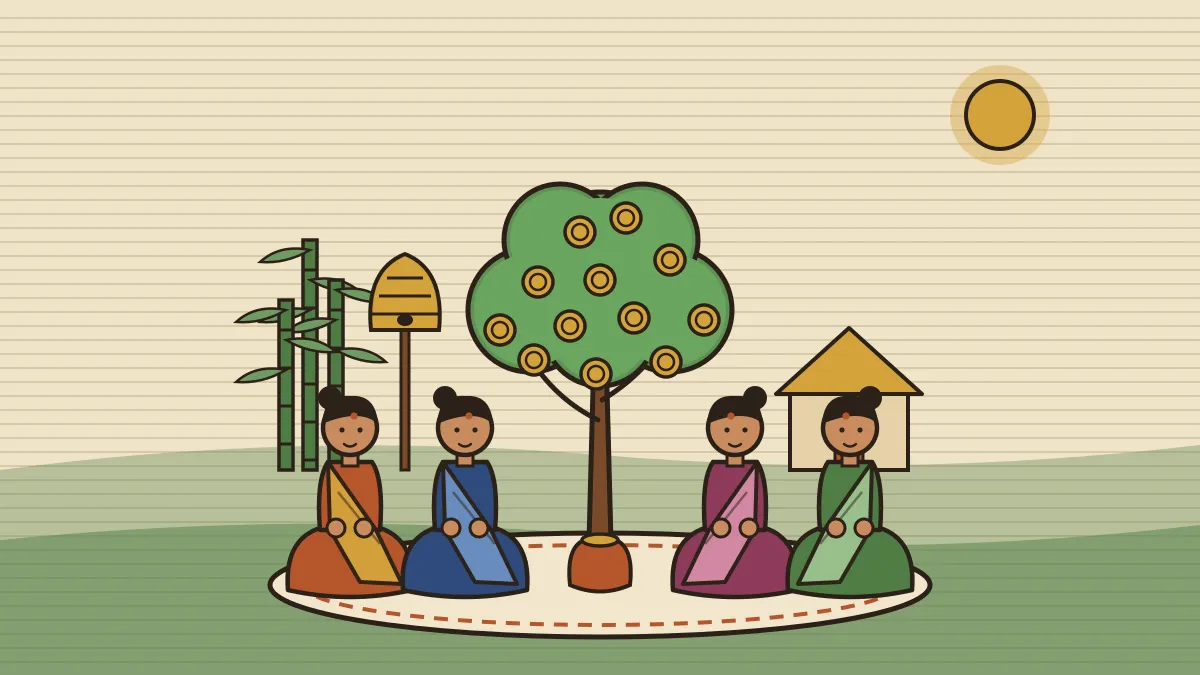
On 15 November 2026 PIB published a Backgrounder on the Lakhpati Didi Initiative, the Ministry of Rural Development's effort to lift rural women's households above an income line of ₹1 lakh a year. The headline is a count: as of June 2026, 3.76 crore women had been enabled as Lakhpati Didis, and another 5.70 crore had been identified as "Potential Lakhpati Didis". The national target, set in February 2026, is six crore by March 2029.
The count is the least interesting part of the document. The more useful part, for a student and for anyone who wants to understand how an Indian welfare programme is actually run, is the machinery: how a target announced on Independence Day 2023 was turned into a household-by-household process, which digital tools were built, and what was done to keep the numbers honest. This article follows that thread.
(For the history of the programme DAY-NRLM itself, from IRDP and SGSY to the mission, and for the definition read closely, see our explainer on the SARAS Mela at Vijayawada. This piece does not repeat it.)
The initiative in numbers
| Item | Figure | Date or source |
|---|---|---|
| Lakhpati Didis enabled | 3.76 crore | as of June 2026 |
| "Potential Lakhpati Didis" identified | 5.70 crore | as of June 2026 |
| Target | 6 crore by March 2029 | envisioned February 2026 |
| SHG members mobilised under DAY-NRLM | about 10.13 crore | 12 November 2026 |
| Self-help groups | about 94.40 lakh | 12 November 2026 |
| Change in average monthly household income | +61% | IIM Ahmedabad assessment |
| Change in average monthly savings | +61.7% | IIM Ahmedabad assessment |
The IIM Ahmedabad assessment covered 6,531 respondents in 17 States and Union Territories. It is an independent evaluation, which is why the Ministry leans on it. Remember what it measures: change among households surveyed, not a national census of all 3.76 crore.
What counts as a Lakhpati Didi
The definition has to be read word by word, because each word closes a loophole.
- A Lakhpati Didi is a self-help group (SHG) member. A woman outside the SHG network is not counted.
- The household must earn at least ₹1 lakh a year. The benchmark takes total household income, not individual earnings.
- Income may come from eligible farm and non-farm activities.
- It is calculated after expenses, so it is a net figure, not turnover.
- It should be sustainable across agricultural seasons or business cycles, which excludes a one-time windfall.
In plain arithmetic, ₹1 lakh a year is about ₹8,333 a month for a whole household, or roughly ₹274 a day (calculated here). The bar is modest. The achievement lies in the number of women who have crossed it, and in the fact that the same measurement is now applied to every household.
From announcement to target: the timeline
The initiative's own timeline shows that the early work was not about money. It was about measurement and institutions.
| Date | Step |
|---|---|
| 21 October 2021 | Advisory to States to promote diversified farm and non-farm livelihoods among SHG households |
| 29 December 2021 | States asked to set time-bound targets |
| 10 June 2022 | Mobile-app household income survey introduced |
| 15 August 2023 | Government announces the initiative, with a target of two crore SHG women |
| 6 September 2023 | National Conclave; Strategy Note on enabling two crore Lakhpati SHG Didis released |
| 10 October 2023 | Strategy considerations presented to the Prime Minister |
| 16 October 2023 | Implementation action points issued |
| November 2023 to March 2024 | Structured training of community cadres |
| February 2024 | Interim Budget raises the target to three crore; Lakhpati Didi portal launched |
| May 2024 | Digital Aajeevika Register begins recording household livelihoods and income |
| August 2024 | One crore achieved |
| July 2025 | Didi Business Plan tool and a financial-literacy app for community resource persons |
| August 2025 | Two crore reported |
| December 2025 | Three crore achieved, ahead of schedule |
| February 2026 | National target revised to six crore by March 2029 |
The pace is worth working out. From August 2023 to December 2025 is about 28 months, so three crore women in that time is roughly 10.7 lakh a month on average (calculated). From December 2025 to June 2026 the count rose by about 76 lakh in six months, or about 12.7 lakh a month. To reach six crore by March 2029, the remaining 2.24 crore must be added over about 33 months, a required pace of nearly 6.8 lakh a month. That is slower than what has been achieved so far. But the households that remain are likely to be the harder ones to move, so the arithmetic does not settle whether the target is easy.
The strategy design: four considerations
The Strategy Note of 6 September 2023 was built on the existing DAY-NRLM network rather than a new structure, and it recognised four critical considerations.
- Credit. Viable livelihoods need additional credit, and the household needs the capacity to repay it.
- Measurement. Household income needed a consistent framework, or one State's "lakhpati" would not match another's.
- State capacity. States differ, so support had to be context-specific.
- Community institutions. SHGs and their federations needed training before they could prepare household-level plans.
The first point is the heart of the matter. Raising income needs a loan for a buffalo, a sewing machine or a stock of raw material, and a loan needs a borrower who can repay. Self-help groups are the mechanism by which poor women borrow together and repay on time.
The five-stage process
At household level the initiative follows a community-led process, with equal opportunity for SHG members of all social and economic categories.
- Identification. Potential beneficiaries are identified through the SHG network and the LokOS platform. Women flagged here are the "Potential Lakhpati Didis".
- Income assessment. Household livelihoods, income and expenses are recorded. The Digital Aajeevika Register is the common monitoring framework.
- Enterprise planning. Trained Community Resource Persons (CRPs) prepare an individual business plan for each household. The plans are then pooled to find common needs and sector-wise opportunities.
- Implementation support. Women receive coordinated help over three years, covering training, finance, livelihood assets and market access.
- Monitoring. National and State missions review progress through the digital records, and State missions validate the reported achievements.
Consultations with States identified 12 priority livelihood sub-sectors, among them bamboo, honey, goat rearing, poultry and tasar silk. Notice the mix: these are the activities a village woman can start with local resources, which is why they sit at the centre of the plans.
The people behind the process
A programme of this size cannot be run from Delhi. The Backgrounder describes structured training for community cadres between November 2023 and March 2024: about 5.5 lakh persons trained in 12 modules over 15 hours. These are the community resource persons who sit with a household and work out a business plan.
DAY-NRLM has long used such local women as its field force. Earlier PIB backgrounders list the Krishi Sakhi for farming advice, Pashu Sakhi for livestock, Bank Sakhi and Banking Correspondent Sakhi as the link to banks, and Bima Sakhi for insurance. A PIB backgrounder of October 2025 reported 47,952 Bank Sakhis deployed, more than ₹11 lakh crore of credit disbursed to women's SHGs through formal institutions, and a repayment rate above 98%. The Lakhpati Didi initiative is a new target placed on top of an old workforce. Our note on Pension Sakhis shows the same network being used for yet another service.
The digital layer, step by step
Every digital tool in the story answers a specific problem.
- LokOS, the platform on which women are identified as potential Lakhpati Didis, was upgraded in May 2026.
- The Lakhpati Didi portal (February 2024) gave the programme a public face.
- The Digital Aajeevika Register (May 2024) records each household's livelihoods and income, so there is one source of truth.
- The Didi Business Plan tool and the financial-literacy application (July 2025) equip CRPs for the planning stage.
- A learning portal and chatbot followed in October 2025.
- An application for individual enterprise loans was introduced on 21 February 2026.
- On 29 June 2026 a platform for producer groups and enterprises and a public Lakhpati Didi dashboard were launched.
The sequence runs from counting, to planning, to credit, to market. The last two items matter most: a household that gets a loan but cannot sell what it makes will not cross the income line for long.
Keeping the numbers honest
Any programme that reports a headline number invites a question about how it is counted. The Backgrounder is clear about this. During 2025-26 the government introduced checks to identify unusual income entries. State missions were asked to reconcile discrepancies and certify the figures they report. The document says this "helped strengthen the credibility of progress assessments".
That is a fair thing to note. A target of this scale, passed down from the Centre to State missions, creates pressure to report success. Validation by the State missions, anomaly checks and an independent IIM study are the three safeguards the Ministry points to. For students, the point is a general one: in governance, how a figure is defined and audited is as important as the figure.
Leadership attention and convergence
The Backgrounder also sets out a series of reviews. A Performance Review Committee met in July 2024. Regional consultations were held at Guwahati, Srinagar, Jaipur, Hyderabad, Bengaluru and Raipur during 2024-25. A Lakhpati Didi tableau appeared in the Republic Day parade of January 2025. Regional workshops followed at Gaya and Pushkar, and a review involving all States took place at the Rashtriya Grameen Vikas Sammelan on 28-29 June 2026.
In March 2025 discussions began with the Agriculture, Animal Husbandry and MSME departments on convergence of their schemes. This is how a livelihood plan becomes workable. A woman starting a goat unit needs the animal-husbandry department's veterinary support and its insurance. A woman making a food product needs the MSME ecosystem's registration and marketing help. Our MSME and Udyam note explains the enterprise side, and the poverty and development note places livelihood missions within the wider anti-poverty framework.
Questions a careful student should ask
The article is about a success story, but a good answer in the Mains or in an interview discusses both sides.
- Income versus assets. A household may pass ₹1 lakh in a year and still be one illness away from falling back. The "sustainable across seasons" clause is the Ministry's answer, and the three-year support window is meant to secure it.
- Household versus woman. The measure counts household income, so it does not show how much of that income the woman herself earns or controls. The initiative's wider aims of entrepreneurship and community leadership go beyond the number.
- Targets and data. With a count passed up from villages to the Centre, validation is essential. The reconciliation steps taken in 2025-26 show the Ministry recognises this.
- Market access. Production is rarely the bottleneck. Selling at a fair price is.
🔑 Revision block
The release. PIB Backgrounder "The Lakhpati Didi Initiative", 15 November 2026; Ministry of Rural Development.
Progress. 3.76 crore Lakhpati Didis (June 2026); 5.70 crore Potential; target 6 crore by March 2029 (set February 2026). DAY-NRLM: about 10.13 crore SHG members in 94.40 lakh SHGs (12 November 2026).
Targets over time. 2 crore (announced 15 Aug 2023) → 3 crore (Interim Budget, Feb 2024) → 6 crore (Feb 2026). 1 crore by Aug 2024; 2 crore by Aug 2025; 3 crore by Dec 2025.
Definition. SHG member; household income at least ₹1 lakh a year; after expenses; farm and non-farm; sustainable across seasons or cycles.
Process. Identification (LokOS) → income assessment (Digital Aajeevika Register) → enterprise planning (CRPs) → support for three years → monitoring and State validation.
Tools. Portal (Feb 2024); Register (May 2024); Didi Business Plan tool (Jul 2025); chatbot (Oct 2025); enterprise-loan app (21 Feb 2026); dashboard (29 Jun 2026).
Evidence. IIM Ahmedabad: 6,531 respondents, 17 States/UTs; income +61%, savings +61.7%. Training: about 5.5 lakh cadre, 12 modules, 15 hours. 12 priority sub-sectors (bamboo, honey, goat rearing, poultry, tasar silk).
🎯 Practice MCQs
Q1. Under the Lakhpati Didi Initiative, a Lakhpati Didi is a self-help group member whose household earns at least:
(a) ₹50,000 a year
(b) ₹75,000 a year
(c) ₹1 lakh a year
(d) ₹2 lakh a year
→ (c)
The benchmark is ₹1 lakh a year at the household level, after expenses, from farm and non-farm activities, and it should be sustainable across seasons or business cycles.
Q2. Potential Lakhpati Didis are identified through the SHG network and which platform?
(a) LokOS
(b) UMANG
(c) e-Shram
(d) GeM
→ (a)
LokOS is the platform on which women are identified as Potential Lakhpati Didis, and an upgraded version was released in May 2026.
Q3. The initiative was announced on 15 August 2023 with a target of two crore women. In which month of 2024 was the national target raised to three crore?
(a) January
(b) February
(c) July
(d) December
→ (b)
The Interim Budget of February 2024 raised the target to three crore, and the Lakhpati Didi portal was launched in the same period.
Q4. Consider the following statements:
1. The Lakhpati Didi measure counts total household income, not an individual woman's earnings.
2. The income is calculated after expenses.
Which of the statements given above is/are correct?
(a) 1 only
(b) 2 only
(c) Both 1 and 2
(d) Neither 1 nor 2
→ (c)
Both features are part of the definition. The benchmark takes household income and treats it as a net figure.
Q5. The independent assessment of the initiative by IIM Ahmedabad reported that average monthly household income increased by about:
(a) 21%
(b) 33%
(c) 47%
(d) 61%
→ (d)
Income rose 61% and savings rose 61.7% among the 6,531 respondents surveyed in 17 States and Union Territories.
Q6. The Lakhpati Didi Initiative operates through DAY-NRLM, which is implemented by the:
(a) Ministry of Rural Development
(b) Ministry of Women and Child Development
(c) Ministry of Panchayati Raj
(d) Ministry of Housing and Urban Affairs
→ (a)
DAY-NRLM is a Ministry of Rural Development programme that organises poor rural women into self-help groups.
Q7. As of June 2026, the number of women identified as "Potential Lakhpati Didis" was:
(a) 1.2 crore
(b) 3 crore
(c) 3.76 crore
(d) 5.70 crore
→ (d)
3.76 crore had already been enabled as Lakhpati Didis, and a further 5.70 crore had been identified as potential ones.
Q8. Roughly how many community cadre persons were trained in 12 modules over 15 hours between November 2023 and March 2024?
(a) 55,000
(b) 5.5 lakh
(c) 55 lakh
(d) 5.5 crore
→ (b)
About 5.5 lakh persons received the structured training, which prepared them to draw up household-level plans.
📋 How this gets asked (PYQ pattern)
Rural livelihood and women-empowerment schemes recur in CDS general knowledge, usually in one of three forms.
The first is the matching item: a scheme or mission paired with its ministry, its target group or its core mechanism. Here the pairings are DAY-NRLM with the Ministry of Rural Development and SHGs with poor rural women.
The second is the definition trap. "Household income, not the woman's own earnings" and "after expenses" are the sort of qualifiers the examiner can twist, as in Q4 above.
The third is the number and date item: targets, launch dates and achievement figures. The sequence of targets (2 crore in 2023, 3 crore in 2024, 6 crore in 2026) is easy to scramble under exam pressure. This cycle the fresh hooks are 3.76 crore, 5.70 crore potential, March 2029 and the 61% income rise.
Preparing for CDS? Make a one-line card for each flagship rural scheme: the ministry, the target group, the key tool and the latest number. Revise the wider context in our notes on poverty and development, follow the daily CDS current affairs, and learn with experienced faculty in the upcoming Cavalier courses in Delhi.
Source: PIB Backgrounder, "The Lakhpati Didi Initiative: From Household Income Enhancement to Women-Led Rural Entrepreneurship", Ministry of Rural Development, 15 November 2026 (Release ID 2336452). Context on DAY-NRLM from PIB Backgrounder, "Deendayal Antyodaya Yojana - National Rural Livelihoods Mission", 23 October 2025. Monthly pace figures and income per month were calculated by The Cavalier from the published figures.
✍️ Written by Hitendra Deswal — Polity & current-affairs faculty at The Cavalier. Reviewed by the Cavalier Faculty Desk.