On 14 November 2026, the Press Information Bureau announced that the Competition Commission of India (CCI) had approved the acquisition of a shareholding in Yatharth Hospital & Trauma Care Services Ltd by Rasmalai Limited. The buyer is a Cyprus-incorporated investment vehicle with no presence in India that is indirectly controlled by funds managed or advised by Advent International. The target runs a network of super-specialty hospitals. Such announcements look routine, but each one is the State's market referee at work: a deal above certain size limits cannot be completed until the CCI has found that it will not harm competition. UPSC asks about this regulator through its parent law, its three prohibitions, its composition and its appellate body. We go deeper than our earlier article on CCI combination approvals and link the statute to the market structures you already know from market structures.
From MRTP to Competition: Size Versus Conduct
By Hitendra Deswal · Economics faculty, The Cavalier
The Monopolies and Restrictive Trade Practices (MRTP) Act, 1969 came from the licence-permit era. Its worry was concentration of economic power. Firms above an asset limit (₹100 crore from 1985) were classed as MRTP firms and needed case-by-case government approval to expand, and a firm controlling more than 25 per cent of a market could be treated as a monopoly. The 1991 industrial policy removed that asset limit and the prior-approval requirement. Once licences went and foreign firms were allowed in, a law that treated size itself as the problem no longer fitted.
The government appointed a High Level Committee on Competition Policy and Law, chaired by S.V.S. Raghavan, in 1999. It reported in 2000 and recommended a new law aimed at behaviour that harms competition, not at size. The result was the Competition Act, 2002, which received presidential assent in January 2003. The CCI was established in 2003, but the Act was brought into force in stages. Sections 3 and 4 came into force in May 2009, the MRTP Commission was wound up in 2009, and the merger-control provisions took effect only on 1 June 2011.
| Point | MRTP Act, 1969 | Competition Act, 2002 |
|---|---|---|
| Philosophy | Curb size and concentration of power | Curb anti-competitive conduct; being big is legal |
| Era | Licence-permit, planned economy | Post-1991 liberalised, open economy |
| Body | MRTP Commission | Competition Commission of India (CCI) |
| Mergers | Prior government approval for large firms | Mandatory CCI notification above set thresholds, judged on effect on competition |
| Consumer side | Handled unfair trade practices | Left to consumer law, now the Consumer Protection Act, 2019 |
MRTP asked "How big is the firm?" The Competition Act asks "What is the firm doing to the market?" The CCI's duty (Section 18) is to stop practices that hurt competition, promote and sustain competition, protect consumers and ensure freedom of trade.
The Two Conduct Rules: Section 3 and Section 4
Section 3 bans anti-competitive agreements between enterprises. They come in two kinds, and the Act treats them differently.
| Horizontal agreements (Section 3(3)) | Vertical agreements (Section 3(4)) | |
|---|---|---|
| Between | Rivals at the same stage of production or trade | Firms at different stages, such as maker and distributor |
| Covers | Fixing prices; limiting output or supply; dividing markets or customers; bid rigging | Tie-in sales; exclusive supply or distribution; refusal to deal; resale price maintenance |
| Legal test | Presumed to cause an appreciable adverse effect on competition (AAEC). The firms must prove otherwise | Judged case by case on actual effect (the "rule of reason"); the CCI must show AAEC |
| Worst form | A cartel: rivals secretly agreeing not to compete | Harmful mainly when the firm has market power |
Imagine three cement makers in one region who quietly agree that none will cut price below a set rate and that each will stay out of the others' districts. That is a horizontal cartel, and it is presumed illegal without any need to show that prices actually rose. The 2023 amendment widened the net to the hub-and-spoke cartel, in which a firm that is not a competitor, such as a common supplier or trade body, helps rivals coordinate.
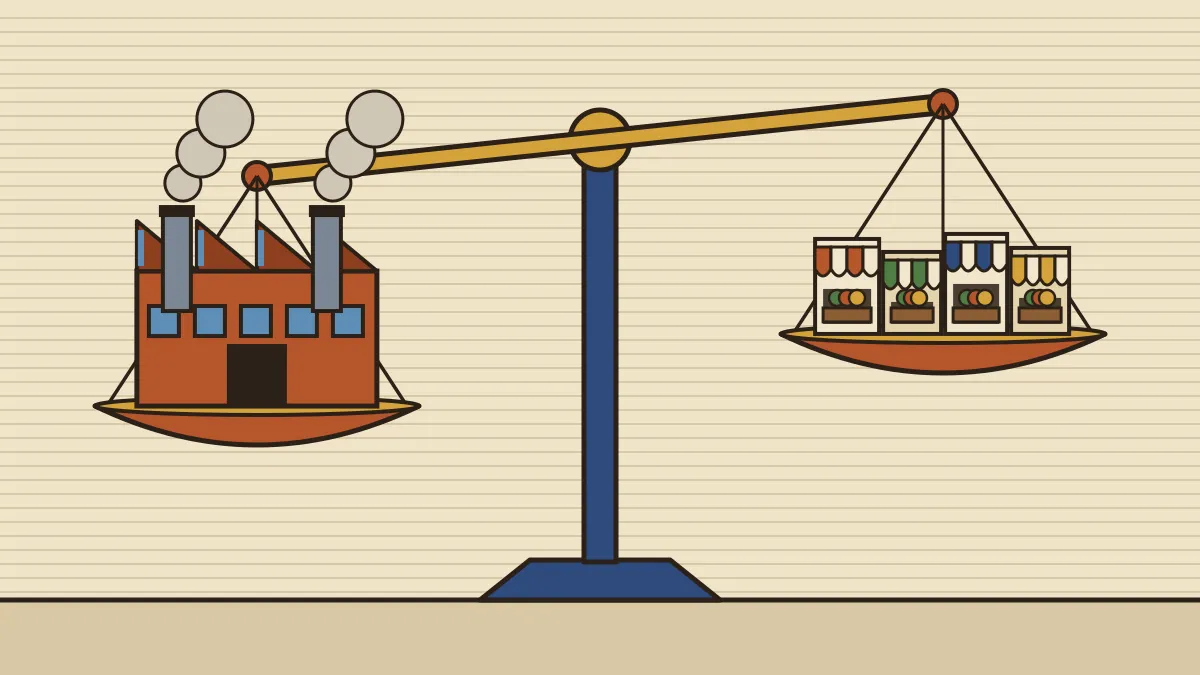
Section 4 bans abuse of dominant position. A firm is dominant if its strength lets it act independently of competitors and consumers or influence the market in its favour. To judge this, the CCI first defines the relevant market, meaning the relevant product market (which goods are close substitutes) and the relevant geographic market (where competitive conditions are alike). It then looks at market share, size and resources, entry barriers, vertical integration and how dependent customers are.
Dominance is not illegal; its abuse is. Section 4(2) lists the abuses: unfair or discriminatory prices or conditions (including predatory pricing, selling below cost to drive out rivals); limiting production or technical development; denying market access; making a contract depend on unrelated extra obligations; and using dominance in one market to enter or protect another.
Compare this with the textbook market forms. A monopoly or oligopoly (a few interdependent sellers) tends to produce less and charge more than perfect competition. The Act does not ban those structures. It bans the conduct, cartels and abuse, that turns market power against consumers. How industry itself is organised is in our industry and services article.
Combinations: Sections 5 and 6 and the Hospital Deal
A combination is an acquisition of control, shares, voting rights or assets, or a merger or amalgamation, that crosses the asset and turnover limits set in Section 5. Section 6 forbids any combination that causes or is likely to cause an AAEC in India, and requires the parties to notify the CCI. They may not complete the deal until the CCI approves it or the time limit runs out, and breaking that standstill (called "gun-jumping") is penalised, at up to 1 per cent of total turnover or assets, whichever is higher.
The test is not "will the firm become large" but "will the deal lessen competition". It looks at market shares, entry barriers and the likely effect on prices and choice. Under Section 31 it can approve the deal, approve it subject to modifications, or block it. Clearing the Yatharth Hospital stake was an approval under that section. A foreign buyer with no Indian business still needs clearance if its deal crosses the limits and affects Indian markets, because the Act applies to conduct outside India that affects competition inside India.
| Stage | Before the 2023 amendment | After |
|---|---|---|
| Overall time limit | 210 days | 150 days |
| Prima facie opinion on AAEC | Longer, set by regulations | Within 30 calendar days of the notice |
| Tests that trigger notification | Assets or turnover | Assets or turnover, plus deal value |
The new deal value threshold requires notification when the transaction is worth more than ₹2,000 crore and the target has substantial business operations in India, even if its assets and turnover are small. It targets digital start-ups that are worth a lot but earn little, which the old tests missed.
The Commission, the DG and the Appeals Ladder
The CCI is a statutory, quasi-judicial body, headquartered in New Delhi, made up of a Chairperson and not less than two and not more than six other Members, all appointed by the Central Government from a panel recommended by a Selection Committee (Sections 8 and 9). It is not a constitutional body like the Election Commission, and it is not a non-statutory body like NITI Aayog. It has its own Act.
| Step | Who | What happens |
|---|---|---|
| 1. Trigger | Any person or firm; the government or a statutory authority; the CCI itself (suo motu) | Information or a reference is filed |
| 2. Prima facie view | Commission | Decides whether there is a case to investigate |
| 3. Investigation | Director General (DG) | Collects evidence, including by searches, and files a report |
| 4. Hearing and order | Commission | Passes a cease-and-desist order, can modify agreements, and imposes penalties |
| 5. Appeal | NCLAT, then the Supreme Court | Appeal within 60 days at each step |
Penalties are heavy. The basic penalty is up to 10 per cent of the average turnover of the last three years. For cartels it can be up to three times the profit for each year of the cartel's life or 10 per cent of turnover, whichever is higher. Since the 2023 amendment, turnover for this purpose is the firm's global turnover.
Appeals originally went to the Competition Appellate Tribunal (COMPAT). The Finance Act, 2017 merged COMPAT into the National Company Law Appellate Tribunal (NCLAT), effective 26 May 2017, so appeals now go to the NCLAT, the same tribunal that hears company-law and insolvency appeals. The government's wider tribunal reform is covered in our article on the Tribunals Reforms Bill, 2026. Our article on statutory commissions places such bodies in the constitutional map.
The Competition (Amendment) Act, 2023
The amendment received presidential assent on 11 April 2023. It modernised enforcement for a digital economy.
| Change | What it does |
|---|---|
| Deal value threshold | Notification for deals above ₹2,000 crore with substantial Indian operations, even if asset and turnover limits are not met |
| Settlement and commitment | A firm facing a case on a vertical agreement or abuse of dominance can offer a commitment (a promise to change conduct, made before the DG report, with no finding of contravention) or a settlement (made after the DG report, with a payment). Not available for cartels. Such orders cannot be appealed |
| Leniency plus | A cartel member that has already applied for lesser penalty and discloses a second, different cartel can get a further reduction on both |
| Hub-and-spoke | A facilitator that is not a rival is brought into the cartel ban |
| Global turnover penalty | Fines are computed on worldwide turnover, to deter large multinationals |
| Shorter timelines | 30 calendar days for a prima facie view, 150 days overall for combinations |
The earlier leniency programme already rewarded the first cartel member to confess with a big discount on its penalty, a tool that breaks secret cartels from inside.
Two Cases You Should Know
- Cement cartel. The CCI found eleven cement manufacturers guilty of limiting supply and fixing prices, with a penalty of about ₹6,300 crore. The old tribunal, COMPAT, sent the case back for a fresh hearing, and the CCI penalised the firms again. In July 2018 the NCLAT upheld the penalty and said a cartel has to be proved on the balance of probabilities, not "beyond reasonable doubt" as in a criminal trial. The companies went on appeal to the Supreme Court.
- Google, Android. In October 2022 the CCI fined Google ₹1,337.76 crore for abusing its dominant position in the Android mobile device market. Google challenged the order, and the NCLAT in March 2023 upheld the penalty. It is the standard example of Section 4 applied to a digital platform.
The CCI deals with market competition, so one firm's conduct towards rivals and the market. The CCPA (Central Consumer Protection Authority) deals with consumer rights, such as misleading advertisements. TRAI and SEBI regulate a single sector. In CDS 2022-II, policy implementation in telecom turned out to be neither TRAI nor the CCI but the Digital Communications Commission.
How UPSC Has Asked It: Past Papers Solved
In the CDS and NDA papers from 2018 onwards we found no question on the CCI itself, but UPSC tests the ideas underneath it: market forms and the types of public body.
Match List-I with List-II. List-I (Market structure): A. Perfect competition, B. Monopoly, C. Monopolistic competition, D. Oligopoly. List-II (Characteristic): 1. Only one producer selling one commodity, 2. Few producers selling similar or almost similar products, 3. Many producers selling differentiated products, 4. Many producers selling similar products.
(a) A-4, B-3, C-1, D-2 (b) A-4, B-1, C-3, D-2 (c) A-2, B-1, C-3, D-4 (d) A-2, B-3, C-1, D-4
Answer: (b). Perfect competition has many sellers of similar goods (4), a monopoly has one (1), monopolistic competition has many sellers of differentiated goods (3), and an oligopoly has few (2). The CCI's cartel rules matter mostly where market forms like these let firms collude.
Which of the following factors signify monopolistic competition? 1. Differentiated products 2. Large number of buyers and sellers 3. Barriers to entry 4. Homogeneous products
(a) 1 and 2 only (b) 1, 2 and 3 only (c) 3 and 4 only (d) 2 and 4 only
Answer: (a). Monopolistic competition has many buyers and sellers and differentiated products (soaps, toothpastes), with free entry. Barriers to entry belong to monopoly and oligopoly, and homogeneous products to perfect competition.
Which one among the following pairs of type of firm and feature is not correctly matched?
(a) Oligopoly firm : Interdependence in decision-making (b) Monopolistic firm : Firm is a price setter (c) Monopoly firm : Produces an efficient level of output (d) Perfectly competitive firm : Produces socially optimum output
Answer: (c). A monopolist restricts output to keep prices high, so it falls short of the efficient level. This loss of output and consumer welfare is exactly why competition law exists.
Which one of the following is neither a constitutional nor a statutory body?
(a) Finance Commission (b) NITI Aayog (c) National Green Tribunal (d) Union Public Service Commission
Answer: (b). The Finance Commission and UPSC are constitutional bodies, and the NGT is statutory. NITI Aayog was set up by a government resolution. The CCI, with its own Act, belongs in the statutory column.
In India, which one of the following is responsible for the implementation of the Government of India's policy in all matters concerning telecommunications?
(a) Digital Communications Commission (b) Telecom Regulatory Authority of India (c) Telecom Advisory Committee (d) Telecommunications Consultants India Limited
Answer: (a). TRAI is the sector regulator, which is the tempting wrong option, while the Digital Communications Commission implements policy. Always ask whether a body makes policy, implements it or regulates.
Economy questions use market-structure matching, and regulators appear as "which body does what". For the CCI itself, prepare four one-liners: Competition Act, 2002; replaced MRTP; three heads (agreements, dominance, combinations); appeals to NCLAT.
Practice MCQs (with answers)
- The Competition Act, 2002 replaced which earlier law?
- MRTP Act, 1969
- FERA, 1973
- SEBI Act, 1992
- Consumer Protection Act, 1986
- Abuse of dominant position is prohibited under which section of the Competition Act?
- Section 3
- Section 4
- Section 5
- Section 6
- Appeals against CCI orders now go to
- COMPAT
- the High Court
- the NCLAT
- the NCDRC
- Which of the following agreements is presumed to have an appreciable adverse effect on competition?
- Resale price maintenance
- A tie-in arrangement
- Exclusive supply agreement
- Bid rigging by rival firms
- The deal value threshold introduced by the 2023 amendment is
- ₹200 crore
- ₹20,000 crore
- ₹2,000 crore
- ₹500 crore
- Which statement about dominance is correct under the Act?
- Dominance is lawful, but its abuse is prohibited
- Dominance itself is unlawful
- Only public-sector firms can be dominant
- Dominance is judged only by turnover
- Settlement and commitment under the 2023 amendment are NOT available for
- vertical agreements
- cartels
- abuse of dominance
- none of these
- The CCI consists of a Chairperson and
- one to three Members
- four to eight Members
- exactly six Members
- at least two and at most six Members
1-a, 2-b, 3-c, 4-d, 5-c, 6-a, 7-b, 8-d. Q4: horizontal agreements (price fixing, output limits, market sharing, bid rigging) are presumed harmful, while vertical ones like tie-ins and resale price maintenance are judged on actual effect. Q7: cartels are excluded because they are the most serious offence, and they can instead be dealt with by leniency. Q3: COMPAT was merged into the NCLAT in 2017.
Quick Revision
- MRTP Act 1969 curbed size; Raghavan Committee (1999-2000) recommended a law on conduct; Competition Act 2002 (assent January 2003); CCI set up 2003; MRTP Commission wound up 2009; merger rules from 1 June 2011.
- CCI: statutory, quasi-judicial; Chairperson plus 2 to 6 Members (Section 8).
- Section 3: anti-competitive agreements. Horizontal (price fixing, output limits, market sharing, bid rigging) are presumed AAEC; vertical (tie-in, exclusive dealing, resale price maintenance) are judged by effect.
- Section 4: abuse of dominance (predatory pricing, denial of market access, leveraging). Dominance is legal; abuse is not. First define the relevant product and geographic market.
- Sections 5 and 6: combinations above asset, turnover or deal-value limits need prior CCI approval; the test is AAEC. Deal value threshold ₹2,000 crore.
- Process: information, DG investigates, Commission orders, appeal to NCLAT (COMPAT merged on 26 May 2017), then Supreme Court. Penalty up to 10 per cent of average turnover; global turnover since 2023.
- 2023 Act (assent 11 April 2023): deal value threshold, settlement and commitment (not for cartels), leniency plus, hub-and-spoke, 150-day combination limit.
- Cases: cement cartel (about ₹6,300 crore, NCLAT upheld 2018); Google Android (₹1,337.76 crore, October 2022, NCLAT upheld 2023).
Frequently asked questions
What is the Competition Commission of India?
The Competition Commission of India is a statutory, quasi-judicial body created under the Competition Act, 2002. It stops anti-competitive agreements and abuse of dominant position, regulates large mergers and acquisitions, and works to promote competition and protect consumers.
Why was the MRTP Act replaced by the Competition Act?
The MRTP Act of 1969 was built for a licensed, closed economy and tried to limit the size of firms. After 1991, the S.V.S. Raghavan committee recommended a law that targets harmful conduct, not size.
What is the difference between Section 3 and Section 4 of the Competition Act?
Section 3 prohibits anti-competitive agreements between enterprises, such as price-fixing cartels or bid rigging. Section 4 prohibits a single dominant enterprise from abusing its position, for example by predatory pricing or denying rivals access to the market. Being dominant is not illegal, but abusing dominance is.
What is a combination and why does the CCI approve it?
A combination is a merger, amalgamation or acquisition of control, shares or assets that crosses the size limits in the Act. Such deals must be notified to the CCI and cannot be completed until approved, so that the Commission can check whether they would cause an appreciable adverse effect on competition.
Where do appeals against CCI orders go?
Appeals against CCI orders go to the National Company Law Appellate Tribunal, which took over from the Competition Appellate Tribunal in May 2017. A further appeal lies to the Supreme Court.
Related CDS / OTA Economics topics
Economy and polity together make up a big slice of the CDS GS paper
Cavalier's CDS/OTA batches teach economy with regulators, laws and PYQs in one connected course.