India observes National Consumer Day on 24 December, the day in 1986 on which the President gave assent to the first Consumer Protection Act, popularly called COPRA. The world marks World Consumer Rights Day on 15 March, recalling a message US President John F. Kennedy sent to Congress on that date in 1962 on consumer rights. The law behind the Indian day is no longer the 1986 one. The Consumer Protection Act, 2019 replaced it, and its regulator, the Central Consumer Protection Authority (CCPA), has been busy in 2026: it fined firms for dark patterns (3 June), fined two food companies for misleading "100%" claims (21 June) and acted against 41 restaurants over default service charges (19 July).
From COPRA 1986 to the 2019 Act
By Aditya Tiwari · Polity faculty, The Cavalier · Lawyer, 10 years teaching law and Polity
The Indian consumer movement began as a response to food shortages, hoarding, black marketing and adulteration. It took an organised form in the 1960s. Until then an unhappy customer simply stopped buying from that shop. Consumer groups changed that, helped by the UN Guidelines for Consumer Protection (1985). The Indian answer, in 1986, was the Consumer Protection Act, 1986 (COPRA), which set up a three-tier system of quasi-judicial bodies: the District Forum, the State Commission and the National Commission.
By 2019 the market had changed: people bought through apps and celebrities endorsed products. Parliament passed the new Bill in the Lok Sabha on 30 July 2019 and in the Rajya Sabha on 6 August, and the President assented on 9 August 2019. The Act came into force on 20 July 2020, with the CCPA following on 24 July 2020, and it repealed COPRA.
| Feature | COPRA 1986 | Consumer Protection Act, 2019 |
|---|---|---|
| Regulator | None; only redressal bodies | CCPA with power to recall goods, order refunds and fine |
| Who is a consumer? | Buyer of goods or hirer of services | Same, but online transactions, teleshopping, direct selling and multi-level marketing are covered |
| Misleading ads | No special rule | Fine, endorser liability and ban |
| Filing a complaint | Where the seller is or does business | Also where the complainant lives or works; e-filing allowed |
| Disputes | Adjudication only | Adds mediation cells |
| Unfair contracts | Not covered | Covered (State and National Commissions) |
National Consumer Day marks the 1986 Act, not the 2019 one.
Who Is a Consumer, and the Six Rights
A consumer is a person who buys goods or hires or avails of a service for a consideration, that is, for a price paid or promised. The definition leaves out anyone who buys goods for resale or for any commercial purpose, and anyone who gets a service free of charge or under a contract of personal service. The user of the goods or services, with the buyer's approval, is also a consumer. A shopkeeper buying stock to sell is not a consumer in that deal.
| The six rights | What it means |
|---|---|
| 1. Safety | Protection from marketing of goods and services that are hazardous to life and property. Example: a defective pressure-cooker valve or cylinder |
| 2. Information | To be informed of the quality, quantity, potency, purity, standard and price of goods and services. Example: the date of manufacture, expiry date and maximum retail price (MRP) printed on a pack |
| 3. Choice | To be assured, wherever possible, access to a variety of goods and services at competitive prices. Example: refusing to be forced to buy a stove with a gas connection |
| 4. To be heard | To be heard and assured that consumers' interests get due consideration at appropriate forums |
| 5. Redressal | To seek redressal against unfair or restrictive trade practices and exploitation |
| 6. Awareness | To consumer education throughout life |
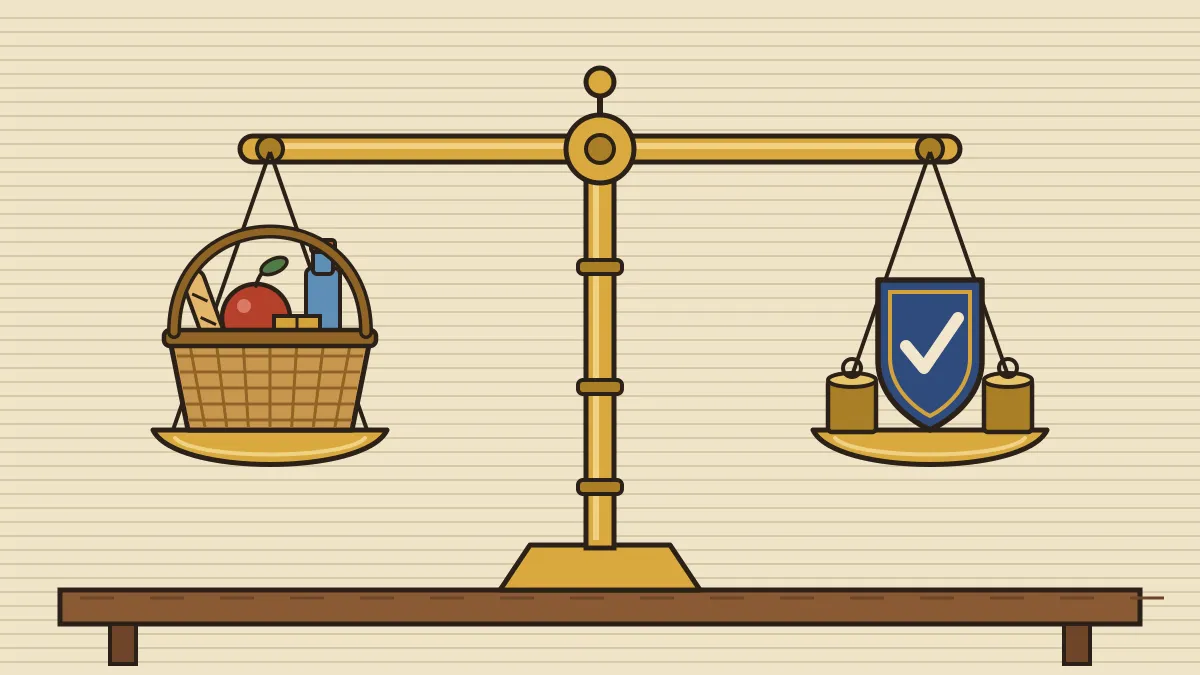
Kennedy's 1962 message named four rights: safety, information, choice and being heard. India's list adds redressal and consumer education. Quality marks put the right to information into practice: ISI (Bureau of Indian Standards) for industrial goods, Agmark for farm produce and the Hallmark for gold jewellery.
The right to be heard and the right to redressal are different rights. The first is about voice at policy forums; the second is about getting relief in an individual case. The MRP is a ceiling on price, so it is a price ceiling and not a price floor (CDS and CAPF both asked this).
A monopoly or cartel restricts choice; the market structures page explains why.
The Three-Tier Commissions and the 2021 Revision
The Act keeps COPRA's three tiers, now called Consumer Disputes Redressal Commissions: the District Commission, the State Commission and the National Commission (NCDRC) in New Delhi. What changed was the money limit. COPRA's lines were ₹20 lakh and ₹1 crore. The 2019 Act itself (Sections 34, 47 and 58) first set ₹1 crore and ₹10 crore, and the Centre's Jurisdiction Rules of December 2021 then brought them down to ease the load on the higher bodies. The test is the value of goods or services paid as consideration, not the compensation claimed.
| Commission | COPRA (as taught in school) | 2019 Act (2020) | After the 2021 Rules |
|---|---|---|---|
| District | Up to ₹20 lakh | Up to ₹1 crore | Up to ₹50 lakh |
| State | ₹20 lakh to ₹1 crore | Above ₹1 crore to ₹10 crore | Above ₹50 lakh to ₹2 crore |
| National | Above ₹1 crore | Above ₹10 crore | Above ₹2 crore |
Asha buys a phone for ₹40,000, Ravi buys a flat for ₹1.4 crore, and a company buys machinery for ₹3 crore. Which commission hears each dispute? Ravi claims ₹2.5 crore as compensation for delay.
Appeals run upward: from the District to the State Commission within 45 days, from the State to the National Commission within 30 days, and from the National Commission to the Supreme Court within 30 days. A complaint must be filed within two years of the cause of action. A complainant may file where he or she lives or works, a change that helps a buyer in a small town sue a seller in a distant city. Hearings can be held by video. The online filing portal began as e-Daakhil (September 2020) and, since 1 January 2025, has been merged with other systems into e-Jagriti. A complaint worth up to ₹5 lakh carries no fee, and the National Consumer Helpline (1915) takes complaints before they reach a commission.
Ask first how much was paid, then pick the tier. Appeals: 45, 30, 30 days.
The CCPA: A Regulator at Last
The Central Consumer Protection Authority is the biggest change. It works under the Ministry of Consumer Affairs, Food and Public Distribution, has an Investigation Wing headed by a Director General, and is meant to protect and enforce consumers' rights as a class. A commission settles one person's dispute; the CCPA acts for all consumers.
- Inquire and investigate violations of consumer rights and unfair trade practices, on a complaint or on its own (suo motu).
- Recall dangerous goods, order refunds and stop unfair practices; it can begin class action proceedings.
- Misleading advertisements: order them withdrawn or changed, and fine a manufacturer or endorser up to ₹10 lakh (up to ₹50 lakh for a repeat offence). It can bar an endorser from endorsing for up to one year (up to three years for repeat offences). A court can also impose imprisonment on conviction. An endorser who checked the claims with due diligence is not liable.
These powers are not hypothetical. On 3 June 2026 the CCPA fined two firms for dark patterns, the tricks that push a buyer into a choice, which our article on dark patterns and digital consumer rights lists as thirteen types. On 21 June 2026 it fined Storia Foods and Mrs. Bectors ₹1 lakh each over "100%" claims (see that explainer), and on 19 July 2026 it took suo motu action against 41 restaurants that added service charge by default (see the service-charge article).
The CCPA is a statutory body, created by an Act of Parliament; compare it with other commissions on our statutory commissions page.
Product Liability, Unfair Contracts, E-Commerce and Mediation
Product liability is the duty to pay compensation for harm caused by a defective product or a deficient service. The Act places it on the product manufacturer, the product service provider and the product seller. The harm counts if it is personal injury, illness, death, mental agony or damage to other property; damage to the defective product itself is not covered. A manufacturer is liable if the product has a manufacturing defect, a design defect, does not match its specification or express warranty, or lacks adequate warnings or instructions. A seller is liable on narrower grounds, such as controlling the design or packaging.
Unfair contracts have terms that tilt too far toward the seller, such as excessive security deposits or one-sided cancellation. Only the State and National Commissions can declare such terms null and void.
E-commerce. The Act brings online marketplaces and sellers within its scope, and the Consumer Protection (E-Commerce) Rules, 2020 add duties: showing the seller's identity and the country of origin, a clear return and refund policy, and a grievance officer. Platforms may not manipulate prices to make unreasonable profit. Unfair trade practices now include refusing to take back a defective product within the period stated, failing to issue a bill, and revealing a consumer's personal information.
Mediation. Each District, State and National Commission has a Consumer Mediation Cell. A dispute can be referred to mediation at the first hearing or later, but only with the written consent of both sides. A settlement reached in mediation ends the case. Like the Lok Adalat, mediation is a way to settle a dispute without a full trial; our judiciary page covers the court system around it.
How UPSC Has Asked It: Past Papers Solved
UPSC asks this topic rarely and through neighbouring ideas: the Act's year, the MRP as a price ceiling, and alternative dispute bodies. These are the closest real questions.
Which one of the following Acts is correctly paired with the year of its enactment?
(a) The Consumer Protection Act : 2012 (b) The Right to Information Act : 2004 (c) The Scheduled Tribes and Other Traditional Forest Dwellers (Recognition of Forest Rights) Act : 2006 (d) The Protection of Children from Sexual Offences Act : 2010
Answer: (c). The Consumer Protection Act is 1986 (replaced in 2019), RTI is 2005, and POCSO is 2012. The Forest Rights Act, 2006, is correct.
Which one of the following is an example of a price floor?
(a) Minimum Support Price (MSP) for Jowar in India (b) Subsidy given to farmers to buy fertilizers (c) Price paid by people to buy goods from ration shops (d) Maximum Retail Price (MRP) printed on the covers/packets of goods sold in India
Answer: (a). A floor is a minimum, and MSP is the minimum price the government pays. Option (d) is the tempting one: the MRP is a maximum, so it is a price ceiling.
Which one of the following is an example of a price ceiling
(a) Fares charged by Airlines in India (b) Price printed on biscuit packets (c) Minimum support price for cane growers (d) Minimum wages fixed by state Governments
Answer: (b). The price printed on a pack is the maximum retail price, so a seller cannot charge more. MSP and minimum wages are floors, and airline fares are market-set.
Which one of the following authorities CANNOT organize 'Lok Adalats'
(a) Panchayat Committees (b) Taluk Legal Services Committee (c) District Authority (d) High Court Legal Services Committee
Answer: (a). Under the Legal Services Authorities Act, 1987, Lok Adalats are organised by the legal services authorities and committees (State, District, Taluk, High Court and Supreme Court). Panchayat committees are not among them.
Which of the following statements is/are correct 1. The abolition of the Official Secrets Act, 1923 was recommended by the Second Administrative Reforms Commission 2. The Right to Information Act was enacted in 2005. Select the answer using the code given below
(a) 1 only (b) 2 only (c) Both 1 and 2 (d) Neither 1 nor 2
Answer: (c). The Second ARC recommended repealing the Official Secrets Act, and the RTI Act came in 2005. This sits next to the consumer's right to information.
Expect the Act's year, floor versus ceiling, and ADR bodies, plus current-affairs questions on CCPA actions.
Practice MCQs (with answers)
- National Consumer Day in India, which marks the Consumer Protection Act of 1986, is observed on
- 15 March
- 24 December
- 9 August
- 20 July
- Which of the following is NOT one of the six consumer rights in the 2019 Act?
- Protection from hazardous goods and services
- To be informed of quality, quantity and price
- To be heard at appropriate forums
- To a refund on every purchase within 30 days
- After the 2021 Rules, the District Commission can hear complaints where the consideration paid is
- up to ₹50 lakh
- up to ₹1 crore
- up to ₹2 crore
- up to ₹10 crore
- Which of these bodies can order the recall of unsafe goods and fine an endorser of a misleading advertisement?
- The Competition Commission of India
- The Bureau of Indian Standards
- The Central Consumer Protection Authority
- The Securities and Exchange Board of India
- Meera pays ₹1.4 crore for a flat and files a complaint about the builder. Which commission should she approach?
- State Commission
- District Commission
- National Commission
- Supreme Court
- An appeal from a State Commission to the National Commission must be filed within
- 15 days
- 21 days
- 90 days
- 30 days
- Product liability under the 2019 Act can be fixed on
- manufacturers only
- the manufacturer, the product service provider and the product seller
- sellers only
- e-commerce platforms only
- Which statement about mediation under the Act is correct?
- It is compulsory for every complaint
- It is available only before the National Commission
- It needs the consent of both parties, and each commission has a mediation cell
- Any settlement can be appealed to the State Commission
1-b, 2-d, 3-a, 4-c, 5-a, 6-d, 7-b, 8-c. Q1: 15 March is World Consumer Rights Day. Q2: the Act gives no blanket refund right. Q5: ₹1.4 crore lies between ₹50 lakh and ₹2 crore. Q4: BIS sets standards and the CCI handles competition, but neither recalls goods. Q8: mediation is voluntary.
Quick Revision
- COPRA 1986 (assent 24 Dec 1986: National Consumer Day) was replaced by the 2019 Act (assent 9 Aug 2019; in force 20 July 2020). World Consumer Rights Day: 15 March.
- Six rights: safety, information, choice, to be heard, redressal, consumer education. Consumers exclude resale and commercial purchases. Online sales are covered.
- Commissions (2021 Rules, on price paid): District up to ₹50 lakh; State above ₹50 lakh to ₹2 crore; National above ₹2 crore. Appeals: 45, 30, 30 days. Complaint within 2 years; e-Jagriti (from 1 Jan 2025, earlier e-Daakhil).
- CCPA (24 July 2020): suo motu action, recall, refund, class action; misleading ads fine up to ₹10 lakh (₹50 lakh repeat); endorser ban up to 1 year (3 years repeat).
- Product liability: manufacturer, service provider, seller. Unfair contracts: State and National only. Mediation: by consent, cell in every commission. E-Commerce Rules 2020.
- MRP is a price ceiling; MSP is a floor.
Frequently asked questions
What is the Consumer Protection Act, 2019?
The Consumer Protection Act, 2019 is the law that replaced the Consumer Protection Act, 1986. It gives six consumer rights, sets up three tiers of commissions, creates the CCPA, and covers product liability, e-commerce and mediation. It came into force on 20 July 2020.
Which commission hears which complaint?
After the 2021 Rules, the District Commission hears complaints where the price paid is up to ₹50 lakh, the State Commission above ₹50 lakh and up to ₹2 crore, and the National Commission above ₹2 crore. The test is the price paid, not the compensation claimed.
What does the Central Consumer Protection Authority do?
The CCPA protects consumers as a class. It can investigate on its own, recall dangerous goods, order refunds, start class action and have misleading advertisements withdrawn. It can fine manufacturers and endorsers up to ₹10 lakh, and ₹50 lakh for repeat offences.
Who is not a consumer under the Act?
A person who buys goods for resale or for any commercial purpose is not a consumer, and neither is someone who receives a service free of charge or under a contract of personal service. Online buyers, however, are covered along with offline buyers.
Why is National Consumer Day observed on 24 December?
On 24 December 1986 the President gave assent to the Consumer Protection Act, 1986, India's first national consumer law. National Consumer Day is observed on that date every year.
Related CDS / OTA Polity topics
Polity and economy questions overlap on consumer law
Cavalier's CDS/OTA batches teach polity through live laws and PYQs, with a weekly test on every topic covered.