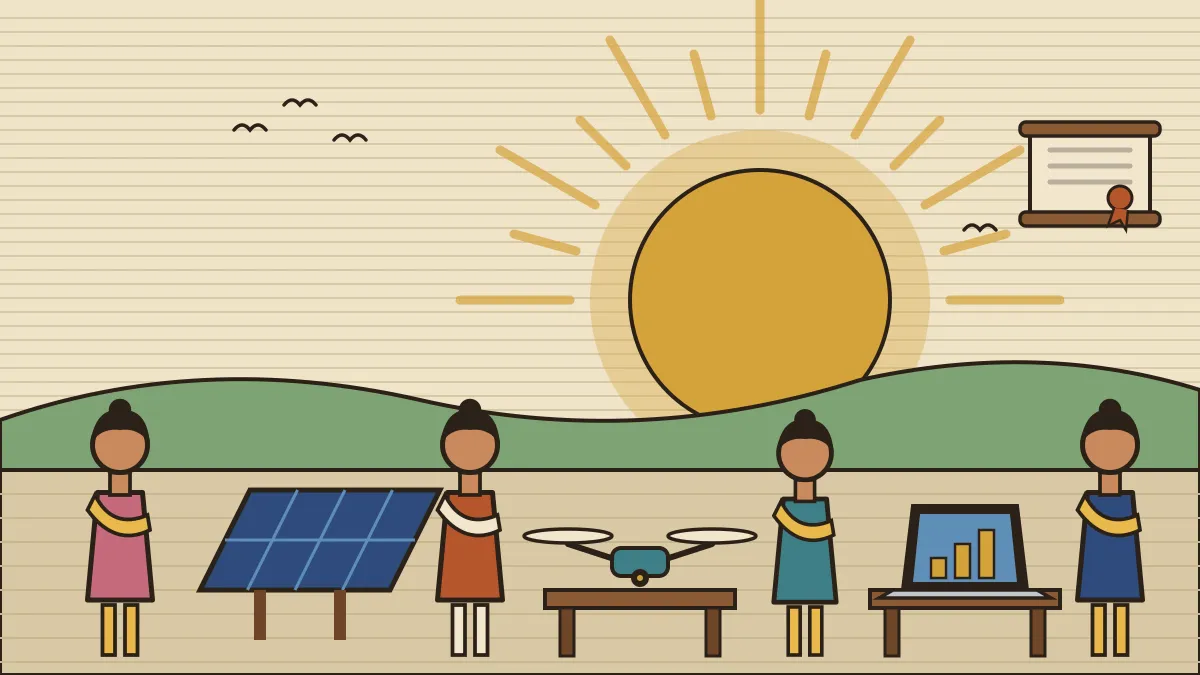
A scheme that began as a pilot in 27 districts has now been extended to 100. On 28 November 2026, Smt. Annpurna Devi, Union Minister for Women and Child Development, and Shri Jayant Chaudhary, Minister of State (Independent Charge) for Skill Development and Entrepreneurship, jointly launched NAVYA 2.0 from the Uttarakhand Sanskrit Sansthanam in Haridwar.
NAVYA stands for Nurturing Aspirations through Vocational Training for Young Women and Adolescent Girls. It is a joint initiative of two ministries: Women and Child Development (MWCD), which finds and mobilises the girls, and Skill Development and Entrepreneurship (MSDE), which trains and certifies them.
The second phase will run in 100 districts across 24 States and Union Territories, with a focus on aspirational and hard-to-reach areas. It raises the eligible age from 16–18 to 16–25 years, offers training in industry-relevant, emerging and non-traditional job roles, and aims at three exits: a job, an apprenticeship or an enterprise of one's own.
Pilot and phase two compared
| Feature | NAVYA pilot | NAVYA 2.0 |
|---|---|---|
| Launched | 24 June 2025, Sonbhadra (Uttar Pradesh) | 28 November 2026, Haridwar (Uttarakhand) |
| Districts | 27 aspirational and North-Eastern districts in 19 States | 100 districts in 24 States/UTs |
| Age group | 16–18 years (minimum Class X) | 16–25 years |
| How it is run | Resources of existing MSDE schemes such as PMKVY and PM Vishwakarma | PMKVY 4.0, with a common Standard Operating Procedure (SOP) for every district |
| Tracking | Training centres in each pilot district | Skill India Digital Hub (SIDH), from enrolment to certification |
| Mobilisation | Girls identified by MWCD | MWCD network with State Nodal Officers leading implementation |
| Stated aim | Skills and confidence for adolescent girls | Employment, apprenticeship and entrepreneurship pathways |
The pilot had a target of 3,850 girls. Government figures show how it progressed: by 10 December 2025, 1,295 girls were enrolled in 13 pilot districts and 671 were trained or oriented; in August 2026 the government reported 1,060 girls trained from 15 States and UTs; and the announcement before the launch put the number trained at about 1,200. Those numbers are small beside a 100-district programme, which is why the expansion leans so heavily on process: a single SOP and a digital tracker.
From decision to launch
The steps were short and public.
- 27 May 2026: the government decided to expand NAVYA to 100 aspirational districts.
- 6 October 2026: MSDE and MWCD held an orientation at Kaushal Bhawan, New Delhi, chaired by the two Secretaries, Debashree Mukherjee (MSDE) and Anil Malik (MWCD). The SOP for NAVYA 2.0 was released there. The audience was the district machinery: District Collectors, Regional Directors of Skill Development and Entrepreneurship, ITI principals and Child Development Project Officers (CDPOs).
- 28 November 2026: the formal launch at Haridwar.
The roster of attendees is itself a lesson in convergence. A CDPO is a Women and Child Development officer who supervises anganwadis; an ITI principal belongs to the skilling system. NAVYA works only if they act together at district level.
What girls are trained for
The idea behind "non-traditional" job roles is to move young women into occupations in which they are rarely found. The pilot trained girls as Drone Manufacturing and Assembly Technicians, Solar PV Installation Helpers and Fashion Designers, and courses included digital marketing, cyber security, AI-enabled services, graphic design and CCTV installation. Girls from the pilot also took short life-skills modules on hygiene, communication, conflict management, workplace safety under the laws on sexual harassment and child protection (POSH and POCSO), and financial literacy.
In NAVYA 2.0 the same idea becomes a mandatory Holistic Development Module covering digital literacy, financial literacy, career readiness and entrepreneurship orientation, alongside an industry-linked course with on-the-job training.
At Haridwar, Annpurna Devi said that mobilisation means more than filling batches: it is continuous engagement with each girl and her family, from enrolment to livelihood, with State Nodal Officers leading and the SIDH portal showing each girl's progress. Chaudhary stressed that a skilling programme should be judged by the opportunities it opens afterwards, and encouraged careers young women might not have considered.
The machinery underneath: PMKVY 4.0 and the Skill India Digital Hub
NAVYA is not a new funding stream. It borrows the machinery of the Pradhan Mantri Kaushal Vikas Yojana (PMKVY).
- The Skill India Mission was launched on 15 July 2015, World Youth Skills Day, and PMKVY began the same day, offering free short-term training with certification.
- Versions 1.0 to 3.0 ran from 2015-16 to 2021-22. PMKVY 4.0 has run since 2022-23, with courses designed by industry bodies, on-the-job training built in, and District Skill Development Plans drawn up by District Skill Committees to match courses with local jobs.
- An independent evaluation of PMKVY 4.0 by the Arun Jaitley National Institute of Financial Management found that the combined share of short-term trainees who were employed or self-employed rose from 26.6% before training to 45.4% afterwards, a gain of 18.8 percentage points.
The Skill India Digital Hub (SIDH) was launched on 13 September 2023 as digital public infrastructure for skilling. It brings training, assessment and certification onto one platform and issues digitally verifiable, portable credentials. As of early 2026 it had onboarded more than 7,000 training providers, over 70 assessment agencies, more than 68,000 employers and over 1.5 crore candidates, and it is linked with DigiLocker, e-Shram, the National Career Service, UIDAI and the Public Financial Management System. For NAVYA, SIDH is the register and the report card: it tracks registration, attendance, training progress and certification, and certificates that can be verified online are meant to help a trained girl show a recruiter what she can do.
Skill programmes from other ministries follow the same pattern; our article on DDU-GKY 2.0 and rural skill training shows how a rural-livelihood scheme handles batches and placement.
Why young women, and why now
The reason is visible in the labour data. The Periodic Labour Force Survey (PLFS) is the Government's main source of employment figures, and its monthly bulletin for September 2026, released in October, reported these figures for persons aged 15 years and above:
| Indicator | All persons | Female |
|---|---|---|
| Labour force participation rate (LFPR) | 55.5% | 34.6% |
| Worker population ratio (WPR) | 52.7% | 32.8% |
| Unemployment rate (UR) | 5.0% | 5.2% |
Within the female figures, the rural LFPR was 38.9% and the urban LFPR 25.9%; the male WPR was 73.6% and the male unemployment rate 4.9%. The three terms are easy to mix up:
- LFPR: the share of the population that is working or looking for work.
- WPR: the share of the population that is actually employed.
- UR: the share of the labour force that is jobless and looking.
By these numbers, for every 100 men aged 15 and above about 74 are working, against about 33 women, a gap of roughly 41 percentage points. Most women of working age are outside the labour force altogether, not jobless inside it (the female unemployment rate is only 5.2%), which is why programmes like NAVYA focus on entering work rather than only on finding work. Our note on measuring unemployment through the PLFS sets out the definitions, and our article on women-led development puts this in policy context.
NAVYA 2.0 targets aspirational districts, the group of backward districts first named in the Aspirational Districts Programme launched in January 2018. The ministries link the scheme to the goal of Viksit Bharat 2047, in which women are described as leaders of development, not only beneficiaries.
Two programmes inaugurated on the same stage
The Haridwar event was also used to open 477 Saksham Anganwadi Centres and five new Anganwadi Centres built under PM-JANMAN in Uttarakhand, and to felicitate 10 candidates trained under PMKVY 4.0. Both openings are worth knowing.
Saksham Anganwadi and Poshan 2.0. The Government is strengthening two lakh anganwadi centres, housed in government buildings, as Saksham Anganwadis at 40,000 a year during the 15th Finance Commission cycle. A Saksham centre has better infrastructure than a conventional one: LED screens, a water filter, a Poshan Vatika (nutrition garden), early-childhood education material and decorated learning walls. By March 2026, 1,03,940 centres had been upgraded.
PM-JANMAN (Pradhan Mantri Janjati Adivasi Nyaya Maha Abhiyan). Approved by the Cabinet on 29 November 2023 with an outlay of ₹24,104 crore, it targets 75 Particularly Vulnerable Tribal Groups (PVTGs) in 18 States and the Andaman and Nicobar Islands through 11 interventions by 9 ministries: houses, roads, drinking water, mobile medical units, hostels, power, mobile towers, and 2,500 anganwadi centres, among others. Our article on PM-JANMAN and PVTGs goes through the list.
What to watch
- Batch starts and certificates in the new districts. The test of the SOP is how many of the 100 districts begin training, and how quickly.
- The exit routes. An apprenticeship is arranged through bodies such as the National Apprenticeship Promotion Scheme, and entrepreneurship through institutes such as NIESBD; the numbers who actually reach them matter more than enrolment.
- The age band. Moving from three age-years to ten changes who is in the classroom: it now includes women who may already have left education, with different needs from a Class X student.
🔑 Revision block
The launch. NAVYA 2.0, 28 November 2026, Haridwar (Uttarakhand Sanskrit Sansthanam); Union Minister Annpurna Devi (WCD) and MoS (I/C) Jayant Chaudhary (Skill Development).
Full form. Nurturing Aspirations through Vocational Training for Young Women and Adolescent Girls; joint initiative of MWCD and MSDE.
Scale and eligibility. 100 districts, 24 States/UTs, aspirational and hard-to-reach areas; age 16–25 (pilot: 27 districts, 19 States, 16–18 years; pilot launched 24 June 2025, Sonbhadra).
Design. Training under PMKVY 4.0; common SOP (released 6 October 2026); tracking on the Skill India Digital Hub (launched 13 September 2023); mandatory Holistic Development Module; exits: job, apprenticeship, enterprise.
Umbrella facts. Skill India Mission and PMKVY: 15 July 2015; PMKVY 4.0 since 2022-23; PMKVY 4.0 evaluation: employed share 26.6% → 45.4%.
Same event. 477 Saksham Anganwadi Centres and 5 PM-JANMAN anganwadis opened; PM-JANMAN: ₹24,104 crore, 75 PVTGs, Cabinet 29 November 2023.
Women's workforce (PLFS, Sept 2026). Female LFPR 34.6%; female WPR 32.8% vs male 73.6%.
🎯 Practice MCQs
Q1. NAVYA 2.0 was formally launched on 28 November 2026 from:
(a) Jaipur
(b) Guwahati
(c) Bhopal
(d) Haridwar
→ (d)
The launch took place at the Uttarakhand Sanskrit Sansthanam in Haridwar, Uttarakhand.
Q2. The age group eligible under NAVYA 2.0 is:
(a) 14–18 years
(b) 16–25 years
(c) 18–30 years
(d) 18–35 years
→ (b)
Eligibility was widened from 16–18 years in the pilot to 16–25 years.
Q3. NAVYA 2.0 is planned to cover:
(a) 50 districts in 15 States/UTs
(b) 75 districts in 20 States/UTs
(c) 100 districts in 24 States/UTs
(d) 200 districts in 28 States/UTs
→ (c)
The pilot covered 27 districts in 19 States; the second phase covers 100 districts in 24 States and UTs.
Q4. NAVYA is a joint initiative of which two Union Ministries?
(a) Women and Child Development; Skill Development and Entrepreneurship
(b) Education; Labour and Employment
(c) Rural Development; Social Justice and Empowerment
(d) Minority Affairs; Micro, Small and Medium Enterprises
→ (a)
MWCD mobilises the girls through its network, and MSDE trains and certifies them under PMKVY 4.0.
Q5. Which platform is used to track NAVYA trainees from enrolment to certification?
(a) DIKSHA
(b) SWAYAM
(c) e-Shram
(d) Skill India Digital Hub
→ (d)
SIDH tracks registration, attendance, training progress and certification. e-Shram is a database of unorganised workers, with which SIDH is integrated.
Q6. PM-JANMAN, whose anganwadi centres were inaugurated alongside the NAVYA 2.0 launch, is aimed at:
(a) Particularly Vulnerable Tribal Groups
(b) Urban slum dwellers
(c) Coastal fishing communities
(d) Street vendors
→ (a)
PM-JANMAN covers 75 PVTG communities in 18 States and the Andaman and Nicobar Islands, with an outlay of ₹24,104 crore.
Q7. Consider the following statements about NAVYA:
1. The pilot phase covered girls aged 16–25 years.
2. NAVYA 2.0 widens eligibility to 16–25 years.
Which of the statements given above is/are correct?
(a) 1 only
(b) 2 only
(c) Both 1 and 2
(d) Neither 1 nor 2
→ (b)
The pilot was for 16–18 years. The widening to 16–25 years is the change made in NAVYA 2.0.
Q8. According to the PLFS monthly bulletin for September 2026, the female labour force participation rate (15 years and above) was about:
(a) 24.6%
(b) 29.6%
(c) 34.6%
(d) 44.6%
→ (c)
The female LFPR was 34.6%, against 55.5% for all persons. The female worker population ratio was 32.8%.
📋 How this gets asked (PYQ pattern)
Scheme questions are a reliable part of the General Knowledge paper, and they follow a few predictable patterns.
The first is who runs it: which ministry, whether two ministries share it, and which umbrella scheme it sits under. NAVYA is a good test because it sits across MWCD and MSDE and under PMKVY 4.0. The second is who it is for: age group, gender and target area. Examiners change one number in the options, as in Q2 and Q3 above. The third is the digital tool: which platform tracks or certifies the beneficiary, with a plausible look-alike such as DIKSHA or e-Shram as bait.
Behind these sits the data question on LFPR, WPR and unemployment rate, which can be asked as definitions or as a comparison of two groups. The fresh hooks this cycle are 100 districts and 24 States/UTs, 16–25 years, the Skill India Digital Hub and the PLFS gap between women's and men's work.
Preparing for CDS? Make a one-page table of every scheme in the news: ministry, launch date, target group and the digital tool. Use our CDS/OTA study material, follow the daily CDS current affairs, and learn with experienced faculty in the upcoming Cavalier courses in Delhi.
Source: PIB / Ministry of Skill Development and Entrepreneurship and Ministry of Women and Child Development, "Union Ministers Smt. Annpurna Devi and Shri Jayant Chaudhary launch NAVYA 2.0 in Haridwar", 28 November 2026; PIB, "MWCD and MSDE to jointly launch NAVYA 2.0 in Haridwar on 28 November 2026", 27 November 2026. Background from PIB releases on NAVYA (24 June 2025, 28 September 2025, 17 December 2025, 10 August 2026, 6 October 2026), Skill India Digital Hub (2 February 2026), PMKVY outcomes (18 March 2026), PM-JANMAN (29 November 2023), Saksham Anganwadi (6 February and 1 April 2026) and the PLFS monthly bulletin for September 2026 (15 October 2026).
✍️ Written by Aditya Tiwari — Economy & current-affairs faculty at The Cavalier. Reviewed by the Cavalier Faculty Desk.