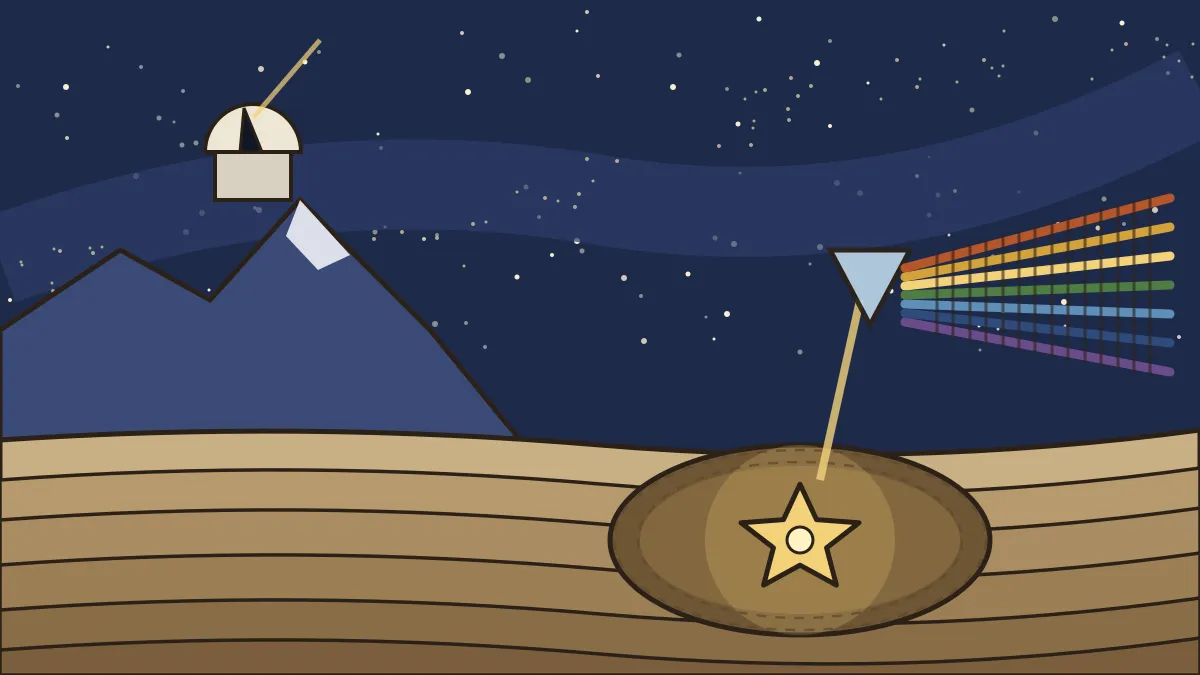
On 23 November 2026 the Ministry of Science and Technology announced that astronomers had found "a rare ancient star", HE 1153-0518, whose chemical make-up carries the signature of some of the earliest generations of stars in the Universe. The team came from the Indian Institute of Astrophysics (IIA), Bengaluru, an autonomous institute of the Department of Science and Technology (DST), and Dakshin Kamrup College, Assam. The work is published in the journal Monthly Notices of the Royal Astronomical Society (MNRAS).
The star has an unusual composition. It holds only about one-thousandth of the Sun's iron, yet it is rich in carbon and sodium and severely short of the heavy elements made by neutron capture. That combination makes it what astronomers call a carbon-enhanced metal-poor (CEMP-no) star, and the release describes such stars as "stellar fossils".
The news is a good excuse to learn a set of ideas that science papers like to test: how elements are made, what "metal" means to an astronomer, why old stars are like fossils, and which Indian institutions do this kind of work.
What was announced
According to the PIB release, the team used high-resolution spectroscopic data collected with the Subaru telescope in Hawaii, together with recent astrometric and photometric data, to measure the star's atmospheric properties and chemical abundances with high precision. The key findings are:
- HE 1153-0518 is a CEMP-no star. The release calls it "a previously unknown sub-class of CEMP stars", though CEMP-no stars as a group have been studied for years; what is new is this individual star.
- Its iron is about 1/1000 of the Sun's, but it is remarkably rich in carbon and sodium.
- It is severely deficient in heavy elements produced by neutron-capture nucleosynthesis.
- Its carbon isotopic ratio (12C/13C) is low, which the team reads as a sign of significant internal mixing of its gas.
- Its light in the optical and infrared shows excess infrared emission, suggesting circumstellar dust.
The work was led by Partha Pratim Goswami of Dakshin Kamrup College, with Aruna Goswami of the IIA as a co-author. The authors also compared the measured abundances with the predictions of theoretical nucleosynthesis models to understand how the star's pattern arose.
Metals, in the astronomer's sense
Chemistry students learn that a metal is an element that conducts electricity and forms positive ions. Astronomers use a blunter definition. In astronomy, every element heavier than helium is a "metal", including carbon, oxygen and nitrogen. The reason is history.
In the first few minutes after the Big Bang, the young Universe produced almost only hydrogen and helium, with a trace of lithium. Our own NCERT geography text dates the Big Bang to about 13.7 billion years ago and says the first atoms formed within the first three minutes. Nothing heavier than that could form then, because the Universe cooled too fast.
Every heavier atom, such as the carbon in our bodies, the oxygen we breathe and the iron in our blood, was made later inside stars or in stellar explosions. That is why an astronomer's "metallicity" of a star is a measure of how much of its material has been recycled through earlier generations of stars. More metals means a later generation.
Reading metallicity: what "one-thousandth of the Sun's iron" means
Astronomers measure metallicity with the iron-to-hydrogen ratio, written [Fe/H], on a logarithmic scale compared with the Sun.
- [Fe/H] = 0 means the same iron fraction as the Sun.
- [Fe/H] = −1 means one-tenth of the Sun's.
- [Fe/H] = −3 means one-thousandth of the Sun's.
HE 1153-0518, with about a thousandth of the solar iron, therefore sits near the [Fe/H] ≈ −3 mark, which astronomers call extremely metal-poor. Stars like this are rare in the Galaxy and are found mostly in its old, extended halo.
Iron works as the yardstick because it shows up well in a star's spectrum, and because it comes out of many kinds of explosions. Our notes on the periodic table show where carbon, sodium and iron sit, and the page on stellar life cycles explains the burning stages that make them.
Why an old star is called a "fossil"
The PIB release spells out the logic.
- The first generations of stars formed only a few hundred million years after the Big Bang. They were massive and short-lived. None survives today.
- Before dying in supernova explosions, they made new elements and spread them into the surrounding gas.
- The next stars formed from that enriched gas. If such a star is small, it lives for a very long time, so some of these stars are still shining now. A star lighter than roughly 0.8 times the Sun's mass lives longer than the current age of the Universe.
- Because a star's surface keeps the chemical mix of the gas it was born from, its composition is a preserved record, like a fossil in rock.
By reading this record, astronomers can reconstruct the kinds of stars that came first, how they exploded, and what they produced. The release quotes the IIA's Aruna Goswami that such stars let scientists study nucleosynthesis that happened more than 13 billion years ago, and says the discovery brings us closer to understanding how the first stars enriched the Universe with the elements that later became the building blocks of stars, planets and life.
CEMP stars and the meaning of "no"
CEMP stands for carbon-enhanced metal-poor. The accepted dividing line, shown on the Yoon-Beers diagram in the PIB release, is a carbon-to-iron ratio of [C/Fe] = +0.7 in a star that is already very poor in iron. Astronomers split CEMP stars by what they show about heavy elements:
| Class | What the spectrum shows | Common reading |
|---|---|---|
| CEMP-s | Carbon plus heavy elements from the slow neutron-capture process | A companion star in a binary passed material to it |
| CEMP-r | Carbon plus heavy elements from the rapid neutron-capture process | Pollution by a rare, violent r-process event |
| CEMP-no | Carbon-rich, but no excess of neutron-capture elements | Often linked to the very first stars |
The "no" in CEMP-no means no neutron-capture enhancement. The release says these stars "form a rare class of stellar fossils that provides a direct window into the earliest phases of Galactic evolution". The release says the team compared the measured abundances with theoretical models of nucleosynthesis, which shows how science works: the finding is a strong observation, and the explanation is a set of models to be tested.
Reading the isotope clue
Carbon has two stable isotopes, carbon-12 and carbon-13. In the Sun the ratio of the two is about 90 to 1. A star whose gas has been mixed through hotter regions where hydrogen is burned through the carbon-nitrogen cycle shows far less carbon-12 relative to carbon-13. The release reports a low ratio for HE 1153-0518, which it reads as evidence of significant internal mixing. Our page on isotopes explains why two atoms of the same element can have different masses.
The dust clue
The release also mentions excess infrared emission. Warm dust around a star absorbs its light and re-emits it as infrared radiation. Finding such an excess in a star this metal-poor is interesting because dust is itself built from heavier elements; the release says only that it is "possible" circumstellar dust and that it adds to what the star's history can tell us.
How astronomers read a star's chemistry
A star is too far for any probe to visit. Astronomers instead split its light into a spectrum, a rainbow crossed by thin dark lines. Each element absorbs light at its own fixed wavelengths, so the position of a line says which element is present and the depth of the line says how much. This is spectroscopy.
High-resolution spectroscopy stretches the spectrum out so that individual lines can be measured accurately. The IIA team used data from the Subaru telescope, an 8.2-metre optical and infrared telescope on Mauna Kea, Hawaii, run by Japan's National Astronomical Observatory. They combined this with astrometric data (position and motion) and photometric data (brightness in different colours) to fix the star's temperature and surface gravity before working out the abundances. The point is that the weak lines of a metal-poor star can only be read if the star's basic properties are known first.
India's place in this work
The Indian Institute of Astrophysics traces its origin to the Madras Observatory, set up in 1786, which makes it one of the oldest centres of astronomy in the country. It runs a network of facilities that the Minister for Science and Technology listed in April 2026:
- Kodaikanal Solar Observatory (established 1899), a pioneer of solar astrophysics in India.
- Kavalur, for night-time optical astronomy.
- Gauribidanur, for radio astronomy.
- Hanle, Ladakh, a high-altitude observatory, home of the Himalayan Chandra Telescope, which the IIA also uses with its Hanle Echelle Spectrograph for studies of stellar chemistry.
The IIA also builds instruments for space missions. It supplied the Ultraviolet Imaging Telescope on AstroSat, and it contributed the Visible Emission Line Coronagraph to Aditya-L1.
The Union Budget 2026-27 announced four telescope facilities, to be implemented by the IIA:
- the National Large Solar Telescope (NLST), at Merak, Ladakh;
- the National Large Optical-Infrared Telescope (NLOT) at Hanle;
- an upgraded Himalayan Chandra Telescope (uHCT) at Hanle;
- COSMOS-2, the second LED-dome planetarium in India, at Amaravati.
On 28 April 2026 the Minister laid the foundation of a seven-storey, ₹75 crore additional building at the IIA's campus in Bengaluru. For a discovery like HE 1153-0518, the lesson is that Indian observers still lean on foreign telescopes such as Subaru for the highest-resolution work, which is precisely the gap that large new Indian optical and infrared telescopes are meant to narrow.
Why this matters for you
For the exam, this story is a vehicle for concepts, not for the star's name. The examiner will not ask about HE 1153-0518 directly. The examiner is far more likely to ask any of the following:
- what astronomers call a "metal", and how the first elements were made after the Big Bang;
- the difference between nuclear fusion in stars and the formation of heavy elements in supernovae;
- what an isotope is, with carbon-12 and carbon-13 as the usual example;
- spectroscopy as the method of finding what stars are made of;
- Indian institutions (IIA, Kodaikanal, Hanle) and missions (AstroSat, Aditya-L1).
🔑 Revision block
The news. 23 November 2026: DST/PIB announces HE 1153-0518, a CEMP-no "stellar fossil", found by the Indian Institute of Astrophysics (IIA), Bengaluru and Dakshin Kamrup College, Assam; published in MNRAS; lead author Partha Pratim Goswami, co-author Aruna Goswami.
The star. Iron about 1/1000 of the Sun's ([Fe/H] ≈ −3); rich in carbon and sodium; low in neutron-capture elements; low 12C/13C; infrared excess, so possibly circumstellar dust. Data from the Subaru telescope, Hawaii.
The ideas. Astronomers' "metals" = all elements heavier than helium. Big Bang made H, He and a little Li; heavier elements came from stars and supernovae. CEMP = [C/Fe] > +0.7 in a very iron-poor star. CEMP-s (binary mass transfer) vs CEMP-r vs CEMP-no (no neutron-capture excess; linked to the first stars).
Indian facilities. IIA (DST autonomous institute; roots in the Madras Observatory); Kodaikanal (1899), Kavalur, Gauribidanur, Hanle; AstroSat UVIT, Aditya-L1 VELC.
Budget 2026-27 telescopes. NLST (Merak), NLOT and uHCT (Hanle), COSMOS-2 (Amaravati).
🎯 Practice MCQs
Q1. In astronomy, the word "metal" is used for any element that is:
(a) An isotope of hydrogen
(b) A volatile gas
(c) Heavier than helium
(d) A good conductor of electricity
→ (c)
Astronomers call all elements heavier than helium "metals", including carbon and oxygen. Only hydrogen, helium and a trace of lithium came out of the Big Bang.
Q2. HE 1153-0518, announced on 23 November 2026, was identified as:
(a) A CEMP-no star
(b) A CEMP-s star
(c) A pulsar
(d) A red supergiant
→ (a)
The study identifies it as a CEMP-no star: carbon-enhanced and extremely metal-poor, with no excess of neutron-capture elements.
Q3. The iron content of HE 1153-0518 is about what fraction of the Sun's?
(a) One-hundredth
(b) One-thousandth
(c) One-millionth
(d) The same as the Sun's
→ (b)
PIB states that it holds about one-thousandth of the Sun's iron, which corresponds to [Fe/H] of about −3.
Q4. Which autonomous institute of the Department of Science and Technology took part in the discovery of the stellar fossil HE 1153-0518?
(a) ISRO
(b) TIFR
(c) IUCAA
(d) The Indian Institute of Astrophysics
→ (d)
The IIA, Bengaluru, worked with Dakshin Kamrup College, Assam; the lead author, Partha Pratim Goswami, is from the college and Aruna Goswami of the IIA is a co-author.
Q5. Consider the following statements:
1. Ancient metal-poor stars are young stars that formed in the last billion years.
2. CEMP-no stars show enhanced carbon but are deficient in heavy elements made by neutron capture.
Which of the statements given above is/are correct?
(a) 1 only
(b) 2 only
(c) Both 1 and 2
(d) Neither 1 nor 2
→ (b)
Metal-poor stars are among the oldest surviving stars, formed from gas enriched by the first stellar explosions. Statement 2 is the definition of a CEMP-no star.
Q6. Consider the following statements:
1. Most of the iron seen in the Universe today was produced in the first three minutes after the Big Bang.
2. The 12C/13C ratio measured in HE 1153-0518 is higher than that in the Sun.
Which of the statements given above is/are correct?
(a) 1 only
(b) 2 only
(c) Both 1 and 2
(d) Neither 1 nor 2
→ (d)
Iron was made later in stars and supernovae, and the star's ratio is low, whereas the solar value is about 90.
Q7. The Himalayan Chandra Telescope of the Indian Institute of Astrophysics is located at:
(a) Hanle
(b) Kavalur
(c) Kodaikanal
(d) Gauribidanur
→ (a)
It is at Hanle in Ladakh, the IIA's high-altitude observatory. Kodaikanal is the solar observatory, Kavalur an optical site and Gauribidanur the radio site.
Q8. Where will the National Large Solar Telescope announced in the Union Budget 2026-27 be built?
(a) Amaravati
(b) Hanle
(c) Merak
(d) Kodaikanal
→ (c)
The NLST is planned at Merak in Ladakh. The NLOT and the upgraded Himalayan Chandra Telescope are at Hanle, and the COSMOS-2 planetarium at Amaravati.
📋 How this gets asked (PYQ pattern)
Astronomy questions in CDS general science are usually conceptual and short, and they follow three patterns.
The first is vocabulary and definitions: what a light-year is, what an isotope is, what makes a star a red giant or a white dwarf. The word "metal" in astronomy is a classic trap because it differs from the school-chemistry meaning, as in Q1.
The second is processes: what happens in a star's core, which elements form where, and what a supernova does. The examiner likes to test the order of events, such as hydrogen to helium, then to carbon and heavier elements, and the idea that only stars and supernovae make the heavier elements.
The third is Indian institutions and missions: AstroSat, Aditya-L1, Chandrayaan, and the observatories at Kodaikanal and Hanle. A new discovery by an Indian institute, like this one, makes that group more likely to appear.
Preparing for CDS? Revise the burning stages and end-points on our page on the life cycle of stars, then make a two-line note on each Indian observatory and mission. Follow the daily CDS current affairs, and learn with experienced faculty in the upcoming Cavalier courses in Delhi.
Source: PIB / Ministry of Science and Technology, "Scientists discover a rare stellar fossil that preserves clues to the universe's first generations of stars" (23 November 2026). The study is published in Monthly Notices of the Royal Astronomical Society (link in the PIB release). IIA and telescope background from PIB releases of 24 January 2025, 10 March 2026 and 28 April 2026; Big Bang timeline from the NCERT Class 11 geography text. The carbon isotope ratio of the Sun, the 0.8 solar-mass lifetime limit and the Subaru telescope's size and site are standard astronomy reference facts, not from PIB.
✍️ Written by Col D.N. Sharma — Science & general-studies faculty at The Cavalier. Reviewed by the Cavalier Faculty Desk.