On 24 November 2026 the Prime Minister paid tribute to Lachit Borphukan on Lachit Diwas. In a post on X, released by the Prime Minister's Office, he said that Lachit's "courage and determination helped protect Assam" and that his leadership and devotion to the people "continue to inspire generations". The post carried the same message in Assamese.
Lachit Diwas falls on the day Lachit was born, 24 November 1622, so this year marks his 404th birth anniversary. The PIB release is short, but the man behind it is one of the most examined figures in the medieval history that CDS candidates study. He commanded the army of the Ahom kingdom of Assam at the Battle of Saraighat (1671), where a smaller force with smaller boats defeated a Mughal army sent by Aurangzeb under Raja Ram Singh of Amber.
This article tells that story in order, from the Ahom state he served, through the long Mughal-Ahom wars, to the river fight at Saraighat and the way the country remembers him today.
Who the Ahoms were, and what a "Borphukan" was
The Ahoms belonged to the Mao-Shan sub-tribe of the Tais of south-east Asia. They migrated from upper Burma and Yunnan to upper Assam in 1228, and settled in 1253 in the Dikhou valley with Charaideo as their capital. Sukapha (1228-68) was the first Ahom king. By the sixteenth century the Ahoms had become the strongest power in the Brahmaputra valley, and they held it until 1826.
Their government rested on a small council and a very unusual military system:
- The council of five (patra-mantri). Sukapha's original counsellors were the Buragohain and the Bargohain. Siu-hum-mong (1497-1539) added the Barpatragohain. Pratapa Singha (1603-41) added the Barbarua and the Barphukan. The first three were hereditary and permanent; the offices of Phukans and Baruas were neither hereditary nor permanent.
- The paik system. Adult men between 16 and 50 were enrolled as paiks. Each owed the state labour or military service. Paiks were grouped into a got of four men, and one man from each got served the state at a time, while the others farmed. Units called khels were headed by a phukan or a barua.
Two of these terms are exam traps. A Borphukan (Barphukan) is an office, not a personal name. The Barphukan was the king's officer for the western frontier, posted at Guwahati, which is exactly where the Mughals pressed hardest. The Borbarua was the other great executive officer. When the PIB and the history books say "Lachit Borphukan", they mean "Lachit, holder of the Borphukan's office".
| Term | What it means |
|---|---|
| Swargadeo | The Ahom king |
| Buragohain, Bargohain, Barpatragohain | The three hereditary great Gohains (advisers) |
| Borbarua, Borphukan | The two executive officers added by Pratapa Singha |
| Paik | An adult male owing labour or military service |
| Got / Khel | A unit of four paiks / a larger working unit under a phukan or barua |
The paik system matters for Lachit's story because the Ahoms had no standing army in the modern sense. They could raise a very large force from the villages in a crisis, and every man in it knew the rivers, hills and forests. The home guide for this system is our page on the Ahom kingdom and the Battle of Saraighat.
The Mughals reach Assam (1612-1667)
The Mughals came into contact with the Ahoms because of the Koch kingdom. When Koch power split in the early seventeenth century, the Mughals entered Assam at the invitation of a Koch ruler. In 1612 they occupied western Assam up to the Bar Nadi, and the Koch ruler became a Mughal vassal. After a long war, a treaty of 1638 fixed the Bar Nadi as the boundary between the Mughals and the Ahoms. Guwahati (Gauhati) therefore lay on the Mughal side.
The big change came in the reign of Aurangzeb, whose empire is covered in our notes on Mughal administration. Mir Jumla, whom Aurangzeb had made governor of Bengal, wanted to bring Cooch Bihar and the whole of Assam under Mughal rule. He first annexed Cooch Bihar and then invaded the Ahom kingdom. He occupied the Ahom capital Garhgaon (1662-63). He then forced the Ahom king into a humiliating treaty in 1663:
- the king had to send his daughter to the Mughal harem;
- the Ahoms paid a large war indemnity and an annual tribute of 20 elephants;
- the Mughal boundary moved from the Bar Nadi to the Bharali river.
Mir Jumla died soon after. The Mughals found that Assam was poor in revenue, surrounded by warlike hill tribes, and that the back of Ahom power had not been broken. The Ahoms had avoided pitched battles and used guerrilla tactics instead, a method that, as the standard history notes, other opponents of the Mughals later copied with similar success.
In 1667 the Ahoms renewed the contest. They recovered the territory they had ceded and occupied Guwahati again. Lachit Borphukan held the western command in these years. This is the setting in which Lachit's career belongs. The recovery of Guwahati was exactly what made Aurangzeb send a major army.
Ram Singh's campaign and the fight at Alaboi
Aurangzeb chose Raja Ram Singh of Amber, the Kachhwaha ruler, who had fought campaigns across the empire (the Home Minister's 2022 speech notes that he had won battles "from Bengal to Kandahar"). He was appointed at the end of 1667 and reached the Guwahati area by about 1669.
Before the main river battle came an earlier clash at Alaboi, fought in 1669 near present-day Dadara, close to Guwahati. It was a costly encounter: by the usual account the Ahoms lost very heavily, and it is remembered as the fight that checked the Mughal advance. Alaboi is the less famous battle, and examiners sometimes confuse the two. The memory aid is simple: Alaboi (1669) was the costly fight that stopped the advance; Saraighat (1671) was the decisive river battle.
Saraighat, 1671: the battle on the river
Saraighat lies on the Brahmaputra near present-day Guwahati. The current NCERT Class 8 textbook records that the Ahoms used their knowledge of the terrain, with dense forests, hills and rivers, to repulse a larger force, and that at Saraighat "Lachit Borphukan and his 10,000 men defeated a Mughal force of 30,000 soldiers". Figures of this kind vary between accounts, so treat the exact numbers as the textbook's version. What every source agrees on is the imbalance: the Mughals had more men and a larger fleet of river boats.
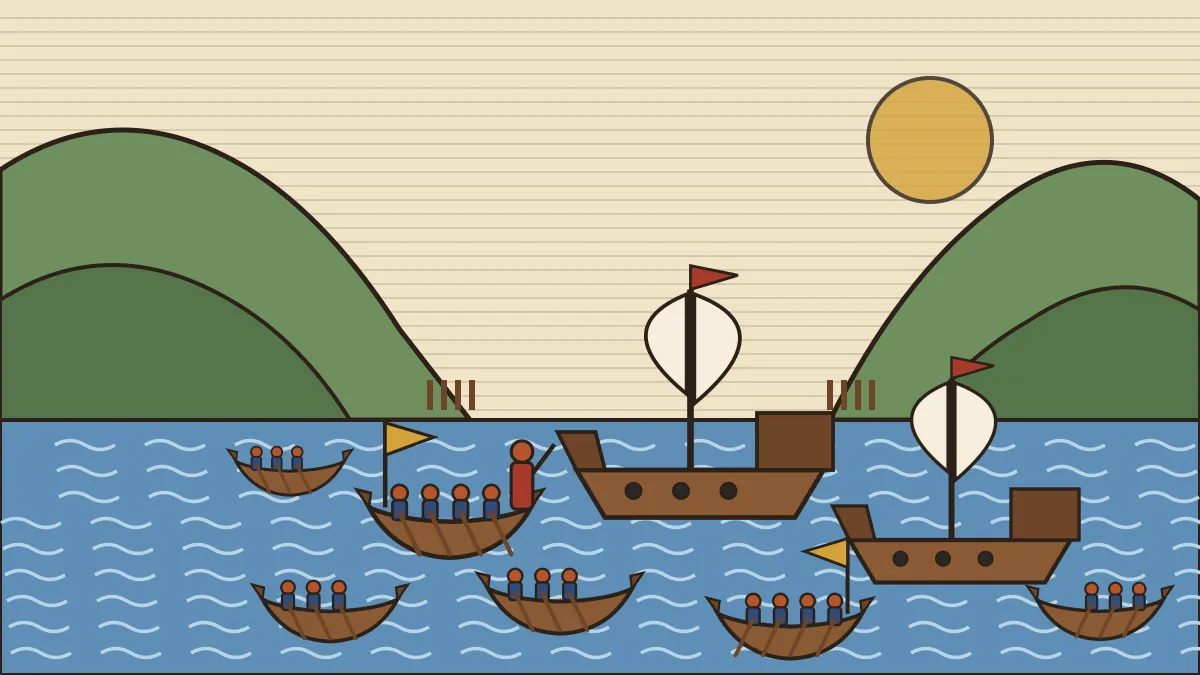
Traditional accounts describe the battle as mainly naval. The Mughals brought large boats, the Ahoms had small ones, and the Ahoms are said to have thrown a bridge of boats across the Brahmaputra and attacked from the front and the rear. The Union Home Minister, speaking at the 400th-anniversary function in New Delhi in 2022, summed up the same picture: according to historians, Lachit faced the big cannons and ships of the Mughals "on the strength of his small boats and well-armed army".
Three things made the difference:
- Ground. The Ahoms chose a place where the narrow river favoured quick, small craft over big ships.
- A trained, mixed force. According to the Home Minister's 2022 account, Ram Singh expressed surprise after his defeat that he had never seen such a multi-talented army, whose men were expert at sailing boats, shooting arrows, digging trenches and using guns and cannon.
- The commander's will. The Home Minister's speech records that Lachit was ill before the battle but was determined to win. This is the part that has entered popular memory, and it should be read as the tradition handed down in the Assamese record, not as a figure from a Mughal source.
A second story is told in the PIB texts and in Assamese tradition. When the fortification work he had entrusted to his maternal uncle (momai) was not completed in time, Lachit is said to have punished him with the words that the momai was not greater than the country. The Prime Minister quoted the line in his 2022 address as an example of putting the nation above personal ties. It is a tradition rather than a documented fact, and a careful answer says "according to tradition".
After Saraighat
Lachit died on 25 April 1672, about a year after the battle. The Mughal pressure on Assam did not end at once. The standard textbooks record that the Mughal onslaught in the region continued till 1682, when Aurangzeb's attention shifted to the Deccan. In that year the Ahoms completed the recovery of Guwahati at the battle of Itakhuli, and the Mughals never held it again.
The wars did leave a mark on the Ahom state. The long, wearing conflict with the Mughals, which ran for about two decades after Mir Jumla's invasion, strained the Ahom monarchy. It also showed the limits of Mughal power in far-flung areas, and the skill of the Ahoms in avoiding pitched battles. In the national syllabus, Saraighat is one of the very few set-piece river battles of Indian history, and one of the few in which a regional state beat the Mughal army on its own terms.
How the nation remembers him
Recent public recognition has built up in steps, and each of them is a possible current-affairs question.
- The NDA medal (from 1999). Since 1999 the Lachit Barphukan Gold Medal has been awarded to the best cadet of the National Defence Academy, as the Home Minister noted in 2022. For anyone aiming at the armed forces, this is the closest link between Lachit and your own preparation.
- The 400th birth anniversary (2022). The country celebrated 2022 as the 400th anniversary year. The year-long celebrations were inaugurated in Guwahati in February 2022 by the then President, and closed at Vigyan Bhawan, New Delhi, on 25 November 2022 with an address by the Prime Minister. In that speech the Prime Minister recalled that the Assam government had announced a museum on Lachit and a memorial for the historical heroes of Assam, and he spoke of "Nation First" as the lesson of Lachit's life.
- A new book (January 2024). The Home Minister released the book Assam's Braveheart Lachit Barphukan in Guwahati on 20 January 2024.
- The 402nd birth anniversary (November 2024). The Ministry of Ports, Shipping and Waterways organised an event in New Delhi. The Union Minister linked Saraighat to the strategic value of inland waterways, which is a useful reminder that the battle was won on a river.
- Lachit Diwas, 2025 and 2026. In both years the Prime Minister paid tribute on 24 November, in 2025 calling him "a symbol of courage, patriotism and true leadership", and in 2026 stressing his role in protecting Assam.
A caution for exam answers: the speeches quoted above include striking political claims, such as comparisons with other historical figures or statements about what Assam would have become. These are the speakers' views. An answer or an MCQ built on dated facts, such as 1612, 1638, 1663, 1667, 1669, 1671 and 1682, is safe. A claim of the form "X would not have happened without Lachit" is an opinion, not an exam fact.
Timeline to learn
| Year | Event |
|---|---|
| 1228 | Sukapha enters upper Assam; Ahom kingdom begins |
| 1253 | Ahoms settle in the Dikhou valley; Charaideo is the capital |
| 1612 | Mughals occupy western Assam up to the Bar Nadi |
| 1638 | Treaty fixes the Bar Nadi as the boundary |
| 1662-63 | Mir Jumla occupies Garhgaon; humiliating Ahom treaty |
| 1667 | Ahoms retake Guwahati; Ram Singh sent against them |
| 1669 | Battle of Alaboi |
| 1671 | Battle of Saraighat |
| 25 April 1672 | Death of Lachit Borphukan |
| 1682 | Last Mughal onslaught ends; Ahoms recover Guwahati at Itakhuli |
🔑 Revision block
The news. On 24 November 2026, Lachit Diwas, the PM paid tribute to Lachit Borphukan (PIB, PMO). It is his 404th birth anniversary (born 24 November 1622; died 25 April 1672).
The office. Borphukan = an office (western frontier, Guwahati), added with the Barbarua by Pratapa Singha (1603-41). Council of five: Buragohain, Bargohain, Barpatragohain (hereditary), Barbarua, Barphukan.
The system. Paik system (men aged 16-50, got of four, khel under a phukan or barua). Ahoms: Tai, arrived 1228; Charaideo 1253.
The wars. 1612 Bar Nadi; 1638 treaty; 1662-63 Mir Jumla at Garhgaon and the 1663 treaty (20 elephants a year; boundary to the Bharali); 1667 Guwahati retaken; 1669 Alaboi; 1671 Saraighat against Raja Ram Singh; Mughal pressure lasts to 1682 (Itakhuli).
The battle. River battle on the Brahmaputra near Guwahati; small Ahom boats, narrow channel, bridge of boats, attack from front and rear; textbook figures 10,000 against 30,000.
Remembrance. Lachit Barphukan Gold Medal at the NDA since 1999; 400th anniversary year 2022 (closing function 25 November 2022, New Delhi); book released 20 January 2024.
🎯 Practice MCQs
Q1. Lachit Diwas, observed on 24 November, marks:
(a) The victory at the Battle of Saraighat
(b) The birth anniversary of Lachit Borphukan
(c) The death anniversary of Lachit Borphukan
(d) The founding of the Ahom kingdom
→ (b)
Lachit was born on 24 November 1622. The battle was fought in 1671 and he died on 25 April 1672.
Q2. The Battle of Saraighat was fought in the year:
(a) 1612
(b) 1638
(c) 1663
(d) 1671
→ (d)
1612 saw the Mughals reach the Bar Nadi, 1638 the boundary treaty and 1663 the humiliating treaty after Mir Jumla's invasion. Saraighat followed in 1671.
Q3. The Mughal commander sent by Aurangzeb whose campaign ended in defeat at Saraighat was:
(a) Mir Jumla
(b) Shaista Khan
(c) Raja Ram Singh of Amber
(d) Mirza Raja Jai Singh
→ (c)
Mir Jumla invaded Assam earlier (1662-63) and died soon after. Ram Singh led the later campaign that ended at Saraighat.
Q4. In the Ahom state, the "Borphukan" was:
(a) An office held by the king's officer for the western frontier at Guwahati
(b) The title of the Ahom king
(c) A personal name given to Lachit at birth
(d) A unit of four paiks
→ (a)
The Barphukan was one of two executive offices added by Pratapa Singha, alongside the Barbarua. The king was the Swargadeo and a unit of four paiks was a got.
Q5. The Lachit Barphukan Gold Medal is awarded each year to the best cadet of the:
(a) Indian Military Academy, Dehradun
(b) Officers Training Academy, Chennai
(c) Air Force Academy, Dundigal
(d) National Defence Academy
→ (d)
The medal has gone to the best NDA cadet since 1999.
Q6. The Ahom treaty of 1663 after Mir Jumla's invasion extended the Mughal boundary from the Bar Nadi to which river?
(a) Manas
(b) Bharali
(c) Dikhow
(d) Subansiri
→ (b)
The 1663 treaty moved the boundary from the Bar Nadi to the Bharali river. The Ahoms also paid an indemnity and an annual tribute of 20 elephants.
Q7. Consider the following statements:
1. The Ahoms recovered Guwahati from the Mughals in 1667.
2. The Battle of Saraighat was fought mainly as a naval battle on the Brahmaputra.
Which of the statements given above is/are correct?
(a) 1 only
(b) 2 only
(c) Both 1 and 2
(d) Neither 1 nor 2
→ (c)
Both are correct. The Ahoms retook Guwahati in 1667, and Saraighat was a river battle in which small Ahom boats met a larger Mughal fleet.
Q8. The country celebrated which birth anniversary of Lachit Borphukan in 2022?
(a) 400th
(b) 402nd
(c) 404th
(d) 406th
→ (a)
1622 + 400 = 2022. By the same count, 2024 was the 402nd and 2026 is the 404th.
📋 How this gets asked (PYQ pattern)
Medieval-regional history appears in CDS papers in two usual shapes.
The first is who and when: a battle, a treaty or a ruler is given, and the candidate must match the year. The fixed points to remember are listed in the timeline above. The common mistake is mixing Alaboi (1669) with Saraighat (1671), or Mir Jumla (1662-63) with Ram Singh (1667-71).
The second is institution and terminology: Ahom offices, the paik system, or the difference between a title and a name. "Borphukan" and "Borbarua" are favourite options because they sound alike.
A third, smaller category is current affairs linked to history. A commemorative day, an anniversary year or a medal named after a historical figure is a typical hook. This cycle's hooks are Lachit Diwas on 24 November, the 404th birth anniversary, and the NDA gold medal introduced in 1999.
Preparing for CDS? Pair this with the full notes on the Ahom kingdom and Saraighat and with Mughal administration, then learn the timeline above cold. Follow the daily CDS current affairs, and learn with experienced faculty in the upcoming Cavalier courses in Delhi.
Source: PIB / Prime Minister's Office, "Prime Minister pays tribute to great Lachit Borphukan on Lachit Diwas" (24 November 2026). Background from PIB releases on the 400th birth-anniversary celebrations (24-25 November 2022), the Union Home Minister's book release in Guwahati (20 January 2024) and the 402nd birth-anniversary event (24 November 2024); NCERT Class 8 social science, "Exploring Society: India and Beyond"; Ahom and Mughal-Ahom chapters of the standard medieval-history textbooks (Satish Chandra, "Medieval India"; IGNOU Medieval India units). The tradition about Lachit's uncle is reported as tradition.
✍️ Written by Maj Sunil Chopra — Veteran, Indian Army; defence-studies & current-affairs faculty at The Cavalier. Reviewed by the Cavalier Faculty Desk.