On 24 November Assam and the Indian Army remember Lachit Diwas, the birth anniversary of Lachit Borphukan, born in 1622. This year is his 404th. The best cadet passing out of the National Defence Academy receives the Lachit Borphukan Gold Medal, introduced in 1999, and UPSC has asked about it (NDA 2023-I). It is also one of the few stories in Indian history where a regional power beat the Mughal army, and did it on water.
The Ahoms ruled the Brahmaputra valley for almost six centuries, from 1228 to 1826. Here is how their state worked, how it beat the Mughals, and how it ended.
Sukaphaa and the Founding of the Kingdom
By Narendra Singh · GS faculty, The Cavalier · 15 years teaching GS
The Ahoms were not Indians by origin in the usual sense. They were a branch of the Tai people, whose homeland lay in what is now Yunnan in China and northern Myanmar. In 1228 a Tai prince from Mong Mao, Sukaphaa, crossed the Patkai hills with his followers and entered the upper Brahmaputra valley. After years of moving through the region, he settled at Charaideo in 1253 and made it the first capital.
The Ahoms came as a small band, so they did not rely on conquest alone. They married into local groups, took over the valley's wet-rice farming, and over the centuries moved from Tai ancestor-worship to Hinduism, while Assamese replaced the Tai language. King Suhungmung (1497-1539), who took the Hindu name Swarga Narayan, is the usual marker of that shift. He also absorbed the neighbouring Chutia kingdom in 1523.
The Paik System, the Great Officers and the Buranjis
The Ahoms never kept a salaried standing army. Their answer was the paik system. Every able-bodied adult male commoner was a paik: he owed the state a share of his labour or military service, and in return he held land from the state. Paiks were grouped into sets called gots, usually of four men. At any time one member of the got was on duty while the others farmed, so the kingdom could call up a large force in a crisis without taking the whole population off the land. Paiks were also organised into khels by skill or duty: boatmen, carpenters, gunpowder-makers, elephant-catchers. The reorganisation of the system is linked to Momai Tamuli Borbarua, around 1608, in the reign of Pratap Singha.
The state was carried by a small set of great offices. They are an exam favourite because the names sound alike.
| Office | What it did |
|---|---|
| Swargadeo | The king; the title means "lord of heaven" |
| Burhagohain, Borgohain, Borpatrogohain | The three great Gohains, senior nobles who advised the king; the Borpatrogohain was added under Suhungmung |
| Borbarua | Chief of the administration and justice, and keeper of the paik records |
| Borphukan | The king's viceroy for the west, based at Guwahati; the frontier commander facing the Mughals |
Lachit's title, Borphukan, is not a name. It is an office, the western viceroy at Guwahati.
The Ahoms also did something that very few Indian dynasties did: they wrote their own history as it happened. These court chronicles are called buranjis, a Tai word that is often explained as "a store of knowledge that teaches the ignorant". They were first written in the Tai-Ahom language and later in Assamese prose. Sukaphaa is said to have ordered that events of his reign be recorded, and the habit continued for centuries. Because of the buranjis, historians can date Ahom events more exactly than those of most medieval Indian kingdoms.
The Ahoms also made gunpowder, cast matchlocks and cannon, and built a river fleet. To see what they were up against, read our page on the Mughal administration.
Mughals Against the Ahoms: 1615 to Mir Jumla
The Mughals had already taken Bengal and, through Koch Bihar and Kamrup, were next to the Ahoms by the early seventeenth century. The first clashes came in 1615-16, in the reign of Pratap Singha.
The great invasion came during Aurangzeb's early reign. Mir Jumla, the Mughal governor of Bengal, set out in late 1661 with a large army and a fleet of river boats. He took Koch Bihar and Kamrup, advanced up the Brahmaputra, and in March 1662 entered the Ahom capital Garhgaon. King Jayadhwaj Singha fled into the hills. On paper it was a total Mughal victory.
It did not last. The monsoon flooded the country, supply lines failed, disease spread through the camp, and the Ahoms harassed the columns from forest and river. Mir Jumla made peace by the Treaty of Ghilajharighat (January 1663): the Ahoms lost territory in the west and paid an indemnity, and gave hostages and a princess. Mir Jumla died on the way back to Dhaka in March 1663, and Jayadhwaj died the same year.
The new king, Chakradhwaj Singha (1663-70), refused to accept the treaty as final. He rebuilt the army and navy and chose Lachit as Borphukan. In 1667 the Ahoms took back Guwahati from the Mughals. Aurangzeb answered by sending Raja Ram Singh of Amber (Jaipur), a senior Rajput commander, with a very large force. Regional states stood up to the empire in the Deccan too; compare the Maratha empire.
Saraighat, 1671: The Battle on the River
Ram Singh reached Assam in 1669 and won a first round at Alaboi (August 1669), where the Ahoms lost heavily. He then moved to Guwahati. Lachit's problem was numbers. The Mughal army under Ram Singh was many times larger than his, and the Mughal side also had a bigger fleet of boats. The Ahoms had to choose the ground.
They chose the Brahmaputra at Saraighat, near present-day Guwahati, where the river narrows between the hill on the south bank and the Itakhuli bank on the north. Lachit built earth ramparts and forts on the banks and used the narrow channel to the full. Ahom war-boats could move quickly in it. The tall Mughal ships could not turn. Lachit was seriously ill on the day of the final battle in March 1671. According to the accounts, he had himself carried to a boat, led a small flotilla into the fight and rallied his men when they wavered. The Mughal fleet, caught in the narrows and attacked from front, rear and both banks, broke up, and the Mughal admiral, Munnawar Khan, was killed. Ram Singh withdrew from Assam. He is on record as saying that he had seen no soldiers like the Assamese anywhere in India, men who could row boats, shoot arrows, dig trenches and fire guns and cannon.
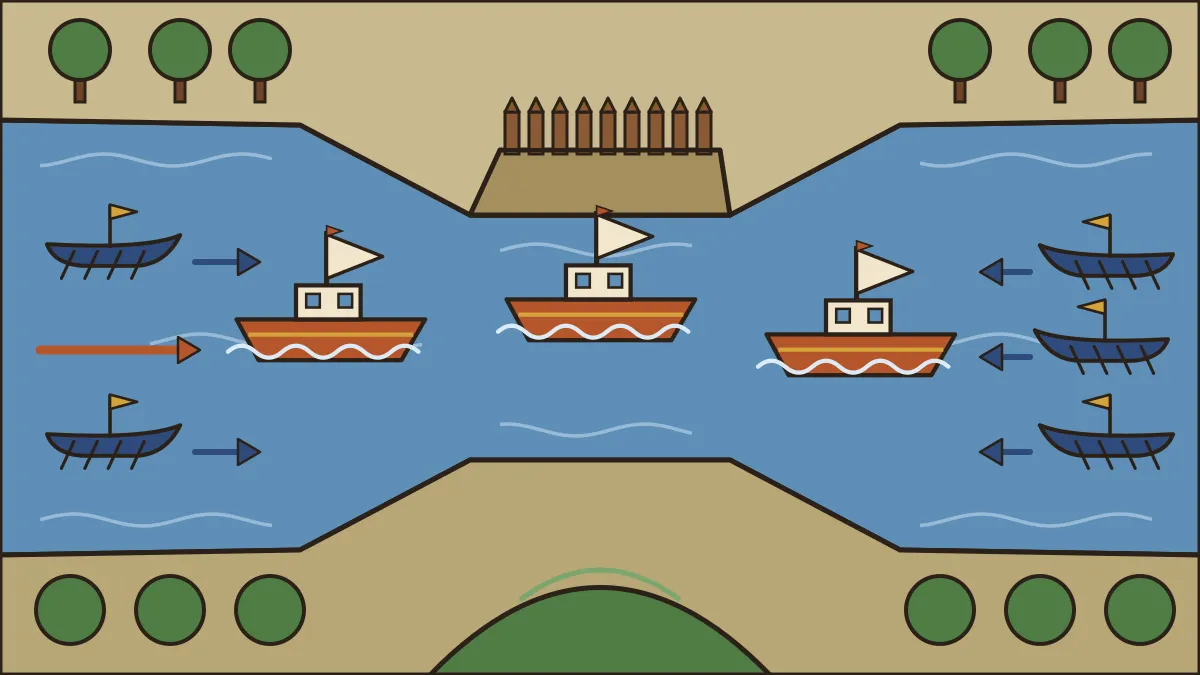
Tradition adds that when Lachit found his maternal uncle slack in building a rampart, he had him executed, saying his uncle was not greater than his country. It is tradition, but it explains why Lachit is a byword for discipline. He died in April 1672, about a year after Saraighat, of natural causes. The Ahoms completed the work in 1682 at the Battle of Itakhuli, under King Gadadhar Singha, and recovered Guwahati for good; the Manas river became the western border.
Know the ground (the narrow channel), use your own strength (small, fast boats against big ships), keep the will to fight (a sick commander who still fought). The victory kept Assam independent until the nineteenth century.
Moamoria Revolt, Burmese Invasions and Yandabo
The same machinery that held off the Mughals wore out from the inside. By the second half of the eighteenth century the paik system had become a heavy burden, and the nobility had grown powerful at the cost of the king. The rebellion that followed is called the Moamoria rebellion (1769-1805). Its core was the followers of the Moamoria sect of the Vaishnava saint-reformer Aniruddhadeva, together with Morans, Matak peasants and others who felt oppressed by the nobles and by compulsory service. The rebels captured the capital Rangpur, and the kingdom's rule was shaken for decades.
The crisis brought the British in. In 1792 King Gaurinath Singha, driven from his capital, appealed to the East India Company. Captain Thomas Welsh led a small force into Assam, restored the king, and stayed until 1794. It was the Company's first military step into Assam.
After the revolt, the Ahom court was divided. In 1817 one faction, led by Badan Chandra Borphukan, invited the Burmese to help against the powerful Burhagohain, Purnananda. The Burmese came, returned in 1819 and 1821-22, and ruled Assam harshly until 1824. Their hold on Assam, Manipur and Arakan put them on the doorstep of British India, and the First Anglo-Burmese War was declared in March 1824.
| Treaty of Yandabo (24 February 1826) | Term |
|---|---|
| Assam, Cachar and Jaintia | Burma gave up all claims to them |
| Manipur | Recognised as an independent state |
| Arakan and Tenasserim | Ceded by Burma to the British |
| Indemnity | One crore rupees as war compensation |
| Other terms | A British Resident at Ava; a commercial treaty to be negotiated |
With Yandabo the Ahom kingdom, after nearly six hundred years, passed into British hands. The British first restored a member of the old family, Purandar Singha, in part of Upper Assam in 1833, but removed him in 1838 and took direct control. They also replaced paik service with cash revenue; later revolts are covered in our pages on tribal revolts under British rule and on the peasant and tribal uprisings.
Charaideo and the Moidams: Heritage Today
Charaideo, where Sukaphaa settled in 1253, is also where Ahom royalty was laid to rest. The burial mounds are called moidams (also spelt maidams): domed earth mounds built over a vault holding the body and belongings of a king or noble. There are around 90 in the area inscribed by UNESCO.
On 26 July 2024, at the 46th session of the World Heritage Committee in New Delhi, the Charaideo Moidams were inscribed on the UNESCO World Heritage List. They are India's 43rd World Heritage Site, the third in Assam (after Kaziranga and Manas, both natural sites) and the first cultural site from the North-East. CDS 2025-I asked this directly. For the wider region, see our page on the North-East and the Ashtalakshmi idea.
How UPSC Has Asked It: Past Papers Solved
UPSC asks about the Ahoms mostly as who and when: Lachit, Saraighat, Yandabo and the paik system. The recent trend is to attach a current-affairs hook, such as the moidams.
Which of the following statements about Lachit Borphukan is/are correct? 1. He was a General of the Ahom Force. 2. He is known for his leadership in the Battle of Saraighat. 3. Lachit Borphukan Gold Medal is given to the best cadet at the National Defence Academy.
(a) 1, 2 and 3 (b) 2 and 3 only (c) 1 only (d) 2 only
Answer: (a). All three are true. The tempting wrong answer is (b), which drops the first statement; the Borphukan was indeed the senior military commander of the Ahom state.
The treaty of Yandabo was signed in
(a) 1826 (b) 1825 (c) 1824 (d) 1823
Answer: (a). The war began in 1824 and Yandabo ended it in February 1826. The year 1824 is the trap: it is the year the war was declared.
The Treaty of Yandabo was concluded as part of which one of the following wars?
(a) First Anglo-Burmese War (b) Second Anglo-Burmese War (c) Anglo-Kuki War (d) Anglo-Maratha War
Answer: (a). The Second Anglo-Burmese War was fought in 1852.
Which of the following statements is/are correct? 1. Moidam-The Mound-Burial system of the Ahom dynasty was inscribed in the UNESCO World Heritage list. 2. The Government of India conferred the status of classical language to Pali, Assamese, Bengali and Maithili. 3. Project PARI is an initiative of Ministry of Education.
(a) 2 only (b) 1 only (c) 2 and 3 only (d) 1, 2 and 3
Answer: (b). Statement 1 is correct (July 2024). In statement 2, the October 2024 decision covered Marathi, Pali, Prakrit, Assamese and Bengali, but not Maithili. Project PARI (Public Art of India) is a Ministry of Culture initiative, so statement 3 is wrong.
Who among the following were famous for their metal-casting skills and used to cast excellent matchlocks during the medieval period?
(a) Marathas (b) Rajputs (c) Ahoms (d) Gonds
Answer: (c). The Ahoms made gunpowder and cast matchlocks and cannon, and their craftsmen formed khels of the paik system.
Most questions ask for a single fact (a year, a war, a craft). Statement questions combine a person, a battle and an honour (NDA 2023) or a heritage listing and two unrelated claims (CDS 2025). Check each clause separately.
Practice MCQs (with answers)
- The Ahom kingdom in the Brahmaputra valley was founded in 1228 by
- Suhungmung
- Pratap Singha
- Sukaphaa
- Rudra Singha
- Under the Ahom paik system, every able-bodied male commoner
- owed labour or military service to the state in return for land
- paid a fixed cash tax and was free of any service
- joined a paid standing army
- served only as a boatman
- The Ahom officer who acted as the king's viceroy in the west, from Guwahati, was the
- Burhagohain
- Borbarua
- Borpatrogohain
- Borphukan
- Mir Jumla captured the Ahom capital Garhgaon in
- 1639
- 1662
- 1671
- 1682
- Which one of the following statements about the Battle of Saraighat (1671) is correct?
- It was fought on the Brahmaputra near Guwahati and the Mughals were led by Ram Singh of Amber
- It was fought on the Manas river and the Mughals were led by Mir Jumla
- It ended Ahom rule in Assam
- It was won by the Mughals after Lachit Borphukan's death
- The Moamoria rebellion (1769-1805) was mainly
- a Mughal revolt against the Ahom king
- a Burmese war of conquest
- a revolt of tribal chiefs against the British
- a revolt of sect followers and commoners against the nobles and compulsory service
- The East India Company first sent a military force to Assam in 1792 under Captain Welsh at the request of
- Purnananda Burhagohain
- Gaurinath Singha
- Badan Chandra Borphukan
- Purandar Singha
- Which one of the following was NOT a term of the Treaty of Yandabo (1826)?
- Burma gave up claims to Assam, Cachar and Jaintia
- Burma ceded Arakan and Tenasserim
- Manipur was made a British province
- Burma paid one crore rupees as compensation
1-c, 2-a, 3-d, 4-b, 5-a, 6-d, 7-b, 8-c. Q3: the Burhagohain was a senior noble, the Borbarua the civil chief; the Borphukan held the west. Q4: 1662 is Mir Jumla; 1671 is Saraighat and 1682 is Itakhuli. Q7: Badan Chandra invited the Burmese later, in 1817. Q8: Yandabo recognised Manipur as an independent state, which is why (c) is the false term.
Quick Revision
- Sukaphaa, a Tai prince from Mong Mao, crosses the Patkai in 1228; first capital Charaideo (1253). The kingdom lasts to 1826.
- Paik system: labour or military service for land; gots of four; khels by skill. Reorganised around 1608 under Momai Tamuli Borbarua. Offices: Swargadeo, three Gohains, Borbarua, Borphukan (west, Guwahati).
- Mughal clashes from 1615; Mir Jumla takes Garhgaon 1662; Ghilajharighat 1663; Guwahati retaken 1667; Alaboi 1669 (Mughal win).
- Saraighat, March 1671: Lachit Borphukan beats Ram Singh on the Brahmaputra; Lachit dies 1672; Itakhuli 1682 ends the Mughal hold on Guwahati.
- Lachit Diwas: 24 November (born 1622). Lachit Borphukan Gold Medal: best NDA cadet, since 1999.
- Decline: Moamoria revolt 1769-1805; Captain Welsh 1792 (Gaurinath Singha); Burmese 1817-24; First Anglo-Burmese War 1824-26; Yandabo, 24 Feb 1826.
- Charaideo Moidams: UNESCO listing 26 July 2024; India's 43rd site; first cultural site from the North-East; Assam's third.
Frequently asked questions
Who founded the Ahom kingdom and when?
The Ahom kingdom was founded by Sukaphaa, a Tai prince from Mong Mao, who crossed the Patkai hills into the Brahmaputra valley in 1228. He settled at Charaideo in 1253, and the dynasty ruled until 1826.
What was the paik system?
The paik system was the Ahom labour and military service system. Every able-bodied male commoner owed the state service, and in return he held land. Paiks were grouped into gots of about four, one of whom served at a time, so the state needed no permanent paid army.
Why is the Battle of Saraighat important?
At Saraighat in March 1671, the Ahom commander Lachit Borphukan defeated a much larger Mughal force under Ram Singh of Amber on the Brahmaputra near Guwahati. The victory blocked Mughal expansion.
What is Lachit Diwas?
Lachit Diwas is observed on 24 November, the birth anniversary of Lachit Borphukan, born in 1622. The best cadet passing out of the National Defence Academy receives the Lachit Borphukan Gold Medal, introduced in 1999.
What are the Charaideo Moidams?
The Charaideo Moidams are the mound burial vaults of Ahom kings and nobles at Charaideo in Assam. UNESCO inscribed them on the World Heritage List on 26 July 2024, making them India's 43rd World Heritage Site and the first cultural site from the North-East.
Related CDS / OTA History topics
History is where CDS and NDA reward the regional detail
Cavalier's CDS/OTA batches teach ancient, medieval and modern history with dates, maps of events and weekly PYQ tests.