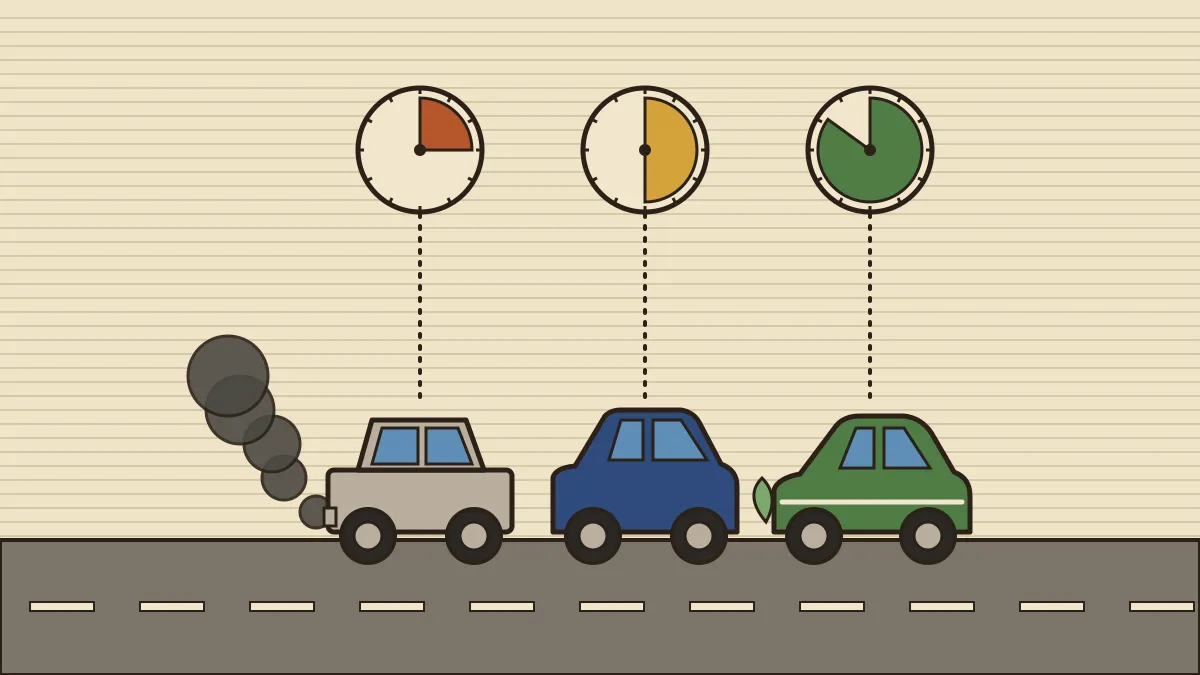
Every Indian motorist knows the Pollution Under Control certificate, or PUC, as the slip a roadside officer asks for. On 19 November 2026, the Ministry of Road Transport and Highways (MoRTH) announced a change in how long that slip stays valid. The idea is simple: the frequency of the emission test should depend on how clean the vehicle was built to be and how old it is.
The Ministry has amended sub-rule (7) of Rule 115 of the Central Motor Vehicles Rules. The stated aims are to align testing with the age profile of vehicles, to reduce the compliance burden on owners of newer and cleaner vehicles, and to keep a check on emissions from vehicles already on the road. This article sets out the new schedule, the history of the Bharat Stage norms that it rests on, and what a PUC test actually measures.
What the new schedule says
The release gives validity periods by Bharat Stage (BS) category and, for BS-VI, by age from first registration.
| Vehicle category | Age band | Validity of the PUC certificate |
|---|---|---|
| BS-I, BS-II and BS-III | Any | 3 months |
| BS-IV | Any | 6 months |
| BS-VI, non-transport (private) | Up to 6 years | 3 years |
| More than 6 and up to 10 years | 1 year | |
| More than 10 years | 6 months | |
| BS-VI, transport (commercial) | Up to 6 years | 2 years |
| More than 6 and up to 10 years | 1 year | |
| More than 10 years | 6 months |
The logic is a ladder. The older and dirtier the engine technology, the more often it is checked. A BS-VI car in its first six years is tested rarely; the same car after ten years is tested twice a year; a vehicle built to BS-III or older is tested every quarter. A transport vehicle, which runs far more kilometres than a private car, gets a shorter interval than a private vehicle of the same age.
Two administrative rules
The release adds two details that are easy to miss.
- Transition. For a certificate issued before the amendment comes into force, the new validity applies only from its first renewal after commencement. Nobody's existing certificate is cut short.
- Early renewal. If a PUC is renewed within ten days before the expiry of the old one, the new certificate runs from the date the old one expires, so nothing is lost by being prompt. If renewal is sought after expiry, the new certificate runs from the date of renewal.
A note on wording
The PIB release says the Ministry "has amended" sub-rule (7), yet it also calls the validity periods "proposed". The release does not give a G.S.R. number or a commencement date, and it does not say whether the schedule is already in force. Students should therefore treat it as the Ministry's announced position and check the Gazette notification for the date it takes effect.
The rule it changes
The legal home of the PUC is Rule 115(7) of the Central Motor Vehicles Rules (CMVR), 1989, made under the Motor Vehicles Act, 1988. As the Ministry quoted it in 2021, the rule says that after the expiry of one year from first registration, every vehicle must carry a valid PUC certificate issued by an agency authorised for this purpose by the State Government, and it must be produced on demand by the officers named in sub-rule (1) of Rule 116. Under that text the certificate was valid for six months, and for twelve months for vehicles built to BS-IV or BS-VI norms.
Two points of federal structure follow from this.
- The Centre writes the rules. The States authorise the testing centres and enforce them. The Ministry itself says that implementing the Act and Rules is the responsibility of the State and Union Territory governments.
- Two reforms since 2018 gave the system a national backbone. G.S.R. 527(E) of 6 June 2018 linked PUC data to the VAHAN database, the national vehicle register. G.S.R. 410(E) of 14 June 2021 standardised the PUC certificate to a common format across the country, for the whole country.
The 2021 Ministry advisory also asked States to place a PUC centre at every fuel station, to have third parties calibrate the test machines regularly, to take the fee before the test, and to cancel the authorisation of centres that cheat. The advisory exists because the weak point of the whole system has always been the testing centre, not the rule.
Penalty. The release does not mention penalties. The 2021 Ministry release says only that the owner is liable to a penalty for non-compliance; the exact amounts are set in the Motor Vehicles Act, 1988, and are not given in the sources used here, so look them up in the Act before quoting a figure.
Bharat Stage norms: the ladder behind the schedule
Bharat Stage (BS) norms are India's emission standards for new vehicles. They are modelled on the European standards, and each stage sets tighter limits on pollutants such as carbon monoxide, hydrocarbons, oxides of nitrogen and particulate matter. They are not a rating that stays with a vehicle for life: they describe the standard it was built to at the time of sale.
| Stage | Where and when |
|---|---|
| BS-III | Nationwide from October 2010 |
| BS-IV | 13 major cities from April 2010; nationwide from 1 April 2017 |
| BS-V | Skipped |
| BS-VI | Decided in 2016 to be brought in from 1 April 2020 |
Three points are worth remembering.
Why BS-V was skipped. The government decided in 2016 to leap from BS-IV straight to BS-VI. The reason was the time the shift from BS-III to BS-IV had taken, and the worry that a short intermediate step would waste effort. Because vehicle and fuel must change together, the leap needed refineries to deliver the cleaner fuel at the same time.
The fuel. Each stricter stage also needs cleaner fuel, with less sulphur and fewer aromatics (the NCERT environment chapter makes this point about vehicular pollution). Low sulphur cuts sulphur dioxide directly, and it lets the exhaust after-treatment devices of modern engines work without being poisoned.
The cut-off. With BS-VI compulsory from 1 April 2020, new BS-IV vehicles stopped being made for sale from about that date. That is why the age bands in the new PUC schedule line up so neatly with the standards: by November 2026 even the youngest BS-IV vehicle is about six years old or more. The oldest BS-VI vehicles, from April 2020, have just crossed six years and are moving into the one-year band, and they will cross ten years in 2030.
Why BS-VI vehicles can be tested less often
The release does not state a technical reason, so what follows is our reading. BS-VI vehicles carry on-board diagnostics (OBD) and advanced exhaust after-treatment that monitor engine performance and emissions continuously. And the cleaner, low-sulphur fuel reduces pollutants such as nitrogen oxides and particulates, particularly from diesel engines. If the equipment is sound, the vehicle will stay clean for years. The age bands then work as a proxy for wear: as the vehicle ages, the control equipment degrades, so checks become more frequent.
What a PUC test measures
The test is a simple roadside-style check, not the laboratory test done before a model is sold.
- Petrol, CNG and LPG vehicles: the analyser measures carbon monoxide (CO) and hydrocarbons (HC) in the exhaust while the engine is idling, and at a higher idle speed.
- Diesel vehicles: a free-acceleration smoke test. The engine is revved rapidly and a smoke meter measures how opaque the exhaust is, since diesel pollution shows up as black smoke from unburnt carbon particles.
Analysts have long criticised the diesel smoke test because it correlates poorly with the driving-cycle tests used to certify new vehicles, and have criticised enforcement because a machine that is not calibrated, or a centre that passes every car, defeats the purpose. That is why the Ministry's advisory dwells on calibration and on cancelling the licence of non-compliant centres.
Why the change is more than a convenience
There are good arguments on each side, and a CDS answer should name both.
For the change.
- It focuses effort where emissions come from. The older, more polluting vehicles are tested four times a year (BS-I to BS-III) while newer, cleaner ones are tested once every few years.
- It cuts the cost and the queues for owners of the cleanest vehicles, which rewards the shift to BS-VI.
- It lightens the load on testing centres, so that more inspection time goes to vehicles that matter.
Cautions.
- Fewer tests mean fewer chances to catch a single faulty vehicle, such as one with a tampered or removed particulate filter. A three-year gap is long.
- A test only checks what the machine reads on the day. A smoke-belching vehicle can still be stopped and challaned for visible pollution, whatever its certificate says.
- The system's weakness is quality of testing. A schedule that is perfectly designed does little if the centres issue certificates without testing.
The change also sits inside a wider air-quality effort. In Delhi-NCR, the Commission for Air Quality Management (CAQM) has been tightening vehicle rules; see our explainers on CAQM's move on light goods vehicles and on CAQM, GRAP and NCR air quality. On the fuel side, the CAFE-III fuel-economy norms set the next step for vehicle efficiency. For the science of the pollutants themselves, revise air pollutants, sources and standards.
What to watch
- The Gazette notification. The commencement date and the G.S.R. number will fix when the new periods begin.
- State action. Because States authorise the centres, the benefit depends on how quickly each State updates its software, its fee rules and its enforcement.
- Data from VAHAN. With PUC data linked to the national register, the ministry can see which categories fail most often, and the age bands could be adjusted.
🔑 Revision block
The change. 19 November 2026, MoRTH, Rule 115(7) of the Central Motor Vehicles Rules, 1989; validity linked to BS category and age.
The schedule. BS-I/II/III: 3 months; BS-IV: 6 months; BS-VI non-transport: 3 years (up to 6 years), 1 year (6-10), 6 months (over 10); BS-VI transport: 2 years, 1 year, 6 months.
Administrative rules. Existing certificates move to the new validity at first renewal. Renewal within 10 days before expiry runs from the expiry date; renewal after expiry runs from the date of renewal.
Earlier reforms. G.S.R. 527(E), 6 June 2018: PUC linked to VAHAN. G.S.R. 410(E), 14 June 2021: common PUC format ("One Nation, One PUC"). Centres are authorised by the State Government.
Bharat Stage. BS-IV in 13 cities April 2010, nationwide 1 April 2017; BS-V skipped (decision 2016); BS-VI from 1 April 2020.
The test. Petrol/CNG/LPG: CO and HC at idle. Diesel: free-acceleration smoke test.
🎯 Practice MCQs
Q1. Under the revised schedule, a BS-VI transport vehicle up to 6 years from first registration gets a PUC certificate valid for:
(a) 3 months
(b) 6 months
(c) 1 year
(d) 2 years
→ (d)
BS-VI transport vehicles get 2 years in the first age band, then 1 year (6-10 years) and 6 months (over 10 years). Private BS-VI vehicles get 3 years in the first band.
Q2. Under the revised schedule, the PUC certificate for BS-I, BS-II and BS-III vehicles is valid for:
(a) 3 months
(b) 6 months
(c) 1 year
(d) 3 years
→ (a)
The oldest standards face the shortest interval. BS-IV is at 6 months.
Q3. Which Bharat Stage standard did India skip in its move from BS-IV to BS-VI?
(a) BS-II
(b) BS-III
(c) BS-V
(d) BS-VII
→ (c)
The government decided in 2016 to leap from BS-IV directly to BS-VI, which came into force nationwide on 1 April 2020.
Q4. Consider the following statements about the PUC system:
1. PUC certificates are issued by agencies authorised by the Central Government under Rule 115(7).
2. PUC data has been linked to the VAHAN database.
Which of the statements given above is/are correct?
(a) 1 only
(b) 2 only
(c) Both 1 and 2
(d) Neither 1 nor 2
→ (b)
Rule 115(7) speaks of an agency authorised by the State Government, so statement 1 is wrong. The VAHAN linkage was made by G.S.R. 527(E) of 2018.
Q5. Consider the following statements about renewal under the new rules:
1. A PUC renewed within ten days before expiry takes effect from the expiry of the old certificate.
2. A PUC renewed after expiry takes effect from the date of renewal.
Which of the statements given above is/are correct?
(a) 1 only
(b) 2 only
(c) Both 1 and 2
(d) Neither 1 nor 2
→ (c)
Both are in the release. Prompt renewal loses no time; late renewal restarts the clock from the day it is done.
Q6. Under Rule 115(7) of the Central Motor Vehicles Rules, PUC centres are authorised by the:
(a) Central Pollution Control Board
(b) Ministry of Environment, Forest and Climate Change
(c) Central Government
(d) State Government
→ (d)
The Centre frames the rule; the States authorise the centres and enforce it.
Q7. Bharat Stage IV emission norms were extended to the whole country from:
(a) April 2010
(b) April 2017
(c) April 2018
(d) April 2020
→ (b)
BS-IV began in 13 major cities in April 2010 and covered the whole country from April 2017. BS-VI followed from April 2020, with BS-V skipped.
Q8. BS-VI emission norms came into force across India from:
(a) 1 April 2020
(b) 1 April 2021
(c) 1 April 2022
(d) 1 April 2023
→ (a)
The government decided in 2016 to skip BS-V and adopt BS-VI by 2020. The BS-IV norm covered the whole country from April 2017.
📋 How this gets asked (PYQ pattern)
Vehicle pollution comes up in environment and general-science papers in three recurring ways.
The first is the norm itself: what BS stands for, which stage is current, which was skipped, and that cleaner fuel goes with each stage. The trap options mix BS-V and BS-VI, or confuse the vehicle standard with the fuel standard.
The second is the pollutant and its source: carbon monoxide from incomplete combustion, oxides of nitrogen and particulates from diesel, and sulphur dioxide from sulphur in the fuel. Learn which pollutant each control device removes.
The third is institutions and law: who frames the rule (Central Government, MoRTH), who authorises and enforces (State Government), and which Acts apply (Motor Vehicles Act, 1988; Air Act, 1981). For this cycle the fresh hooks are the 3, 6 and 12-month ladder, the age bands of 6 and 10 years and the ten-day early renewal rule.
Preparing for CDS? Build a one-line chain for the BS norms (BS-IV in 13 cities 2010, BS-IV nationwide 2017, BS-V skipped, BS-VI 2020) and revise the pollutants with our notes on air pollutants, sources and standards. Follow the daily CDS current affairs, and learn with experienced faculty in the upcoming Cavalier courses in Delhi.
Source: PIB / Ministry of Road Transport & Highways, "MoRTH Revises Validity Periods of PUC Certificates Based on Vehicle Age and Emission Standards", 19 November 2026; PIB release of 22 July 2021 on the standardised PUC certificate and Rule 115(7); Bharat Stage timeline from the NCERT Class XII Biology chapter on environmental issues and the IGNOU environment text (BS-IV 2010 and 2017, BS-V skipped in 2016, BS-VI from 2020).
✍️ Written by Col D.N. Sharma — Science & general-studies faculty at The Cavalier. Reviewed by the Cavalier Faculty Desk.