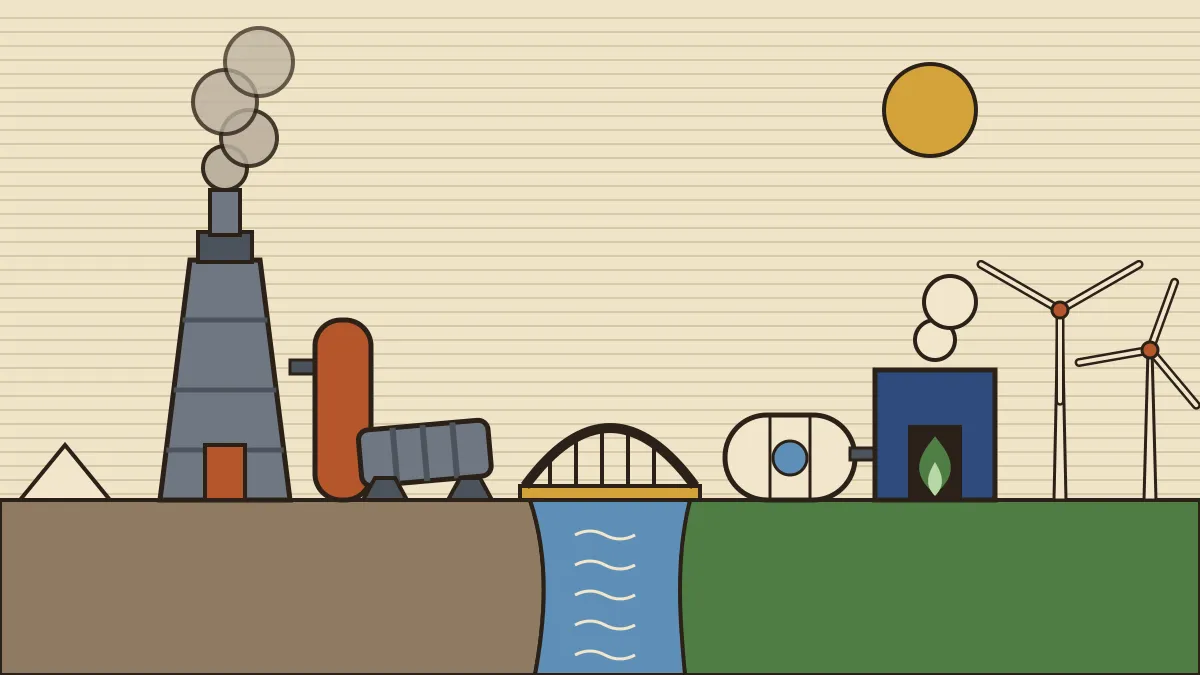
Some industries can switch to solar power and be done. Steel, cement and long-haul transport cannot. They need heat at over a thousand degrees, they release carbon dioxide from the chemistry of the product itself, and their plants are built to last forty years. These are the hard-to-abate sectors, and cutting their emissions is among the toughest jobs in climate policy.
On 12 November 2026, with the UN climate conference COP31 at Antalya (Türkiye) only days away, Union Environment Minister Bhupender Yadav held an interaction in New Delhi with Indian members and project partners of the Leadership Group for Industry Transition (LeadIT). The Ministry of Environment, Forest and Climate Change said that he and Sweden's Ministry of Climate and Enterprise will launch the third phase, LeadIT 3.0, on 17 November 2026 at the LeadIT Industry Leaders Roundtable at COP31.
This article explains what LeadIT is, why its target sectors are so difficult, what India and Sweden have built so far, and how it fits with the other climate initiatives India has launched.
What happened on 12 November
The meeting brought together three groups.
- LeadIT member companies from India: Tata Steel, JSW Steel, SAIL, Synergy Advanced Metals, Adani Ambuja Cement, Dalmia Cement, JK Cement, JSW Cement, UltraTech Cement, Volvo Group and SpiceJet.
- Project partners under the India-Sweden Industry Transition Partnership (ITP): Jindal Steel and Power, Prism Johnson, Höganäs India and MyHome Industries.
- Research institutions: the National Council for Cement and Building Materials, and IIT Bombay, IIT Bhubaneswar, IIT (ISM) Dhanbad, IIT Hyderabad and IIT Kharagpur.
Mr Yadav said LeadIT 3.0 "will be an implementation-oriented platform, translating ambition into tangible impact", and stressed that India's approach rests on cooperation among government, industry and academia. Industry representatives said the platform had helped them form project partnerships, assess whether technologies work, and share knowledge. They also asked for more support in three areas: pre-competitive project preparation, pilot projects and capacity building.
The phrase "pre-competitive" is worth knowing. It means early-stage work such as feasibility studies and shared testing, where competing companies can cooperate because nobody yet has a product to sell.
What LeadIT is
LeadIT was launched by the governments of India and Sweden in 2019 at the UN Climate Action Summit in New York, with the support of the World Economic Forum. It is a public-private partnership: its members are national governments and companies, and it aims to move heavy industry towards net-zero emissions, with a focus on sectors such as steel, cement and transport. Its secretariat is hosted by the Stockholm Environment Institute.
Three points that exams like to test:
- LeadIT is voluntary. It is not a UN body, a treaty or a negotiating bloc, and its members take on no legally binding targets.
- It is co-chaired by India and Sweden, so it is an India-co-led initiative in the same family as the International Solar Alliance.
- Its target is industry, which is a different part of the emissions picture from power generation or forests.
Growth in membership
| Date | Countries | Companies | Source |
|---|---|---|---|
| November 2025 (COP30, Belém) | 18 | 27 | PIB, 18 November 2025 |
| November 2026 | 19 | 33 | PIB, 12 November 2026 |
In one year the group gained one country and six companies. Of the 33 companies, 13 are Indian, which is a measure of how much of the push comes from India's own heavy industry.
Three phases, three COPs
LeadIT's history follows the UN climate calendar.
| Phase | Period | Launched at | What it did |
|---|---|---|---|
| Phase I | 2019 to 2023 | UN Climate Action Summit, New York (2019) | Built the membership, held annual summits at COPs, supported transition roadmaps for hard-to-abate sectors |
| Phase II (LeadIT 2.0) | 2024 to 2026 | COP28, Dubai (1 December 2023) | Three pillars: a global forum for dialogue; technology transfer and co-development; an Industry Transition Platform |
| Phase III (LeadIT 3.0) | Period not stated in the release | Due at COP31, Antalya (17 November 2026) | "Implementation-oriented" |
LeadIT 2.0 was co-launched by Prime Minister Narendra Modi and Swedish Prime Minister Ulf Kristersson at COP28 for the period 2024 to 2026. The two Prime Ministers announced the renewed mandate in May 2026, and in a press statement that month the Prime Minister said the two countries had decided to work on a third phase. The release does not state the third phase's period.
A small trap sits in the name of the platform. A 2023 PIB release called the India-Sweden body the Industry Transition Platform; the 12 November 2026 release calls it the Industry Transition Partnership. Both abbreviate to ITP, and both describe the same India-Sweden arrangement, which links governments, industries, technology providers, researchers and think tanks of the two countries.
Why steel and cement are "hard to abate"
Two reasons stand out, and both can be explained with school chemistry.
1. The chemistry itself emits carbon dioxide.
- Cement. Clinker, the main ingredient, is made by heating limestone (calcium carbonate) in a kiln. CaCO₃ breaks into CaO and CO₂. That carbon dioxide is released whatever fuel heats the kiln, so even a fully solar-powered kiln would still emit it.
- Steel. In the blast furnace route, coke is used to strip oxygen from iron ore: Fe₂O₃ + 3CO → 2Fe + 3CO₂. The carbon is part of the reaction, not just the fuel.
2. The heat is very high and the plants last decades. A cement kiln runs at roughly 1,450 °C, and a blast furnace hotter still. Electricity does not easily supply heat at that level, and a plant built today will run until the 2060s. Changing it means rebuilding it.
That is why the options being tested are not simple substitutions:
- Hydrogen as a reducing agent in steel. In direct reduced iron made with hydrogen, Fe₂O₃ + 3H₂ → 2Fe + 3H₂O. The by-product is water, not carbon dioxide, but green hydrogen is still expensive.
- Electrification of lower-temperature process heat.
- Carbon capture and utilisation (CCU), which traps CO₂ from the kiln or furnace and converts it to a product.
- Process optimisation with artificial intelligence, which cuts fuel use per tonne.
- Using by-products and waste gases as inputs, so that waste from one plant becomes raw material for another.
What India has built so far
The India-Sweden work sits inside a wider Indian effort.
Net zero by 2070. India's long-term goal, stated at COP26 in 2021, frames everything below.
The Green Steel Taxonomy (12 December 2024). The Ministry of Steel released it, and India was, in the Ministry's words, the first nation to do so. It defines green steel by the emission intensity of the plant: steel from a plant emitting less than 2.2 tonnes of CO₂-equivalent per tonne of finished steel qualifies. A star rating follows:
- Five-star: below 1.6 t CO₂e per tonne.
- Four-star: 1.6 to 2.0.
- Three-star: 2.0 to 2.2.
It advances the National Mission on Green Steel.
Cement testbeds (May 2025). The Department of Science and Technology announced five carbon capture and utilisation testbeds in the cement sector, in academia-industry partnership, on National Technology Day (11 May 2025).
ITP projects (announced at COP30, November 2025). The Minister said that 18 industries and research institutions from India and Sweden would soon start projects on creating value from industrial by-products and gases, CCU, AI for process optimisation, electrification, and hydrogen-based industrial heating.
Transport. LeadIT helped bring about cooperation between Tata Motors and Volvo Group on decarbonising heavy-duty vehicles.
Where it meets trade and carbon markets
Industry transition is not only an environmental issue. It decides who can sell to whom.
- The European Union's Carbon Border Adjustment Mechanism (CBAM) puts a carbon price on imports such as steel and cement. An Indian exporter whose steel is made with a lower-carbon process pays less. Our explainer on the EU CBAM and Indian exporters sets out how it works.
- India's own Carbon Credit Trading Scheme is meant to put a domestic price on industrial emissions. See India's Carbon Credit Trading Scheme.
Together, the two explain why the companies at the table are keen. A cleaner process is both a climate action and a market advantage.
LeadIT among India's international initiatives
| Initiative | Year | Launched with / at | Focus |
|---|---|---|---|
| International Solar Alliance | 2015 | France, at COP21 Paris | Solar energy in sunshine-rich countries |
| CDRI | 2019 | UN Climate Action Summit, New York | Disaster-resilient infrastructure |
| LeadIT | 2019 | Sweden, at the UN Climate Action Summit, New York | Low-carbon heavy industry |
| Global Biofuel Alliance | 2023 | G20 summit, New Delhi | Biofuels |
Note that CDRI and LeadIT were both announced at the same 2019 summit in New York, a favourite pairing for examiners. For the briefing India is taking to COP31 on finance and adaptation, see our explainer on India's COP31 priorities.
The Minister's wider message
Speaking on climate action, Mr Yadav made the point that India has "decoupled" growth from emissions. At COP30 in 2025 he said India had cut the emission intensity of its GDP by 36% between 2005 and 2020. Emission intensity is emissions per unit of GDP, so this figure can fall even while total emissions rise; it measures efficiency, not absolute cuts. Students should keep that distinction in mind, as an option that says "India has cut total emissions by 36%" would be wrong.
What to watch
- 17 November 2026: the launch of LeadIT 3.0 at Antalya, and what the "implementation" focus means in money and projects.
- Finance and technology. Industry has asked for help with project preparation, pilots and capacity building. Whether developed members commit funding is the real test.
- Green steel demand. A taxonomy defines what counts as green; it does not create buyers. Public procurement and export rules will decide demand.
- CCU testbeds. Whether the five cement testbeds move from pilot to plant.
🔑 Revision block
The news. 12 November 2026: Environment Minister Bhupender Yadav met LeadIT industry members and ITP project partners, New Delhi; LeadIT 3.0 to be launched 17 November 2026 at COP31, Antalya (Türkiye).
LeadIT. Launched 2019, UN Climate Action Summit, New York, by India and Sweden (WEF support). Public-private; 19 countries, 33 companies (13 Indian). Voluntary. Secretariat: Stockholm Environment Institute. November 2025: 18 countries, 27 companies.
Phases. I: 2019 onwards. II (LeadIT 2.0): 2024 to 2026, launched 1 December 2023 at COP28 Dubai by PM Modi and PM Kristersson; three pillars: forum, technology transfer and co-development, Industry Transition Platform. III: renewed mandate May 2026.
Why hard to abate. Cement: CaCO₃ → CaO + CO₂. Steel: coke reduces ore (Fe₂O₃ + 3CO → 2Fe + 3CO₂); hydrogen route gives water. Very high heat; long-lived plants.
India. Net zero 2070. Green Steel Taxonomy (12 December 2024): below 2.2 t CO₂e per tonne of finished steel; stars at 1.6 and 2.0. Five CCU testbeds in cement (May 2025). Emission intensity of GDP down 36% (2005 to 2020).
🎯 Practice MCQs
Q1. The Leadership Group for Industry Transition (LeadIT) was launched in 2019 by India and:
(a) Sweden
(b) France
(c) Brazil
(d) The United Kingdom
→ (a)
India and Sweden co-launched LeadIT. The India-France partnership is the International Solar Alliance.
Q2. LeadIT was launched at which event?
(a) COP21, Paris, 2015
(b) UN Climate Action Summit, New York, 2019
(c) COP26, Glasgow, 2021
(d) COP28, Dubai, 2023
→ (b)
It was launched in 2019 at the UN Climate Action Summit. COP28 Dubai is where its second phase, LeadIT 2.0, was launched.
Q3. LeadIT 2.0, launched at COP28 in Dubai, covers the period:
(a) 2022 to 2024
(b) 2023 to 2025
(c) 2024 to 2026
(d) 2025 to 2027
→ (c)
Prime Ministers Modi and Kristersson co-launched Phase II for 2024 to 2026 on 1 December 2023.
Q4. Cement is called a hard-to-abate sector mainly because a large share of its emissions comes from:
(a) Electricity used in grinding mills
(b) Transport of clinker to markets
(c) The use of gypsum in the final mix
(d) Decomposition of limestone during clinker production
→ (d)
Limestone (CaCO₃) breaks into lime and carbon dioxide inside the kiln, so the gas is released even if the fuel is clean.
Q5. Under India's Green Steel Taxonomy, steel is classed as green if it comes from a plant whose emission intensity is below:
(a) 1.2 tonnes of CO₂e per tonne of finished steel
(b) 1.6 tonnes of CO₂e per tonne of finished steel
(c) 2.0 tonnes of CO₂e per tonne of finished steel
(d) 2.2 tonnes of CO₂e per tonne of finished steel
→ (d)
The threshold is 2.2 t CO₂e per tonne of finished steel. The 1.6 and 2.0 figures mark the five-star and four-star bands.
Q6. Consider the following statements about LeadIT:
1. It is a subsidiary body of the UNFCCC with legally binding emission targets for members.
2. It is a public-private partnership of governments and companies.
Which of the statements given above is/are correct?
(a) 1 only
(b) 2 only
(c) Both 1 and 2
(d) Neither 1 nor 2
→ (b)
LeadIT is voluntary and brings together governments and companies. It is not a UNFCCC body and carries no binding targets.
Q7. The International Solar Alliance was launched by India together with:
(a) Sweden at COP28
(b) The United Kingdom at COP26
(c) France at COP21
(d) Brazil at COP30
→ (c)
India and France launched the ISA at COP21 in Paris in 2015. Sweden is India's partner in LeadIT.
Q8. In May 2025 the Department of Science and Technology announced five carbon capture and utilisation testbeds for which sector?
(a) Cement
(b) Aluminium
(c) Fertiliser
(d) Textiles
→ (a)
The cement testbeds were announced on National Technology Day, 11 May 2025, as an academia-industry cluster.
📋 How this gets asked (PYQ pattern)
Climate and environment questions in CDS come in three recurring forms.
The first is who launched what and where: an initiative, its co-founder and the summit. The distractors are other India-led bodies, so learn the pairs: ISA with France at Paris, LeadIT with Sweden at New York, and Global Biofuel Alliance at the G20.
The second is science behind the policy: why a sector is hard to decarbonise, what the by-product of a reaction is, and which gas is released. Q4 above is the model: know the cement and steel reactions.
The third is definitions and numbers: net zero year, emission intensity versus total emissions, and thresholds such as the 2.2 tonne green steel line. This cycle's fresh hooks are LeadIT 3.0 on 17 November 2026, 19 countries and 33 companies, and COP31 at Antalya.
Preparing for CDS? Treat every climate initiative as a fixed set of facts: launch year, co-founder, venue, purpose. Revise the underlying chemistry from the CDS/OTA study material, and follow the daily CDS current affairs through the COP31 fortnight. Learn with experienced faculty in the upcoming Cavalier courses in Delhi.
Source: PIB / Ministry of Environment, Forest and Climate Change, "Union Environment Minister holds interaction with LeadIT Industry Members and Project Partners", 12 November 2026; PIB releases of 1 December 2023 (PMO), 9 December 2023 and 18 November 2025 (MoEFCC), May 2026 (PM's press statement); Ministry of Steel release of 12 December 2024; Department of Science and Technology release of 14 May 2025. Secretariat details from LeadIT (industrytransition.org) and the Stockholm Environment Institute. Reaction chemistry and kiln temperature are standard textbook values.
✍️ Written by Aditya Tiwari — Economy & current-affairs faculty at The Cavalier. Reviewed by the Cavalier Faculty Desk.