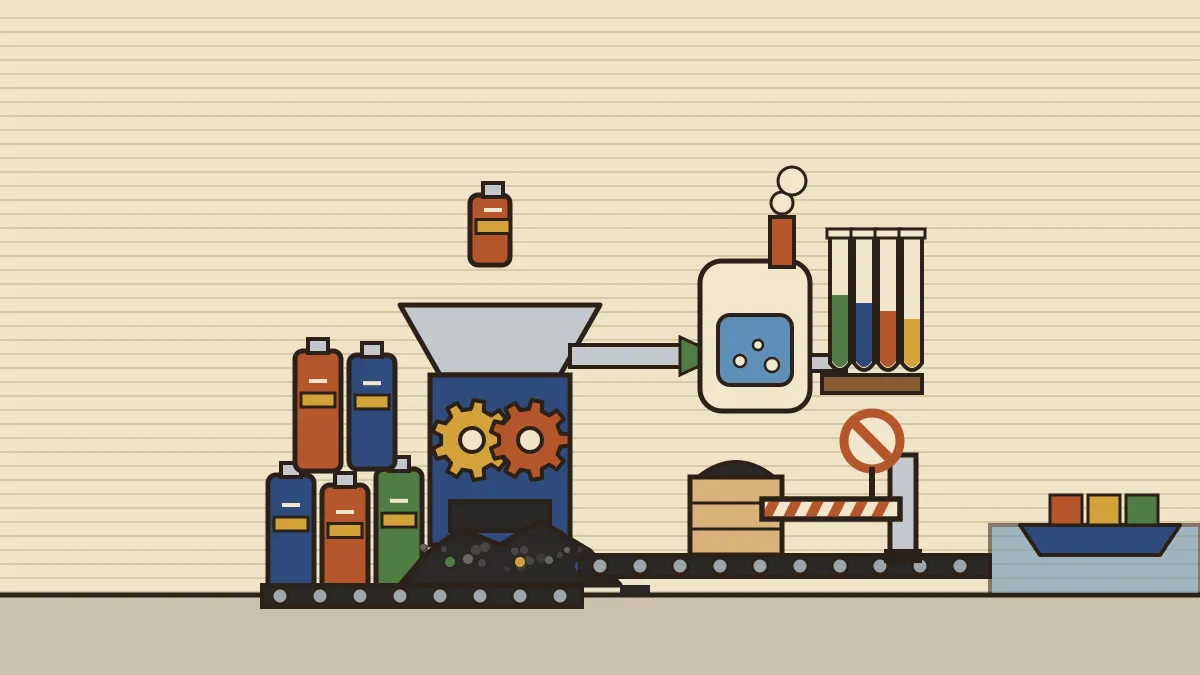
India has stopped shipping its shredded battery waste abroad. On 10 November 2026, the Directorate General of Foreign Trade (DGFT) in the Department of Commerce issued Notification No. 49/2026-27, which moves the export of lithium-ion battery black mass from "Free" to "Prohibited". The change took effect immediately and runs "until further orders". The item falls under ITC(HS) code 85491400.
Black mass sounds obscure, but it sits at the centre of three national projects: electric mobility, critical-mineral security and the circular economy. The government's argument is simple. India has built recycling and refining capacity, that capacity is not being fully used because it lacks feedstock, and some of the feedstock is leaving the country as raw powder. This article explains the material, the recycling methods, the legal route used for the ban and the policy background.
What black mass is
When a lithium-ion battery reaches the end of its life, or when a battery factory produces defective cells, the battery is discharged, dismantled and shredded. The steel casing, copper and aluminium foils and plastics are separated out. What remains is a fine dark powder. That is black mass.
The Commerce release defines black mass as the powder obtained from shredding end-of-life lithium-ion batteries and battery manufacturing waste. It contains recoverable lithium, cobalt, nickel and manganese. Because battery anodes are made largely of graphite, the powder also contains carbon, which is why it is black. (The graphite point is general technical knowledge, not from the release.)
| Metal | Role in a lithium-ion battery (general background) |
|---|---|
| Lithium | Carries charge between the electrodes; present in the cathode and electrolyte |
| Cobalt | Cathode material; helps stabilise its structure |
| Nickel | Cathode material; raises energy density |
| Manganese | Cathode material in some battery chemistries |
The release stresses that critical minerals are inputs for electric mobility, advanced chemistry cell (ACC) batteries, energy storage, electronics and renewable energy. India depends substantially on imports for several of these critical minerals, so black mass that is processed at home is metal that does not have to be bought abroad.
Getting metal out of the powder
Black mass is an intermediate product. It still has to be turned into metals or battery-grade chemicals. Two broad routes exist, and the difference is an exam favourite.
| Pyrometallurgy | Hydrometallurgy | |
|---|---|---|
| Method | Smelting at high temperature | Dissolving in acid (leaching), then chemical separation |
| Usually recovers | Cobalt, nickel (and copper) | Lithium, cobalt, nickel, manganese |
| Lithium | Mostly lost to slag | Recovered |
| Energy use | High | Lower |
| Waste to handle | Slag, gases | Acidic wastewater, chemical sludge |
The Ministry of Mines says the new recycling scheme will help expand capacity using processes such as hydrometallurgy. A homegrown example is MiniMines Cleantech Solutions, which the Technology Development Board (Department of Science & Technology) backed in March 2026 for a zero-discharge process called Hybrid Hydrometallurgy. PIB describes the firm as the first R4 category recycler, meaning one that goes end to end from battery scrap to extracted metal, and claims recovery of up to 99%.
The distinction matters for the ban. A recycler that only makes black mass is mid-chain. The real value, and the real critical-mineral supply, comes from the refining step. A Ministry of Mines release of October 2025 had already pointed out that India's capacity to process black mass was limited, so the powder was being exported before its valuable metals were extracted. The ban is aimed squarely at that gap.
The reasoning behind the ban
The Commerce release gives five linked reasons.
- Idle capacity. Domestic recycling and refining capacity has grown considerably but is not fully used, because there is not enough feedstock.
- Leakage and imports. Exports of Indian black mass send a valuable secondary resource abroad, while some domestic recyclers have had to import material to meet their needs.
- Import dependence. Recovering lithium, cobalt and nickel at home cuts imports and the foreign-exchange outgo.
- Urban mining. The measure advances the circular economy and urban mining, which means treating discarded products as an ore body, and it reduces reliance on primary mining.
- Safe processing. The release describes black mass as a hazardous material and says it should be recycled within the country under the applicable environmental rules.
It adds that several major economies have adopted similar measures to keep battery waste and black mass at home for processing. The expected results are assured feedstock, better capacity use, new investment and jobs, and stronger supply chains for batteries, electric vehicles, storage and clean energy.
A note on scale. Government figures cited in October 2025 estimate that India generates about 1.75 million tonnes of e-waste and about 60 kilotonnes of spent lithium-ion batteries each year, and that availability will grow manifold over the next four to five years. In December 2025 the Heavy Industries Ministry cited a NITI Aayog projection that annual lithium-ion battery demand would rise from 40 GWh in 2025 to about 210 GWh by 2030. Today's black mass volumes are small; the policy is built for the waste that is coming.
How a ban is imposed: the legal route
Export and import policy in India is run through the DGFT, an office of the Department of Commerce, under the Foreign Trade (Development and Regulation) Act, 1992, and the Foreign Trade Policy (FTP) 2023. Each product is listed by an ITC(HS) code, the Indian Trade Classification based on the international Harmonized System. For each code the policy is one of:
- Free: no licence needed.
- Restricted: allowed only with a licence or authorisation.
- Prohibited: not allowed at all, unless the policy gives a specific exception.
- State trading: allowed only through designated agencies.
Black mass moved from the first category to the third. The release adds that the transitional arrangements under Para 1.05 of the FTP 2023 will apply, which generally exist to protect shipments already committed before a policy change.
Export bans of this kind sit uneasily with the trade rule that members should not impose quantitative export restrictions, but the WTO system allows exceptions, for example for measures relating to the conservation of exhaustible natural resources, subject to conditions. Whether black mass fits those exceptions is a legal question the release does not address.
The rules and schemes it plugs into
Battery Waste Management Rules, 2022. Published by the Environment Ministry on 24 August 2022, they replaced the Batteries (Management and Handling) Rules, 2001, and cover electric-vehicle, portable, automotive and industrial batteries. They work on Extended Producer Responsibility (EPR): producers, including importers, must make sure their waste batteries are collected and recycled or refurbished, using EPR certificates traded on a central online portal. Disposal in landfills and incineration is prohibited, and recycled material content in new batteries becomes mandatory from FY 2027-28. A Rajya Sabha reply of August 2025 recorded 3,664 producers and 442 recyclers registered, and EPR certificates of 7.29 lakh tonnes of key battery metals bought against a target of 10.96 lakh tonnes. A December 2025 reply said about 15,370 tonnes of lithium-ion battery waste had been recycled since the rules came in.
National Critical Mineral Mission (NCMM). Approved by the Cabinet on 29 January 2025 with an expenditure of ₹16,300 crore and an expected ₹18,000 crore from public sector undertakings, a combined outlay of about ₹34,300 crore over seven years. It covers exploration, auction, processing and recovery from end-of-life products. See our report on how the Mission's auctions are progressing.
The ₹1,500 crore recycling incentive scheme. Approved on 3 September 2025 and opened for applications on 2 October 2025, it runs from FY 2025-26 to FY 2030-31. Its features:
- 20% capital subsidy on plant and machinery, plus an operating subsidy linked to incremental sales.
- A cap on total incentive of ₹50 crore per large entity and ₹25 crore per small entity.
- One-third of the outlay earmarked for small and new recyclers, including start-ups.
- Targets of at least 270 kilotonnes of annual recycling capacity, about 40 kilotonnes of annual critical-mineral output, about ₹8,000 crore of investment and close to 70,000 jobs.
- Support for the part of the chain that actually extracts critical minerals, not for firms that only produce black mass.
Read together, the targets imply about ₹5.3 of investment for every rupee of outlay, and that roughly 15% of the tonnage processed comes out as critical minerals (calculated by The Cavalier from the release figures).
The ban is the demand-side partner of this scheme. The subsidy builds the refineries; the export prohibition keeps them supplied. For related reading, see our explainers on electric mobility and battery supply chains and on grid-scale energy storage, which will add to battery waste in the coming decade.
What to watch
- Price effects. Collectors and dismantlers who used to sell to overseas buyers now have only domestic buyers. If refining capacity lags, they may be squeezed.
- Capacity coming online. The ban works only if recyclers actually build and run refining lines; the 270-kilotonne target is the benchmark.
- Formalising the informal sector. EPR certificates reward registered recyclers only, which is meant to pull informal collectors into the formal chain.
- Trade reaction. Buyers of Indian black mass abroad, and the WTO question above, may prompt responses.
🔑 Revision block
The ban. DGFT Notification 49/2026-27, 10 November 2026; lithium-ion battery black mass, ITC(HS) 85491400; export policy Free to Prohibited, immediate; transitional arrangements under Para 1.05, FTP 2023.
The material. Powder from shredded end-of-life or factory-reject lithium-ion batteries; contains lithium, cobalt, nickel, manganese (plus graphite).
Recovery routes. Pyrometallurgy: smelting, lithium lost to slag. Hydrometallurgy: acid leaching, recovers lithium too, lower energy.
Why. Idle domestic recycling capacity, feedstock shortage, some recyclers importing material, import dependence, urban mining and circular economy.
Rules and schemes. Battery Waste Management Rules, 2022 (24 August 2022; EPR; recycled content mandatory from FY 2027-28); NCMM (29 January 2025; ₹16,300 crore + ₹18,000 crore PSU); ₹1,500 crore recycling scheme (3 September 2025; 20% capex subsidy; caps ₹50 crore / ₹25 crore; targets 270 kt capacity, 40 kt minerals, ₹8,000 crore investment, 70,000 jobs).
Trade policy words. Free, Restricted, Prohibited, State trading; DGFT sits in the Department of Commerce.
🎯 Practice MCQs
Q1. 'Black mass', in the context of the DGFT notification of 10 November 2026, is:
(a) Molten slag left over from a smelter
(b) A lithium-rich mineral from mining tailings
(c) The liquid electrolyte drained from used cells
(d) A powder obtained by shredding end-of-life lithium-ion batteries and battery manufacturing waste
→ (d)
It is the shredded, powdery residue that holds recoverable lithium, cobalt, nickel and manganese.
Q2. The DGFT amended the export policy of lithium-ion battery black mass:
(a) From Restricted to Prohibited
(b) From Free to Prohibited
(c) From Free to Restricted
(d) From Prohibited to Free
→ (b)
The item under ITC(HS) 85491400 was moved from 'Free' to 'Prohibited' by Notification 49/2026-27 of 10 November 2026.
Q3. Which set of metals does the Commerce release list as recoverable from black mass?
(a) Lithium, cobalt, nickel and manganese
(b) Copper, zinc, tin and lead
(c) Gold, silver, platinum and palladium
(d) Uranium, thorium, radium and polonium
→ (a)
Lithium, cobalt, nickel and manganese are named in the release; the others are not.
Q4. Consider the following statements about recovering metals from black mass:
1. In pyrometallurgy, lithium is typically lost to slag.
2. In hydrometallurgy, the powder is dissolved in acid and the metals are separated chemically, which can recover lithium.
Which of the statements is/are correct?
(a) 1 only
(b) 2 only
(c) Both 1 and 2
(d) Neither 1 nor 2
→ (c)
Both describe the standard difference between the two routes.
Q5. The Battery Waste Management Rules, 2022 are built mainly on which concept?
(a) Sustainable yield
(b) Extended Producer Responsibility
(c) Subsidiarity
(d) Public trust doctrine
→ (b)
Under EPR, producers (including importers) are responsible for collecting and recycling or refurbishing waste batteries.
Q6. The National Critical Mineral Mission, approved by the Cabinet on 29 January 2025, has a Government expenditure of:
(a) ₹1,500 crore
(b) ₹8,000 crore
(c) ₹16,300 crore
(d) ₹18,100 crore
→ (c)
₹16,300 crore of Government expenditure, with ₹18,000 crore expected from PSUs. ₹1,500 crore is the recycling incentive scheme, and ₹18,100 crore is the PLI scheme for ACC batteries.
Q7. The ₹1,500 crore critical-mineral recycling incentive scheme is meant to support:
(a) Firms that only produce black mass
(b) Exports of black mass
(c) Imports of battery-grade lithium
(d) The recycling value chain that actually extracts critical minerals
→ (d)
The scheme supports extraction of critical minerals from secondary sources, not firms that stop at black mass.
Q8. The Directorate General of Foreign Trade, which issued the notification, is an office under the:
(a) Department of Commerce
(b) Department of Revenue
(c) Ministry of Mines
(d) Ministry of Environment, Forest and Climate Change
→ (a)
The DGFT sits in the Department of Commerce and implements the Foreign Trade Policy.
📋 How this gets asked (PYQ pattern)
Economy questions on trade and resources come in three forms.
The first is vocabulary: urban mining, circular economy, Extended Producer Responsibility and the difference between pyro- and hydrometallurgy. The options are usually one word apart, so learn each term with a one-line meaning.
The second is institutions and tools: who regulates foreign trade (DGFT), under which Act, and what Free, Restricted and Prohibited mean. A common trap is to attribute trade policy to the Reserve Bank or the Ministry of Finance.
The third is schemes and numbers: the NCMM outlay and date, the recycling scheme's size, and the Battery Waste Management Rules. The fresh hooks this cycle are ₹1,500 crore, ₹16,300 crore, 24 August 2022, ITC(HS) 85491400 and the 10 November 2026 notification.
Preparing for CDS? Revise the minerals chapter in our geography notes on critical minerals and the trade basics in international trade. Follow the daily CDS current affairs, and learn with experienced faculty in the upcoming Cavalier courses in Delhi.
Source: PIB / Ministry of Commerce & Industry, "DGFT prohibits export of Lithium-Ion Battery Black Mass to strengthen domestic recycling and critical mineral recovery", 11 November 2026; Ministry of Mines releases of 29 January 2025, 3 September 2025, 24 October 2025 and 25 November 2025; Ministry of Environment, Forest and Climate Change releases of 25 August 2022 and 21 August 2025; Ministry of Heavy Industries reply of 16 December 2025; Ministry of Science & Technology release of 6 March 2026. Ratios calculated by The Cavalier from the published figures. The graphite and pyrometallurgy/hydrometallurgy comparisons are standard technical background, not from the releases.
✍️ Written by Aditya Tiwari — Economy & current-affairs faculty at The Cavalier. Reviewed by the Cavalier Faculty Desk.