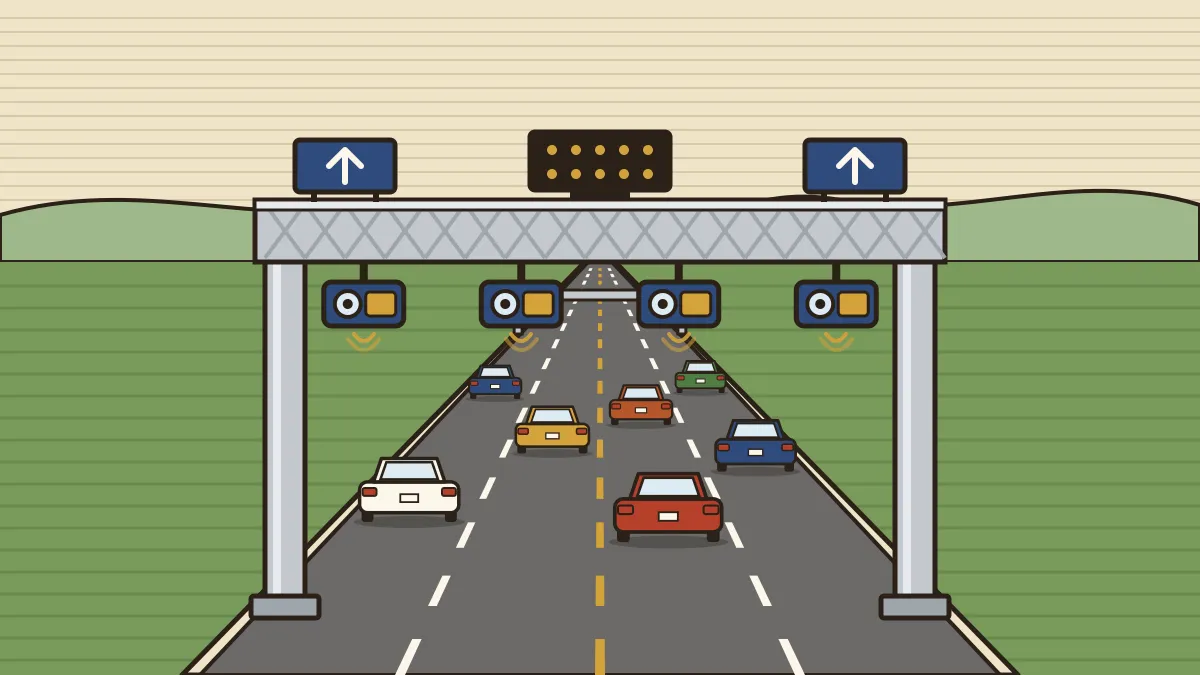
For most of the last three decades, paying a highway toll meant slowing down, queuing and, until recently, fumbling for cash. On 6 November 2026, the National Highways Authority of India (NHAI) issued guidelines that are meant to make the opposite the norm. The policy circular sets standard design and infrastructure for multi-lane free-flow (MLFF) toll plazas on four-lane and wider National Highways, so that new and ongoing projects are built ready for barrier-free tolling, in which vehicles are charged as they drive through, without stopping.
This is a rulebook for engineers, but the idea behind it is a good exam subject: how India moved from toll booths to FASTag, from FASTag to a barrier-free system, and what satellite-based tolling really is, since newspapers have often mixed it up with the system now being rolled out.
What the circular says
According to the PIB release of the Ministry of Road Transport & Highways:
- The guidelines apply to four-lane and above National Highways and cover "uniform requirements" for toll plaza layouts, lane configuration, gantries, road infrastructure, lighting, signage and supporting facilities.
- They also set an implementation framework. They apply to all future and under-construction projects. Projects at the Detailed Project Report (DPR) stage will build the new design into their documents, and projects already awarded or under construction will adopt it through applicable contractual provisions. NHAI field offices have been told to include the requirements in new projects and help adoption in ongoing ones.
- Because vehicles are tolled without stopping, the number of lanes needed at a toll plaza has been rationalised compared with a conventional plaza, which frees space and improves traffic movement.
- On safety and convenience, the circular provides for adequate lighting, advance information through signage and Electronic Variable Message Signs (VMS), and an administrative building-cum-operations and maintenance centre at each plaza.
- It follows NHAI's earlier guidelines for planning and designing high-speed, access-controlled National Highways other than expressways, which aimed at consistent DPR standards. Our explainer on access control as the whole design covers that.
The stated aims: remove queues and waiting time, cut fuel burnt at toll plazas, and make journeys safer and smoother.
How MLFF works
A conventional toll plaza is a funnel. A highway of four or six lanes narrows to a row of booths, vehicles slow or stop at each, and a barrier lifts. The booths set the capacity of the road, no matter how wide the road is.
Multi-Lane Free Flow (MLFF) removes the funnel. A gantry, a steel frame spanning the carriageway, carries equipment overhead. As each vehicle passes beneath at normal speed, two things happen:
- RFID readers read the vehicle's FASTag.
- ANPR cameras (Automatic Number Plate Recognition) read the vehicle registration number, which is matched with the FASTag and the vehicle database.
The toll is then deducted from the linked FASTag account. Where the vehicle has no valid tag or the payment fails, the system treats it as an offence: as PIB described in April 2025, e-notices are served, and non-payment can lead to suspension of the FASTag and penalties linked to VAHAN, the national vehicle register.
So MLFF is an ANPR-plus-FASTag system. It is not satellite-based, and its gantries are fixed at the plaza. The circular is about making that design repeatable: where the gantries go, how many lanes lie beneath them, and how the road, lights and signs around them are laid out.
Memory line: MLFF = gantry + RFID + ANPR (no stopping). GNSS tolling = on-board unit + satellite position (charges by distance).
The road to this circular
FASTag and NETC. FASTag is a radio-frequency identification (RFID) tag on a vehicle's windscreen linked to a prepaid or bank account. It works through the National Electronic Toll Collection (NETC) programme, developed by the National Payments Corporation of India (NPCI), which provides interoperability and a central clearing house for settlements and disputes. The Ministry made FASTag mandatory in stages: fitment for M and N category vehicles (four-wheeled passenger and goods vehicles) from 1 January 2021, and all lanes of fee plazas declared FASTag lanes from midnight of 15/16 February 2021. A vehicle without a valid tag entering a FASTag lane pays twice the fee. By November 2025 FASTag penetration was about 98%, with more than 8 crore users.
Fee rules. Tolls on National Highways are levied under the National Highways Fee (Determination of Rates and Collection) Rules, 2008, framed under the National Highways Act, 1956. They have been amended several times. From 15 November 2025, a non-FASTag user paying cash pays twice the fee, while one paying by UPI pays 1.25 times. The FASTag Annual Pass, launched on 15 August 2025, costs ₹3,000 for 200 trips or one year, whichever ends first, and by January 2026 PIB reported more than 40 lakh passes sold.
The satellite question. In 2024 NHAI ran pilot studies of GNSS-based tolling, which charges by distance travelled using an on-board unit and satellite positioning, on Bengaluru-Mysuru (NH-275) and Panipat-Hisar (NH-709), and invited a global expression of interest. The fee rules were then amended in September 2024 to allow it; news reports of the amendment describe a free allowance of about 20 km for private vehicles with a working device. In April 2025, when some media reported that satellite tolling would replace FASTag from 1 May, the Ministry clarified that no such decision had been taken; instead it would introduce an ANPR-FASTag-based barrier-less system at selected plazas. The distinction matters: GNSS tolling is a future add-on, while MLFF is what is actually being deployed.
The first plazas.
| Date | Event |
|---|---|
| 30 Aug 2025 | Indian Highways Management Company Limited (IHMCL), promoted by NHAI, signs an agreement with ICICI Bank for MLFF at Choryasi (NH-48, Gujarat) and Gharaunda (NH-44, Haryana) |
| 1 May 2026 | India's first MLFF barrier-less tolling launched at Choryasi, on the Surat-Bharuch section of NH-48 |
| 11 May 2026 | A barrier-less toll plaza rolled out at Mundka-Bakkarwala on UER-II (Urban Extension Road), Delhi-NCR |
| 6 Nov 2026 | NHAI circular standardises design and infrastructure for MLFF plazas on four-lane and wider highways |
In May 2026 the Union Minister said that toll-collection costs, earlier around 15% of collections, could fall to about 3-4% under MLFF, saving roughly ₹5,000-6,000 crore a year, and that the system could save about 250 crore litres of fuel annually. These are the Minister's projections, not measured results.
A vehicle's journey through an MLFF zone
It helps to follow one car through the system, since examiners like process descriptions.
- Approach. Advance signs and variable-message boards warn the driver of the tolling zone. The car holds its normal speed. There is no booth to queue at, and, on a standard layout, no lane to choose.
- Detection. As the car passes under the gantry, sensors detect a vehicle and trigger the equipment. The RFID reader asks the FASTag for its identity, and the ANPR camera photographs the number plate. Both reads are matched against the vehicle register and the tag database.
- Charging. If the tag is valid and funded, the toll is deducted from the linked account, and a message goes to the owner. The vehicle never stops.
- Exceptions. If the tag is missing, blacklisted or empty, the plate read still identifies the vehicle. The system raises an e-notice to the registered owner. If it goes unpaid, the FASTag can be suspended and other VAHAN-linked penalties can follow.
- Back office. The operations and maintenance centre handles disputed charges, camera faults and reconciliation with banks through NETC.
This is why the circular treats the gantry and its surroundings as a system, not just a steel frame. A reader that cannot see the tag, because the lanes beneath are too wide or the gantry is badly placed, produces more exceptions, and each exception is cost and friction. Standardising how many lanes sit beneath each gantry, and where lights and signs stand, is a way of reducing exceptions before they happen. The design of the highway itself, from the access-control rules to the transport networks covered in our geography notes, has to support that.
Why standard designs matter
A fair question is why a design circular is news. The answer lies in scale and in cost.
Scale. India's National Highway network stood at 1,46,204 km in March 2025, up from 91,287 km in 2013-14. Hundreds of toll plazas sit on it, built by different concessionaires to different layouts. Retrofitting a one-off design for barrier-free tolling is slow and costly.
Building it in from the start. Under the circular, projects still at the DPR stage can include the MLFF layout in their drawings, which is the cheapest moment to do so. Awarded projects need a contract change, which is more complex, and the release says it will happen through "applicable contractual provisions".
Space. Conventional plazas need a wide, flared footprint with many booths. Rationalising the number of lanes means less land acquired and less concrete laid.
Safety. A vehicle that stops or weaves through booths is a collision risk. Lighting, advance signs and variable-message boards give drivers notice that a tolling zone is coming, and the plaza becomes a place where speed is predictable.
Operations. The circular requires an administrative building-cum-operations and maintenance centre, since a camera-and-reader plaza needs a control room to manage faults, disputes and e-notices.
Questions the system still has to answer
- Enforcement. Collecting from vehicles without tags, or with unreadable number plates, depends on e-notices and vehicle-register penalties working at scale.
- Accuracy. Systems that read plates must cope with dirt, damaged or non-standard plates and night-time reads.
- Privacy. Cameras at every gantry create records of vehicle movement. The data-protection rules that apply are a policy question that has not been settled in the release.
- Mixed traffic. Roads with two-wheelers, tractors and exempt vehicles need clear lane management beneath a gantry.
🔑 Revision block
The news. 6 November 2026: NHAI policy circular on standard design and infrastructure for MLFF toll plazas on four-lane and above National Highways. Covers layout, lane configuration, gantries, lighting, signage, VMS, administrative building-cum-O&M centre.
Who it covers. Future and under-construction projects; DPR-stage designs include it; awarded projects adopt via contractual provisions. Fewer lanes needed than a conventional plaza.
How MLFF works. Gantry + RFID (FASTag) + ANPR cameras; no stop. Non-payment: e-notice, FASTag suspension, VAHAN penalties. Not satellite-based.
Milestones. FASTag mandatory for M/N from 1 Jan 2021; all lanes 15/16 Feb 2021. Annual Pass 15 Aug 2025 (₹3,000, 200 trips/1 year). Cash 2x, UPI 1.25x from 15 Nov 2025. First MLFF Choryasi, NH-48, 1 May 2026; Mundka-Bakkarwala, 11 May 2026.
Framework. NH Fee Rules, 2008 (NH Act, 1956); NETC by NPCI; IHMCL promoted by NHAI. NH network 1,46,204 km (Mar 2025) vs 91,287 km (2013-14). GNSS tolling: pilots on NH-275 and NH-709 (2024); not the system now rolled out.
🎯 Practice MCQs
Q1. In the term "MLFF tolling", MLFF stands for:
(a) Multi-Level Fee Facility
(b) Multi-Lane Fixed Fee
(c) Mobile Lane Fee Flow
(d) Multi-Lane Free Flow
→ (d)
Multi-Lane Free Flow tolling lets vehicles pass through the plaza without stopping, as tolls are read and charged electronically.
Q2. India's first MLFF barrier-less tolling system was launched on 1 May 2026 at Choryasi on which National Highway?
(a) NH-48
(b) NH-44
(c) NH-19
(d) NH-275
→ (a)
Choryasi lies on the Surat-Bharuch section of NH-48 in Gujarat. NH-44 hosts the second planned site at Gharaunda, Haryana.
Q3. FASTag, used for electronic toll payment on National Highways, is based on:
(a) Global Positioning System
(b) Radio-frequency identification
(c) Bluetooth
(d) LiDAR
→ (b)
FASTag is an RFID tag on the windscreen, read by readers at the plaza. GPS is the basis of GNSS tolling, a different system.
Q4. The National Electronic Toll Collection (NETC) programme was developed by:
(a) The Reserve Bank of India
(b) The National Highways Authority of India
(c) The National Payments Corporation of India
(d) The Insurance Regulatory and Development Authority
→ (c)
NPCI developed NETC as an interoperable platform with a central clearing house. NHAI and its company IHMCL run the toll system on highways.
Q5. Consider the following statements about the NHAI circular of 6 November 2026:
1. It applies to four-lane and above National Highways.
2. It exempts projects that have already been awarded.
Which of the statements given above is/are correct?
(a) 1 only
(b) 2 only
(c) Both 1 and 2
(d) Neither 1 nor 2
→ (a)
Statement 1 is correct. Awarded projects are not exempt; they adopt the changes through applicable contractual provisions.
Q6. The FASTag Annual Pass launched on 15 August 2025 for non-commercial vehicles is valid for one year or a maximum of how many toll-plaza crossings?
(a) 50
(b) 100
(c) 150
(d) 200
→ (d)
The pass costs ₹3,000 and lapses after 200 trips or one year, whichever comes first.
Q7. In toll systems, ANPR stands for:
(a) Automatic Navigation and Position Reporting
(b) Automatic Number Plate Recognition
(c) Advanced Network Payment Routing
(d) Automated National Permit Registration
→ (b)
ANPR cameras read the vehicle registration number. In MLFF they work with FASTag readers.
Q8. Consider the following statements:
1. From the midnight of 15/16 February 2021, all lanes of fee plazas on National Highways were declared FASTag lanes.
2. A vehicle without a valid, functional FASTag entering a FASTag lane pays two times the applicable fee.
Which of the statements given above is/are correct?
(a) 1 only
(b) 2 only
(c) Both 1 and 2
(d) Neither 1 nor 2
→ (c)
Both statements are correct, as stated in the Ministry's announcement of 14 February 2021 under the NH Fee Rules, 2008.
📋 How this gets asked (PYQ pattern)
Infrastructure and technology items in the CDS general-knowledge section follow a familiar pattern.
The first is expansion of an acronym or the technology behind a scheme: FASTag is RFID, ANPR reads plates, GNSS is satellite positioning. The examiner likes options that attach the wrong technology to the right scheme, as in Q3.
The second is institutions: NHAI builds and operates highways, NPCI runs NETC, IHMCL is NHAI's tolling company, and the Ministry of Road Transport and Highways frames the fee rules. A question may swap these.
The third is recent firsts and numbers: the first MLFF site, the Annual Pass price and trip cap, and the length of the National Highway network. The fresh 2026 hooks are the 1 May 2026 launch at Choryasi and the 6 November design circular. Revise the road network and logistics chapters alongside this, because the examiner often pairs a tolling item with a question on highway length or classification.
Preparing for CDS? Build a three-line contrast of FASTag, MLFF and GNSS tolling and revise the base facts in our notes on transportation geography, with the satellite basics in satellite orbits and the planning side in our explainer on PM GatiShakti. Follow the daily CDS current affairs, and learn with experienced faculty in the upcoming Cavalier courses in Delhi.
Source: PIB / Ministry of Road Transport & Highways, "NHAI Guidelines to Standardise Design and Infrastructure for Multi-Lane Free Flow Tolling on Four-Lane and Above National Highways", 6 November 2026; PIB releases of 1 May 2026 and 11 May 2026 on the Choryasi and Mundka-Bakkarwala plazas; 30 August 2025 (IHMCL agreements); 18 April 2025 (clarification on satellite-based tolling); 14 February 2021 (FASTag mandatory); 24 July 2024 (GNSS pilots); 11 November 2025 (backgrounder) and 14 January 2026 (toll policy review). The September 2024 fee-rule amendment is as reported in the press.
✍️ Written by Aditya Tiwari — Economy & current-affairs faculty at The Cavalier. Reviewed by the Cavalier Faculty Desk.