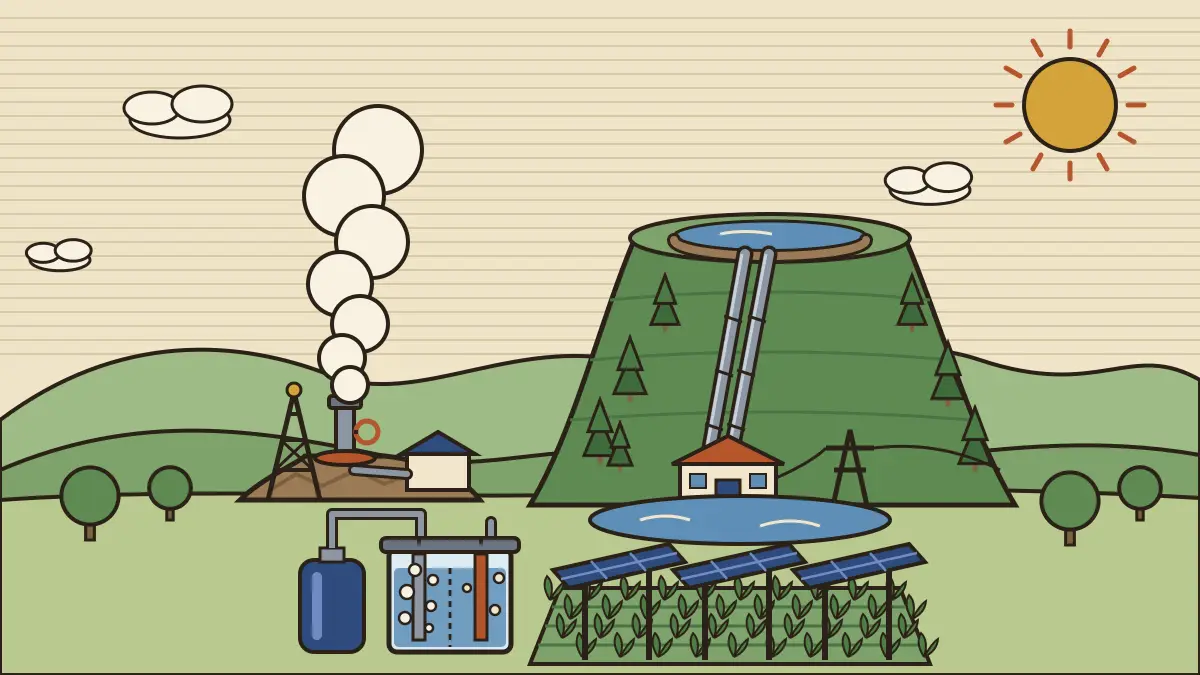
Solar and wind have done most of the work in India's clean-energy build-out so far. The Bharat Renewable Energy Summit & Expo 2026 (Bharat RE 2026) is the occasion to ask what comes next. The Prime Minister is inaugurating it at Bharat Mandapam, New Delhi, on 2 November, from about 4:30 PM according to the PMO announcement. On the same day, PIB published four backgrounders on technologies that sit beside solar and wind: geothermal energy, pumped storage hydropower, green hydrogen and agri-voltaics.
The useful way to read them is not as four separate topics. Each one fills a gap that solar and wind cannot fill alone. This article sets out the gap first, then the four answers, and finishes with the numbers an examiner can ask about.
The summit in one table
| Item | Detail (PMO release, 1 November 2026) |
|---|---|
| Dates and venue | 2–5 November 2026, Bharat Mandapam, New Delhi |
| Theme | 'Invest. Innovate. Inspire.' |
| Participation | Over 130 countries, more than 40 Ministers, investors, financial institutions and industry |
| Country Partners (9) | Australia, Denmark, the European Union, France, Germany, the Netherlands, Norway, Sweden, the United Kingdom |
| States and UTs (13) | Andhra Pradesh, Assam, Bihar, Chhattisgarh, Delhi, Gujarat, Karnataka, Madhya Pradesh, Maharashtra, Odisha, Rajasthan, Uttar Pradesh, West Bengal |
| Expo | Over 400 exhibitors across solar and wind, green hydrogen, energy storage and other areas |
| Predecessor | Builds on RE-INVEST, India's flagship renewable energy investment summit |
Three platforms meet in the same week. Bharat RE is about investment, industry and technology partnerships. The 9th Session of the International Solar Alliance (ISA) Assembly is about international cooperation on solar, including finance and institutional capacity. The 4th International Conference on Green Hydrogen (ICGH) is about hydrogen technologies, investment and scale-up. The ISA was launched by India and France at the Paris climate conference (COP21) on 30 November 2015 for sunshine-rich countries between the Tropics, is headquartered at Gurugram, and its Framework Agreement came into force on 6 December 2017.
On the day of the summit, the Prime Minister also shared two articles on India's solar journey. One, by Union Minister Pralhad Joshi, looks at PM Surya Ghar, PM-KUSUM, solar-powered farming, storage and manufacturing. The other, by Joshi and Mike Bloomberg, covers rooftop solar and investment in storage and transmission.
Why "beyond solar and wind"
Start with the arithmetic. India's installed non-fossil capacity was 308.027 GW as of September 2026, up from the 300.50 GW we reported at the end of July in India Crosses 300 GW Non-Fossil Power Capacity. About 55.29 GW was added in FY 2025-26, and the target is 500 GW by 2030.
The remaining gap is 500 − 308.027 = about 192 GW. At last year's pace of roughly 55 GW a year, that is about 3.5 years. This is The Cavalier's calculation, not an official forecast, but it shows that the build-out is plausible. The harder question is what the grid does with the power. Solar delivers by day, wind when it blows, and demand peaks in the evening. Four gaps follow:
| The gap | The answer | What it does |
|---|---|---|
| Power is generated at one hour and needed at another | Pumped storage | Moves energy across hours |
| Solar and wind depend on weather | Geothermal | Gives firm, round-the-clock power |
| Some industries and vehicles cannot easily run on electricity | Green hydrogen | A fuel and feedstock made from clean power |
| Panels compete with farms for land | Agri-voltaics | Puts both on the same acre |
Geothermal: firm power, first wells
Geothermal energy is heat from inside the Earth, used for power or directly. Unlike solar and wind, it is available round the clock. Our earlier explainer, Heat From Below: India's First Geothermal Wells at Puga, covers the Earth's layers, the ten geothermal provinces and the field projects. The new backgrounder adds the policy and the global picture.
- Policy. The National Policy on Geothermal Energy was notified in September 2025, with the Ministry of New and Renewable Energy (MNRE) as nodal ministry. It prioritises research, drilling, reservoir management and direct-use applications, supports Ground Source Heat Pumps for heating and cooling, allows abandoned oil and gas wells to be repurposed, and provides for a national geothermal data repository, pilot projects and Centres of Excellence.
- First wells. In July 2026 the ONGC Energy Centre commissioned India's first two geothermal wells at Puga Valley, Ladakh, at over 14,000 feet. The two 1,000-metre wells support reservoir evaluation and lead to India's first 1 MW demonstration plant.
- The world. Global installed geothermal capacity reached 15.67 GW by the end of 2025. Indonesia, the United States, the Philippines, Türkiye and New Zealand hold about 67% of it.
- Partners. Cooperation with Australia and Iceland names geothermal as a key area, and an MoU with Saudi Arabia makes it a focus of bilateral engagement.
Keep the scale in view. India's theoretical potential of about 10.6 GW equals roughly two-thirds of what the whole world has installed today, but it is under 4% of India's non-fossil capacity (calculated). Geothermal's value is its firmness, not its size, and the backgrounder itself notes that commercial-scale generation is yet to be established. Newer methods such as Enhanced Geothermal Systems and Advanced Geothermal Systems may widen the map beyond the natural hot-spring belts.
Pumped storage: the long-duration battery
A pumped storage project (PSP) uses two reservoirs at different heights. Surplus electricity pumps water uphill; when power is needed, the water runs down through turbines. For the physics and the comparison with batteries, see our NDA explainer on pumped storage hydropower. What the new backgrounder adds is the classification, the national map and the policy package.
Three types, classified by how the reservoirs relate to natural watercourses:
| Type | Where the reservoirs sit |
|---|---|
| On-stream | Both reservoirs on a river, stream or nallah |
| Off-stream open-loop | One reservoir on a river, stream or nallah; the other not |
| Off-stream closed-loop | Neither reservoir on a river, perennial stream or perennial nallah |
The Government is trying to identify more off-stream sites, because they allow faster execution and have less impact on aquatic ecology.
Where India stands (Central Electricity Authority, August 2026):
| Stage | Capacity | Projects |
|---|---|---|
| Operational | 7.43 GW | 10 |
| Under construction or implementation | 15.87 GW | 11 |
| Concurred or appraised by the CEA | 10.40 GW | 8 |
| Identified potential | 345.38 GW | 320 (62 on-stream, 56.67 GW; 258 off-stream, 288.71 GW) |
The Western Region has the most potential (129.72 GW), led by Maharashtra (67.36 GW) and Gujarat (33.36 GW), thanks to the steep rivers of the Western Ghats. The South has 97.76 GW, the East 53.41 GW (of which Odisha 41.53 GW), the North 50.32 GW and the North East 14.18 GW.
Globally, pumped hydro stood at 159.8 GW at the end of 2025 (IRENA). China has nearly 66 GW, Japan about 22 GW and the United States about 19 GW. India ranks fourth, with 7.18 GW at the end of 2025.
Storage need and the roadmap. The CEA projects 73.93 GW of storage by 2031-32: 26.69 GW from PSPs and 47.24 GW from battery energy storage systems (BESS). The two are complementary. BESS responds quickly and can be sited near generation or demand, while PSPs deliver long-duration storage and long life but need suitable terrain. A separate CEA roadmap envisages 100.81 GW of PSPs to be commissioned by 2035-36, which would take cumulative capacity to 105.56 GW.
The policy package is the part most likely to be asked:
- Ministry of Power guidelines to promote PSPs (April 2023) and tariff-based competitive bidding guidelines (February 2025).
- A 100% waiver of inter-state transmission (ISTS) charges for 25 years from commercial operation, for PSPs awarded by 30 June 2028.
- DPR concurrence time cut from 90 to 50 days; the CEA concurrence limit for hydro schemes raised to ₹3,000 crore, and off-stream closed-loop schemes exempted regardless of cost.
- Environmental appraisal under the B2 category for eligible projects, and the CEA's Jal Vidyut DPR portal for real-time monitoring.
Green hydrogen: for what electricity cannot easily reach
Hydrogen is an energy carrier, not an energy source, and its climate impact depends on how it is made. Rather than repeat the electrolysis chemistry, this section follows the new backgrounder: the National Green Hydrogen Mission (NGHM) and where hydrogen is meant to be used.
Where it fits. Fertiliser plants (ammonia), refineries (removing sulphur and upgrading heavy oil), steelmaking (direct reduced iron), city-gas blending, heavy transport and shipping (as green ammonia or methanol). These are the "hard-to-abate" sectors where direct electrification is difficult. India's first indigenous hydrogen-powered train was inaugurated on 17 July 2026 on the Jind–Sonipat section.
What counts as green. The Green Hydrogen Standard (notified by MNRE in August 2023) requires emissions of no more than 2 kg of CO₂ equivalent per kg of hydrogen, measured well-to-gate as a 12-month average. About 9 litres of demineralised water are needed per kg of hydrogen.
| NGHM at a glance | Figure |
|---|---|
| Approved | January 2023; outlay ₹19,744 crore |
| Target | At least 5 million tonnes a year by 2030 (up to 10 MMT with export demand) |
| SIGHT programme | ₹17,490 crore to 2029-30, for electrolyser manufacturing and hydrogen production |
| Electrolyser incentives | 15 companies, 3,000 MW a year |
| Capacity commissioned | About 8,000 tonnes a year (February 2026) |
| Capacity with incentives awarded | 8.62 lakh tonnes a year |
| Offtake commitments signed | Over 5.5 lakh tonnes a year (till October 2026) |
| Expected gains by 2030 | ₹1 lakh crore of fossil-fuel imports avoided, ₹8 lakh crore of investment, 6 lakh+ jobs, about 50 MMT of CO₂ avoided a year |
Read those numbers against the target. The 8,000 tonnes commissioned is about 0.16% of 5 million tonnes, and the 8.62 lakh tonnes awarded is about 17% (calculated). The Mission is at the start of its scale-up, and that is the honest way to describe it.
The architecture around the numbers: Green Hydrogen Hubs at Deendayal Port (Kandla), V.O. Chidambaranar Port (Tuticorin) and Paradip Port; four Hydrogen Valley Innovation Clusters (Jodhpur, Odisha, Pune, Kerala); pilots in steel, heavy mobility (70 vehicles, 16 refuelling stations) and shipping; waiver of ISTS charges for 25 years for plants commissioned by 31 December 2030; a Green Hydrogen Certification Scheme (April 2025) with the Bureau of Energy Efficiency accrediting agencies; and dedicated policies in six states (Gujarat, Andhra Pradesh, Maharashtra, Uttar Pradesh, Rajasthan, West Bengal).
Agri-voltaics: two harvests from one acre
Agri-voltaics (also agri-solar or dual-use solar) combines crops, or livestock, and solar generation on the same land. Panels sit on elevated structures high enough to let light, rain and machinery pass; partial shade can reduce soil moisture loss. Our detailed explainer, One Field, Two Harvests, and the Height of the Panel, covers PM-KUSUM and the conference. The new backgrounder adds the following:
- Status. As of August 2025, India had 36 operational agri-voltaic projects with 37.54 MW installed, and 10 pilots under development.
- Potential. Estimates range from 3,000 GW to nearly 14,000 GW, a spread that shows how assumption-dependent they are. A GIS screening found 47.35 million hectares of "restricted cropland" suitable after environmental, agronomic and technical filters. Six states (Maharashtra, Rajasthan, Andhra Pradesh, Madhya Pradesh, Karnataka, Uttar Pradesh) account for nearly 50% of the potential.
- Income. In some cases earnings could rise from about ₹60,000 per acre to over ₹1 lakh per acre. Fruits, vegetables, spices and medicinal plants are the promising crops.
- Institutions. PM-KUSUM (launched February 2019, central assistance of about ₹34,422 crore); a Centre of Excellence run by the National Institute of Solar Energy with ICAR's IARI, including a 100 kW system; and the India Agrivoltaics Alliance (2023, anchored by NSEFI).
- States. Maharashtra's Mukhyamantri Saur Krushi Vahini Yojana 2.0, Gujarat's Kisan Suryoday Yojana and Karnataka's Surya Raitha.
Four traps for the exam
- Capacity is not generation. GW measures how much power a plant can deliver at an instant, not how much it delivers over a year. For storage, the hours it can sustain matter as much as the GW.
- Storage and hydrogen are not sources. Pumped storage and hydrogen move energy in time or across sectors, and some is lost on the way. Geothermal and solar are sources.
- "Green" has a number. In India it is 2 kg CO₂e per kg of hydrogen, well-to-gate, averaged over 12 months.
- Mind the planning horizons. 26.69 GW (CEA's PSP projection for 2031-32) and 105.56 GW (cumulative PSP capacity under the roadmap to 2035-36) are different documents with different dates. Do not mix them.
🔑 Revision block
The summit. Bharat RE 2026, 2–5 November 2026, Bharat Mandapam; theme 'Invest. Innovate. Inspire.'; 130+ countries, 9 Country Partners, 13 states and UTs, 400+ exhibitors; alongside the 9th ISA Assembly and 4th ICGH. ISA: COP21 Paris (30 Nov 2015), HQ Gurugram, in force 6 Dec 2017.
The gap. Non-fossil capacity 308.027 GW (Sept 2026); 55.29 GW added in FY 2025-26; target 500 GW by 2030 (gap about 192 GW, about 3.5 years at last year's pace).
Geothermal. Policy September 2025 (MNRE); first two wells at Puga (July 2026, ONGC Energy Centre); 1 MW demo next; potential about 10.6 GW; world 15.67 GW (top five hold 67%).
Pumped storage. 7.43 GW operational (10), 15.87 GW under construction (11), 10.40 GW concurred (8); potential 345.38 GW (320 sites); India 4th in the world; CEA storage need 73.93 GW by 2031-32 (26.69 PSP + 47.24 BESS); 100.81 GW to be added by 2035-36; 100% ISTS waiver for 25 years if awarded by 30 June 2028.
Green hydrogen. NGHM January 2023, ₹19,744 crore, 5 MMT by 2030; SIGHT ₹17,490 crore; standard 2 kg CO₂e/kg H₂ (Aug 2023); hubs at Kandla, Tuticorin, Paradip; hydrogen train 17 July 2026.
Agri-voltaics. 36 projects, 37.54 MW (Aug 2025); potential 3,000–14,000 GW; PM-KUSUM (Feb 2019); income ₹60,000 to ₹1 lakh+ per acre.
🎯 Practice MCQs
Q1. The 9th Assembly of which body is being held alongside Bharat RE 2026?
(a) International Renewable Energy Agency
(b) International Solar Alliance
(c) International Energy Agency
(d) International Energy Forum
→ (b)
The ISA, launched by India and France at COP21 in 2015, is headquartered at Gurugram. IRENA is based in Abu Dhabi and the IEA in Paris.
Q2. A pumped storage scheme in which neither reservoir lies on a river, perennial stream or perennial nallah is called:
(a) On-stream
(b) Off-stream open-loop
(c) Run-of-the-river
(d) Off-stream closed-loop
→ (d)
Open-loop has one reservoir on a watercourse. Run-of-the-river is a different type of hydro plant that does not store water.
Q3. Consider the following statements:
1. Pumped storage stores electricity by moving water between two reservoirs at different heights.
2. India's operational pumped storage capacity of about 7.43 GW is larger than its installed solar capacity.
Which of the statements given above is/are correct?
(a) 1 only
(b) 2 only
(c) Both 1 and 2
(d) Neither 1 nor 2
→ (a)
Solar capacity was about 164.59 GW at the end of July 2026, far above 7.43 GW. Statement 1 is the definition.
Q4. India's Green Hydrogen Standard allows a maximum of how many kg of CO₂ equivalent per kg of hydrogen (well-to-gate, 12-month average)?
(a) 0.5
(b) 1
(c) 2
(d) 4
→ (c)
The standard was notified by MNRE in August 2023. Hydrogen above that threshold does not qualify as green.
Q5. The National Green Hydrogen Mission targets annual green hydrogen production capacity of at least how much by 2030?
(a) 1 million tonnes
(b) 5 million tonnes
(c) 10 million tonnes
(d) 19.7 million tonnes
→ (b)
The 10 MMT figure applies if export demand materialises. The outlay of ₹19,744 crore is the source of option (d)'s digits.
Q6. The nodal ministry for the National Policy on Geothermal Energy (September 2025) is:
(a) Ministry of New and Renewable Energy
(b) Ministry of Power
(c) Ministry of Earth Sciences
(d) Ministry of Mines
→ (a)
MNRE is nodal. The Geological Survey of India, under the Ministry of Mines, mapped the hot springs and provinces but does not run the policy.
Q7. India had 308.027 GW of non-fossil capacity in September 2026 and added about 55.29 GW in FY 2025-26. At that pace, the time needed to reach 500 GW is closest to:
(a) 1.5 years
(b) 2.5 years
(c) 3.5 years
(d) 5.5 years
→ (c)
(500 − 308.027) ÷ 55.29 ≈ 3.5. This is an illustration of pace, not a forecast.
Q8. The PM-KUSUM scheme, which supports solar pumps and decentralised solar plants for farmers, was launched in:
(a) 2014
(b) 2016
(c) 2018
(d) 2019
→ (d)
It was launched in February 2019. PM Surya Ghar, the rooftop-solar scheme, came in 2024.
📋 How this gets asked (PYQ pattern)
Energy questions in the CDS general knowledge paper appear in three common forms. The first is match the technology to its description or its nodal body: geothermal to MNRE, a "water battery" to pumped storage, hydrogen as a carrier. The second is targets and dates: 500 GW by 2030, net zero by 2070, the year a scheme was launched. The third is statement-type items on policy, where one clause carries a subtle error such as swapping capacity for generation or a source for a store.
The fresh hooks this cycle are the 308.027 GW figure, India's fourth rank in pumped storage, the 2 kg CO₂e hydrogen standard, the first geothermal wells at Puga and the nine Country Partners at the summit. Questions on the Bharat RE event itself usually ask for its theme, venue and co-located platforms.
Preparing for CDS? For every energy technology, learn one number, one place and one policy. That is how this topic is usually set. Follow the daily CDS current affairs, revise with our notes on economic geography: energy, and learn with experienced faculty in the upcoming Cavalier courses in Delhi.
Source: PIB, "PM to Inaugurate Bharat Renewable Energy Summit & Expo 2026 on 2nd November" (Prime Minister's Office, 1 November 2026); PIB Backgrounders "Geothermal Energy", "Pumped Storage Hydropower", "Green Hydrogen" and "Agri-Voltaics" (2 November 2026); PIB releases on the Prime Minister sharing articles on solar energy (2 November 2026). International Solar Alliance background from the UNFCCC and ISA records. Remaining-gap arithmetic and percentage comparisons calculated by The Cavalier from the published figures.
✍️ Written by Aditya Tiwari — Environment & current-affairs faculty at The Cavalier. Reviewed by the Cavalier Faculty Desk.