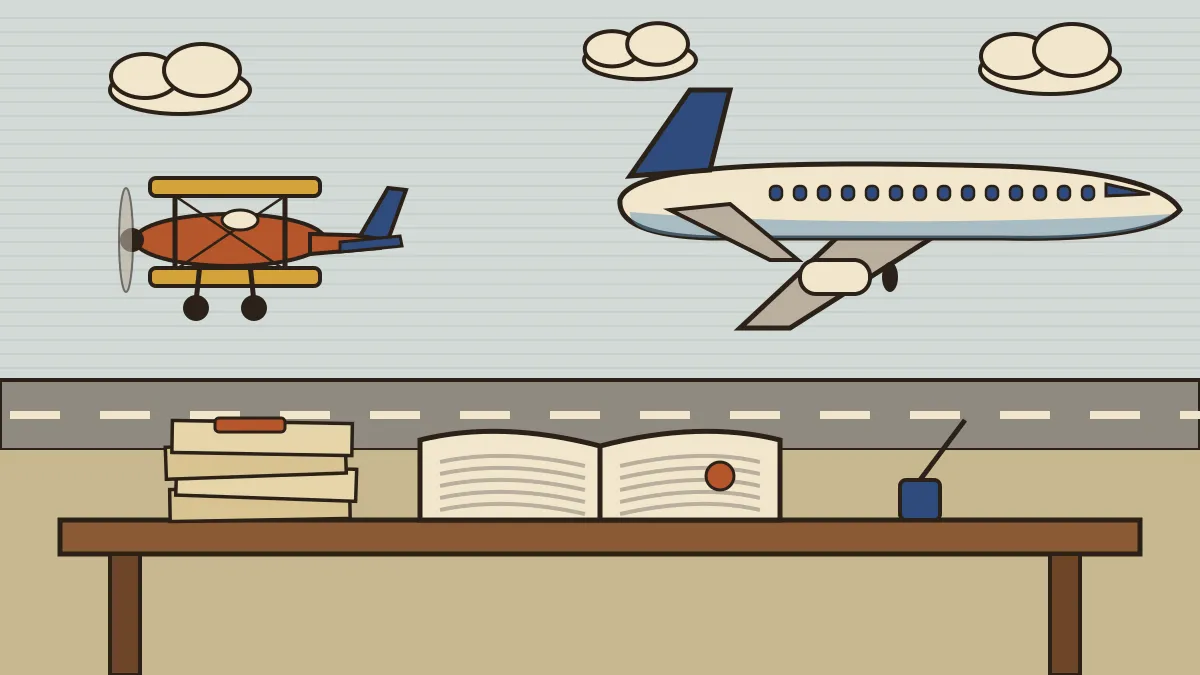
For almost ninety years, the day-to-day rules of Indian civil aviation were written in a document drawn up when aircraft were small, slow and few. The Aircraft Rules, 1937 governed how an aeroplane was registered, how a pilot was licensed and what an aerodrome had to provide. They were amended many times, but the frame was that of the biplane age.
On 4 November 2026, a PIB Backgrounder set out the rulebook for a different era: the Bharatiya Vayuyan Niyam, 2026. It comes into force on 1 January 2027 and replaces the 1937 Rules. This article explains where the new Rules sit in the legal order, what they change, and how to remember the numbers.
Three layers of aviation law
The first step is to see that there are three separate layers, because examiners test the layers.
| Layer | Name | What it is |
|---|---|---|
| International | Chicago Convention, 1944 and ICAO Annexes | The global treaty that sets standards; India is a contracting State |
| Statute | Bharatiya Vayuyan Adhiniyam, 2024 | Act of Parliament; re-enacted the Aircraft Act, 1934; in force 1 January 2025 |
| Subordinate law | Bharatiya Vayuyan Niyam, 2026 | Rules made by the Central Government under the Adhiniyam; replace the Aircraft Rules, 1937 |
Below the Rules sit the Civil Aviation Requirements (CARs), Aeronautical Information Circulars and Notices to Airmen (NOTAMs) issued by the Directorate General of Civil Aviation (DGCA), the regulator we describe in our piece on aviation safety, the AAIB and DGCA.
An Adhiniyam is simply the Hindi word for an Act, and Niyam is the word for rules. The renaming follows the Government's drive to replace colonial-era laws with Bharatiya titles, seen most clearly in the three criminal laws we covered in the new criminal laws explainer.
Why rules matter as much as the Act
An Act sets the principles and gives the Government power to make detailed rules. The detail (how long a licence lasts, who must carry how many cabin crew, what the fine is for a particular breach) lives in the rules. Such rules are called delegated legislation or subordinate legislation: Parliament delegates the power, and the executive uses it within the limits the Act sets.
Delegated rules are not beyond Parliament's reach. They must ordinarily be laid before Parliament, and the Committee on Subordinate Legislation of each House examines whether the Government has stayed inside the power given. Our notes on parliamentary committees cover how that scrutiny works.
The legislative history of this change is short:
- Bharatiya Vayuyan Vidheyak, 2024: introduced by Civil Aviation Minister Ram Mohan Naidu; passed by the Lok Sabha on 9 August 2024 and the Rajya Sabha on 5 December 2024.
- Bharatiya Vayuyan Adhiniyam, 2024: in force from 1 January 2025.
- Bharatiya Vayuyan Niyam, 2026: the rules, effective 1 January 2027.
Note the gap between the Act (2025) and the Rules (2027). An Act cannot do much day-to-day work until its detailed rules are ready, and the gap gives airlines, airports and the regulator time to prepare.
The Niyam at a glance
According to PIB, the Niyam comprise 220 rules organised into eight chapters and six schedules. They cover aircraft registration, airworthiness, personnel licensing, aerodrome operations, air navigation services and aircraft operations, plus oversight, safety management, enforcement and penalties. They replace the Aircraft Rules, 1937 and Part IX of the Aircraft Rules, 1920, and repeal the Radio Telephone Operator (Restricted) Certificate and Licence Rules, 2025, subject to savings.
The context is growth. The number of operational airports rose from 74 in 2014 to 166 as of October 2026. A rulebook written for a handful of airfields cannot manage that, nor a fleet and a passenger base that have grown many times over.
What is new: design, ownership and finance
The most notable changes are about the aircraft itself and who owns it.
Aircraft design and certification. The Rules set a clearer framework for type certificates, acceptance of designs and authorisation to manufacture components. DGCA may issue type certificates for aircraft, engines and propellers where India is the State of Design, and may validate foreign type certificates on conditions. In ICAO language, the State of Design is the country whose authority approves a product's type design. The aim is to strengthen India's position as a designer and manufacturer, not just an operator.
Fractional ownership. An aircraft can be jointly owned, while its operation and maintenance sit under a clearly identified responsible party. This is common in business aviation abroad and was not explicit in the old Rules.
Aircraft leasing and IDERA. Many airlines lease their aircraft rather than buy them. The Protection of Interests in Aircraft Objects Act, 2025, passed by Parliament in April 2025, gave domestic effect to the Cape Town Convention (2001), which India had adopted in 2008. PIB noted that weak enforcement had raised leasing costs by about 8 to 10% compared with other countries. The Niyam add the practical piece: the Irrevocable De-registration and Export Request Authorisation (IDERA). When a lessor holds an IDERA and the lessee defaults, the lessor can ask for the aircraft to be deregistered and exported, and eligible applications must be processed within five working days. Faster repossession lowers lenders' risk and, over time, the cost of leasing and airfares.
Registration marks. Indian aircraft carry the nationality mark VT, followed by a hyphen and three capital letters. Aircraft may be registered in Category A or B, depending on ownership, citizenship and leasing criteria.
Safety rules: people, places and procedures
The Rules keep the core of aviation safety and tighten the detail.
People. The Niyam specify 23 categories of licences, ratings and certificates for pilots, flight engineers, aircraft maintenance engineers, air traffic controllers and radio-telephone operators. Air traffic controllers may exercise licence privileges only up to the age of 60. Crew may not consume alcohol or specified intoxicants within 12 hours before a flight or during duty, and alcohol consumption is prohibited on domestic air transport services. The pilot-in-command has final authority over the aircraft.
Cabin crew. An Indian-registered aircraft carrying passengers for public transport must carry a minimum number, according to seats:
| Aircraft | Minimum cabin crew |
|---|---|
| Aeroplanes with 10–50 seats; helicopters with 20–50 seats | 1 |
| More than 50 seats | 2, plus 1 more for every 50 seats or part of 50 beyond 99 seats |
No cabin crew member may serve on more than three aircraft types.
Aerodromes. Aerodromes may be licensed for public or private use; licensees must keep an aerodrome manual. Around airports the Rules limit hazards: misleading lights within 5 nautical miles, lasers within 10 nautical miles (permission from the aerodrome operator needed), and slaughter, garbage dumping and other wildlife-attracting activity within 10 km, since birds are among the commonest hazards to aircraft. Photography at aerodromes and from aircraft in flight needs permission.
Air navigation. The Rules cover air traffic management, controllers' duty and rest limits, communication and surveillance facilities, weather information (records kept for at least 30 days), the design of instrument flight procedures, and search and rescue agreements with neighbouring States. Civil aircraft operations that generate sonic booms over India are prohibited.
Passengers, fares and regional connectivity
The Niyam also reach the passenger. Airlines must set tariffs on factors including operating costs and publish them digitally; scheduled operators submit tariffs to DGCA for monitoring; and booking websites and tickets must show the total payable amount with a breakdown of fare, taxes, fees and charges. In extraordinary situations, the Central Government may issue proportionate, time-bound directions in the public interest. PIB frames this as a balance between airlines' commercial freedom and passengers' interests.
A further provision lets the Central Government set up a Regional Air Connectivity Fund, to pay viability gap funding for regional routes, financed possibly by a levy on domestic scheduled flights and contributions from States. That is the legal footing for the kind of support the UDAN scheme gives, which we discuss in our explainer on Viksit UDAN.
Oversight and the shift to softer penalties
The most significant policy shift is in how the Rules punish.
- 21 punishable offences, with imprisonment of up to two years, a fine of up to ₹1 crore, or both.
- 18 compoundable offences, meaning the offender can settle the matter by paying, without a trial.
- A graded penalty structure of ten severity levels, with money penalties from ₹10,000 to ₹1 crore, depending on the nature of the breach and the category and size of the offender.
- Appeals, opportunity of hearing and reasoned orders, so that a penalty can be challenged.
PIB describes this as a "calibrated approach towards decriminalisation of regulatory contraventions" that keeps safety standards high. The idea is that jail should be kept for the dangerous acts, and a paperwork lapse should cost money, not liberty.
Supervision is also sharpened. DGCA must frame a State Safety Programme; operators, aerodromes, maintenance and training organisations and air traffic service providers must run Safety Management Systems; and DGCA must run both mandatory and voluntary safety reporting. The voluntary system must be non-punitive and protect the reporter's confidentiality, which is the "just culture" idea. Draft CARs must ordinarily be published for 30 days for comment, though that period can be shortened or waived in the public interest by a written order. DGCA-authorised staff may carry out unannounced inspections, and licences or approvals can be suspended, cancelled or restricted for non-compliance or unresolved safety concerns.
Questions to carry away
- Is this a new law? No. It is subordinate legislation made under a 2024 Act.
- Does it apply today? No. It starts on 1 January 2027.
- Does it replace the Act of 1934? No. The 1934 Act was re-enacted as the 2024 Adhiniyam; the Niyam replace the 1937 Rules.
- What is the headline? A modern, safety-first rulebook with less criminalisation and more transparency.
🔑 Revision block
The Rules. Bharatiya Vayuyan Niyam, 2026: 220 rules, eight chapters, six schedules; in force 1 January 2027; PIB Backgrounder of 4 November 2026.
What they replace. Aircraft Rules, 1937 and Part IX of the Aircraft Rules, 1920; repeal the Radio Telephone Operator (Restricted) Certificate and Licence Rules, 2025 (with savings).
Legal chain. Chicago Convention, 1944 → Bharatiya Vayuyan Adhiniyam, 2024 (re-enacted Aircraft Act, 1934; LS 9 Aug 2024, RS 5 Dec 2024; in force 1 Jan 2025) → Niyam, 2026 → CARs/NOTAMs of DGCA.
Key provisions. 23 licence categories; controllers up to age 60; crew alcohol ban 12 hours; no alcohol on domestic flights; cabin crew 1 / 2 + 1 per 50 beyond 99; max 3 types per cabin crew; lasers 10 NM, misleading lights 5 NM, wildlife hazards 10 km; mark VT.
Finance and ownership. Fractional ownership; IDERA, deregistration processed within 5 working days; Protection of Interests in Aircraft Objects Act, 2025 (Cape Town Convention 2001; India adopted 2008); Regional Air Connectivity Fund with possible levy on domestic flights.
Penalties. 21 punishable offences (up to 2 years, fine up to ₹1 crore), 18 compoundable, ten severity levels (₹10,000 to ₹1 crore), appeals and reasoned orders.
Numbers. Operational airports 74 (2014) to 166 (October 2026); draft CARs open for 30 days.
🎯 Practice MCQs
Q1. The Bharatiya Vayuyan Niyam, 2026 replaces which of the following?
(a) Aircraft Act, 1934
(b) Bharatiya Vayuyan Adhiniyam, 2024
(c) Carriage by Air Act, 1972
(d) Aircraft Rules, 1937
→ (d)
The Niyam are rules and replace the 1937 Rules. The Act of 1934 was re-enacted as the Adhiniyam of 2024, and the Carriage by Air Act deals with airline liability.
Q2. The Bharatiya Vayuyan Niyam, 2026 are made under the authority of:
(a) The Bharatiya Vayuyan Adhiniyam, 2024
(b) The Carriage by Air Act, 1972
(c) The Chicago Convention, 1944, directly
(d) The Aircraft Act, 1934
→ (a)
Subordinate legislation draws its power from the parent Act. The 1934 Act was re-enacted in 2024, and a treaty is not a source of rule-making power by itself.
Q3. The Bharatiya Vayuyan Niyam, 2026 consist of how many rules, arranged in eight chapters and six schedules?
(a) 120
(b) 220
(c) 320
(d) 420
→ (b)
PIB's backgrounder gives 220 rules in eight chapters and six schedules.
Q4. Under the Niyam, eligible applications from an IDERA holder for cancellation of an aircraft's registration must be processed within:
(a) 24 hours
(b) 2 working days
(c) 5 working days
(d) 30 days
→ (c)
The time-bound five-working-day process is meant to speed up repossession and export, lowering leasing risk.
Q5. The IDERA mechanism is linked to which international convention?
(a) Chicago Convention
(b) Cape Town Convention
(c) Montreal Convention
(d) Tokyo Convention
→ (b)
IDERA is part of the Cape Town Convention framework on aircraft financing, which India gave domestic effect through the Protection of Interests in Aircraft Objects Act, 2025.
Q6. Consider the following statements about the Niyam:
1. Aerodrome tariffs may be set higher for foreign aircraft of other contracting States than for Indian aircraft.
2. Crew members may consume alcohol up to six hours before a flight.
Which of the statements given above is/are correct?
(a) 1 only
(b) 2 only
(c) Both 1 and 2
(d) Neither 1 nor 2
→ (d)
Aerodrome tariffs must give equal treatment to Indian aircraft and aircraft of other contracting States, and the alcohol bar on crew is 12 hours before a flight.
Q7. Consider the following statements about the Niyam:
1. Draft Civil Aviation Requirements must ordinarily be published on the DGCA website for 30 days to invite comments.
2. The maximum imprisonment for the punishable offences is five years.
Which of the statements given above is/are correct?
(a) 1 only
(b) 2 only
(c) Both 1 and 2
(d) Neither 1 nor 2
→ (a)
The consultation period is 30 days, though it can be shortened or waived by written order. The maximum imprisonment is two years.
Q8. Consider the following statements about enforcement under the Niyam:
1. There are 21 punishable offences and 18 compoundable offences.
2. Monetary penalties are graded across ten severity levels, from ₹10,000 to ₹1 crore.
Which of the statements given above is/are correct?
(a) 1 only
(b) 2 only
(c) Both 1 and 2
(d) Neither 1 nor 2
→ (c)
Both figures are in the PIB backgrounder, which describes a calibrated, graded approach with appeals and reasoned orders.
📋 How this gets asked (PYQ pattern)
Law and governance questions on a new instrument like this are asked in three ways.
The first is the hierarchy of laws: Constitution, Act, rules, regulations and executive orders, and which can be made by whom. The usual trap is to confuse an Act with the rules made under it, as Q1 and Q2 do.
The second is bodies and their functions: the Ministry of Civil Aviation for policy, the DGCA as regulator, the AAIB as investigator, the AAI as airport operator, and ICAO as the international standard setter. Match the body to its job.
The third is statement-type items on provisions, where one clause carries a subtle error such as a wrong number of hours, years or crore. The fresh hooks this cycle are 220 rules, 1 January 2027, 1937 Rules replaced, IDERA in five working days, 21 punishable and 18 compoundable offences, and the ₹1 crore ceiling.
Preparing for CDS? Revise how Parliament, committees and delegated powers work in our CDS/OTA polity notes, and follow the daily CDS current affairs for each new law as it is notified. Learn with experienced faculty in the upcoming Cavalier courses in Delhi.
Source: PIB Backgrounder, "Bharatiya Vayuyan Niyam, 2026: A Modern Rulebook for India's Skies", Ministry of Civil Aviation / PIB Research, 4 November 2026. Legislative history from the PIB Year End Review 2024 of the Ministry of Civil Aviation (3 January 2025) and PIB's release on the Protection of Interest in Aircraft Objects Bill (4 April 2025).
✍️ Written by Hitendra Deswal — Polity & current-affairs faculty at The Cavalier. Reviewed by the Cavalier Faculty Desk.