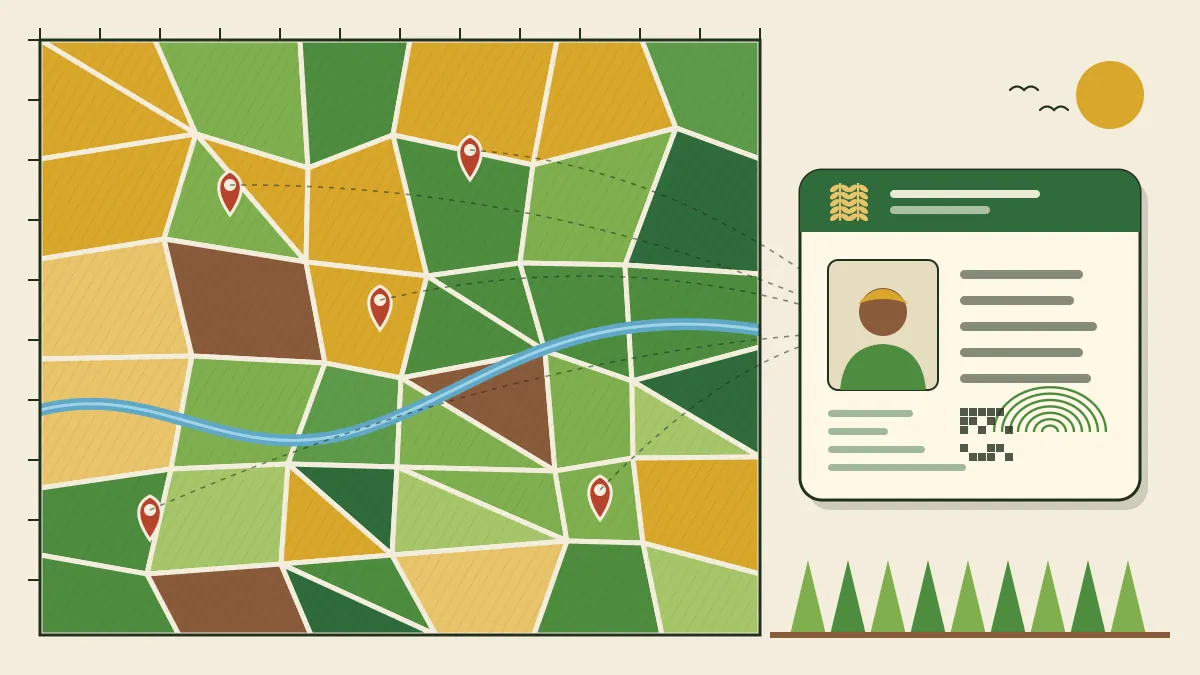
India has created 11 crore Farmer IDs, the Agriculture Ministry announced on 24 October 2026. The target was reached on the night of 23 October, five months ahead of the 31 March 2027 deadline. The IDs are being built under the Digital Agriculture Mission, and the Ministry says that more than 6 crore farmers have already received benefits through Farmer ID-based delivery.
A Farmer ID sounds like one more card. It is better understood as the farm sector's version of the identity layer that made direct benefit transfers possible — and its weaknesses are as instructive as its strengths.
What a Farmer ID is
A Farmer ID is a unique digital identity for a farmer, held in a Farmers' Registry and linked to:
- the farmer's land records;
- livestock ownership;
- the crops sown, season by season;
- demographic and family details;
- the schemes and benefits the farmer has already received.
It is often described as "Aadhaar for farmers", and the comparison is useful in one respect: Aadhaar establishes who a person is, while a Farmer ID establishes who farms what land, and what grows on it. That second fact is what agricultural schemes actually depend on.
The mission behind it
The Digital Agriculture Mission was approved by the Union Cabinet on 2 September 2024, with an outlay of ₹2,817 crore, of which the Centre's share is ₹1,940 crore. It has three parts:
| Component | What it contains |
|---|---|
| Digital public infrastructure (DPI) | AgriStack; the Krishi Decision Support System; Soil Profile Mapping |
| Digital General Crop Estimation Survey (DGCES) | Technology-based crop-cutting experiments for estimating yields |
| IT initiatives | Support for Central and State projects, academic and research institutions |
AgriStack's three registries
AgriStack is built on three foundational registries:
- Farmers' Registry — the Farmer IDs.
- Geo-referenced village maps — land parcels located precisely on a map.
- Crop Sown Registry — what is sown on each parcel in each season, recorded through digital crop surveys.
Put together, they answer the three questions every agricultural scheme must answer: who the farmer is, where the land is, and what is growing on it.
Why the States build it
The registries are created and maintained by State and UT governments, and the Minister described the milestone as an example of cooperative federalism. That follows from the Constitution: agriculture and land, including land records, are State subjects in the Seventh Schedule. The Centre can fund the mission and set common standards, but the land records that a Farmer ID depends on belong to the States.
What changes for a farmer
The Ministry listed four areas where Farmer IDs are meant to cut paperwork and repeated verification:
- Bank credit and the Kisan Credit Card — loans processed without the same documents being submitted again and again. The wider credit picture is in our explainer on rural credit and agricultural finance.
- Pradhan Mantri Fasal Bima Yojana — crop-loss assessment and claim payments made more transparently, straight to bank accounts.
- Disaster relief — assistance reaching eligible farmers faster.
- Procurement at Minimum Support Price — fewer intermediaries between the farmer and the procurement agency.
The largest single user is likely to be PM-KISAN, the income-support scheme whose 23rd instalment reached 9.44 crore farmers in June. A verified registry linked to land records is exactly what such a scheme needs to keep ineligible or duplicate beneficiaries out.
The gap the registry has to close: tenant farmers
The design has one structural weakness, and the release itself points to it: States are taking steps to bring tenant farmers and actual cultivators onto the platform.
The difficulty is simple. A Farmer ID is anchored in land records, and land records record the owner. In much of India, the person who actually farms a plot is a tenant or sharecropper whose arrangement is informal and unrecorded. A registry built on ownership can therefore identify the landlord precisely and miss the cultivator entirely — and the cultivator is the person who bears crop losses and needs credit. How States bring tenants in, without forcing landlords to formalise arrangements they would rather keep informal, is the policy question that will decide how complete the registry really is.
A second dependency is the quality of land records themselves. The registry can only be as accurate as the records it links to, which is why land-record digitisation and the Unique Land Parcel Identification Number (ULPIN) — a 14-digit identity for each land parcel, sometimes called Bhu-Aadhaar — sit alongside it.
AgriStack in the wider DPI story
India's development strategy over the past decade has relied on digital public infrastructure: a shared, interoperable layer that public and private services can build on. The pattern began with Aadhaar for identity and UPI for payments, and is now being extended sector by sector — the Ayushman Bharat Digital Mission for health, the Account Aggregator framework and Unified Lending Interface for credit, and AgriStack for agriculture.
The principle in each case is the same: build the registry and the rails once, as public infrastructure, and let many schemes and services use them. A Farmer ID is valuable not because of any one benefit it unlocks, but because every future agricultural scheme can be designed on top of it.
🔑 Revision block
- The milestone: 11 crore Farmer IDs created by 23 October 2026, five months before the 31 March 2027 deadline; 6 crore+ farmers already received benefits through Farmer ID-based delivery.
- Farmer ID: unique digital identity in the Farmers' Registry, linked to land records, livestock, crops sown, family details and benefits availed.
- Digital Agriculture Mission: approved 2 September 2024; outlay ₹2,817 crore (Centre ₹1,940 crore).
- Components: DPI (AgriStack, Krishi Decision Support System, Soil Profile Mapping), Digital General Crop Estimation Survey, IT initiatives.
- AgriStack registries: Farmers' Registry, geo-referenced village maps, Crop Sown Registry — built and maintained by States/UTs (agriculture and land are State subjects).
- Uses: KCC credit, PMFBY claims, disaster relief, MSP procurement, PM-KISAN verification.
- Gap: tenant farmers and actual cultivators, because the registry is anchored in ownership records; land-record quality and ULPIN (14-digit land parcel ID).
- DPI pattern: Aadhaar → UPI → sectoral stacks (health, credit, AgriStack).
🎯 Practice MCQs
Q1. The Farmer ID is being created under which mission? (a) National Mission on Sustainable Agriculture (b) Digital Agriculture Mission (c) Mission for Integrated Development of Horticulture (d) National Food Security Mission
→ (b) The Digital Agriculture Mission, approved in September 2024, includes AgriStack and its Farmers' Registry.
Q2. Which of the following is NOT one of AgriStack's three foundational registries? (a) Farmers' Registry (b) Geo-referenced village maps (c) Crop Sown Registry (d) Soil Health Card Registry
→ (d) Soil Profile Mapping is a separate DPI component of the mission; it is not one of AgriStack's three registries.
Q3. The Digital Agriculture Mission was approved by the Union Cabinet in: (a) September 2024 (b) February 2019 (c) August 2021 (d) January 2026
→ (a) It was approved on 2 September 2024 with an outlay of ₹2,817 crore.
Q4. AgriStack's registries are created and maintained by State and UT governments mainly because: (a) the Union has no funds for agriculture (b) agriculture and land are State subjects under the Seventh Schedule (c) the Supreme Court has barred central databases (d) the Finance Commission requires it
→ (b) Land records belong to the States, so the registry that depends on them is built by the States.
Q5. The Digital General Crop Estimation Survey is primarily intended to: (a) count the number of tractors in each district (b) register agricultural labourers (c) estimate crop yields using technology-based crop-cutting experiments (d) fix the Minimum Support Price
→ (c) Yield estimates feed crop-insurance assessments and production statistics.
Q6. The main reason tenant farmers are hardest to include in a Farmer ID registry is that: (a) they are not citizens of India (b) they do not have bank accounts (c) the registry is anchored in land records, which usually record the owner rather than the cultivator (d) they are barred from all government schemes
→ (c) Informal tenancy leaves the actual cultivator invisible in ownership-based records.
Q7. The Unique Land Parcel Identification Number (ULPIN) is a: (a) 12-digit number issued to every farmer (b) 14-digit identity for each land parcel (c) bank account number for land revenue (d) registration number for agricultural machinery
→ (b) ULPIN, sometimes called Bhu-Aadhaar, identifies land parcels rather than people.
Q8. Which of the following best describes "digital public infrastructure"? (a) shared, interoperable digital systems on which many public and private services can be built (b) government-owned telecom towers (c) computers supplied to government schools (d) private apps licensed by the government
→ (a) Aadhaar, UPI and now AgriStack are examples of the same approach.
Q9. The Farmer ID target of 11 crore was originally to be achieved by: (a) 31 December 2025 (b) 31 March 2026 (c) 15 August 2026 (d) 31 March 2027
→ (d) It was achieved on 23 October 2026, five months early.
Q10. Which of the following schemes is expected to use the Farmer ID to make crop-loss claims more transparent? (a) Pradhan Mantri Fasal Bima Yojana (b) PM Surya Ghar (c) Pradhan Mantri Awas Yojana (d) Stand-Up India
→ (a) PMFBY is the crop-insurance scheme; claims would be assessed and paid through the verified registry.
📋 How this gets asked (PYQ pattern)
Agricultural schemes and digital governance are steady sources of CDS Economy questions, and AgriStack supplies material for the usual forms.
The first is the component question: which of the following is NOT part of AgriStack, or of the Digital Agriculture Mission. The registries, the decision support system and soil mapping are easily confused, and a plausible-sounding extra item such as a soil health registry is the natural distractor.
The second is the federalism question: who builds and maintains the registries. Candidates who assume a central database answer wrongly; the State-subject logic gives the right answer every time.
The third is the scheme-linkage question: which schemes the Farmer ID serves — PM-KISAN, PMFBY, KCC, MSP procurement — usually with an unrelated scheme slipped in.
A fourth, increasingly common, is the concept question on digital public infrastructure: what DPI means and which systems are examples of it.
For a written answer on agricultural reform, the point to make is that India's farm schemes have long been limited less by money than by information — who farms what, and where. AgriStack attempts to fix the information problem. State honestly that a registry built on ownership records will under-count tenants, and argue that its value depends on how completely it captures the people who actually cultivate.
Preparing for CDS/OTA? For every scheme, learn its ministry, its year and its components — and for digital schemes, which level of government holds the data. Start with our CDS/OTA study material, follow the daily CDS current affairs, and prepare with our faculty in the upcoming Cavalier courses in Delhi.
✍️ Written by Aditya Tiwari — Economy & current-affairs faculty at The Cavalier. Reviewed by the Cavalier Faculty Desk.