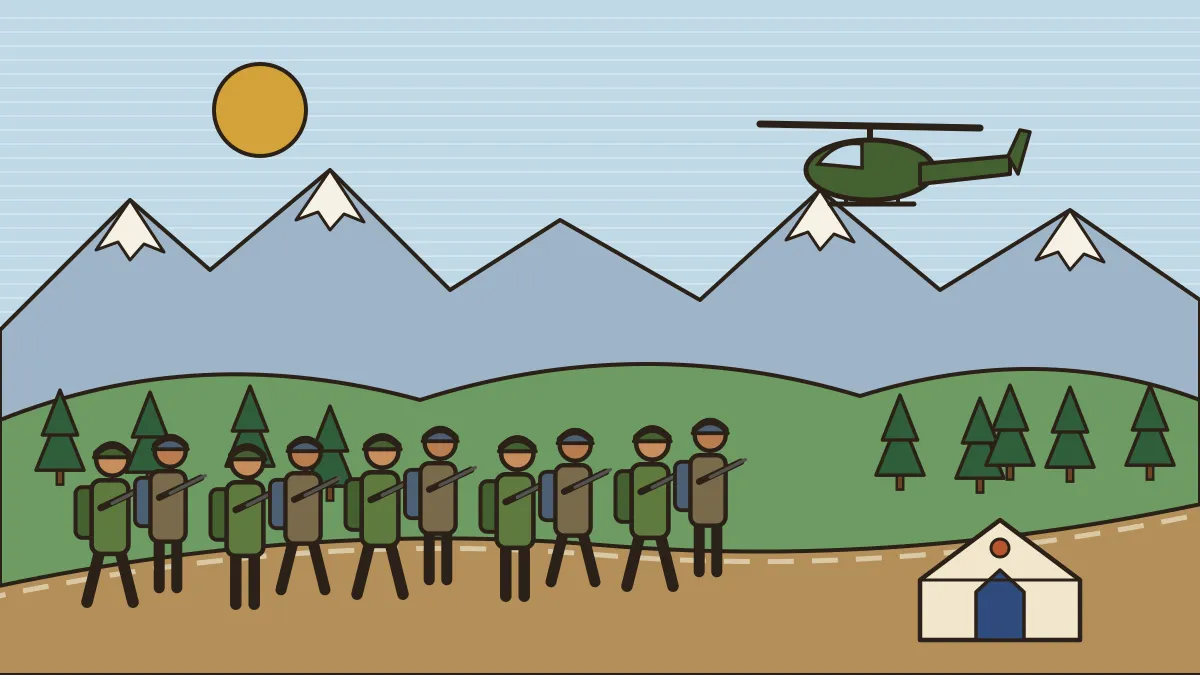
On 25 November 2026, the 20th edition of the India-Nepal Joint Military Exercise Suryakiran began at the Nepal Army Battle School, Saljhandi, in Nepal. It runs until 8 December 2026, a span of two weeks. The Indian Army sent a contingent of 334 personnel, drawn from the Kumaon Regiment. The Nepal Army fielded the same number, drawn from the Shri Jawla Dal Battalion. The opening ceremony was graced by Major General Purna Bahadur Khatri, General Officer Commanding, Mid Western Division, Nepal Army.
A bilateral exercise between two infantry units can look like routine news. For an NDA candidate it is much more useful than that. Suryakiran is the standing example of how India builds trust with a neighbour through its army, it carries a date, a place, a regiment and a number in every release, and it comes up in the exercise-matching questions that the paper asks every year. This article reads the announcement closely, lines up all the recent editions side by side, and then explains what the training actually covers and why the two armies do it.
What the Ministry of Defence announced
The release gives a compact set of facts, and each one is a possible question.
- Edition: the 20th Suryakiran.
- Place: the Nepal Army Battle School, Saljhandi, in Nepal. Saljhandi is in the Rupandehi district of the Nepali plains, close to the Indian border.
- Dates: 25 November to 8 December 2026.
- Indian side: 334 personnel, represented by troops of the Kumaon Regiment.
- Nepali side: an equal number, represented by the Shri Jawla Dal Battalion.
- Aim: to enhance interoperability, operational coordination and mutual understanding between the two armies through joint training in counter-insurgency and counter-terrorism operations in challenging terrain.
- Scope: joint tactical operations, heliborne operations, disaster response and medical training. Troops from both armies exchange operational experiences and best practices while refining tactics, techniques and procedures.
- Rhythm: an annual bilateral exercise, conducted alternately in India and Nepal.
Three words in that list deserve a definition, since examiners like them. Interoperability is the ability of two forces to work together without friction: the same drills, compatible radio procedures, a shared vocabulary for orders. Counter-insurgency means operations against armed groups that operate among the population, and counter-terrorism means operations against groups that use violence on civilians for political ends. Heliborne operations are the movement of troops and equipment by helicopter, for example to insert a team on a ridge that no road reaches.
Twenty editions, one pattern: the alternating venue
The rule that the exercise alternates between the two countries is the best aid to memory. If you know where the last edition was held, you know where this one is. The releases of the Ministry of Defence let us build the sequence.
| Edition | Year and dates | Venue | Indian unit | Nepal Army unit |
|---|---|---|---|---|
| 14th | 2019 | Nepal | not covered here | not covered here |
| 15th | from 20 September 2021 | Pithoragarh, Uttarakhand | an infantry battalion | an equivalent unit |
| 16th | 16-29 December 2022 | Saljhandi, Nepal | 5 Gorkha Rifles | Shree Bhawani Baksh Battalion |
| 17th | 24 November-7 December 2023 | Pithoragarh | Kumaon Regiment | Tara Dal Battalion |
| 18th | 31 December 2024-13 January 2025 | Saljhandi, Nepal | 11 Gorkha Rifles | Srijung Battalion |
| 19th | 25 November-8 December 2025 | Pithoragarh | Assam Regiment | Devi Datta Regiment |
| 20th | 25 November-8 December 2026 | Saljhandi, Nepal | Kumaon Regiment | Shri Jawla Dal Battalion |
Read the table the way an examiner would. The venue flips every time: India (2021), Nepal (2022), India (2023), Nepal (2024-25), India (2025), Nepal (2026). The 2021 release also tells us that the edition before it had been held in Nepal in 2019, which means the series paused in 2020 and resumed in India. The Kumaon Regiment has now represented India twice, in 2023 at Pithoragarh and in 2026 at Saljhandi. The Indian unit changes from year to year, and the units are not always Gorkha units, which is a useful correction to the common guess that only Gorkha battalions go.
The last two editions also began on the same date, 25 November, and ran for the same fortnight. Do not let that tempt you into assuming the schedule is fixed. The 2022 edition began in mid-December and the 2024 edition straddled the new year.
What the two sides do for fourteen days
The scope listed by the Ministry of Defence reads like a short syllabus, and each part has a reason.
Joint tactical operations. Two units of similar strength train as one force: patrolling, cordon-and-search, ambushes and the clearing of a village or ridge. The earlier releases describe the exercise as battalion-level, which is the size at which an army really learns whether its drills fit with a partner's. Each army brings its own tactics, techniques and procedures (called TTPs), and the exercise is the moment they are compared and aligned.
Heliborne operations. Much of the border country on both sides is hills and forest with few roads. A helicopter insertion saves hours, but it demands precise drills: loading, landing zone security, extraction under pressure. Practising this together means a joint force can be moved quickly when a real situation needs it.
Disaster response. Nepal lies in a high seismic zone, and the Himalayan arc on both sides of the border is prone to earthquakes, landslides and floods. The two armies are often the first responders. Training together on rescue, evacuation and relief is therefore practical, not decorative. The 2022 release of the Ministry of Defence already described "the role of armed forces in management of disaster" as a focus.
Medical training. Combat first aid, casualty evacuation and field medical care. Armies in remote terrain depend on doing this well, and the common drills mean a wounded soldier of one army can be treated by the other's medics under one standard.
The release adds that troops will "exchange operational experiences and best practices". That phrase matters, because it describes a two-way learning. The Nepal Army has fought and policed its own internal conflict and has deep peacekeeping experience. The Indian Army has decades of counter-insurgency experience in the Northeast and Jammu and Kashmir. Neither side is the teacher.
How this edition differs from the last
Compare the 2026 text with the one issued on 25 November 2025 for the 19th edition at Pithoragarh. The 2025 release was heavy on new technology: it named unmanned aerial systems, drone-based ISR (intelligence, surveillance and reconnaissance), AI-enabled decision support tools, unmanned logistic vehicles and armoured protection platforms. It also set the aim as rehearsing sub-conventional operations under Chapter VII of a United Nations mandate, and it listed jungle warfare, environmental conservation and integrated ground-aviation operations.
The 2026 release is plainer. It stresses counter-insurgency and counter-terrorism in challenging terrain, heliborne operations, disaster response and medical training. It does not mention drones. We should be careful not to read too much into that: a press note is a summary, and the actual training may well include these elements. What we can say, from the text alone, is that the stated emphasis has returned to the core fundamentals of small-unit infantry work.
The earlier releases are also a reminder that the exercise has long carried a United Nations dimension. The 2022, 2023 and 2024 releases all mention humanitarian assistance and disaster relief under the UN Charter, and the 2025 release speaks of peacekeeping. India and Nepal are both among the largest contributors of troops to UN peacekeeping missions, so a shared vocabulary of drills is useful far from either country.
Why the Kumaon Regiment
The Kumaon Regiment is one of the Army's oldest infantry regiments, with a lineage that goes back to 1813, and its Regimental Centre is at Ranikhet, in the hills of Uttarakhand. Its war cry is "Kalika Mata ki Jai" and its motto is "Parakramo Vijayate", which means "valour triumphs".
Two of its battalions are famous in the history of the Army:
- 4 Kumaon, whose Major Somnath Sharma won the first Param Vir Chakra for his stand at Badgam, near Srinagar, on 3 November 1947.
- 13 Kumaon, whose C Company held Rezang La in Ladakh on 18 November 1962 under Major Shaitan Singh, who was awarded the Param Vir Chakra.
Both are good examples of a point NDA questions return to: regiments are raised on a recruiting identity but fight as part of the whole Army. The regiment's hill heritage, with its Regimental Centre in the Kumaon hills, is why it is at home in mountain training. For the hierarchy that sits above a battalion, see our Defence GK notes on brigades and battalions.
Why Nepal, and why the army
The strategic logic is older than the exercise. India and Nepal share a border of about 1,751 km that is open, and they are bound by the Sugauli Treaty (1816), the Tripartite Agreement (1947) and the Treaty of Peace and Friendship (1950). Gorkha soldiers serve in the Indian Army, and both armies confer the honorary rank of General on each other's chief, a tradition that began in 1950. We cover that tradition and the unresolved question of Gorkha recruitment in our explainer on General Dhiraj Seth's visit to Nepal.
Suryakiran is the working part of all that. A treaty sets the frame, a visit sets the tone, but only shared training makes two armies able to operate together. The 2024 talks between the Chiefs of the two armies even discussed scaling up the exercise: a Ministry of Defence release of that year described Suryakiran as the flagship event between the two armies and said its scope would be considered for enhancement.
There is a security reason too. A 1,751 km open border is hard to police by any single force. It is guarded on the Indian side by the Sashastra Seema Bal. Smuggling, trafficking and the movement of armed groups across the border are real concerns, and an army that trains next to its neighbour understands the terrain and the problems on both sides.
Where Suryakiran sits among India's army exercises
India holds joint exercises with many partners, and the NDA paper tests the pairings. The ones below recur most often. Treat it as a matching drill.
| Exercise | Partner |
|---|---|
| Suryakiran | Nepal |
| Mitra Shakti | Sri Lanka |
| Nomadic Elephant | Mongolia |
| Maitree | Thailand |
| Yudh Abhyas | United States |
| Garuda Shakti | Indonesia |
| Harimau Shakti | Malaysia |
| Dharma Guardian | Japan |
| Ekuverin | Maldives |
You can revise the whole family in our Defence GK page on military exercises. Two of the recent ones are covered in our explainers on Mitra Shakti with Sri Lanka and Nomadic Elephant with Mongolia.
Note the difference in kind. Suryakiran is battalion-level, with hundreds of troops on each side. Nomadic Elephant is a much smaller, platoon-level event. Naval exercises such as those at sea have ships, not battalions, and air exercises have squadrons. When a question asks for the "largest" or the "battalion-level" exercise, size is the clue.
What to watch
- The closing ceremony on or about 8 December 2026, when the Ministry of Defence usually issues a note on the validation exercise at the end.
- The 21st edition. If the alternating rule holds, it should be in India, most likely at Pithoragarh, as the 2021, 2023 and 2025 editions were.
- The recruitment question. The military-to-military channel is strong while the political question on Gorkha recruitment remains open. The exercise is one of the things that keeps the first working.
🔑 Revision block
The news. The 20th India-Nepal Joint Military Exercise Suryakiran began on 25 November 2026 at the Nepal Army Battle School, Saljhandi, and runs to 8 December 2026.
Troops. 334 Indian personnel (mainly Kumaon Regiment) and 334 Nepal Army personnel (Shri Jawla Dal Battalion). Opening ceremony graced by Maj Gen Purna Bahadur Khatri, GOC Mid Western Division.
Aim and scope. Interoperability in counter-insurgency and counter-terrorism in challenging terrain; joint tactical operations, heliborne operations, disaster response, medical training.
Pattern. Annual, alternately in India and Nepal: 2021 Pithoragarh, 2022 Saljhandi, 2023 Pithoragarh, 2024-25 Saljhandi, 2025 Pithoragarh, 2026 Saljhandi.
Regiment. Kumaon Regiment: origin 1813, Centre at Ranikhet, first PVC Maj Somnath Sharma (4 Kumaon, Badgam, 3 Nov 1947), Rezang La (13 Kumaon, 18 Nov 1962, Maj Shaitan Singh).
Frame. Border 1,751 km, open; Sugauli 1816, Tripartite Agreement 1947, Treaty of Peace and Friendship 1950; honorary General rank since 1950.
🎯 Practice MCQs
Q1. The 20th edition of the India-Nepal joint military exercise Suryakiran, which began on 25 November 2026, is being held at:
(a) Pithoragarh, Uttarakhand
(b) The Nepal Army Battle School, Saljhandi
(c) The Counter Insurgency and Jungle Warfare School, Vairengte
(d) Auli, Uttarakhand
→ (b)
The Ministry of Defence says the exercise commenced at the Nepal Army Battle School, Saljhandi. Pithoragarh hosted the 2025 edition, so the alternating rule points to Nepal this time.
Q2. The Indian Army contingent in Suryakiran XX is mainly drawn from which regiment?
(a) The Assam Regiment
(b) The 11 Gorkha Rifles
(c) The Rajput Regiment
(d) The Kumaon Regiment
→ (d)
The Indian side is represented by troops of the Kumaon Regiment. The Assam Regiment represented India in 2025 and the 11 Gorkha Rifles in 2024-25.
Q3. How many personnel has each army fielded in Suryakiran XX?
(a) 334
(b) 354
(c) 500
(d) 668
→ (a)
The release gives 334 for India and an equal number for Nepal. The figure of 354 was the Indian strength in 2023, and 668 is the combined total of the two sides.
Q4. Consider the following statements about Exercise Suryakiran:
1. It is held alternately in India and Nepal.
2. The 19th edition, in 2025, was held at Pithoragarh in Uttarakhand.
Which of the statements given above is/are correct?
(a) 1 only
(b) 2 only
(c) Both 1 and 2
(d) Neither 1 nor 2
→ (c)
The Ministry of Defence describes it as annual and alternating, and the 19th edition was at Pithoragarh from 25 November to 8 December 2025.
Q5. The scope of Suryakiran XX, as announced by the Ministry of Defence, includes all of the following EXCEPT:
(a) Joint tactical operations
(b) Heliborne operations
(c) Disaster response and medical training
(d) Joint amphibious landings
→ (d)
Amphibious landings belong to naval and tri-service exercises and are not in the announced scope. The other three items are.
Q6. Which of the following Param Vir Chakra awardees belonged to the Kumaon Regiment?
(a) Major Somnath Sharma
(b) Subedar Joginder Singh
(c) Captain Vikram Batra
(d) Major Dhan Singh Thapa
→ (a)
Major Somnath Sharma of 4 Kumaon won the first PVC at Badgam in 1947. Joginder Singh was of the Sikh Regiment, Vikram Batra of 13 JAK Rifles and Dhan Singh Thapa of 1/8 Gorkha Rifles.
Q7. The agreement of 1947 between India, Nepal and the United Kingdom is chiefly concerned with:
(a) The demarcation of the border
(b) The open border and free movement
(c) The service terms of Gorkha soldiers
(d) The sharing of river waters
→ (c)
The Tripartite Agreement governed the division of the Gorkha regiments and their terms of service. The open border comes from the 1950 Treaty of Peace and Friendship.
Q8. Which of the following exercise-country pairs is correctly matched?
(a) Mitra Shakti - Maldives
(b) Nomadic Elephant - Mongolia
(c) Maitree - Bangladesh
(d) Garuda Shakti - Malaysia
→ (b)
Mitra Shakti is with Sri Lanka, Maitree with Thailand and Garuda Shakti with Indonesia. Nomadic Elephant is with Mongolia.
📋 How this gets asked (PYQ pattern)
Exercise questions in the NDA General Ability paper follow three dependable shapes.
The first is exercise-to-country matching, as in Q8 above. The examiner picks four exercises and shuffles the partners. The only defence is to know the pairs cold, and Suryakiran with Nepal is among the easiest marks if you do.
The second is the facts of a recent edition: the place, the number of the edition and the regiment. The alternating-venue rule is a quick guard against a wrong option, and the Ranikhet and Param Vir Chakra details about the Kumaon Regiment are the sort of supporting fact that shows up in the history-of-the-armed-forces part of the paper.
The third is the India-Nepal framework: the treaties of 1816, 1947 and 1950, the open border and the honorary General rank. The treaties are often asked together because their dates and subjects are easy to confuse.
The fresh hooks this cycle are the 20th edition, Saljhandi, Kumaon Regiment and the 25 November to 8 December 2026 dates. We describe the pattern here, not any exact past question.
Preparing for NDA? Make a one-page table of exercise, partner, venue and level (battalion, platoon, ship, squadron), and add a line each time a new edition begins. Revise the family on our Defence GK page for military exercises, work through the NDA study material, follow the daily NDA current affairs, and learn with experienced faculty in the upcoming Cavalier courses in Delhi.
Source: PIB / Ministry of Defence, "India-Nepal Joint Military Exercise 'Suryakiran XX' commences in Nepal", 25 November 2026 (Release ID 2341241); earlier editions from PIB / Ministry of Defence releases of 17 September 2021, 15 December 2022, 24 November 2023, 28 December 2024 and 25 November 2025, and the release of 15 December 2024 on the Nepal Army Chief's visit. Kumaon Regiment history and the treaties from the Indian Army's regimental records and standard references.
✍️ Written by Col Vijayant Thakur — Veteran, Indian Army; SSB & defence-studies faculty at The Cavalier. Reviewed by the Cavalier Faculty Desk.