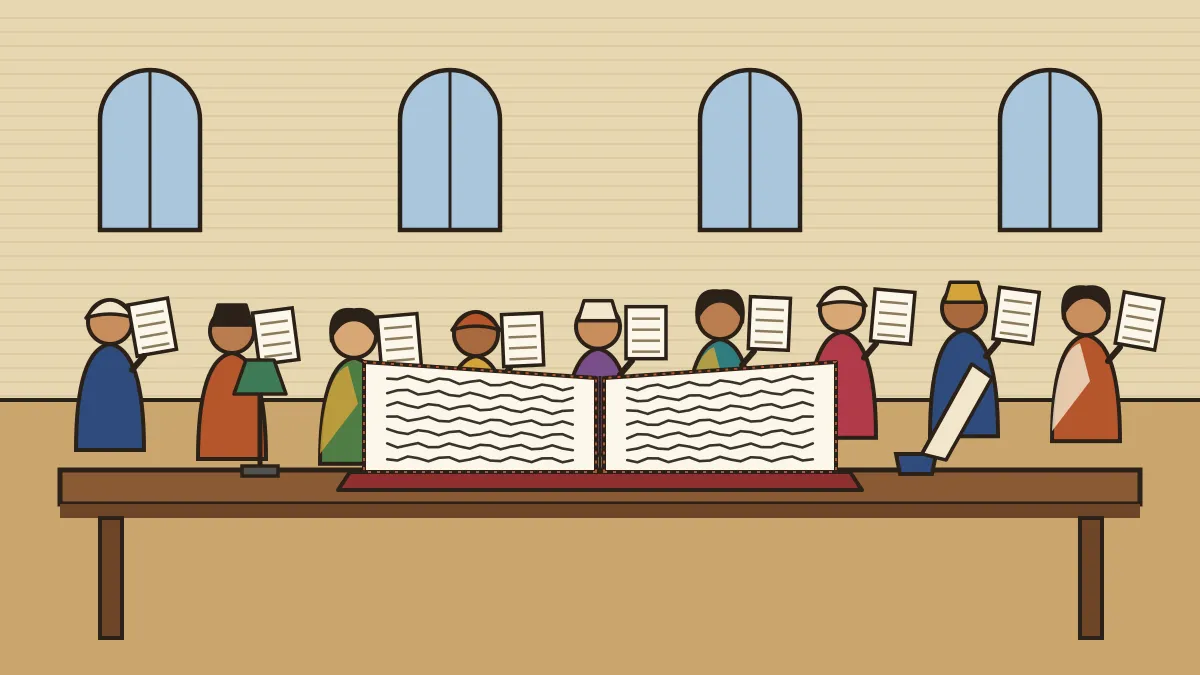
On 25 November 2026, the Ministry of Parliamentary Affairs announced how the country will observe Constitution Day (Samvidhan Diwas) on 26 November 2026. The day marks the adoption of the Constitution of India by the Constituent Assembly on 26 November 1949. The programme has four parts. An online reading of the Preamble is being run through the MyGov portal in 23 languages, which are the 22 Scheduled Languages and English. A Constitution Quiz runs on the MyGov and MyBharat portals from 18 to 26 November. Viksit Bharat Yuva Samvad is being held across 786 districts in all 36 States and Union Territories from 24 to 26 November. Ministries, state governments, schools, colleges and universities are also holding collective Preamble readings, essay and debate contests, walks and awareness campaigns.
An observance like this can look like a ceremony with no exam value. In fact it is the best annual reminder of a block of facts that the NDA paper asks about again and again: the Assembly's dates, the committees, the Preamble's words, the languages and the way the armed forces fit into the constitutional scheme. This article uses the 2026 announcement as a starting point, and then walks through how the Constitution came to be written. (For the idea of duties, which our earlier piece covered, see Reading Article 51A.)
Why 26 November, and since when
The Constitution was adopted on 26 November 1949 but came into force on 26 January 1950. That gap is the first thing to fix in memory, and examiners play on it.
Why the later date? 26 January had been marked as "Purna Swaraj Day" since 1930, after the Lahore session of the Congress declared complete independence as its goal in December 1929, and the framers chose to honour it. Some provisions, however, took effect straight away on 26 November 1949, because the country needed citizens, a provisional Parliament and an election machinery before the new system could start. They include the articles on citizenship (Articles 5 to 9), and Articles 60, 324, 366, 367, 379, 380, 388, 391, 392 and 393.
The day itself has a short history of its own.
- Before 2015, 26 November was observed as Law Day.
- On 11 October 2015, the Prime Minister announced it would be observed as Constitution Day, at the foundation-stone ceremony of a memorial to Dr B.R. Ambedkar in Mumbai, in the year of Ambedkar's 125th birth anniversary.
- The formal gazette notification is dated 19 November 2015.
The Ministry of Parliamentary Affairs' release of 25 November 2026 repeats that the day "has been observed as Constitution Day since 2015".
The Constituent Assembly in numbers
The Assembly was not elected by the people at large. It was chosen by the members of the provincial legislatures and the princely states' representatives under the Cabinet Mission Plan of 1946. It had 389 members at the start. After Partition the number fell to 299.
| Date | Event |
|---|---|
| 9 December 1946 | First meeting; Dr Sachchidananda Sinha, the oldest member, was the temporary president |
| 11 December 1946 | Dr Rajendra Prasad elected permanent President of the Assembly |
| 13 December 1946 | Jawaharlal Nehru moved the Objectives Resolution |
| 22 January 1947 | Objectives Resolution adopted |
| 29 August 1947 | Drafting Committee set up, with Dr B.R. Ambedkar as chairman |
| 4 November 1948 | Draft Constitution introduced in the Assembly |
| 26 November 1949 | Constitution adopted |
| 24 January 1950 | Members signed the final text (284 signatories) |
| 26 January 1950 | Constitution comes into force |
The Assembly worked for 2 years, 11 months and 18 days, over eleven sessions. On the day it ended, the Constitution had a Preamble, 395 Articles, 22 Parts and 8 Schedules. The text has since grown to roughly 450 Articles in 25 Parts and 12 Schedules through amendments. For the full sequence see our notes on the making of the Constitution.
On 24 January 1950, the Assembly also elected Rajendra Prasad as the first President of India. After the Constitution came into force it became the provisional Parliament, until the first general election of 1951-52.
Who wrote it: committees and people
No single person wrote the Constitution. The Assembly worked through committees, and each committee fed one part of the final text.
Major committees and chairs
- Drafting Committee: Dr B.R. Ambedkar.
- Union Constitution Committee and Union Powers Committee: Jawaharlal Nehru.
- Provincial Constitution Committee: Sardar Vallabhbhai Patel.
- Advisory Committee on Fundamental Rights, Minorities and Tribal and Excluded Areas: Sardar Patel.
- Rules of Procedure Committee and Steering Committee: Dr Rajendra Prasad.
The Drafting Committee had seven members: Ambedkar (chairman), N. Gopalaswami Ayyangar, Alladi Krishnaswami Ayyar, K.M. Munshi, Syed Mohammad Saadulla, N. Madhava Rau (who took the place of B.L. Mitter) and T.T. Krishnamachari (who took the place of D.P. Khaitan, who died in 1948).
Sir B.N. Rau, the Constitutional Adviser to the Assembly, prepared the first working draft in October 1947, from the committees' reports and a study of other countries' constitutions. The Drafting Committee refined it, and Ambedkar piloted the final draft through the House, which is why he is called the "chief architect".
The Assembly also had fifteen women members (the Vice-President recalled their contribution in a speech reported by PIB in November 2026). They included Hansa Mehta, Durgabai Deshmukh, Sarojini Naidu and Dakshayani Velayudhan.
The document itself was handwritten. The English original was calligraphed in italic script by Prem Behari Narain Raizada, and the pages were decorated by artists of Santiniketan under Nandalal Bose. The Ministry of Culture published a booklet on this art and calligraphy at the 2025 observance. The Constitution is the longest written constitution of any sovereign country, partly because the framers wrote in details that other countries leave to ordinary laws.
What India borrowed, and from where
Examiners love the source-and-feature pairing. India took ideas from many places, but the final text is a blend and not a copy.
| Feature | Source |
|---|---|
| Parliamentary system, rule of law, single citizenship, Speaker | United Kingdom |
| Fundamental Rights, judicial review, independent judiciary, Vice-President | United States |
| Directive Principles of State Policy | Ireland |
| Federation with a strong Centre, residuary powers with the Centre | Canada |
| Concurrent List, freedom of trade | Australia |
| Emergency provisions, suspension of Fundamental Rights in emergency | Germany (Weimar Constitution) |
| Procedure established by law | Japan |
| Amendment procedure | South Africa |
| Ideals of liberty, equality and fraternity | France |
The Government of India Act, 1935 is the biggest single source. Much of the structure of federalism, the Federal Public Service Commission (now UPSC) and the emergency powers were adapted from it.
The Preamble: the Constitution in one paragraph
The Preamble opens with "We, the people of India" and closes with the words that the Assembly "adopted, enacted and gave to ourselves" the Constitution on "this twenty-sixth day of November, 1949". In between, it lists the character of the state and four objectives.
- The state: Sovereign, Socialist, Secular, Democratic, Republic.
- Justice: social, economic and political.
- Liberty: of thought, expression, belief, faith and worship.
- Equality: of status and of opportunity.
- Fraternity: assuring the dignity of the individual and the unity and integrity of the nation.
Two points are asked repeatedly. First, the words "socialist", "secular" and "integrity" were added in 1976 by the 42nd Amendment. The 1949 Preamble said only "Sovereign Democratic Republic" and "unity of the nation". It is the only amendment of the Preamble to date. Second, the Supreme Court has changed its view of the Preamble's status. In the Berubari Union case (1960) it held that the Preamble is not a part of the Constitution. In Kesavananda Bharati (1973), a thirteen-judge bench, deciding 7 to 6, held that it is a part of the Constitution, and the case established the basic structure doctrine. Our notes on the Preamble and the basic structure give the full case law.
Why 23 languages
This year's reading is in 22 Scheduled Languages and English. The 22 are listed in the Eighth Schedule, which had 14 languages in 1950. The list has grown by amendments.
- Sindhi was added in 1967 (21st Amendment).
- Konkani, Manipuri and Nepali were added in 1992 (71st Amendment).
- Bodo, Dogri, Maithili and Santhali were added in 2003 (92nd Amendment).
That makes 14 + 1 + 3 + 4 = 22. The Eighth Schedule is not the same as the list of official languages: it lists the languages the Constitution recognises, and Articles 344 and 351 draw on it for the Official Language Commission and for the enrichment of Hindi. Our page on the Schedules of the Constitution lists all twelve.
The digital work on languages is part of a pattern. In 2024, for the 75th anniversary, the Constitution was released in Sanskrit and Maithili. In 2025, the Legislative Department released it in nine more languages: Malayalam, Marathi, Nepali, Punjabi, Bodo, Kashmiri, Telugu, Odia and Assamese.
A look back at the 75th year
On 26 November 2024, the Government began a year-long celebration of 75 years of the Constitution under the tagline "Hamara Samvidhan, Hamara Swabhimaan", with a grand inaugural programme in the Central Hall of Parliament, a mass reading of the Preamble and a dedicated website, constitution75.com. The national ceremony of 26 November 2025 was presided over by the President in the Central Hall of Samvidhan Sadan and ended with the Preamble reading led by the President. The 2026 observance follows that jubilee year, and the emphasis in this year's programme is on participation, with youth dialogues across 786 districts.
Ambedkar's warning and why it matters
In his closing speech on 25 November 1949, a day before the adoption, Ambedkar made three points that remain exam favourites. He said that political democracy cannot last unless it rests on social democracy, a way of life that recognises liberty, equality and fraternity as one body of principles. He pointed to a "life of contradictions" that India was entering: equality in politics with one person, one vote, one value, but inequality in social and economic life. And he warned that a Constitution is only as good as the people who work it.
That last idea is the link between Constitution Day and the Preamble reading. The ceremony is meant to turn the document from a text into a habit.
The Constitution and the armed forces (for the future officer)
A candidate to the NDA should know where the armed forces sit in the constitutional scheme. Four provisions cover most of it.
- Article 53(2): the supreme command of the Defence Forces is vested in the President, and its exercise is regulated by law. The President is not a commander in the field: the power is exercised on the advice of the Council of Ministers.
- Union List, Entries 1 and 2 (Seventh Schedule): defence of India and the naval, military and air forces are subjects on which only Parliament can legislate. This is why the Army Act, Navy Act and Air Force Act are central laws.
- Article 33: Parliament may by law restrict or abrogate the Fundamental Rights of members of the armed forces, to the extent needed to ensure the proper discharge of their duties and the maintenance of discipline.
- Article 352: a National Emergency may be proclaimed on the ground of war, external aggression or armed rebellion. The Constitution also records, in Article 355, the Union's duty to protect every state against external aggression and internal disturbance.
Candidates often mix up Article 33 with Article 32. Article 32 is the right to constitutional remedies, and Ambedkar called it the "heart and soul" of the Constitution. Article 33 is the limit on rights for the forces. They are next to each other and have opposite effects.
What to watch
- 26 November 2026: the main ceremonies, and which new digital or print release the government announces on the day.
- Winter Session of Parliament, which usually begins soon after Constitution Day, where the debate on constitutional values often appears in the speeches.
- Eighth Schedule demands: several languages have long-pending requests for inclusion. A change would need a constitutional amendment, and it is the sort of development that appears in current-affairs questions.
🔑 Revision block
The 2026 news. Constitution Day on 26 November 2026: Preamble reading on MyGov in 23 languages (22 Scheduled + English); Constitution Quiz 18-26 November; Viksit Bharat Yuva Samvad in 786 districts, 24-26 November.
Dates. Assembly first met 9 Dec 1946; Objectives Resolution 13 Dec 1946 (adopted 22 Jan 1947); Drafting Committee 29 Aug 1947; adopted 26 Nov 1949; signed 24 Jan 1950; in force 26 Jan 1950. Constitution Day notified 19 Nov 2015 (earlier Law Day).
People. Chairman of Drafting Committee Ambedkar; President of Assembly Rajendra Prasad; Constitutional Adviser B.N. Rau; temporary president Sachchidananda Sinha; 15 women members.
Text. As adopted: 395 Articles, 22 Parts, 8 Schedules. Preamble amended once: 42nd Amendment, 1976 (socialist, secular, integrity). Berubari (1960): not a part; Kesavananda (1973, 7:6): part.
Languages. Eighth Schedule: 14 to 22 (Sindhi 1967; Konkani, Manipuri, Nepali 1992; Bodo, Dogri, Maithili, Santhali 2003).
Armed forces. Art 53(2) supreme command; Union List Entries 1-2; Art 33 restricts forces' rights; Art 352 emergency on war or external aggression.
🎯 Practice MCQs
Q1. In which year was 26 November formally notified as Constitution Day?
(a) 1949
(b) 1950
(c) 2015
(d) 2020
→ (c)
The gazette notification is dated 19 November 2015. Before that the day was observed as Law Day.
Q2. Who was the chairman of the Drafting Committee of the Constituent Assembly?
(a) Dr B.R. Ambedkar
(b) Dr Rajendra Prasad
(c) Sir B.N. Rau
(d) Jawaharlal Nehru
→ (a)
Ambedkar chaired the seven-member committee set up on 29 August 1947. Prasad presided over the Assembly and Rau was its Constitutional Adviser.
Q3. As adopted on 26 November 1949, the Constitution of India contained how many Articles and Schedules?
(a) 280 Articles and 6 Schedules
(b) 305 Articles and 9 Schedules
(c) 360 Articles and 10 Schedules
(d) 395 Articles and 8 Schedules
→ (d)
The original text had 395 Articles in 22 Parts, and 8 Schedules. It has since grown through amendments.
Q4. Consider the following statements:
1. The words "socialist" and "secular" were part of the Preamble as adopted in 1949.
2. The online Preamble reading on Constitution Day 2026 is offered in 23 languages.
Which of the statements given above is/are correct?
(a) 1 only
(b) 2 only
(c) Both 1 and 2
(d) Neither 1 nor 2
→ (b)
Both words were added by the 42nd Amendment in 1976. The 2026 reading covers the 22 Scheduled Languages plus English.
Q5. The Constituent Assembly of India held its first meeting on:
(a) 9 December 1946
(b) 13 December 1946
(c) 15 August 1947
(d) 26 November 1949
→ (a)
The first meeting was on 9 December 1946. The Objectives Resolution came four days later and the Constitution was adopted on 26 November 1949.
Q6. The supreme command of the Defence Forces of India is vested in the President under which Article?
(a) Article 33
(b) Article 51
(c) Article 53
(d) Article 352
→ (c)
Article 53(2) provides this. Article 33 allows restriction of the forces' Fundamental Rights, and Article 352 deals with national emergency.
Q7. The idea of the Directive Principles of State Policy was borrowed from the Constitution of:
(a) The United States
(b) Ireland
(c) Canada
(d) Australia
→ (b)
The Directive Principles come from Ireland. The United States gave judicial review, Canada the strong-Centre federation and Australia the Concurrent List.
Q8. How many languages are listed in the Eighth Schedule of the Constitution at present?
(a) 14
(b) 18
(c) 21
(d) 22
→ (d)
The list began with 14 in 1950 and now has 22, after the additions of 1967, 1992 and 2003.
📋 How this gets asked (PYQ pattern)
Constitution-making material shows up in the NDA General Ability paper in four familiar forms.
The first is the date and sequence question: first meeting, Objectives Resolution, adoption and enforcement. The trap is the gap between adoption on 26 November 1949 and enforcement on 26 January 1950, as in Q5.
The second is the people-and-committee match, such as the chairman of the Drafting Committee against the President of the Assembly and the Constitutional Adviser (Q2).
The third is sources of provisions: which country gave which feature. Remember the table above in pairs (Q7).
The fourth is the Preamble: the 42nd Amendment, the Berubari-to-Kesavananda change of view, and the four objectives. The Eighth Schedule and the armed-forces articles (Q6) appear less often, but they are an easy score for someone who has read them once.
The fresh hooks are the 23-language Preamble reading, the 786 districts of the youth dialogue and the 18 to 26 November quiz. We describe the pattern, not any exact past question.
Preparing for NDA? Draw the timeline from 9 December 1946 to 26 January 1950 from memory, then check it against our NDA study material on the Constitution. Follow the daily NDA current affairs, and learn with experienced faculty in the upcoming Cavalier courses in Delhi.
Source: PIB / Ministry of Parliamentary Affairs, "Constitution Day, 2026 to be observed on 26th November", 25 November 2026 (Release ID 2341449); PIB / Ministry of Parliamentary Affairs releases of 26 November 2025 (Release ID 2194656) and 25 November 2024 (Release ID 2076894); PIB, 20 November 2026 (Vice-President's speech on women members of the Assembly). Constituent Assembly history, committee chairs, borrowed features and case law from the text of the Constitution and Constituent Assembly Debates; the 2015 notification from the Gazette of India.
✍️ Written by Hitendra Deswal — Polity & current-affairs faculty at The Cavalier. Reviewed by the Cavalier Faculty Desk.