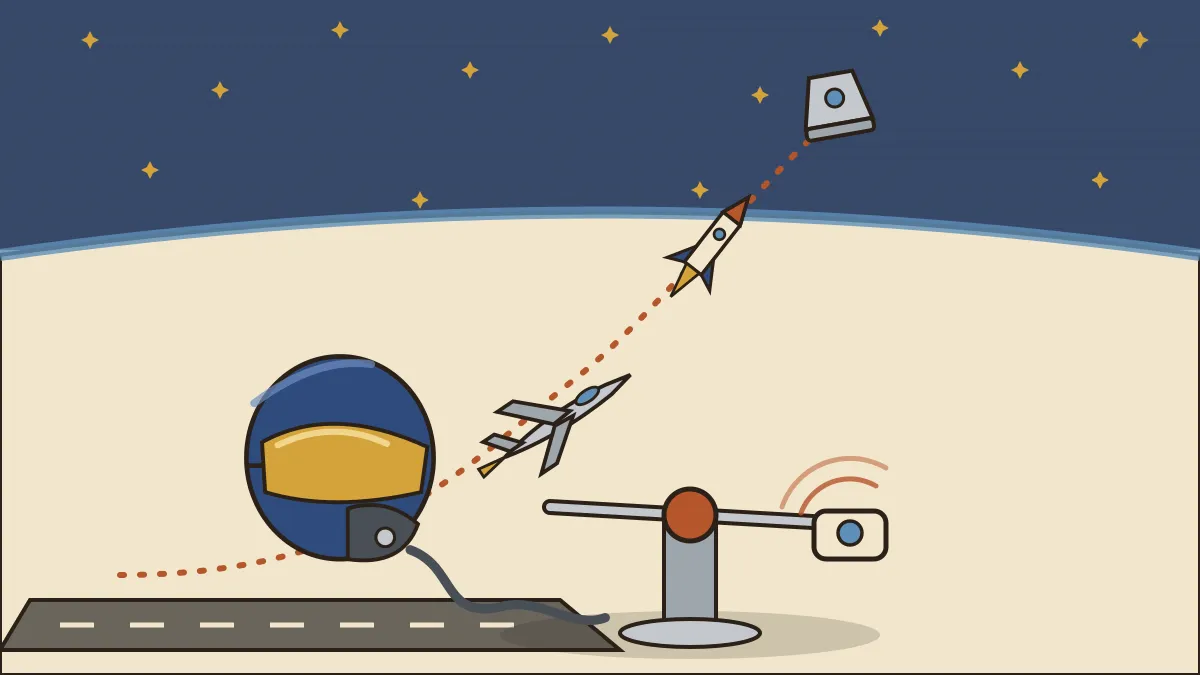
On 24 November 2026, the Ministry of Defence announced that the Indian Society of Aerospace Medicine (ISAM) will hold its 65th Annual Conference on 26 and 27 November 2026 at the Institute of Aerospace Medicine (IAM), Bengaluru. The theme is "One Airspace - One Mission: Aeromedical Support from Runway to Orbit".
A medical conference might look like a niche item for a defence examination. It is not. The story ties together the Indian Air Force's pilots, the Gaganyaan astronauts, the civil aviation sector and the private space industry, and it lets an examiner ask about the human body in the air in the same breath as a rocket launch. This article covers the announcement first, then the science behind the word "aerospace medicine", and then the institutions you should be able to name.
What was announced
According to the Ministry of Defence:
- ISAM was established in 1952 and describes itself as the nation's sole registered aeromedical society. It has held an annual scientific conference since 1954.
- The 65th conference runs on 26 and 27 November 2026 at IAM, Bengaluru, which the release calls the premier nodal hub for aeromedical activities in India. IAM supports the design and development of indigenous aircraft and the human spaceflight programme.
- It will be inaugurated by Air Chief Marshal Ashutosh Dixit, the Chief of the Air Staff. He took over the IAF's top post at the end of October 2026; our report on the change of IAF leadership has the details.
- About 250 delegates are expected: military and civil aviation doctors, IAF aircrew, and scientists from DRDO and the aerospace industry.
- More than 100 research papers will be presented through panels, symposia, podium talks and posters, alongside an exhibition of aeromedical equipment and biomedical devices.
The theme itself is the message. The phrase "one airspace" means that military aviation, civil aviation and human spaceflight are being treated as a single medical problem: keeping a human being alive and functioning from the ground to orbit.
The named orations and a new lecture
Memorial lectures are a favourite source of "who is this person" questions, so note who the names honour.
- Air Marshal Subroto Mukerjee Memorial Oration, to be delivered by Shri APVS Prasad, Chief Executive, CEMILAC. Subroto Mukerjee was the first Indian Chief of the Air Staff, who took charge on 1 April 1954. The Subroto Cup football tournament is named after him. CEMILAC is the DRDO body that certifies the airworthiness of military aircraft.
- Air Vice Marshal Srinagesh Memorial Oration, by Air Vice Marshal Anupam Agarwal (Retd), Principal Consultant (Aerospace Medicine) at the Airports Authority of India.
- JHF Manekshaw Panel, with Wing Commander Surender Sodhi (Retd) and Colonel KN Rao (Retd).
- Cosmonaut Rakesh Sharma lecture, a new series launched this year to honour Wing Commander Rakesh Sharma (Retd). The inaugural lecture will be given by Pawan Kumar Chandana, CEO of Skyroot Aerospace, the company whose small-satellite launch vehicle Vikram-I reached orbit on its first flight on 18 July 2026, the first orbital launch by an Indian private company from Indian soil (PIB backgrounder of 15 November 2026).
The choice of a private-sector rocket maker to open a lecture named for India's first astronaut is a small sign of how the space sector has changed. A generation ago spaceflight was a state monopoly; the speaker is now from a company.
Rakesh Sharma was an IAF test pilot who flew to the Soviet Salyut 7 space station aboard Soyuz T-11 in April 1984, spending about eight days in orbit. He remains the first Indian in space, flying on a Soviet mission and not an Indian one.
Why the conference is held at IAM
The Institute of Aerospace Medicine is an Indian Air Force institute in Bengaluru. The institute traces its origin to 1957, according to the ISAM website.
From earlier official releases, IAM's role can be summed up in five tasks:
- Pilot selection and medical evaluation. It judges whether an aviator is fit to fly, and whether one can fly again after an injury.
- High-G training. In March 2025 Raksha Mantri Rajnath Singh became the first Raksha Mantri to visit IAM. He inspected the Dynamic Flight Simulator and High Performance Human Centrifuge used for high-G training of fighter pilots, and the Spatial Disorientation Simulator.
- Research. On that visit he launched an ICMR extramural research project, a Centre for Advanced Research on space psychology: the selection and behavioural-health training of astronauts and astronaut-designates for Indian space missions.
- Design advice. IAM gives aeromedical advice on crew modules and cockpit design. The Raksha Mantri listed its contribution to the Advanced Light Helicopter, Light Utility Helicopter, Light Combat Helicopter and Light Combat Aircraft Tejas, and its advice for the Advanced Medium Combat Aircraft (AMCA).
- Astronaut preparation. In August 2025 the Raksha Mantri called Group Captain Shubhanshu Shukla, who flew to the International Space Station on Axiom Mission 4, "a shining embodiment" of IAM's success. He added that Shukla completed training that would normally take two and a half years in two and a half months.
Group Captain Shukla belongs to the same IAF test-pilot cadre as the Gaganyaan astronaut-designates. For the mission itself, see our explainer on Gaganyaan.
What aerospace medicine actually deals with
The subject is a mix of physiology, engineering and psychology. A good picture of the main hazards makes most exam questions easy.
Altitude and hypoxia. The air stays about 21% oxygen at every height. What falls is barometric pressure, so the partial pressure of oxygen falls too, and the body gets less oxygen with each breath. This is hypobaric hypoxia. At around 18,000 feet the pressure is roughly half that at sea level. Our article on high-altitude medicine at Keylong works through the numbers. Aircraft solve the problem with pressurised cabins and, in fighters, oxygen masks. Hypoxia is dangerous because a pilot can lose judgement without noticing. Textbooks list four types: hypoxic (low pressure), hypaemic (blood cannot carry oxygen, as in anaemia or carbon monoxide), stagnant (blood flow too slow) and histotoxic (cells cannot use oxygen).
G-forces. In a hard turn, a fighter pilot feels several times the weight of gravity. Sustained high positive G pulls blood from the head towards the legs. Vision narrows ("grey-out"), then fails ("blackout"), and finally the pilot can lose consciousness. This is G-induced loss of consciousness (G-LOC). Pilots are protected by anti-G suits and straining techniques, and the human centrifuge at IAM is where they are trained and tested.
Spatial disorientation. In cloud, at night or in a steep manoeuvre, the inner ear and the eyes can give the pilot a false sense of which way is up. The cure is training: IAM's simulator teaches pilots to trust the instruments over their senses.
The space environment. The Raksha Mantri named three challenges in 2025: microgravity, radiation and isolation. In orbit, bones lose mineral, muscles weaken and body fluids shift towards the head. These are the problems the Gaganyaan crew must be prepared for.
Psychology. A mission is also a test of nerves in a small, sealed space. That is why IAM has a research project on space psychology.
Runway to orbit: three regimes, one body
The theme is easier to grasp if you compare what the body faces in each setting.
| Setting | Main medical problems | Main protection |
|---|---|---|
| Fighter cockpit | High and sudden G-forces, hypoxia if pressurisation fails, spatial disorientation, ejection injuries | Anti-G suit, oxygen mask, centrifuge and simulator training, strict medical selection |
| Civil airliner | Cabin pressure that is lower than sea level, long-duty fatigue for crew, medical emergencies among passengers | Pressurised cabins (held to roughly the pressure at a few thousand feet of altitude), duty-time rules, crew medical checks |
| Spacecraft | Microgravity, radiation, isolation, and the heavy loads of launch and re-entry | Life-support systems, exercise, psychological selection, long pre-flight training |
Three points follow. First, the human being is the common limit. An aircraft can be redesigned; the tolerance of the human body changes very little. That is why a medical institute is consulted at the design stage of cockpits and crew modules, as the Raksha Mantri noted in 2025.
Second, the two worlds of military and civil aviation share a great deal. The Air Vice Marshal Srinagesh oration is to be given by a retired IAF officer who now advises the Airports Authority of India, and the Subroto Mukerjee oration by the head of the DRDO's airworthiness certification body. The same medical principles, such as hypoxia limits and fatigue rules, apply on both sides of the fence.
Third, spaceflight adds time. A fighter sortie lasts an hour; a stay on a space station lasts weeks or months, so slow effects such as bone loss, muscle wasting and the strain of isolation become central. Group Captain Shukla's mission to the International Space Station in 2025 and the planned Gaganyaan flights are why India's aerospace medicine community has widened its agenda from the cockpit to the capsule. The 2026 theme says so in its first three words: one airspace.
Why this matters for the services and for the country
- Aircrew safety. Many aviation accidents trace back to the human, not the machine. Medical selection, training and research reduce that risk.
- Indigenous design. An aircraft or crew capsule has to be designed around the person inside it, so the aeromedical contribution to Tejas and AMCA is part of Aatmanirbhar Bharat.
- Jointness. The ISAM theme links the IAF, civil aviation and the space programme. For NDA aspirants who will become officers in a tri-service environment, this is a useful example of civil-military fusion, a phrase the Raksha Mantri used about Group Captain Shukla's flight.
- The pipeline. The same Bengaluru institute that selects fighter pilots also helps prepare astronauts, which shows how closely the IAF and ISRO work together.
The full picture of the Air Force's organisation, commands and ranks is in our Defence GK section on the Indian Air Force.
A look at the previous conference
The Ministry of Defence release for the 64th conference gives a useful comparison. It was held on 20-21 November 2025, also at IAM, and was inaugurated by the then Chief of the Air Staff, Air Chief Marshal AP Singh. Its theme was "Innovations in Aerospace Medicine: Infinite Possibilities", and it expected about 300 delegates and over 100 papers. The 2026 edition keeps the same 100-paper scale but shifts the focus from innovation in general to integration across military flying, civil flying and human spaceflight.
🔑 Revision block
The event. 65th Annual Conference of the Indian Society of Aerospace Medicine (ISAM), 26-27 November 2026, Institute of Aerospace Medicine (IAM), Bengaluru. Announced by the Ministry of Defence on 24 November 2026.
Theme. "One Airspace - One Mission: Aeromedical Support from Runway to Orbit". Inaugurated by Air Chief Marshal Ashutosh Dixit (Chief of the Air Staff).
ISAM. Founded 1952; the only registered aeromedical society in India; annual conferences since 1954. About 250 delegates; 100+ papers.
New lecture. Cosmonaut Rakesh Sharma lecture (first this year), inaugural speaker Pawan Kumar Chandana, CEO, Skyroot Aerospace. Rakesh Sharma flew on Soyuz T-11 to Salyut 7 in April 1984.
Orations. Subroto Mukerjee (first Indian Chief of the Air Staff, 1954): APVS Prasad, CEMILAC. Srinagesh: AVM Anupam Agarwal (Retd). JHF Manekshaw Panel.
IAM. IAF institute, Bengaluru, from 1957; human centrifuge, dynamic flight simulator, spatial disorientation simulator; ICMR space psychology project (2025); advises on Tejas, ALH, LUH, LCH, AMCA; trained Shubhanshu Shukla (Axiom-4).
Science. Oxygen stays 21%; pressure falls with altitude (hypobaric hypoxia); G-LOC from sustained high G; space hazards: microgravity, radiation, isolation.
🎯 Practice MCQs
Q1. The Indian Society of Aerospace Medicine (ISAM), whose 65th Annual Conference is in November 2026, was established in:
(a) 1938
(b) 1947
(c) 1952
(d) 1971
→ (c)
ISAM was set up in 1952 and has held an annual conference since 1954. The Institute of Aerospace Medicine traces its origin to 1957.
Q2. The 65th ISAM Annual Conference will be held at:
(a) Institute of Aerospace Medicine, Bengaluru
(b) Air Force Station, Hindon
(c) Armed Forces Medical College, Pune
(d) ISRO Headquarters, Bengaluru
→ (a)
IAM is the Indian Air Force's institute for aviation and space medicine, and is the host of the conference on 26-27 November 2026.
Q3. A pilot in a tight, high-speed turn loses consciousness because sustained high positive G drains blood from the head. This condition is called:
(a) Decompression sickness
(b) Hypobaric hypoxia
(c) Spatial disorientation
(d) G-induced loss of consciousness
→ (d)
G-LOC is the loss of consciousness caused by acceleration. Hypobaric hypoxia is due to low pressure at altitude, and spatial disorientation is a false sense of orientation.
Q4. At high altitude, hypobaric hypoxia occurs because:
(a) The percentage of oxygen in the air falls below 21%
(b) The barometric pressure, and so the partial pressure of oxygen, falls
(c) The temperature of the air drops
(d) Carbon dioxide replaces oxygen in the air
→ (b)
The proportion of oxygen stays about 21% at all heights. It is the lower pressure that reduces the oxygen reaching the blood.
Q5. Who was the first Indian to travel in space, aboard Soyuz T-11 in 1984?
(a) Rakesh Sharma
(b) Shubhanshu Shukla
(c) Kalpana Chawla
(d) Ravish Malhotra
→ (a)
Wing Commander Rakesh Sharma flew to Salyut 7 in April 1984 on a Soviet mission. Shubhanshu Shukla flew to the ISS on Axiom Mission 4 in 2025.
Q6. The Air Marshal Subroto Mukerjee Memorial Oration honours an officer who was:
(a) The first Chief of the Air Staff of independent India, a British officer
(b) The first Chief of Defence Staff
(c) The first Chief of the Naval Staff
(d) The first Indian Chief of the Air Staff
→ (d)
Subroto Mukerjee took charge on 1 April 1954 as the first Indian Chief of the Air Staff. Before him the post was held by British officers.
Q7. Consider the following statements about the Institute of Aerospace Medicine (IAM):
1. It is an institute of the Indian Navy.
2. It operates a human centrifuge used for high-G training of fighter pilots.
Which of the statements given above is/are correct?
(a) 1 only
(b) 2 only
(c) Both 1 and 2
(d) Neither 1 nor 2
→ (b)
IAM belongs to the Indian Air Force and has a Dynamic Flight Simulator and High Performance Human Centrifuge, as shown during the Raksha Mantri's March 2025 visit.
Q8. The inaugural Cosmonaut Rakesh Sharma lecture at the 65th ISAM conference is to be delivered by the chief executive of:
(a) ISRO
(b) Pixxel Aerospace
(c) Skyroot Aerospace
(d) Hindustan Aeronautics Limited
→ (c)
The speaker is Pawan Kumar Chandana, CEO of Skyroot Aerospace. Pixxel's founder spoke at the 2025 conference's panel.
📋 How this gets asked (PYQ pattern)
Questions on this theme usually take one of three forms. Firsts and people ask who was the first Indian in space, who was the first Indian Chief of the Air Staff, and which officers are the Gaganyaan astronaut-designates. Institutions ask which service or ministry runs an institute and what it does, with options that swap the IAF, Navy, DRDO and ISRO. Science of the body asks why altitude causes hypoxia, what G-LOC is, and what space does to bones and muscles; a favourite trap is the idea that the oxygen percentage falls with height.
This week's fresh hooks are the 65th ISAM conference, the new Rakesh Sharma lecture, the Bengaluru venue, and the joint military, civil and space theme.
Preparing for NDA? Revise how breathing works in our notes on circulation and respiration, and the Air Force's structure on the Indian Air Force page. Follow the daily NDA current affairs, and learn with experienced faculty in the upcoming Cavalier courses in Delhi.
Source: PIB / Ministry of Defence, "65th Annual Conference of the Indian Society of Aerospace Medicine (ISAM) 26-27 November 2026", 24 November 2026; PIB / Ministry of Defence releases of 19 November 2025 (64th ISAM conference), 9 March 2025 (Raksha Mantri's visit to IAM) and 24 August 2025 (felicitation of the Gaganyatris). IAM's 1957 origin from the ISAM website, not from PIB. Rakesh Sharma's flight details from Britannica.
✍️ Written by Maj Sunil Chopra — Veteran, Indian Army; defence-studies & current-affairs faculty at The Cavalier. Reviewed by the Cavalier Faculty Desk.