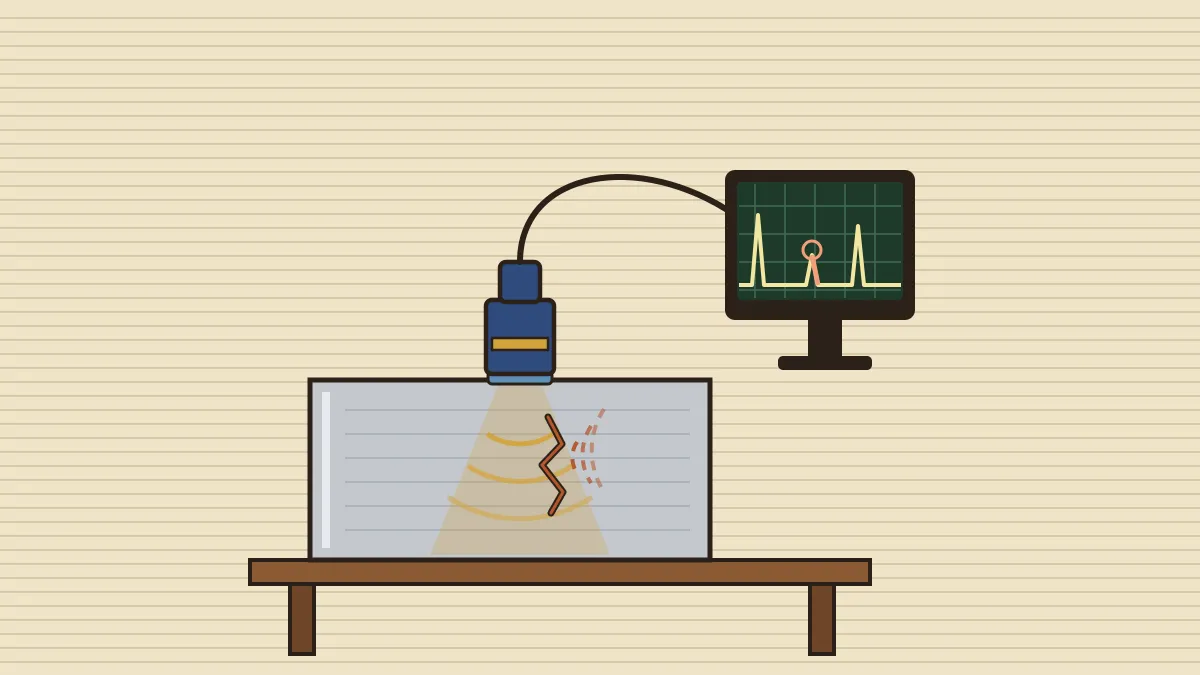
Think of how a doctor checks a broken bone. She does not cut the arm open; she takes an X-ray. Engineers face the same problem with a missile casing, a jet-engine blade or the hull of a warship: they must be sure there is no hidden crack inside, without damaging the part they are checking. The answer is Non-Destructive Testing (NDT), also called Non-Destructive Evaluation (NDE).
On 15 November 2026, Raksha Mantri Rajnath Singh addressed, virtually, the 36th Annual Conference on Non-Destructive Evaluation & Enabling Technologies and the 15th International Symposium on Non-Destructive Testing in Aerospace. The three-day event, organised by the Indian Society for Non-Destructive Testing (ISNT) in Hyderabad, has brought together over 2,000 professionals, researchers, industry experts and students. His message, as released by the Ministry of Defence: India must be not merely a user of advanced technologies but a developer, innovator and global leader.
What the Raksha Mantri said
The PIB release reports several points worth noting.
- Indigenous capability. India must strengthen its own capabilities in advanced inspection technologies, specialised sensors, evaluation equipment and the software that goes with them, to reduce technological dependencies and secure critical defence supply chains.
- Quality assurance everywhere. He asked for consistent quality assurance across the whole defence industrial ecosystem: public sector undertakings, private manufacturers, start-ups and MSMEs. Inspection results must be accurate, reliable and traceable, based on robust procedures and standards, and assessed by qualified professionals.
- No compromise. There can be "no compromise on the integrity of testing results in strategic applications", such as missiles, aircraft, naval platforms and spacecraft.
- Prevention, not just detection. India should move beyond identifying defects to preventing them, by embedding quality at every stage of manufacture.
- Aatmanirbharta as strategy. He said self-reliance in defence "is not merely an economic objective but also a strategic necessity". He cited India's achievements in missiles, naval platforms, aerospace, radar and space, and named the commissioning of INS Vikrant, India's first indigenous aircraft carrier, as a milestone.
- Innovation institutions. He pointed to iDEX and the Technology Development Fund (TDF) as initiatives that have encouraged innovative thinking and experimentation in India's defence ecosystem.
- New technologies. Artificial intelligence, machine learning, robotics, advanced sensors, digital twins and predictive analytics are expanding what inspection and structural health monitoring can do.
How NDT works: the physics you can be asked
NDT is applied physics. Five or six methods cover most of what a competitive exam can ask. The table puts them side by side.
| Method | Physical principle | Best for | Limitation |
|---|---|---|---|
| Visual inspection | Light and the eye, often with a borescope | Surface flaws | Misses anything hidden |
| Liquid (dye) penetrant | Capillary action: a thin dye creeps into surface cracks and shows after development | Surface-breaking cracks on any non-porous material | Internal flaws invisible |
| Magnetic particle | A magnetised part leaks magnetic flux at a crack; iron powder gathers there | Surface and near-surface cracks in ferromagnetic metals | Useless on aluminium or copper |
| Eddy current | A changing magnetic field induces currents in a conductor (Faraday's law); a flaw disturbs them | Cracks in conductive metals, coating thickness, tubes | Shallow depth |
| Ultrasonic | High-frequency sound pulses reflect from flaws | Internal flaws, thickness, weld quality | Needs contact or coupling medium |
| Radiography | X-rays or gamma rays pass through the part; denser or thicker regions absorb more | Internal voids, weld defects, castings | Radiation safety |
Ultrasonic testing is the cleanest example. A probe sends a pulse of sound, at frequencies far above the 20,000 Hz limit of human hearing, into the metal. The pulse travels at a known speed. When it meets a crack or a void, part of it is reflected back to the probe. The instrument measures the time delay and converts it to depth, since distance equals speed multiplied by time, halved for the round trip. A sharp extra spike on the screen between the front-surface and back-wall echoes means a flaw in between. That is the idea behind the picture at the top of this page. Our notes on sound waves cover the underlying concept of echoes and frequency.
Radiography goes back to Wilhelm Röntgen, who discovered X-rays on 8 November 1895. Industrial radiography uses X-ray tubes or sealed gamma sources such as iridium-192 or cobalt-60. The film or digital detector shows a shadow picture in which a void looks darker, because less material has absorbed the radiation. Revise the properties of X-rays and gamma rays in modern physics.
Eddy-current testing applies electromagnetic induction: bring an alternating-current coil near a conducting surface and currents swirl through the metal; a crack makes them detour, which changes the coil's electrical behaviour. It is routinely used on aircraft skins and heat-exchanger tubes.
All of these are non-destructive because the part survives the test and goes back into service. Destructive testing, such as pulling a sample until it snaps, tells you the material's strength but costs you the sample. The two are complementary: destructive tests set the standard, and NDT checks every real part against it.
A worked example for the exam
Sound travels at roughly 5,900 m/s in steel. Suppose the probe sees an extra echo 20 microseconds after the pulse leaves. The round-trip distance is 5,900 × 0.000020 = 0.118 m, so the flaw lies at half of that: about 59 mm below the surface. Two habits protect you in such numerical questions: always halve the distance for the round trip, and convert microseconds to seconds before multiplying. The same arithmetic is behind ship sonar and bat echolocation, so a question may present it in any of those clothes.
Note also what the test cannot do. A single probe reading gives depth along one line, not the flaw's shape, so inspectors scan the probe across the surface to build up a map. Operators must also account for the coupling gel between probe and metal, since a thin layer of air would reflect almost all the sound before it enters the part. This is the reason real inspections need trained, certified people, a theme the Raksha Mantri returned to.
Why defence is the most demanding customer
A lesson from civil aviation shows why. In 1954, two de Havilland Comet airliners broke up in flight within three months. Investigators traced the failures to metal fatigue, cracks that start at stress concentrations, around the corners of the cabin windows, and grow with every pressurisation cycle. Inspection regimes, window design and test methods changed worldwide afterwards. Hidden cracks that grow silently are exactly what NDT is meant to catch.
In military equipment the stakes are higher still. The Raksha Mantri's words capture the logic: hidden defects can affect operational availability, raise maintenance needs, shorten service life and, "in critical situations, jeopardise mission success". Consider the things the Armed Forces test:
- Missiles and rocket motors: weld seams and propellant bonding in casings that cannot be opened.
- Aircraft: turbine blades, wing spars, landing-gear forgings and composite panels under repeated stress.
- Ships: hull welds and propeller shafts. INS Vikrant, built by Cochin Shipyard Limited, is about 262.5 m long and 61.6 m wide and displaces roughly 43,000 tonnes; its welded hull is the kind of structure where inspection must be thorough. Our Indian Navy surface ships page puts the carrier in context.
- Spacecraft and satellites: pressure vessels and structures where repair in orbit is impossible.
Developer, not just user: iDEX and TDF
The Raksha Mantri's phrase "developer, innovator and global leader" matters because inspection equipment is often imported. A country that only buys the sensors and software remains exposed in a crisis. India's two main routes for defence innovation, both named in the speech, work like this.
- iDEX (Innovations for Defence Excellence) connects start-ups, MSMEs, individual innovators and academia with the Armed Forces' problem statements. Our earlier explainer on iDEX and defence procurement explains the mechanics.
- Technology Development Fund (TDF) is a Ministry of Defence programme executed by DRDO to encourage industry, especially MSMEs and start-ups, to develop defence technologies. Funding of up to ₹50 crore per project is provided as grant-in-aid, according to a December 2024 PIB note.
An NDT start-up developing a robotic crawler, a digital X-ray detector or an AI tool that reads ultrasonic scans is precisely the kind of innovator these schemes are meant to reach.
The digital turn: AI, robots and digital twins
The Raksha Mantri listed several new tools, each with a plain meaning.
- AI and machine learning can read thousands of scans faster and more consistently than a tired human, and can spot patterns that conventional methods may miss.
- Robotics puts sensors in places people cannot reach: inside pipes, along tall hulls, within engine cavities.
- Digital twins are live virtual models of a physical part. Inspection data feeds the twin, which can estimate how a known crack will grow.
- Predictive analytics uses that history to forecast failure, so a part is replaced just before it becomes unsafe, not on a fixed calendar.
The PIB release describes the goal as the "intelligent integration" of proven inspection techniques with digital tools. Judgement stays with qualified professionals, which is why the minister stressed trained people as much as machines.
About the host body
The Indian Society for Non-Destructive Testing (ISNT) was formed when two earlier bodies merged, one registered in Calcutta in 1972 and another in Madras in 1981; it is headquartered in Chennai. Its flagship National Conference on NDE is held every year in a different Indian city. The 2026 edition is the 36th, held in Hyderabad.
🔑 Revision block
- Event: 36th Annual Conference on NDE & Enabling Technologies and 15th International Symposium on NDT in Aerospace, Hyderabad, organised by ISNT; Raksha Mantri Rajnath Singh addressed it virtually on 15 November 2026; 2,000+ participants.
- Message: India to be a developer, innovator and global leader, not just a user; Aatmanirbharta is a "strategic necessity".
- NDT = testing without damaging the part. Contrast: destructive testing.
- Methods: penetrant (capillary action), magnetic particle (ferromagnetic only), eddy current (induction, conductors), ultrasonic (sound echoes, internal flaws), radiography (X-rays or gamma rays).
- Röntgen discovered X-rays on 8 November 1895. Comet crashes of 1954: metal fatigue.
- INS Vikrant: commissioned 2 September 2022; built by Cochin Shipyard Limited.
- Schemes: iDEX (start-ups, MSMEs); TDF (DRDO-executed, up to ₹50 crore per project as grant-in-aid).
- New tech: AI/ML, robotics, advanced sensors, digital twins, predictive analytics.
🎯 Practice MCQs
Q1. Non-Destructive Testing is best described as:
(a) Testing a material by breaking a sample until it fails
(b) Testing only the outer paint of a component
(c) Testing the speed of a machine under full load
(d) Examining a component for internal or surface defects without damaging it
→ (d)
Because the part is not damaged, it can return to service after inspection.
Q2. In ultrasonic testing, the depth of a hidden crack is estimated from:
(a) The time taken by the sound pulse to return
(b) The colour of the dye that seeps out
(c) The strength of the magnetic field applied
(d) The shade of the film exposed to gamma rays
→ (a)
Depth = speed of sound × time delay ÷ 2, because the pulse travels to the flaw and back.
Q3. Which of the following methods can be used only on ferromagnetic materials?
(a) Eddy current testing
(b) Ultrasonic testing
(c) Magnetic particle testing
(d) Liquid penetrant testing
→ (c)
Magnetic particle testing needs the part to be magnetised, so it fails on aluminium, copper or austenitic stainless steel.
Q4. Liquid penetrant testing depends on which physical property?
(a) Viscosity of the part
(b) Capillary action
(c) Total internal reflection
(d) Electromagnetic induction
→ (b)
A thin dye is drawn into surface-breaking cracks by capillary action and then revealed by a developer.
Q5. X-rays were discovered by:
(a) Marie Curie
(b) J.J. Thomson
(c) Ernest Rutherford
(d) Wilhelm Röntgen
→ (d)
Röntgen reported them on 8 November 1895. They form the basis of industrial radiography.
Q6. Consider the following statements about the 2026 NDT conference addressed by the Raksha Mantri:
1. It was organised by the Indian Society for Non-Destructive Testing.
2. The Raksha Mantri named iDEX and the Technology Development Fund as innovation initiatives.
Which of the statements given above is/are correct?
(a) 1 only
(b) 2 only
(c) Both 1 and 2
(d) Neither 1 nor 2
→ (c)
Both are in the PIB release.
Q7. The Technology Development Fund scheme is:
(a) Executed by DRDO and gives grant-in-aid of up to ₹50 crore per project
(b) Executed by the Ministry of Finance for public sector banks
(c) Run by the Department of Space for satellite start-ups
(d) A loan scheme for exporters run by the Reserve Bank of India
→ (a)
It is a Ministry of Defence programme meant for industry, especially MSMEs and start-ups.
Q8. Eddy-current testing works on the principle of:
(a) Reflection of sound waves
(b) Electromagnetic induction
(c) Absorption of X-rays
(d) Capillary rise
→ (b)
An alternating magnetic field induces eddy currents in a conductor; a crack alters their flow.
📋 How this gets asked (PYQ pattern)
Technology news reaches the NDA paper in two ways, and this story offers both. We describe the recurring pattern, not any exact past question.
The first is applied physics: sound waves and frequency (ultrasound above 20,000 Hz), electromagnetic induction, X-rays and gamma rays, capillary action. Questions often present a real-world use and ask which principle is behind it. Knowing the one-line principle for each NDT method answers them.
The second is defence and science schemes: who runs iDEX, what TDF funds, which ship was commissioned when and where. Options are usually one detail away from the truth, such as a similar-sounding agency or a wrong year.
A third, less frequent type is who discovered what, such as X-rays and Röntgen, and these are quick marks with a little revision.
The fresh 2026 hooks are the 36th NDE conference in Hyderabad, ISNT, the developer, innovator and global leader line, digital twins and predictive analytics, and the ₹50 crore TDF ceiling.
Preparing for the NDA? Physics pays twice when you can connect a principle to a machine. Build the base with our NDA study material, follow the daily NDA current affairs, and prepare with our faculty in the upcoming Cavalier courses in Delhi.
Source: PIB / Ministry of Defence, "India must become a developer, innovator & global leader in advanced technologies: Raksha Mantri", 15 November 2026 (Release ID 2336449); PIB / Ministry of Defence, "Research and Technology Hub in Defence Sector", 6 December 2024 (Release ID 2081451) for TDF; PIB, 2 September 2022 (Release ID 1856230) for INS Vikrant. ISNT's own website for the society's origin; standard NDT method descriptions and the 1954 Comet accident cross-checked with reference sources.
✍️ Written by Col D.N. Sharma — Science & general-studies faculty at The Cavalier. Reviewed by the Cavalier Faculty Desk. The Cavalier, founded by ex-Army officers, has trained NDA/CDS/SSB aspirants since 2001 (Facebook · YouTube).