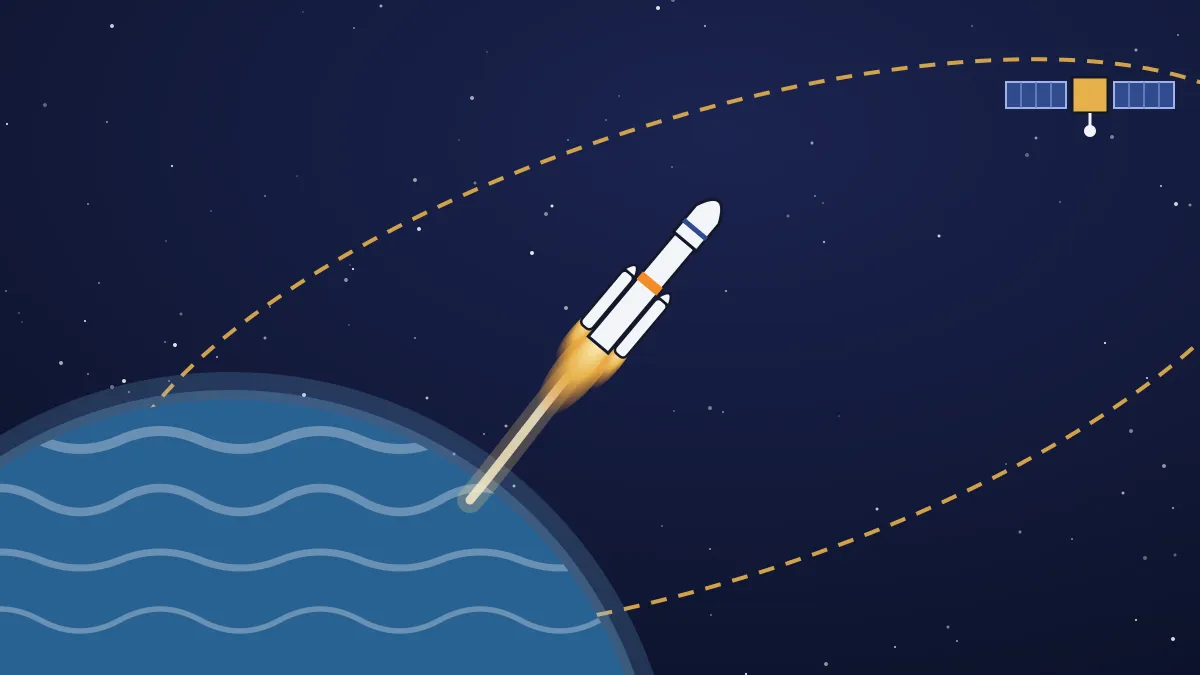
India's navigation satellite system got a much-needed reinforcement on the night of 30 October 2026. ISRO's GSLV-F18 lifted off from the Second Launch Pad at the Satish Dhawan Space Centre (SDSC), Sriharikota, and placed the navigation satellite NVS-03 into a Geosynchronous Transfer Orbit (GTO). On the morning of 31 October, the Prime Minister congratulated ISRO, calling the mission "an important step towards strengthening NavIC".
The launch matters more than a routine replacement would. NavIC, India's regional navigation system, has been running short of working satellites. In March 2026 the government told Parliament that only three satellites were broadcasting navigation signals, one fewer than the four a receiver needs for a standalone position fix. NVS-03 is the third satellite of the second-generation NVS series, built to keep NavIC's services going as the first-generation satellites age.
This article covers the rocket, the orbit, the satellite, and the state of the constellation it joins.
The rocket: GSLV-F18
According to ISRO's mission brochure, GSLV-F18 was the 20th flight of the Geosynchronous Satellite Launch Vehicle.
| Feature | GSLV-F18 |
|---|---|
| Height | about 50 m |
| Lift-off mass | about 420 tonnes |
| Stages | 3 |
| First stage (GS1) | S139 solid motor (HTPB fuel, 138 t of propellant) + four L40H liquid strap-on boosters |
| Second stage (GS2) | GL40HT liquid stage (UH25 and N2O4) |
| Third stage (GS3) | CUS15 cryogenic upper stage (liquid hydrogen + liquid oxygen, 14.4 t of propellant) |
| Payload fairing | 3.4 m diameter, metallic |
| Launch pad | Second Launch Pad, SDSC SHAR |
The third stage is what makes GSLV special. A cryogenic engine burns liquid hydrogen at about −253 °C with liquid oxygen at about −183 °C. It gives the most energy per kilogram of any practical rocket fuel, which is why it is used to push heavy satellites towards geosynchronous orbit. India first flew an indigenous cryogenic stage successfully on GSLV-D5 in January 2014. That came after years of trying to buy the technology and being denied it under the export-control regimes of the 1990s.
The GSLV's record has been uneven, which is why each success counts: - Its first flight was in 2001. - GSLV-F10 (August 2021) failed when its cryogenic stage did not ignite properly. - GSLV-F15 (January 2025), which carried NVS-02, was the 100th launch from Sriharikota. - GSLV-F16 (July 2025) launched NISAR, the joint ISRO–NASA radar satellite. - GSLV-F17 (September 2026) carried the earth-observation satellite EOS-05, covered in our article on GSLV-F17 and geo-imaging.
The orbit: why a transfer orbit first
GSLV-F18 did not put NVS-03 into its final orbit. It placed the ~2,250 kg satellite into a stretched ellipse, a Geosynchronous Transfer Orbit:
| Parameter | Value |
|---|---|
| Perigee (lowest point) | 170 km |
| Apogee (highest point) | 37,023 km |
| Inclination | 20.75° |
| Launch azimuth | 106° |
From here, the satellite's own Liquid Apogee Motor must fire several times at the high point of the orbit. Each burn raises the perigee until the orbit becomes a circle about 36,000 km up, at the slot ISRO has planned for it.
This step is where NVS-02 failed. In January 2025, the GSLV placed it precisely in the intended transfer orbit, but the satellite could not climb to its working orbit and is listed as not operational. NVS-03's success will therefore be judged over the coming days of orbit-raising, not at lift-off.
The physics of orbits (why a geosynchronous satellite takes a day to circle the Earth, and why the transfer orbit is an ellipse) is set out on our page on gravitation.
The satellite: what NVS-03 adds
ISRO describes NVS-03 as "the third satellite in the next-generation navigation satellite system envisaged for providing continuity of navigation services for the IRNSS series". Three features stand out:
- An indigenous atomic clock, carried alongside procured (imported) clocks. Navigation is a timing business: a receiver works out its distance from each satellite from how long the signal took to arrive. A clock error of one billionth of a second means about 30 cm of position error. Atomic clocks failing on the first-generation satellites was the main reason the constellation shrank. India flew its own rubidium atomic clock for the first time on NVS-01 in 2023.
- A new L1 signal in addition to the existing L5 and S-band signals. L1 is the band used by GPS L1 and most other systems, so adding it makes NavIC much easier to build into ordinary smartphone chips and receivers.
- The same coverage: India's landmass and a region extending about 1,500 km beyond its boundaries, NavIC's primary service area.
The constellation it joins
NavIC (Navigation with Indian Constellation) was earlier called the Indian Regional Navigation Satellite System (IRNSS). Unlike the global GPS (USA), GLONASS (Russia), Galileo (EU) and BeiDou (China), it is regional. Its base design uses seven satellites: three in geostationary orbit and four in inclined geosynchronous orbit, so that they stay over the Indian region.
The state of the fleet, from the government's replies to Parliament: - July 2025: 11 satellites launched; 4 providing navigation services, 4 used for one-way messaging, 1 decommissioned, 2 that never reached their orbits (IRNSS-1H in 2017, whose heat shield failed to separate, and NVS-02 in 2025). - March 2026: 8 of the 11 functional; 3 broadcasting navigation signals and 5 capable only of one-way messaging. - July 2026: after IRNSS-1F completed its 10-year life, three satellites were providing services, with NVS-03 ready and NVS-04 and NVS-05 to follow.
So NVS-03 is the 12th NavIC satellite launched. Once it reaches its slot and completes testing, it should bring the number of satellites broadcasting navigation signals back to four. The armed forces are not left exposed in the meantime: they use multi-constellation receivers that combine several systems.
Our earlier explainer on NavIC and satellite navigation explains how a receiver turns four signals into a position.
Why India built its own system
The push for an independent navigation system is often traced to the Kargil conflict of 1999, when India could not count on assured access to satellite navigation data over the battle area. A foreign system can be degraded or switched off in a crisis. NavIC offers two services: - a Standard Positioning Service for civilian users; - an encrypted Restricted Service for authorised and strategic users.
Civilian uses are growing: - the government targets real-time tracking of about 12,000 trains using NavIC alongside other satellite systems; - fishing boats receive warnings and messages through NavIC's one-way messaging; - disaster authorities use it to send alerts; - it supports the dissemination of Indian Standard Time.
🔑 Revision block
The launch. GSLV-F18 launched NVS-03 on the night of 30 October 2026 from the Second Launch Pad, SDSC SHAR; placed in GTO (170 × 37,023 km, 20.75°).
The rocket. 20th GSLV flight; ~50 m, ~420 t; GS1 = S139 solid + 4 × L40H; GS2 = GL40HT; GS3 = CUS15 cryogenic (LH2 + LOX); 3.4 m metallic fairing. First indigenous cryogenic success: GSLV-D5, January 2014.
The satellite. ~2,250 kg; third NVS satellite; indigenous + procured atomic clocks; adds L1 to L5 + S; coverage India + ~1,500 km.
The series. NVS-01 (2023, first indigenous atomic clock), NVS-02 (January 2025, GSLV-F15 = 100th Sriharikota launch; failed to reach orbit), NVS-03 (2026); NVS-04, NVS-05 planned.
The fleet. 11 launched before NVS-03; March 2026: 8 functional, 3 navigating, 5 messaging; base design 7 (3 GEO + 4 inclined GSO). Minimum 4 satellites for a standalone fix.
NavIC basics. Regional; formerly IRNSS; Standard Positioning (civil) + Restricted (encrypted) services; 1 ns clock error ≈ 30 cm.
🎯 Practice MCQs
Q1. GSLV-F18, which launched NVS-03 in October 2026, was which flight of the GSLV? (a) 15th (b) 20th (c) 25th (d) 100th
→ (b) ISRO's brochure calls it the 20th GSLV flight. "100th" was NVS-02's launch, the 100th from Sriharikota.
Q2. The third stage of the GSLV uses which propellant combination? (a) Liquid hydrogen and liquid oxygen (b) HTPB and ammonium perchlorate (c) UH25 and nitrogen tetroxide (d) Kerosene and liquid oxygen
→ (a) The CUS15 cryogenic stage burns LH2 with LOX. HTPB is the solid first-stage fuel; UH25 + N2O4 powers the strap-ons and second stage; kerosene + LOX is the semi-cryogenic combination ISRO is developing.
Q3. NVS-03 was placed by the rocket into which orbit? (a) Sun-synchronous polar orbit (b) Low Earth Orbit (c) Medium Earth Orbit (d) Geosynchronous Transfer Orbit
→ (d) The satellite was left in a 170 × 37,023 km GTO, and it must raise itself to its final orbit using its own motor.
Q4. Which new signal does the NVS series add to NavIC? (a) C-band (b) L1 (c) X-band (d) Ka-band
→ (b) L1 joins the existing L5 and S bands and makes NavIC easier to use on common devices.
Q5. NavIC's primary service area covers India and a region extending about how far beyond it? (a) 500 km (b) 1,000 km (c) 1,500 km (d) 3,000 km
→ (c) ISRO specifies about 1,500 km around India's boundaries.
Q6. Consider the following statements about NavIC: 1. It is a regional, not a global, navigation system. 2. Its base design uses satellites in both geostationary and inclined geosynchronous orbits. Which of the statements given above is/are correct? (a) 1 only (b) 2 only (c) Both 1 and 2 (d) Neither 1 nor 2
→ (c) NavIC serves India and its surroundings using three geostationary and four inclined geosynchronous satellites in its base design.
Q7. Why are atomic clocks essential on navigation satellites? (a) Position is worked out from signal travel time, so tiny timing errors become large distance errors (b) They provide electrical power to the satellite (c) They control the satellite's solar panels (d) They measure the satellite's altitude directly
→ (a) An error of one nanosecond corresponds to about 30 cm in position.
Q8. India's first successful flight of an indigenous cryogenic upper stage was on: (a) GSLV-D1 in 2001 (b) GSLV-F10 in 2021 (c) GSLV-F15 in 2025 (d) GSLV-D5 in 2014
→ (d) GSLV-D5 (January 2014) flew the indigenous cryogenic stage successfully. GSLV-F10 failed at its cryogenic stage in 2021.
📋 How this gets asked (PYQ pattern)
Space questions are a regular in the NDA GAT paper, and navigation satellites are a favourite subset. Three patterns repeat.
The first is "which system belongs to which country": NavIC (India), GPS (USA), GLONASS (Russia), Galileo (EU), BeiDou (China), QZSS (Japan). Regional versus global is the usual twist.
The second is launch vehicle basics: which rocket for which orbit (PSLV for polar and sun-synchronous orbits, GSLV and LVM3 for geosynchronous), and what makes a cryogenic stage different. Statement questions on propellants appear often.
The third is mission facts: the satellite, its purpose and one distinctive feature. The fresh hooks this cycle are GSLV-F18 (20th GSLV flight), NVS-03, the L1 signal, the indigenous atomic clock, and the transfer orbit that every NavIC satellite must climb out of.
Preparing for NDA? Keep a running table of ISRO launches with rocket, satellite, orbit and purpose, and revise it before every mock. Our NDA study material covers the physics behind it, the daily NDA current affairs keeps the table current, and the upcoming Cavalier courses in Delhi prepare you for both the written paper and the SSB.
Source: PIB / Prime Minister's Office, "PM congratulates ISRO scientists and engineers on successful launch of GSLV-F18 carrying NVS-03", 31 October 2026; ISRO, GSLV-F18/NVS-03 mission page and mission brochure (vehicle, orbit and satellite specifications); Department of Space replies in Parliament on NavIC (23 July 2025, 25 March 2026) and on space missions (17 December 2025). History of the GSLV cross-checked with ISRO material.
✍️ Written by Col Vijyanat Thakur — Veteran, Indian Army; SSB & defence-studies faculty at The Cavalier. Reviewed by the Cavalier Faculty Desk.