On 28 October 2026 the government published a PIB Backgrounder, India's New-Age Space Technologies: The Road to Self-Reliance. It reviews the technologies that will carry India's space programme into the next decade: reusable launchers, new kinds of rocket propulsion, docking in orbit, navigation and radar satellites.
The note was released ahead of the Space Science and Technologies session of the Emerging Science, Technology and Innovation Conclave (ESTIC 2026), organised by the Department of Space and ISRO at Bharat Mandapam, New Delhi, on 29 October 2026.
Most of the backgrounder is a list of dates and capabilities, which suits the NDA paper. Several items also connect directly to the physics syllabus: orbits, propulsion, heat engines and electromagnetic waves. This article takes each technology in turn and explains the science behind it.
Where it started
| Year | Milestone |
|---|---|
| 1962 | Indian National Committee for Space Research (INCOSPAR) set up, under the vision of Dr Vikram Sarabhai |
| 21 November 1963 | First sounding rocket launched from Thumba, Kerala |
| 15 August 1969 | ISRO formed, replacing INCOSPAR |
| 1972 | ISRO brought under the new Department of Space |
A sounding rocket carries instruments up into the upper atmosphere and falls back to Earth. It does not go into orbit.
Launch vehicles: today and next
| Vehicle | Capability |
|---|---|
| PSLV | Up to 1,750 kg to a 600 km Sun-synchronous polar orbit |
| GSLV | 2-tonne class communication satellites, using the indigenous cryogenic upper stage |
| LVM3 | 4-tonne class to geosynchronous transfer orbit; 10-tonne class to low Earth orbit |
| SSLV | About 120 tonnes at lift-off; up to about 500 kg into a 500 km orbit |
| NGLV (approved September 2024) | Up to 30 tonnes to low Earth orbit; a partially reusable version with 14 tonnes |
The Next Generation Launch Vehicle (NGLV) was approved with an outlay of ₹8,240 crore. This covers development, three developmental flights, facilities and the launch campaign. It will triple the payload India can lift to low Earth orbit, compared with the 10 tonnes of the LVM3. It is meant to launch crews and modules to the Bharatiya Antariksh Station, as well as lunar and interplanetary missions.
The orbits behind those figures
The capabilities are quoted for different orbits, and each is a common exam term:
- Low Earth Orbit (LEO): a few hundred kilometres up. Space stations and many Earth-observation satellites orbit here.
- Sun-synchronous orbit (SSO): a near-polar orbit in which the satellite passes over a given place at about the same local solar time every day. Lighting is then the same in every image, so changes on the ground can be compared.
- Geosynchronous transfer orbit (GTO): an elliptical orbit, a few hundred kilometres up at its lowest point (perigee) and about 35,786 km at its highest (apogee). A rocket leaves a communication satellite here, and the satellite fires its own motor at apogee to make the orbit circular.
- Geostationary orbit (GEO): a circular orbit about 35,786 km above the Equator, with a period equal to one rotation of the Earth (about 23 hours 56 minutes). The satellite appears fixed in the sky, which is why a dish antenna can point at it permanently.
The link to gravitation is direct: the higher the orbit, the longer the period, and only one height gives a period equal to the Earth's rotation.
The cryogenic and semi-cryogenic stages
The GSLV's cryogenic upper stage burns liquid hydrogen as fuel with liquid oxygen as oxidiser. Both are stored at very low temperatures: liquid hydrogen at about -253°C and liquid oxygen at about -183°C. The indigenous stage replaced a Russian-supplied stage used on early GSLV flights.
The next step is a semi-cryogenic engine, which burns liquid oxygen with kerosene. ISRO is developing a rocket-grade kerosene for it, called ISROSENE. Kerosene is denser and easier to store than liquid hydrogen.
Reusable launch vehicles
Most rockets are thrown away after one flight. A reusable launch vehicle (RLV) recovers its main parts and flies them again, which lowers the cost of each launch. Reuse needs controlled re-entry, autonomous navigation and precise landing.
ISRO tested autonomous runway landing with its winged demonstrator Pushpak in three Landing Experiments (LEX):
| Experiment | Date |
|---|---|
| LEX-01 | 2 April 2023 |
| LEX-02 | 22 March 2024 |
| LEX-03 | 23 June 2024, in harder cross-range and wind conditions |
Private firms are working on the same problem. We covered the Chennai start-up Agnikul's approach in our article on reusable launch vehicles.
New kinds of propulsion
Scramjet: breathing air at hypersonic speed
A rocket carries both its fuel and the oxidiser that burns it. A scramjet (supersonic combustion ramjet) carries only fuel and takes its oxygen from the air it flies through. It is therefore lighter and can lift more payload for the same mass at lift-off.
A scramjet works only inside the atmosphere and only at very high speed, so a booster must first accelerate it. Speed is measured in Mach numbers: Mach 1 is the speed of sound, and anything above Mach 5 is hypersonic.
- India flight-tested its scramjet on 28 August 2016, reaching about Mach 6. The PIB note says this made India the fourth country to demonstrate the technology.
- On 22 July 2024, an experimental flight on an RH-560 sounding rocket tested air-breathing propulsion again.
Electric propulsion: tiny thrust, huge efficiency
Electric propulsion uses electrical energy, usually from solar panels, to accelerate propellant. A typical design ionises a gas such as xenon and drives the ions out at very high speed with an electric field. The thrust is tiny, but the propellant is used very efficiently.
On 27 March 2025, ISRO completed a 1,000-hour life test of its indigenous 300 mN (millinewton) stationary plasma thruster. Its specific impulse is at least six times that of conventional chemical propulsion. The thruster will be tested in space on the Technology Demonstration Satellite (TDS-01).
Specific impulse measures how much thrust a rocket gets from each unit of propellant it uses. A higher value means less propellant is needed for the same change in velocity. An electric thruster can therefore raise a satellite's orbit using much less propellant than a chemical motor, leaving more mass for payload. The physics is Newton's third law: the ions are pushed backwards and the satellite moves forwards.
Green propulsion
ISRO is developing propellants that are less toxic and more efficient. Industry is involved too. Under DRDO's Technology Development Fund, the Bengaluru firm Bellatrix Aerospace developed a 1 N-class green monopropellant thruster for small satellites. It was demonstrated in orbit on a payload launched aboard PSLV-C58 in January 2024.
Nuclear heat and power
ISRO and the Department of Atomic Energy are working on requirements for two devices that use the heat of radioactive decay:
- Radioisotope Heater Units (RHUs) supply heat, to keep instruments warm through long, cold nights.
- Radioisotope Thermoelectric Generators (RTGs) turn that heat into electricity using thermocouples. A thermocouple produces a voltage when its two junctions are at different temperatures: the Seebeck effect.
They are being considered for future Chandrayaan and Mars missions, where solar power is weak or unavailable for long periods.
Docking in orbit: SpaDeX
The Space Docking Experiment (SpaDeX) launched two small satellites and joined them in orbit:
| Date | Achievement |
|---|---|
| 16 January 2025 | First docking, followed later by undocking |
| 20 April 2025 | Second docking, fully autonomous, from 15 m apart |
| 21 April 2025 | Power transfer in both directions between the docked satellites |
India became the fourth country to demonstrate docking in space, after the United States, Russia and China.
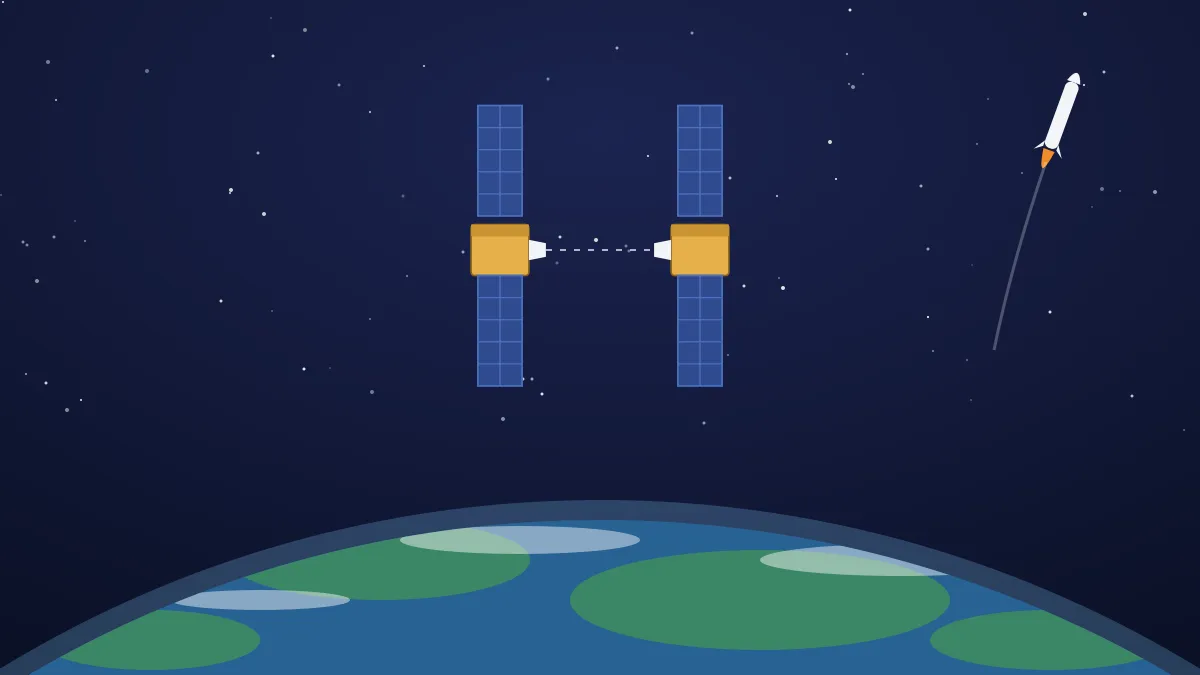
Docking is needed whenever one mission requires several launches. That includes assembling the Bharatiya Antariksh Station and bringing samples back from the Moon. It also opens the way to in-orbit servicing: refuelling, repairing or upgrading satellites in space instead of replacing them.
Navigation and communication
NavIC (Navigation with Indian Constellation) is India's own regional satellite navigation system. It covers India and up to 1,500 km beyond the Indian mainland. It offers a Standard Positioning Service for civilians and an encrypted Restricted Service for authorised users. It can also send emergency warnings to fishermen beyond the reach of mobile networks.
The backgrounder lists three recent communication satellites:
| Satellite | Launch | Purpose |
|---|---|---|
| GSAT-24 | 23 June 2022, Ariane-5 from Kourou, French Guiana | Direct-to-home television |
| GSAT-N2 (GSAT-20) | 19 November 2024 | High-throughput broadband (about 48 Gbps), including in-flight connectivity |
| CMS-03 (GSAT-7R) | 2 November 2025 | Dedicated communication satellite for the Indian Navy |
Watching the Earth
NISAR, the NASA-ISRO Synthetic Aperture Radar, was launched on 30 July 2025 aboard GSLV-F16 from Sriharikota. It is the first satellite to use two radar frequencies together: NASA's L-band and ISRO's S-band. It observes the Earth's land and ice surfaces every 12 days.
Radar uses microwaves, which pass through cloud and need no sunlight. NISAR can therefore image the ground day and night, in almost any weather. It is used to measure ground deformation, glacier movement, soil moisture and crops.
HysIS, the Hyperspectral Imaging Satellite, was launched on 29 November 2018. It records light in many narrow bands across the visible, near-infrared and shortwave-infrared ranges, which helps identify minerals, crops and soils. It flew with 30 foreign satellites from eight countries, 23 of them from the United States.
Between December 2020 and December 2025, ISRO launched 22 satellites, of which 7 were Earth-observation satellites.
The space economy
- The Department of Space has set a target of a US$44 billion space economy by 2033.
- NewSpace India Limited (NSIL), ISRO's commercial arm, has signed 118 technology transfer agreements, passing 83 ISRO technologies to Indian industry.
- Cumulative investment in Indian space start-ups reached about US$618.5 million by 31 March 2026.
🔑 Revision block
Origins. INCOSPAR 1962 (Vikram Sarabhai); first rocket from Thumba, 21 November 1963; ISRO 15 August 1969; Department of Space 1972.
Launchers. PSLV 1,750 kg to 600 km SSO; GSLV 2 t class with indigenous cryogenic stage; LVM3 4 t to GTO, 10 t to LEO; SSLV ~500 kg to 500 km; NGLV: approved September 2024, ₹8,240 crore, 30 t to LEO (14 t partly reusable), three developmental flights.
Orbits. SSO: near-polar, same local solar time. GTO: elliptical, apogee about 35,786 km. GEO: 35,786 km over the Equator, period about 23 h 56 min.
Propellants. Cryogenic: LH₂ (-253°C) + LOX (-183°C); semi-cryogenic: LOX + kerosene (ISROSENE).
Reuse. Pushpak landing tests: 2 April 2023, 22 March 2024, 23 June 2024.
Air-breathing. Scramjet test 28 August 2016, about Mach 6; RH-560 test 22 July 2024. Hypersonic means above Mach 5.
Electric. 300 mN stationary plasma thruster, 1,000-hour test on 27 March 2025; specific impulse at least 6 times chemical; to fly on TDS-01.
Docking. SpaDeX: 16 January 2025; autonomous re-docking 20 April 2025; power transfer 21 April 2025; fourth country after the US, Russia, China.
Satellites. NavIC to 1,500 km beyond the mainland; NISAR (30 July 2025, GSLV-F16, L + S band, every 12 days); CMS-03 (GSAT-7R) for the Navy, 2 November 2025; HysIS 29 November 2018.
Economy. US$44 billion by 2033; NSIL 118 agreements, 83 technologies; start-up investment about US$618.5 million.
🎯 Practice MCQs
Q1. The first sounding rocket launched by India in November 1963 lifted off from: (a) Sriharikota (b) Thumba (c) Balasore (d) Kulasekarapattinam
→ (b) Sriharikota became India's main orbital launch site later.
Q2. A geostationary satellite orbits at a height of about: (a) 600 km (b) 2,000 km (c) 20,200 km (d) 35,786 km
→ (d) At that height the orbital period equals one rotation of the Earth.
Q3. A scramjet engine differs from a rocket engine mainly because it: (a) uses oxygen from the atmosphere instead of carrying an oxidiser (b) uses solid fuel only (c) works only in outer space (d) needs no fuel at all
→ (a) It works only inside the atmosphere and at very high speed.
Q4. In ISRO's cryogenic upper stage, the fuel and the oxidiser are: (a) kerosene and liquid oxygen (b) hydrazine and nitrogen tetroxide (c) liquid hydrogen and liquid oxygen (d) liquid methane and liquid oxygen
→ (c) Kerosene with liquid oxygen is the semi-cryogenic combination.
Q5. Consider the following statements about electric propulsion: 1. It produces large thrust, suitable for launching rockets from the ground. 2. It achieves a much higher specific impulse than chemical propulsion. Which is/are correct? (a) 1 only (b) 2 only (c) Both 1 and 2 (d) Neither 1 nor 2
→ (b) Its thrust is tiny, so it is used for raising and keeping a satellite's orbit, not for launch.
Q6. A Radioisotope Thermoelectric Generator converts heat into electricity using the: (a) photoelectric effect (b) Seebeck effect (c) Doppler effect (d) Raman effect
→ (b) Thermocouples produce a voltage when their junctions are at different temperatures.
Q7. The NISAR satellite, launched in July 2025, is the first to combine radar in the: (a) X-band and C-band (b) Ka-band and Ku-band (c) C-band and S-band (d) L-band and S-band
→ (d) NASA supplied the L-band radar and ISRO the S-band radar.
Q8. Radar imaging satellites can observe the Earth at night and through clouds because they: (a) use visible light of very high intensity (b) use microwaves, which pass through cloud and need no sunlight (c) orbit below the clouds (d) use ultraviolet rays
→ (b) Optical satellites need sunlight and clear skies.
Q9. Which of the following is NOT one of the earlier countries that had demonstrated space docking before India's SpaDeX mission? (a) United States (b) Russia (c) China (d) Japan
→ (d) India became the fourth country, after the United States, Russia and China.
Q10. The Next Generation Launch Vehicle approved in 2024 is designed to carry up to how much payload to low Earth orbit? (a) 30 tonnes (b) 10 tonnes (c) 4 tonnes (d) 14 tonnes
→ (a) 10 tonnes is the LVM3's limit; 14 tonnes is the figure for NGLV's partly reusable version.
📋 How this gets asked (PYQ pattern)
Space is one of the most reliable science-and-technology topics in the NDA General Ability Test, asked in four forms.
The first is the mission-and-first question: which mission did what, and where India stands among countries that have done it. SpaDeX and docking, the scramjet test and NISAR's two radars are the fresh items.
The second is the launcher question: which vehicle carries what, to which orbit. The PSLV-for-polar and GSLV-or-LVM3-for-geostationary distinction is the standard trap.
The third is the physics question dressed as current affairs: why a geostationary satellite appears still, why radar sees through clouds, what a cryogenic stage burns, how a scramjet differs from a rocket. These are the questions where a student with sound physics gains marks that others lose.
The fourth is the institutional question: INCOSPAR, ISRO, the Department of Space, NSIL and IN-SPACe, and the years attached to them.
At the SSB, a lecturette on "India's space programme" is common. The strongest answers move beyond Chandrayaan to the technologies that make future missions possible, such as docking, reusable launchers and electric propulsion.
Preparing for NDA? Make a single table of India's launch vehicles and the orbits they serve, and a second of space "firsts" with dates. Revise both with the physics of orbits. Build the base with our NDA study material, follow the daily NDA current affairs, and train with serving-standard faculty in the upcoming Cavalier courses in Delhi.
Source: PIB Backgrounder, "India's New-Age Space Technologies: The Road to Self-Reliance", 28 October 2026, drawing on Department of Space and ISRO records. Physical constants and orbital figures cross-checked with standard references.
✍️ Written by Col D.N. Sharma — Science & general-studies faculty at The Cavalier. Reviewed by the Cavalier Faculty Desk.