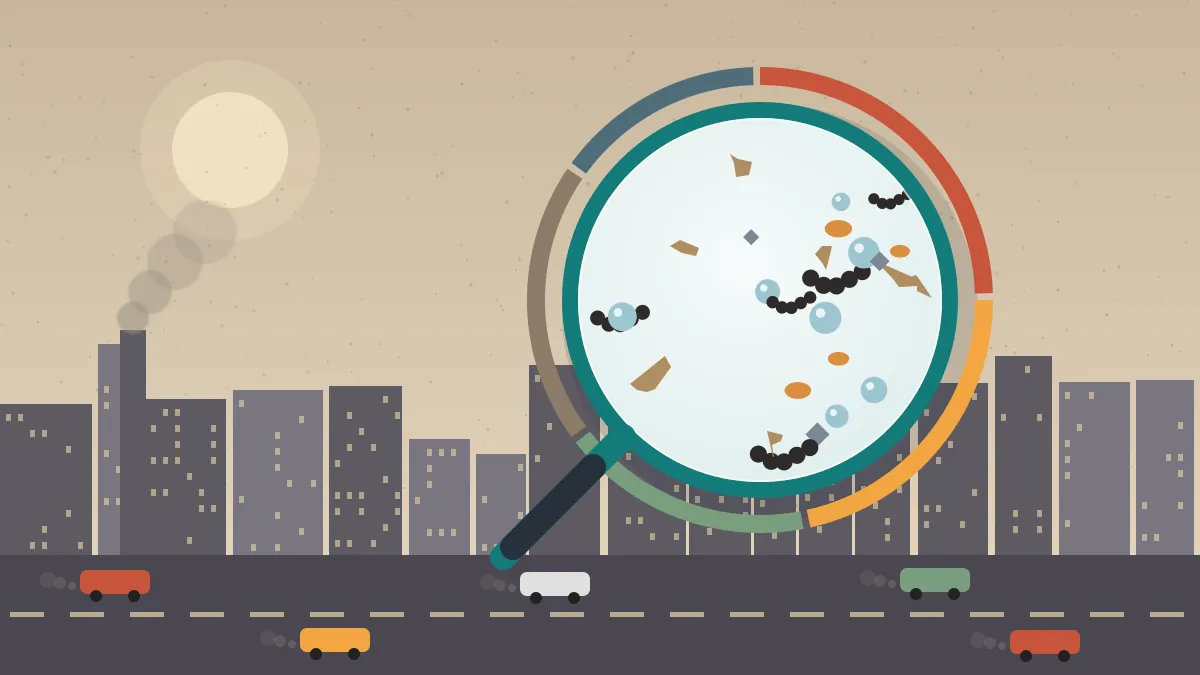
The Ministry of Earth Sciences opened a new air-pollution laboratory for Delhi-NCR on 24 October 2026: the Integrated Atmospheric Chemistry and Aerosol Toxicity Analysis Laboratory (AATAL), at the Indian Institute of Tropical Meteorology's Delhi branch. The Minister of State for Science and Technology and Earth Sciences, who inaugurated it, described it as a "world's first-of-its-kind" integrated facility. That is the Ministry's own description; what the laboratory does is easier to verify, and more useful to understand.
Its purpose, in the Minister's words, is to move the discussion beyond whether the pollution level is "100 or 200" to what the pollution consists of and where it comes from.
What the laboratory does
AATAL brings together three kinds of work in one place:
- Measurement and chemical analysis of the gases and aerosols (fine particles suspended in air) in Delhi's atmosphere, including PM2.5, metals and other toxic elements.
- Source identification — estimating how much of the pollution at a given moment comes from vehicles, industry, biomass and crop-residue burning, construction and road dust, and pollution transported from surrounding regions.
- Decision support — the release says the facility is integrated with a system named AIRWISE for real-time source estimates and air-quality forecasting, and will support the Commission for Air Quality Management (CAQM) and pollution-control agencies.
The Minister gave an example during the inauguration: at that moment the screen showed transport contributing about 25% of Delhi's pollution, with the overall index around 180. That is the kind of figure the laboratory is built to produce continuously.
The facility was set up under Mission Mausam, the Ministry of Earth Sciences' programme to strengthen India's weather and climate science.
Concentration, index and composition — three different things
Most public discussion of air pollution is about one number, the Air Quality Index. AATAL is about the things the index hides.
The AQI
India's National Air Quality Index was launched in 2014. It combines measurements of eight pollutants — PM10, PM2.5, nitrogen dioxide, sulphur dioxide, carbon monoxide, ozone, ammonia and lead — into a single number in six bands:
| AQI | Category |
|---|---|
| 0-50 | Good |
| 51-100 | Satisfactory |
| 101-200 | Moderately polluted |
| 201-300 | Poor |
| 301-400 | Very poor |
| 401-500 | Severe |
Particulate matter
PM10 means particles of 10 micrometres or less in diameter; PM2.5 means 2.5 micrometres or less — far thinner than a human hair. Size decides harm: larger particles are mostly trapped in the nose and throat, while PM2.5 penetrates deep into the lungs and the finest particles can enter the bloodstream. In Delhi's winter, PM2.5 usually drives the AQI.
Composition
Two samples with the same PM2.5 concentration can be very different. One may be mostly soil dust; another may carry soot, metals and acidic compounds. The second is far more harmful, and the AQI cannot tell them apart. AATAL's chemical analysis — including toxic metals — is designed to show what a given level of pollution actually contains, and so its health implications.
How source apportionment works
Source apportionment is the science of dividing measured pollution among its sources. There are two broad approaches:
- Bottom-up (emission inventories): estimate how much each source emits — vehicles, factories, power plants, burning — and model how the emissions disperse.
- Top-down (receptor modelling): measure the chemical composition of the particles at a site and work backwards, because different sources leave different chemical fingerprints. Soil and road dust are rich in crustal elements such as silicon, aluminium and calcium; biomass burning releases potassium and characteristic organic compounds; vehicle exhaust and industry leave their own signatures in carbon and metals.
A significant share of winter PM2.5 is also secondary aerosol — particles that are not emitted directly but form in the air when gases such as sulphur dioxide, nitrogen oxides and ammonia react to produce sulphates, nitrates and ammonium salts. These particles are harder to attribute because their ingredients come from many sources, sometimes far away.
Real-time apportionment matters because Delhi's pollution sources change by the hour and the season. Stubble burning dominates some weeks in October and November; dust dominates dry, windy days; vehicles and local combustion dominate still winter nights. A measure such as halting construction or restricting trucks helps only if dust or traffic is actually the problem at that moment.
Where it fits in Delhi's air-quality machinery
- CAQM, a statutory body for Delhi-NCR and adjoining areas, enforces measures through the Graded Response Action Plan (GRAP), which tightens restrictions as the AQI worsens. Its inspections are explained in our article on what a CAQM inspection actually checks.
- The National Clean Air Programme sets city-level reduction targets, and its contested results are set out in our Green Diwali and NCAP explainer.
- IITM, Pune, an autonomous institute of the Ministry of Earth Sciences, has run air-quality forecasting for Delhi for years, including the SAFAR system first introduced for the 2010 Commonwealth Games.
AATAL adds the missing link between these: evidence of which source to act against, and whether the action worked.
🔑 Revision block
- The event: AATAL — Integrated Atmospheric Chemistry and Aerosol Toxicity Analysis Laboratory — opened at IITM's Delhi branch, 24 October 2026, under Mission Mausam; described by the Ministry as a "world's first-of-its-kind" integrated facility.
- Functions: chemical analysis of gases and aerosols (PM2.5, metals, toxic elements); real-time source apportionment; forecasting and decision support (with AIRWISE); supports CAQM.
- Sources separated: vehicles, industry, biomass/crop-residue burning, construction and road dust, transported pollution; example — transport about 25% at AQI about 180.
- AQI (2014): 8 pollutants (PM10, PM2.5, NO₂, SO₂, CO, O₃, NH₃, Pb); six bands from Good (0-50) to Severe (401-500).
- PM sizes: PM10 ≤ 10 µm, PM2.5 ≤ 2.5 µm; PM2.5 reaches deep into the lungs and bloodstream.
- Source apportionment: bottom-up emission inventories vs top-down receptor modelling using chemical fingerprints (crustal elements = dust; potassium = biomass burning).
- Secondary aerosols: sulphates, nitrates and ammonium salts formed in the air from SO₂, NOx and NH₃.
- Institutions: CAQM (GRAP), NCAP, IITM Pune (MoES; SAFAR, 2010 Commonwealth Games).
🎯 Practice MCQs
Q1. AATAL, opened in October 2026, is primarily designed to: (a) issue pollution fines to vehicles (b) identify the composition and sources of air pollution in Delhi-NCR (c) generate electricity from crop residue (d) forecast earthquakes
→ (b) It analyses what pollution contains and estimates the contribution of each source in real time.
Q2. PM2.5 refers to particulate matter with a diameter of: (a) 2.5 micrometres or less (b) 2.5 millimetres or less (c) exactly 25 micrometres (d) more than 10 micrometres
→ (a) PM10 is 10 micrometres or less; PM2.5 is the finer, more harmful fraction.
Q3. How many pollutants are considered in India's National Air Quality Index? (a) Four (b) Six (c) Eight (d) Twelve
→ (c) PM10, PM2.5, NO₂, SO₂, CO, O₃, NH₃ and lead.
Q4. An AQI value of 350 falls in which category? (a) Moderately polluted (b) Poor (c) Severe (d) Very poor
→ (d) 301-400 is Very poor; 401-500 is Severe.
Q5. "Secondary aerosols" are particles that: (a) form in the atmosphere from reactions between gases such as SO₂, NOx and NH₃ (b) are emitted directly from vehicle exhausts (c) are blown in only from deserts (d) settle within one hour of emission
→ (a) Sulphates, nitrates and ammonium salts are formed in the air rather than emitted directly.
Q6. In receptor-based source apportionment, a high concentration of crustal elements such as silicon, aluminium and calcium indicates a contribution from: (a) vehicle exhaust (b) dust from soil, roads and construction (c) coal-fired power plants only (d) ozone formation
→ (b) Crustal elements are the chemical fingerprint of soil and road dust.
Q7. AATAL has been set up at the Delhi branch of which institute? (a) National Physical Laboratory (b) Central Pollution Control Board (c) Indian Institute of Tropical Meteorology (d) National Environmental Engineering Research Institute
→ (c) IITM, headquartered in Pune, is an autonomous institute of the Ministry of Earth Sciences.
Q8. Why is PM2.5 considered more harmful to health than PM10? (a) It is heavier and settles faster (b) It contains only harmless dust (c) It is trapped entirely in the nose (d) It penetrates deep into the lungs and can enter the bloodstream
→ (d) The smaller the particle, the deeper it travels into the respiratory system.
Q9. The Graded Response Action Plan for Delhi-NCR is enforced by the: (a) Commission for Air Quality Management (b) Ministry of Earth Sciences (c) India Meteorological Department (d) National Green Tribunal
→ (a) CAQM invokes GRAP stages as air quality worsens.
Q10. The SAFAR air-quality forecasting system was first introduced in Delhi for the: (a) 1982 Asian Games (b) 2010 Commonwealth Games (c) 2023 G20 Summit (d) 2014 launch of the AQI
→ (b) IITM developed SAFAR for the 2010 Commonwealth Games in Delhi.
📋 How this gets asked (PYQ pattern)
Air pollution is tested in the NDA GAT through both Environment and Chemistry, and the questions tend to be definitional.
The first form is the particulate-size question: what PM2.5 or PM10 means, and which is more harmful. The trap is to assume the larger number is worse, when the smaller particles do more damage.
The second is the AQI question: how many pollutants it includes, when it was launched, or which band a given value falls in. The 101-200 "moderately polluted" band is the one candidates most often misremember.
The third is the chemistry question: which gases form secondary pollutants, or which pollutant is responsible for a given effect — sulphur dioxide and nitrogen oxides for acid rain, ground-level ozone as a secondary pollutant.
A fourth is the institution question: CAQM and GRAP, IITM and its parent ministry, or the purpose of a named system such as SAFAR.
For the SSB lecturette or group discussion on Delhi's air, the useful point is that policy has long reacted to a single number. Knowing the composition and sources of pollution in real time allows targeted action — dust measures on dusty days, traffic measures when vehicles dominate — and an honest check on whether those measures work.
Preparing for NDA? In environment and chemistry, learn each pollutant with its source and its effect — that pairing answers most pollution questions in the GAT. Build the base with our NDA study material, follow the daily NDA current affairs, and train with serving-standard faculty in the upcoming Cavalier courses in Delhi.
✍️ Written by Col D.N. Sharma — Science & general-studies faculty at The Cavalier. Reviewed by the Cavalier Faculty Desk.