Both hands of a clock point straight up at 12:00. How many times in a full day do they lie exactly on top of each other, counting midnight once? Most people say 24, once an hour. The answer is 22, and the hands never overlap between 11 and 12 at all. The reason is one number: the minute hand gains 5.5° every minute on the hour hand.
We went through every clock question in the 31 CDS and NDA maths papers in our archive (2,747 questions; some copies are incomplete, so the true count is higher). We found 5, all in CDS (2018-I, 2021-II twice, 2024-II and 2026-I) and none in NDA. Not one asks for the angle at 3:40. UPSC asks for the angle a hand sweeps, the time of an overlap, the area swept by the minute hand, and how often two hands coincide. All five are solved below.
Three Hands, Three Speeds
A dial is a 360° circle with 12 hour marks, 30° apart, and 60 minute marks, 6° apart. Each hand is a runner on that circle.
| Hand | One full turn | Speed |
|---|---|---|
| Minute hand | 60 minutes | 6° per minute |
| Hour hand | 12 hours | 30° per hour = 0.5° per minute |
| Second hand | 1 minute | 6° per second = 360° per minute |
The two hands move in the same direction, so, as on our time, speed and distance page, their relative speed is the difference: 6 − 0.5 = 5.5° per minute. In minute-spaces, the minute hand gains 55 spaces an hour on the hour hand.
At H hours M minutes, the hour hand is at 30H + 0.5M degrees from 12 and the minute hand at 6M. Their difference gives the formula:
Find the angle between the hands at 7:20.
At 3:30 the hour hand is halfway between 3 and 4, so the angle is | 90 − 165 | = 75°, not 90°. Forgetting the 0.5° per minute is the commonest error. Angle names are on our lines and angles page.
Overlaps, Opposites and Right Angles: Why 11, Not 12
The hands overlap when the minute hand has gained a whole lap, 360°, on the hour hand. That takes 360 ÷ 5.5 = 720/11 = 65 5/11 minutes. In 12 hours (720 minutes) there are 720 ÷ (720/11) = 11 overlaps, not 12, because the 11th lap ends exactly at 12:00, so there is no overlap between 11 and 12.
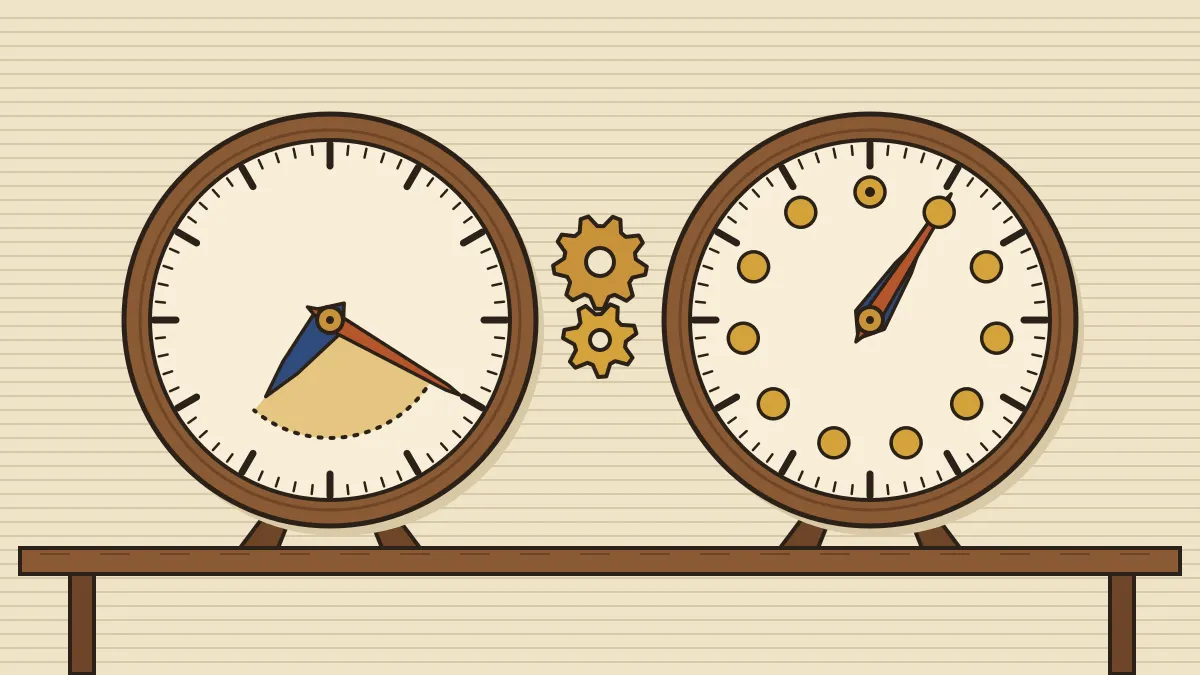
The overlaps fall at 60H/11 minutes past H o'clock:
| After | Minutes past | After | Minutes past |
|---|---|---|---|
| 1 | 5 5/11 | 6 | 32 8/11 |
| 2 | 10 10/11 | 7 | 38 2/11 |
| 3 | 16 4/11 | 8 | 43 7/11 |
| 4 | 21 9/11 | 9 | 49 1/11 |
| 5 | 27 3/11 | 10 | 54 6/11 |
For any angle θ, set the minute hand θ degrees ahead of the hour hand (6M − 30H − 0.5M = θ) or behind it (30H + 0.5M − 6M = θ). Solving gives one formula, with + for ahead and − for behind:
M = (60H ± 2θ) ÷ 11 minutes past H. Use θ = 0 for an overlap, 90 for a right angle, 180 for opposite. Reject any M that is below 0 or at least 60: that hour has no such moment.
At what time between 4 and 5 are the hands opposite each other?
Since one lap happens 11 times in 12 hours, the counts follow. In each lap every angle other than 0° and 180° occurs twice, once on each side.
| Position of the hands | In 12 hours | In 24 hours |
|---|---|---|
| Overlap (0°) | 11 | 22 |
| Straight line (180°) | 11 | 22 |
| Right angle (90°) | 22 | 44 |
| Any other angle | 22 | 44 |
How many times are the hands at right angles between 6 a.m. and 6 p.m.?
The answers are 22 overlaps and 44 right angles a day, not 24 and 48. Also, a right angle can fall exactly on an hour: at 3:00 and 9:00 the hands are 90° apart, so check whether the window includes such an endpoint.
Mirror Images
A mirror swaps left and right, so a clock's 3 appears at the 9. Every hand angle a becomes 360° − a, which works out as a simple rule: real time + mirror time = 12:00, written as 11:60 − T when you subtract. The only fixed points are 12:00 and 6:00.
A clock seen in a mirror shows 4:35. What is the real time?
The rule works both ways: the mirror image of 3:25 is 8:35, and of 8:35 is 3:25.
Fast and Slow Clocks
A faulty clock runs steadily at the wrong rate, so compare clock time elapsed with true time elapsed. A clock that gains g minutes per hour shows 60 + g minutes for every 60 true minutes, so true time = clock time × 60 ÷ (60 + g). Read the wording: "by a correct watch" and "by its own time" name different clocks. Adding hours to a time is itself a remainder sum, on division by 12 or 24, as on our remainders page.
A clock gains 2 minutes every hour. It is set right at 8 a.m. When it shows 3 p.m. on the next day, what is the true time?
The hands of a clock overlap every 65 minutes by a correct watch. How much does the clock gain or lose in 24 hours?
Real clocks drift too. That is why India keeps its national time on atomic clocks: see our explainer on Indian Standard Time and precise timekeeping.
The Second Hand, and Swept Area
The same method gives the other hand pairs. Relative speed in degrees per minute decides how often two hands meet.
| Pair | Relative speed | Meet every | Times in 12 hours |
|---|---|---|---|
| Minute and hour | 5.5° | 65 5/11 min | 11 |
| Second and minute | 354° | 60/59 min | 708 (59 an hour) |
| Second and hour | 359.5° | 720/719 min | 719 |
All three hands meet only at 12:00, twice a day. When a question asks for a count, find the gap between meetings and check whether the window's two ends are themselves meetings.
The minute hand also draws a sector of a circle. If it turns through θ degrees, with θ = 6 × (minutes), then area = (θ/360) × πr² and arc length = (θ/360) × 2πr. Our circles page has the sector formulas.
The tip of a minute hand 7 cm long moves for 20 minutes. How far does it travel? (π = 22/7)
How UPSC Has Asked It: Past Papers Solved
These are all five clock questions in our CDS and NDA maths papers.
The minute hand of a clock is 10 cm long. What angle does it subtend in 1 minute?
(a) 1° (b) 5° (c) 6° (d) 10°
Answer: (c). One full turn of 360° takes 60 minutes, so 360 ÷ 60 = 6°. The 10 cm length is a distractor. Option (b) 5° is the hour hand's turn in 10 minutes, not the minute hand's in one.
Between 3 and 4 O'clock, both hour hand and minute hand will coincide past 3 O'clock between:
(a) 15-16 minutes (b) 16-17 minutes (c) 17-18 minutes (d) 18-19 minutes
Answer: (b). At 3:00 the hour hand is 90° ahead of the minute hand, which gains 5.5° a minute: 90 ÷ 5.5 = 180/11 = 16 4/11 minutes. Option (a) tempts because the minute hand reaches the 3 at 3:15, but by then the hour hand has moved on.
The minute hand of a clock is 21 cm long. What is the area on the face of the clock described by the minute hand between 10:10 a.m. and 10:30 a.m.? (Take π = 22/7)
(a) 231 cm² (b) 331 cm² (c) 462 cm² (d) 492 cm²
Answer: (c). Twenty minutes is 20 × 6 = 120°, a third of the circle: (1/3) × (22/7) × 21² = (1/3) × 1,386 = 462 cm². Option (a) 231 is the area for only 10 minutes (60°).
How many times does the minute hand of a clock coincide with the second hand between 2:01 pm and 4:01 pm on the same day?
(a) 121 (b) 120 (c) 119 (d) None of the above
Answer: (d). The two hands meet every 60/59 minutes. The window is 120 minutes, so 120 ÷ (60/59) = 118 gaps. The first meeting after 2:01 is at 2:01:01 (the 119th since noon) and the last is exactly 4:00:00 (the 236th), giving 236 − 119 + 1 = 118. Option (c) 119 would be right only if both ends of the window were meetings; neither 2:01:00 nor 4:01:00 is.
The minute hand of a clock is 15 cm long and sweeps an area of 15π cm² on the dial of the clock. How much angle does it describe during this period?
(a) 12° (b) 18° (c) 24° (d) 30°
Answer: (c). The full dial has area π × 15² = 225π. The fraction swept is 15π ÷ 225π = 1/15, and 360° ÷ 15 = 24°, which is 4 minutes. Option (d) 30° would be 1/12 of the dial, an area of 18.75π.
All five are CDS, and the only types asked are 6° a minute, sector area, overlap time and a coincidence count. Two need the relative-speed idea (2021-II Q38 and 2024-II Q90). For any count question, work out the gap and test the endpoints.
Practice MCQs (with answers)
- What is the angle between the hands of a clock at 2:20?
- 40°
- 50°
- 60°
- 70°
- At what time between 5 and 6 do the hands overlap?
- 5:27
- 5:30
- 5:32 8/11
- 5:27 3/11
- How many times are the hands of a clock at right angles in one day?
- 44
- 22
- 24
- 48
- A clock seen in a mirror shows 8:10. What is the real time?
- 4:50
- 3:40
- 3:50
- 4:10
- At what time between 8 and 9 are the hands opposite each other?
- 8:10
- 8:12
- 8:54 6/11
- 8:10 10/11
- A clock gains 3 minutes every hour and is set right at 6 a.m. What does it show when the true time is 6 p.m.?
- 6:36 p.m.
- 6:30 p.m.
- 6:33 p.m.
- 6:39 p.m.
- The minute hand of a clock is 14 cm long. What area does it sweep in 15 minutes? (π = 22/7)
- 77 cm²
- 308 cm²
- 154 cm²
- 616 cm²
- How many times do the hour and minute hands coincide between 2:30 p.m. and 10:30 p.m. of the same day?
- 6
- 7
- 8
- 9
1-b, 2-d, 3-a, 4-c, 5-d, 6-a, 7-c, 8-b. Q1: | 60 − 110 | = 50°. Q2: 60 × 5 ÷ 11 = 300/11 = 27 3/11 minutes past 5. Q4: 11:60 − 8:10 = 3:50. Q5: (480 − 360) ÷ 11 = 120/11 = 10 10/11; the plus sign gives 840/11, which is over 60 and so rejected. Q6: 12 hours × 3 = 36 minutes gained. Q7: 15 minutes is 90°, a quarter of π × 14² = 616, so 154. Q8: the overlaps at 3:16, 4:21, 5:27, 6:32, 7:38, 8:43 and 9:49 are 7; 2:10 is too early and 10:54 too late.
Quick Revision
- Minute hand 6° per minute; hour hand 0.5° per minute (30° an hour); relative speed 5.5° per minute. Second hand 6° per second.
- Angle at H:M = | 30H − 5.5M |; if over 180°, take 360° minus it.
- Time between H and H + 1 for angle θ: M = (60H ± 2θ) ÷ 11; reject M outside 0 to 60. Overlap: 60H/11.
- Overlap every 65 5/11 minutes; 11 in 12 hours, 22 in a day; none between 11 and 12. Straight line: 22 a day. Right angles: 44 a day.
- Mirror image = 11:60 − T. 12:00 and 6:00 are unchanged.
- Fast or slow clock: compare clock time with true time; true time = clock time × 60 ÷ (60 + g) for a gain of g minutes an hour.
- Minute and second hands meet every 60/59 minutes (59 an hour); all three hands meet only at 12:00. Sector area = (θ/360) × πr².
Frequently asked questions
What is the formula for the angle between the hands of a clock?
At H hours M minutes, the angle is | 30H − 5.5M | degrees. If the result is more than 180°, subtract it from 360° to get the smaller angle. The formula works because the hour hand is at 30H + 0.5M degrees and the minute hand is at 6M degrees.
How many times do the hands of a clock overlap in a day?
The hands overlap 22 times in 24 hours, which is 11 times in 12 hours. They overlap every 65 5/11 minutes, because the minute hand gains 360° at 5.5° a minute. The eleventh overlap falls at exactly 12:00, so there is none between 11 and 12.
How many times are the hands of a clock at right angles in a day?
The hands are at right angles 44 times a day, or 22 times in 12 hours. In each lap of the minute hand over the hour hand, a right angle occurs twice, once with each hand ahead, and there are 11 laps in 12 hours.
How do I find the real time from a mirror image of a clock?
Subtract the mirror time from 11:60 (that is, from 12:00). For example, if the mirror shows 4:35, the real time is 11:60 − 4:35 = 7:25. The rule works in both directions, and 12:00 and 6:00 look the same in a mirror.
How do I solve fast and slow clock problems?
Compare the time elapsed on the faulty clock with the true time elapsed. A clock that gains g minutes an hour shows 60 + g minutes for every 60 true minutes, so true time equals clock time multiplied by 60 and divided by 60 + g. Check whether the question refers to the correct watch or to the clock's own time.
Related CDS / OTA Maths topics
Clock sums are free marks once you know two numbers
Cavalier's CDS/OTA batches drill clock, calendar and relative-speed problems with timed PYQ sets every week, until each one takes under a minute.