India's National Waterway 1 runs 1,620 km along the Ganga from Prayagraj to Haldia, and cargo barges ply it (see our explainer on inland waterways and navigation). The same engine gives two different speeds: the river helps on the way down and holds you back on the way up. That one fact is the whole chapter, and in 17 CDS maths papers from 2018 to 2026 it produced four direct boat questions, two of them in 2026. The same logic, speed measured against a moving background, solves the train and walker questions too.
The Four Formulas and the One Picture Behind Them
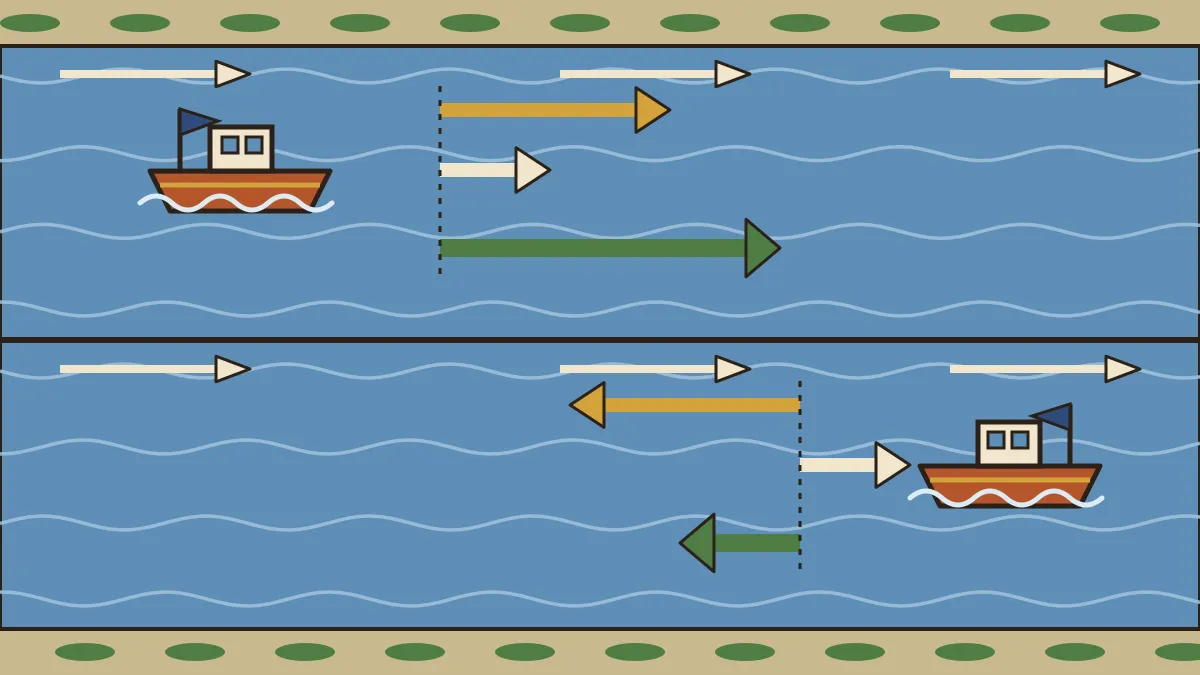
Let u be the boat's speed in still water and v the speed of the stream. The boat's speed relative to the bank is the boat's speed relative to the water plus the speed of the water relative to the bank. Going with the stream the two add, and going against it they subtract.
| Quantity | Formula | Why |
|---|---|---|
| Downstream speed (D) | D = u + v | Boat and stream push the same way |
| Upstream speed (U) | U = u − v | Stream pushes back; needs u greater than v to make progress |
| Boat in still water | u = (D + U) ÷ 2 | Add the two lines, the v's cancel |
| Stream | v = (D − U) ÷ 2 | Subtract the two lines, the u's cancel |
Two more results fall out of these. The ratio of the two unknowns is u : v = (D + U) : (D − U). And for a round trip of equal distances, the average speed is 2DU ÷ (D + U) = (u² − v²) ÷ u, always less than u. The first is a ratio-and-proportion move (our ratio and proportion page has the basics), and the second is the equal-distance average speed rule from our averages page.
A boat goes 30 km upstream in 6 hours and 30 km downstream in 3 hours. Find its speed in still water and the speed of the stream.
A boat with u = 12 km/h goes 36 km down a river with v = 3 km/h and comes back. Find the total time and the average speed.
The average is not 12 km/h, and not the mean of 15 and 9 either. The boat spends longer at the slow speed, which pulls the average below u.
Ratio Shortcuts: Same Distance, Same Time
Boat questions usually give a ratio. Ask: is the distance the same, or the time?
- Same distance: times are in the inverse ratio of speeds. If the time downstream : upstream is a : b, then D : U = b : a.
- Same time: distances are in the same ratio as speeds. If a boat covers 36 km down and 24 km up in equal time, D : U = 36 : 24 = 3 : 2.
Then use u : v = (D + U) : (D − U). Memorise this table of ratios:
| D : U | u : v |
|---|---|
| 2 : 1 | 3 : 1 |
| 3 : 2 | 5 : 1 |
| 3 : 1 | 2 : 1 |
| 4 : 3 | 7 : 1 |
| 5 : 3 | 4 : 1 |
A boat takes twice as long to go upstream as downstream over the same distance. The stream flows at 4 km/h. What is the speed of the boat in still water?
In the same time a boat goes 36 km downstream and 24 km upstream. If the stream is 2 km/h, find the boat's speed.
A boat takes 1 hour longer to go 24 km upstream than to come back downstream. The stream is 2 km/h. Find u.
The last type is where the quadratic equations chapter comes in. The shortcut: the difference of the two times is always d × 2v ÷ (u² − v²).
Crossing the River and Floating Objects
When a boat crosses the river sideways, the two speeds are at right angles and do not interfere: the boat crosses at its engine speed and drifts at the stream's speed.
A boat steered straight across a river at 4 m/s in still water. The river is 160 m wide and flows at 3 m/s. How long does the crossing take, how far downstream does the boat land, and how fast does it move relative to the bank?
To land directly opposite you must head slightly upstream, and the crossing speed becomes √(u² − v²).
The floating-object trick
Imagine you sit on the water itself. The stream vanishes: a floating ball is stationary and the boat moves at its still-water speed in every direction. A boat sails upstream, drops a ball overboard, and the crew notice 10 minutes later and turn round. How long to catch the ball? 10 minutes: away for 10, back for 10, whatever the stream's speed.
Relative Speed: The Same Idea for Trains and Walkers
The boat sum is a relative speed sum with the water as background. Our time, speed and distance page has the basic relation.
| Situation | Relative speed | Distance to cover |
|---|---|---|
| Moving towards each other (or train crossing a train going the other way) | Add the speeds | Gap between them, or the sum of the two lengths |
| Same direction (overtaking, or a faster one catching a slower one) | Subtract the speeds | Gap, head start, or the length of the train passed |
| Train crossing a pole, man or platform | The train's speed (relative to the man if he moves) | Train length (plus platform length) |
Always convert first: km/h × 5/18 = m/s. Two shortcuts:
- Head start. If a walker leaves t hours earlier at speed a, the gap is a × t. The catch-up time is gap ÷ speed difference.
- The square-root rule. Two bodies start together from opposite ends and pass each other. If, after meeting, the first takes t₁ to finish and the second t₂, then speed of first : speed of second = √t₂ : √t₁.
Trap Patterns
- Averaging D and U for the round trip. The right average is 2DU ÷ (D + U).
- Swapping same-distance and same-time. Times flip the ratio; distances do not.
- Halving the wrong thing. u : v = (D + U) : (D − U) has no halving; CDS 2026-I tested this.
- Mixing units: km/h with m/s, minutes with hours.
- Adding instead of subtracting for trains going the same way, or forgetting a train's length.
How UPSC Has Asked It: Past Papers Solved
Six genuine CDS questions, two on boats and four on relative speed. Each answer is our own solution, checked against the key.
A person goes downstream at x km/h and upstream at y km/h by the same boat. What is the ratio of speed of boat in still water to speed of water?
(a) x/y (b) y/x (c) (x + y)/(x − y) (d) (x − y)/(x + y)
Answer: (c). u = (x + y)/2 and v = (x − y)/2, so u : v = (x + y) : (x − y).
A boatman can row to a place (Y) at a distance of 24 km from the starting point (X) and back in 14 hours. If he can row 4 km with the stream in the same time as 3 km against it, what is the speed of the stream?
(a) 0.5 km/hr (b) 1 km/hr (c) 2 km/hr (d) 2.5 km/hr
Answer: (a). Same time, so D : U = 4 : 3. Let D = 4k, U = 3k. Then 24/(4k) + 24/(3k) = 14, so (6 + 8)/k = 14 and k = 1. D = 4, U = 3, so v = (4 − 3)/2 = 0.5 km/h.
A train crosses a man in another train in 10 s (opposite direction) and 20 s (same direction). Length of first train = 200 m, second = 150 m. Find speed of first train.
(a) 60 km/hr (b) 56 km/hr (c) 54 km/hr (d) 52 km/hr
Answer: (c). The man is a point, so only the first train's 200 m is crossed; the 150 m is a distractor. Opposite: relative speed = 200/10 = 20 m/s = a + b. Same direction: 200/20 = 10 m/s = a − b. So a = 15 m/s = 54 km/h.
Two trains X and Y are travelling in the same direction at 100 km/hr and 60 km/hr respectively. Train X crosses a man in train Y in 9 seconds. What is the length of train X?
(a) 80 m (b) 100 m (c) 120 m (d) 150 m
Answer: (b). Relative speed = 40 km/h = 40 × 5/18 = 100/9 m/s. Length = (100/9) × 9 = 100 m.
A train completely crossed two persons X and Y moving in the same direction as the train in 8 seconds and 8.1 seconds respectively. X is walking at a uniform speed of 3 km/hr and Y is walking at a uniform speed of 4 km/hr. What is the speed of the train?
(a) 81 km/hr (b) 82 km/hr (c) 83 km/hr (d) 84 km/hr
Answer: (d). The train's length is the same in both crossings: (s − 3) × 8 = (s − 4) × 8.1 (the 5/18 factor cancels). So 8s − 24 = 8.1s − 32.4, which gives 0.1s = 8.4 and s = 84 km/h.
A train P starts from station X for station Y and another train Q starts from station Y for station X at the same time. After passing each other, P takes 4 hours to reach Y and Q takes 1 hour to reach X. If the average speed of P is 60 km/h, then what is the average speed of Q?
(a) 72 km/h (b) 80 km/h (c) 96 km/h (d) 120 km/h
Answer: (d). By the square-root rule, speed of P : speed of Q = √1 : √4 = 1 : 2, so Q runs at 2 × 60 = 120 km/h. Inverting the ratio by mistake would give 30.
The boat question now arrives as a ratio or an equation rather than a bare number, and relative-speed sums turn up in most papers. Learn u : v = (D + U) : (D − U), the head-start method and the square-root rule, and each takes under a minute.
Practice MCQs (with answers)
- A boat's speed in still water is 9 km/h and the stream flows at 3 km/h. How long does it take to go 24 km upstream?
- 2 hours
- 3 hours
- 4 hours
- 6 hours
- A boat's downstream speed is 18 km/h and its upstream speed is 10 km/h. What is the speed of the stream?
- 3 km/h
- 4 km/h
- 5 km/h
- 6 km/h
- A boat covers 20 km downstream in 2 hours and returns in 4 hours. Its speed in still water is
- 6.5 km/h
- 7 km/h
- 7.5 km/h
- 8 km/h
- The downstream and upstream speeds of a boat are in the ratio 3 : 2. What is the ratio of the boat's speed in still water to the speed of the stream?
- 5 : 1
- 3 : 1
- 6 : 1
- 2 : 1
- A boat has a still-water speed of 10 km/h and the stream flows at 2 km/h. Its average speed over a round trip of equal distances is
- 10 km/h
- 9.6 km/h
- 8 km/h
- 9.8 km/h
- A boat takes three times as long to go a distance upstream as downstream. Its still-water speed is 8 km/h. What is the speed of the stream?
- 2 km/h
- 3 km/h
- 3.5 km/h
- 4 km/h
- A swimmer heads straight across a river 100 m wide at 4 m/s in still water. The river flows at 3 m/s. How far downstream does he land?
- 75 m
- 100 m
- 125 m
- 25 m
- Two trains of length 100 m and 150 m run in opposite directions at 60 km/h and 40 km/h. How long do they take to cross each other completely?
- 6 s
- 7.5 s
- 10 s
- 9 s
1-c, 2-b, 3-c, 4-a, 5-b, 6-d, 7-a, 8-d. Q3: D = 10, U = 5, so u = 7.5. Q5: (100 − 4) ÷ 10 = 9.6; the trap is 10. Q6: D : U = 3 : 1, so u : v = 2 : 1 and v = 4. Q7: time = 100 ÷ 4 = 25 s, drift = 3 × 25 = 75 m. Q8: relative speed 100 km/h = 250/9 m/s, total length 250 m, so time = 9 s.
Quick Revision
- D = u + v, U = u − v. u = (D + U)/2, v = (D − U)/2. u : v = (D + U) : (D − U), with no halving. Boat must have u greater than v to go upstream.
- Same distance: time ratio is inverse of speed ratio. Same time: distances in the speed ratio.
- Round trip, equal distances: average = 2DU/(D + U) = (u² − v²)/u, less than u. Time = 2du/(u² − v²).
- Straight across a river: time = width ÷ u; drift = v × time; ground speed √(u² + v²). The stream does not change crossing time.
- Floating object: work in the water's frame. Away for t, back in t.
- Relative speed: opposite add, same subtract; km/h × 5/18 = m/s. Head start gap = speed × time. Meeting trains: speeds in the ratio √t₂ : √t₁.
Frequently asked questions
What is the formula for upstream and downstream speed?
Downstream speed is the boat's speed in still water plus the stream speed (u + v). Upstream speed is the boat's speed in still water minus the stream speed (u − v). From these, u = (downstream + upstream) ÷ 2 and v = (downstream − upstream) ÷ 2.
How do you find the average speed of a boat on a round trip?
For equal distances it is 2DU ÷ (D + U), not the mean of the two speeds. It also equals (u² − v²) ÷ u, always below the still-water speed.
Why does the stream not matter when a boat crosses straight across a river?
The boat's motion across the river and the stream's motion along it are at right angles and do not affect each other. The crossing time is the width divided by the boat's own speed. The stream only decides how far downstream the boat lands.
How is relative speed used in train questions?
Towards each other the speeds add, and the same way they subtract. The distance is the sum of both lengths, or just the train's length for a man or pole. Convert km/h to m/s by multiplying by 5/18.
What is the shortcut for the speed ratio of two bodies that meet and then finish their journeys?
If two bodies start at the same time from opposite ends and pass each other, their speeds are in the ratio of the square roots of the times each takes after meeting, reversed. If the first takes t₁ and the second t₂, then speed 1 : speed 2 = √t₂ : √t₁.
Related CDS / OTA Maths topics
Speed questions are quick marks in CDS maths
Cavalier's CDS/OTA batches drill boats, trains and relative speed in timed sets, until each sum takes under a minute.