On 19 November 2026 the Prime Minister paid tribute to Rani Lakshmibai of Jhansi on her birth anniversary, recalling her courage in the fight against foreign rule and her refusal to compromise on duty and self-respect. The date is traditionally given as 19 November 1828, although some accounts place her birth in 1835. Her quarrel with the British began not with a bullet but with a rule on adoption. The two weapons that took her kingdom, and most of India before it, were the Subsidiary Alliance of Lord Wellesley and the Doctrine of Lapse of Lord Dalhousie. UPSC asks about them in nearly every Modern India paper: who signed which treaty, what each clause meant, and, above all, which state was taken by which method.
Wellesley's Three Methods
By Narendra Singh · GS faculty, The Cavalier · 15 years teaching GS
Lord Richard Wellesley (Governor-General, 1798 to 1805) arrived with a plan. Until the 1790s the Company had preferred peace, because war ate into profits. By the end of the century its directors and merchants had come to believe that British goods would sell on a large scale only if the whole country were under British control. Wellesley also feared the French. Tipu Sultan of Mysore was talking to Revolutionary France, and Zaman Shah of Kabul was threatening an invasion. He used three methods:
| Method | What it meant | Example |
|---|---|---|
| Subsidiary Alliance | Protect a ruler in exchange for a permanent British force in his land, paid for by him | Hyderabad (1798), Awadh (1801), the Peshwa (1802) |
| Outright war | Crush a ruler who would not sign | Mysore: Tipu died at Seringapatam on 4 May 1799 |
| Taking over territory | Seize the lands of already-subordinated rulers and give them pensions | The Carnatic (1801), Tanjore and Surat |
Helping an Indian ruler with a paid foreign force was an old practice. Wellesley gave it a fixed form and made it the standard way of reducing Indian states to the paramount authority of the Company.
The Subsidiary Alliance: Terms, Treaties and Costs
| What the ruler had to accept | What he was promised |
|---|---|
| A permanent British force stationed in his territory | Protection from his enemies |
| Pay for it, either an annual subsidy or by ceding territory | Non-interference in his internal affairs (a promise seldom kept) |
| A British Resident at his court | |
| No European in his service without British approval (the French were the target) | |
| No negotiation or war with another ruler without the Governor-General's consent |
Look at what the ruler gave up. He lost the right of self-defence, of keeping diplomatic relations, of employing foreign experts and of settling disputes with his neighbours. In every matter outside his borders he became a dependant, and inside them the Resident soon interfered in daily administration.
| State | Year | What happened |
|---|---|---|
| Hyderabad (Nizam) | 1798, extended in 1800 | The first treaty. The Nizam dismissed his French-trained troops and took a force of six battalions. In 1800 he ceded territory in place of cash. |
| Mysore | 1799 | After Tipu's fall, nearly half his land was shared between the Company and the Nizam. The old Wodeyar family was restored under a subsidiary treaty. |
| Awadh | 1801 | The Nawab gave up nearly half his kingdom, including Rohilkhand and the land between the Ganga and Yamuna. His army was virtually disbanded. |
| The Peshwa (Baji Rao II) | Treaty of Bassein, 31 December 1802 | Defeated by Holkar at Poona on Diwali 1802, the Peshwa ran to the English. The treaty led straight to the Second Anglo-Maratha War. |
| Bhonsle and Sindhia | 1803 | Beaten at Assaye (September) and Argaon (November) by Arthur Wellesley, and at Laswari (1 November) by Lord Lake, both signed subsidiary treaties and ceded land. |
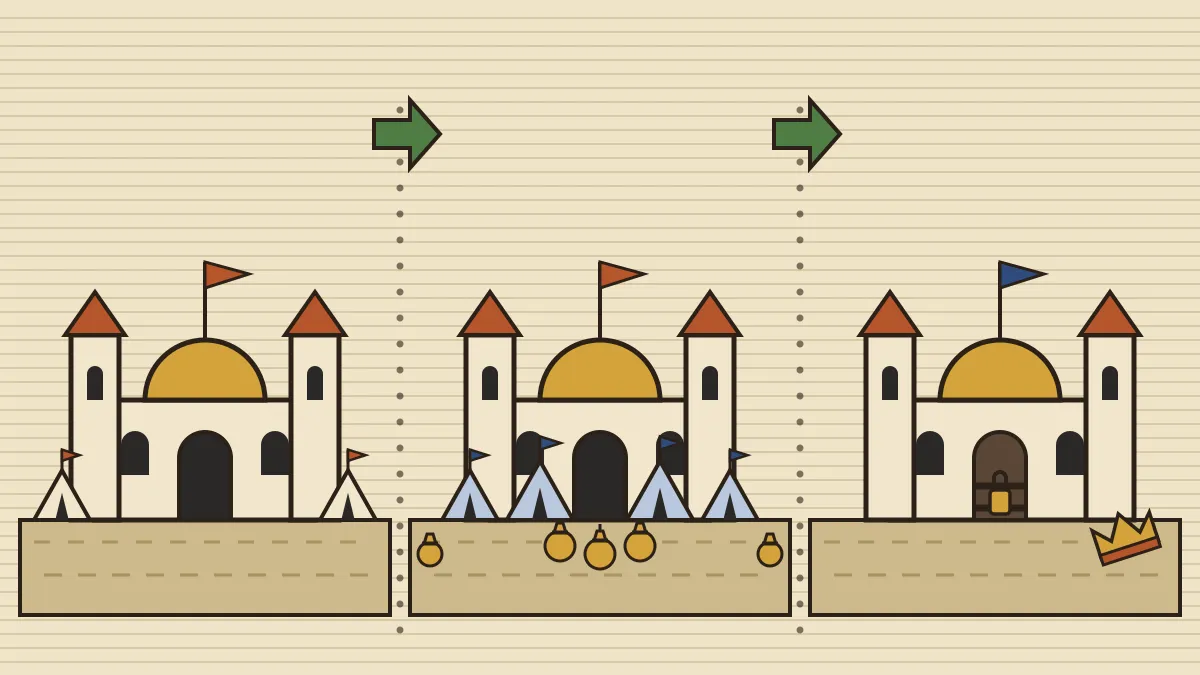
Why it suited the Company. It could keep a large army at the expense of Indian states. It fought its wars far from home, since any war would occur in the territory of an ally or an enemy. It controlled the ally's defence and foreign relations, and it had a powerful force stationed at the heart of his land, ready to depose him as "inefficient" whenever it chose.
Why it ruined the state. The subsidy was fixed at an artificially high sum, far above the state's means, and it drained the treasury and impoverished the people. The ruler's own army was disbanded, which threw lakhs of soldiers out of work. Many joined the roaming Pindari bands that ravaged central India in the first two decades of the 19th century. And the ruler, protected from rebellion and invasion alike, no longer feared his own people and had little reason to govern well.
The ally was not free to make treaties or wage war on its own. That is exactly the false statement CDS 2022-I slipped into the list of terms. The British promised protection and non-interference, but the Resident soon interfered in daily administration.
A Pause, a Revival and the Final Round
Wellesley's last war was against Yashwant Rao Holkar, who fought the British to a standstill and was helped by the Raja of Bharatpur, whose fort Lord Lake could not storm. Meanwhile the Company's debt had risen from about £17 million in 1797 to £31 million in 1806. The directors had had enough of ruinous expenditure. Wellesley was recalled, and the Treaty of Rajghat (January 1806) gave Holkar back most of his lands. Wellesley left other marks as well: his College of Fort William (1800) trained Company officers.
The Marathas never accepted the loss of their freedom. In 1817 the Peshwa attacked the Residency at Poona and Appa Sahib Bhonsle attacked the one at Nagpur. Lord Hastings (Governor-General, 1813 to 1823) struck back. The Peshwa was deposed and pensioned at Bithur, near Kanpur, and his lands were annexed to form the larger Bombay Presidency. To please Maratha pride, a small kingdom of Satara was carved out of the Peshwa's lands and given to a descendant of Shivaji, on condition that he rule as a complete dependant. Hold on to that detail: the British made Satara, and later took it back. For the empire the Marathas had built, see our Maratha page.
Dalhousie and the Doctrine of Lapse
Lord Dalhousie (Governor-General, 1848 to 1856) believed that the end of all native states was only a question of time. He called British administration far better than that of the princes, but the real aim was a larger market for British goods. His main tool was the Doctrine of Lapse. If a ruler of a protected state died without a natural heir, the state could not pass to an adopted son under the old Indian custom. It would instead lapse (be annexed) to the British, unless the Company had approved the adoption beforehand.
| State | Year | How it was taken |
|---|---|---|
| Satara | 1848 | Doctrine of Lapse (the first big case) |
| Sambalpur | 1849-50 | Doctrine of Lapse |
| Jhansi | Formally 1854 (Gangadhar Rao died in November 1853) | Doctrine of Lapse |
| Nagpur | 1853-54 | Doctrine of Lapse |
| Punjab | 1849 | Annexed after the Second Sikh War, a conquest |
| Berar | 1853 | Taken from the Nizam to meet the cost of his subsidiary force; a cotton-growing province |
| Awadh | February 1856 | Alleged misgovernment by Wajid Ali Shah; NOT a lapse case |
The NCERT Class 8 history text gives Satara 1848, Sambalpur 1850, Nagpur 1853 and Jhansi 1854. Bipan Chandra's Modern India gives Satara 1848 and Nagpur and Jhansi 1854, and some other texts put Jhansi in 1853. The firm anchors are Satara 1848 (the first) and Jhansi 1854 (formal annexation). If a question turns on the exact year, trust the NCERT figure.
Dalhousie also refused to recognise the titles of several ex-rulers or to pay their pensions. The titles of the Nawabs of the Carnatic and of Surat and of the Raja of Tanjore were extinguished. When Baji Rao II, the last Peshwa, died at Bithur in 1851, the Governor-General refused to continue his pension to his adopted son Nana Saheb. These humiliations fed directly into the Revolt of 1857, which we trace on our Revolt of 1857 page.
The Nawab of Awadh had many heirs, so Lapse could not be used on him. The Nawabs had also been loyal allies since Buxar. Dalhousie found another reason: Nawab Wajid Ali Shah was accused of misgoverning the state and refusing reforms, and Awadh was annexed in 1856. Dalhousie described it as "a cherry that will drop into our mouth one day" (CDS 2024-II). The misgovernment was real, but the British had controlled and indirectly governed Awadh since 1801, and the true prize was a huge market and cotton-growing land.
Jhansi: The Rani and the Rule on Adoption
Rani Lakshmibai was born in Varanasi, named Manikarnika, and married Gangadhar Rao, the Raja of Jhansi. When he died in November 1853, he had just adopted a son, who was given the name Damodar Rao. The Company refused to recognise the adoption, and Jhansi was annexed in 1854 under the Doctrine of Lapse. The Rani was offered a pension and is said to have answered that she would not give up her Jhansi. When the sepoys of Jhansi rose in June 1857 she hesitated for a time, but once she joined the rebels she proved a brilliant commander.
- March 1858. General Hugh Rose besieged Jhansi. The Rani escaped and joined Tantia Tope at Kalpi.
- Gwalior. The two seized the city after Sindhia's troops went over to them, a blow to the British, although the Sindhia himself had stayed loyal to the Company.
- 17 June 1858. The Rani died fighting near Gwalior. Tantia Tope was betrayed and hanged in April 1859.
Her memory lived on. In 1943 Subhas Chandra Bose named the women's regiment of the Indian National Army the Rani of Jhansi Regiment; see our page on the revolutionary struggle and the INA.
How the story ended. After the Revolt, the Queen's Proclamation of 1 November 1858 promised respect for the rights of princes and an end to annexation. Governor-General Canning then gave the princes adoption sanads recognising their right to adopt an heir, and the Doctrine of Lapse died. The princely states now survived as loyal props of the empire until they were merged into India after Independence; see our page on the integration of princely states.
| Subsidiary Alliance | Doctrine of Lapse | |
|---|---|---|
| Architect | Wellesley (1798–1805) | Dalhousie (1848–1856) |
| Trigger | A ruler seeks or is forced into "protection" | A ruler dies without a natural heir |
| Result | The state loses its freedom but survives, with a garrison and a Resident | The state disappears into British India |
| Famous victims | Nizam, Awadh, Peshwa | Satara, Jhansi, Nagpur |
How UPSC Has Asked It: Past Papers Solved
UPSC asks this topic as a "which treaty or ruler", as a statement on the terms of the alliance, or as an "NOT annexed under Lapse" trap.
Which one of the following was not included in the terms and conditions of Subsidiary Alliance System of Lord Wellesley?
(a) The British would protect their ally. (b) The ally was free to enter into agreements with other rulers or engage in warfare. (c) In the territory of the ally, a British armed contingent would be stationed. (d) The ally would have to provide resources for the maintenance of the British armed contingent.
Answer: (b). The ally could not negotiate or fight without the Governor-General's consent. The other three are genuine terms: protection, a stationed force and payment for it.
Which Maratha statesman signed the Treaty of Bassein on December 31, 1802?
(a) Baji Rao II (b) Vithuji Holkar (c) Daulat Rao Sindhia (d) Madhava Rao Narayan
Answer: (a). Peshwa Baji Rao II signed after Holkar defeated him. Holkar and Sindhia were rivals of the Peshwa and not signatories of this treaty.
Which kingdom was described by Governor-General Lord Dalhousie as 'A cherry that will drop into our mouth one day'?
(a) Delhi (b) Awadh (c) Jhansi (d) Gwalior
Answer: (b). The quote is about Awadh. Jhansi is the tempting wrong answer, because it fell to Dalhousie's other famous policy, the Doctrine of Lapse.
S1: The Subsidiary Alliance system was extremely advantageous to the British. S6: They controlled the defence and the foreign relations of the protected ally. P: They could now maintain a large army at the cost of Indian states. Q: if any war occurred in the territories. R: either of the British ally or of the Britishers. S: This enabled them to fight wars far away from their own territories. Arrange P, Q, R, S in the correct order.
(a) P Q R S (b) P S Q R (c) Q R P S (d) S R P Q
Answer: (b). The advantages come in the order: a large army at the allies' cost (P), which allowed wars far from home (S), because any war would occur (Q) in the territory of either the ally or the enemy (R).
After forming the Indian National Army, Subhas Chandra Bose: 1. recruited a large number of soldiers from the Indian Prisoners of War in Japanese camp; 2. introduced a women's detachment named after the Rani of Jhansi. Which of the statements given above is/are correct?
(a) 1 only (b) 2 only (c) Both 1 and 2 (d) Neither 1 nor 2
Answer: (c). Bose raised the INA's ranks largely from Indian prisoners of war in Japanese hands, and the women's regiment bore the Rani's name.
The College of Fort William was established by which one of the following Governor-Generals?
(a) Warren Hastings (b) Lord Cornwallis (c) Richard Wellesley (d) William Bentinck
Answer: (c). Wellesley founded it in 1800 to train Company civil servants. Bentinck is the tempting wrong choice, since he is better known for education and social reform.
Pin each state to its method before the exam. Subsidiary Alliance: Hyderabad, Mysore, Awadh, the Peshwa, Bhonsle, Sindhia. Lapse: Satara, Sambalpur, Jhansi, Nagpur. Neither: Awadh (1856, misgovernment), Punjab (war), Sindh (1843, Napier). "Which was NOT annexed by Lapse" questions almost always use Awadh or Punjab as the wrong option.
Practice MCQs (with answers)
- Wellesley signed his first Subsidiary Treaty, in 1798, with
- the Nawab of Awadh
- the Peshwa
- the Nizam of Hyderabad
- Daulat Rao Sindhia
- Tipu Sultan died defending Seringapatam in
- 1792
- 1799
- 1803
- 1818
- A common effect of the Subsidiary Alliance on Indian states was
- enlargement of their armies
- lower financial burdens
- more freedom in foreign affairs
- disbanding of armies, some of whose soldiers joined the Pindaris
- Awadh was annexed in 1856 on the ground of
- alleged misgovernment
- the Doctrine of Lapse
- defeat in war
- refusal to pay the subsidy
- The Treaty of Bassein (31 December 1802) led directly to
- the First Anglo-Maratha War
- the Third Anglo-Maratha War
- the Revolt of 1857
- the Second Anglo-Maratha War
- Satara (1848), Nagpur and Jhansi were annexed in the time of
- Lord Hastings
- Lord Dalhousie
- Lord Canning
- Lord William Bentinck
- Which of the following was NOT annexed under the Doctrine of Lapse?
- Awadh
- Satara
- Nagpur
- Jhansi
- After the death of Baji Rao II, Dalhousie refused to continue his pension to his adopted son
- Tantia Tope
- Azimullah Khan
- Nana Saheb
- Kunwar Singh
1-c, 2-b, 3-d, 4-a, 5-d, 6-b, 7-a, 8-c. Q3: the opposite of (a), (b) and (c) happened: armies shrank, subsidies were crushing and freedom in foreign affairs was lost. Q5: the Peshwa's alliance with the British angered Sindhia and Bhonsle and led to war in 1803. Q7: Awadh had many heirs, so Lapse could not be used; it was annexed for misgovernment. Q8: Nana Saheb was Baji Rao II's adopted son, and the pension was stopped.
Quick Revision
- Wellesley, Governor-General 1798–1805: Subsidiary Alliance + war + takeover of territory. College of Fort William, 1800.
- Terms: permanent British force, subsidy or ceded land, Resident at the court, no Europeans employed without consent, no treaty or war without the Governor-General.
- Treaties: Hyderabad 1798 (first), Mysore 1799 (after Tipu's death on 4 May), Awadh 1801, Bassein 31 December 1802 (Peshwa Baji Rao II), Bhonsle and Sindhia 1803.
- Effects: army disbanded (Pindaris), subsidy burden, Resident interference. Company debt £17 million (1797) to £31 million (1806); Wellesley recalled; Rajghat, January 1806.
- Hastings, 1817–18: Peshwa deposed and sent to Bithur; Satara created.
- Dalhousie (1848–56): Doctrine of Lapse. Satara 1848, Sambalpur 1849-50, Nagpur 1853-54, Jhansi 1854 (books differ by a year). Not lapse: Awadh 1856 (misgovernment, "cherry"), Punjab 1849 (war), Berar 1853 (from the Nizam).
- Nana Saheb's pension refused. Rani Lakshmibai: born 19 November (1828 traditional); died 17 June 1858. Proclamation of 1858 and Canning's adoption sanads ended Lapse.
Frequently asked questions
What was the Subsidiary Alliance?
The Subsidiary Alliance was a system devised by Lord Wellesley in which an Indian ruler accepted a permanent British force in his territory and paid for it through a subsidy or ceded land. He also took a British Resident at his court and could not make treaties or wage war without the Governor-General's consent. In return the British promised protection.
Which state signed the first Subsidiary Alliance?
Hyderabad signed the first Subsidiary Treaty with Lord Wellesley in 1798. The Nizam dismissed his French-trained troops and agreed to maintain a British force of six battalions. In 1800 he ceded territory instead of paying cash.
What was the Doctrine of Lapse?
It was the policy of Lord Dalhousie, Governor-General from 1848 to 1856, by which a protected state without a natural heir would be annexed by the British and not pass to an adopted son unless the Company had approved the adoption beforehand. Satara, Sambalpur, Jhansi and Nagpur were annexed in this way.
Was Awadh annexed under the Doctrine of Lapse?
No. The Nawab of Awadh had many heirs, so the Doctrine could not apply. Awadh was annexed in February 1856 on the charge that Nawab Wajid Ali Shah had misgoverned the state.
Why did Rani Lakshmibai oppose the British?
After her husband Gangadhar Rao died in November 1853, the British refused to recognise the son he had adopted and annexed Jhansi under the Doctrine of Lapse. She joined the Revolt of 1857 and died fighting near Gwalior on 17 June 1858.
Related CDS / OTA History topics
History is the heaviest block of the CDS GS paper
Cavalier's CDS/OTA batches teach Modern India with timelines, maps and weekly PYQ tests.