On 16 November 2026, PIB released a backgrounder on the Kutch earthquake of 26 January 2001, which killed 13,805 people and affected about 7,633 villages, and described how Gujarat rebuilt itself over the next few years. Kutch, the district at the centre of that story, holds an older record of human resilience. On an island in the Great Rann stand the ruins of Dholavira, a Harappan city that flourished for roughly 1,500 years in one of the driest and most earthquake-prone corners of the subcontinent. Its neighbour in Gujarat, Lothal, is the site every student links with the "dockyard". CDS asked about Dholavira in 2021, 2022 and 2026. This article goes through the two sites and the rest of Gujarat's Harappan map.
Why Gujarat Matters in the Harappan Story
By Narendra Singh · GS faculty, The Cavalier · 15 years teaching GS
After Partition, Harappa and Mohenjodaro lay in Pakistan, so Indian archaeologists went looking for sites on their own side. An extensive survey in Kutch revealed a number of Harappan settlements, and Kalibangan, Lothal, Rakhi Garhi and, most recently, Dholavira were found and excavated as part of that effort.
| Site | Where | Excavation | What to remember |
|---|---|---|---|
| Dholavira | Khadir bet, an island in the Great Rann of Kutch | Found 1967–68 by J.P. Joshi (ASI); dug by R.S. Bisht from 1990 to 2005 | Stone city in three parts; water reservoirs; signboard; UNESCO 2021 |
| Lothal | Near the head of the Gulf of Khambhat (Cambay), on the Bhogavo, a tributary of the Sabarmati | S.R. Rao, ASI, from 1955 | Dock (debated); bead workshops; fire altars; rice |
| Surkotada | Rapar taluka, Kutch | Found 1964 by J.P. Joshi | Fortified citadel and residential area; disputed horse bones |
| Rangpur, Rojdi | Kathiawar (Saurashtra) | — | Late Harappan settlements |
The two famous Gujarat sites differ in kind: Dholavira is a city in a harsh landscape, Lothal a port and workshop town. Most Harappan settlements have a small high western part and a larger lower eastern section. Dholavira and Lothal are the variations: the entire settlement was fortified, and sections inside the town were also separated by walls. At Lothal the citadel was not walled off but was built on a height.
For extent, seals, script and decline, read our Harappan Civilisation page first.
Dholavira: A City Planned in Three Parts
The site lies on Khadir bet, an island that is cut off by the salt flats of the Great Rann in the rainy season. The city sat between two seasonal streams, the Mansar to the north and the Manhar to the south. It was found in 1967–68 by J.P. Joshi of the Archaeological Survey of India. Excavation by R.S. Bisht began in 1990 and ran through 13 field seasons until 2005.
Dholavira is among the largest of the more than 1,000 Harappan sites discovered so far, and it was occupied for about 1,500 years. Its earliest remains go back to about 3000 BCE (Early Harappan). Mohenjodaro had two parts, a citadel and a lower town. Dholavira had three.
| Part | What it was |
|---|---|
| Castle (citadel) | The fortified, highest part. Its inner enclosure held the most important buildings. Next to it lay a fortified Bailey, which probably housed senior officials, and a large open Ceremonial Ground |
| Middle Town | A separately fortified residential area. This extra tier is not found in the standard two-part Harappan plan |
| Lower Town | The large residential and working area for the general population |
| Cemetery | Lies to the west of the city. Most burials here are memorial in nature, with a large circular structure of ten radial brick walls thought to be a grave or memorial |
UNESCO's description calls the city an example of "preconceived" planning: segregated residential areas that seem to reflect different occupations and a stratified society. Another feature that sets it apart is its material. Most Harappan towns were made of kiln-burnt and mud brick, but Dholavira's buildings were made largely of stone, which was plentiful on the rocky island. Do not carry the "burnt bricks of ratio 4:2:1" line over to Dholavira: it describes the brick towns of the Indus plains.
Why build a city on an island with no perennial river? Unlike most earlier Harappan towns, which stood near rivers and permanent water, Dholavira's location was strategic for raw materials and trade. The island gave access to copper, shell, agate-carnelian, steatite, lead and banded limestone. It also helped trade with Magan (the Oman peninsula) and the Mesopotamian region.
Kutch is also among India's most seismically active regions. Excavation reports describe earthquakes damaging the settlement in ancient times. That fits the geology we cover on our earthquakes page, and it is a neat link with the 2001 disaster in the news. Our explainer on India's seismic zones shows why the Kutch region sits in the highest hazard zone.
Water Engineering: Storing Every Drop
Dholavira's reputation rests on water management. Rain in Kutch is scanty and the island has no perennial stream, so the citizens collected whatever came. Water from the seasonal streams was dammed and diverted, and rainfall and runoff were stored in large stone-cut reservoirs. The reservoirs lie along the eastern and southern sides, outside the castle. A few rock-cut wells served the city, the most impressive being inside the citadel, and UNESCO describes them as among the oldest examples.
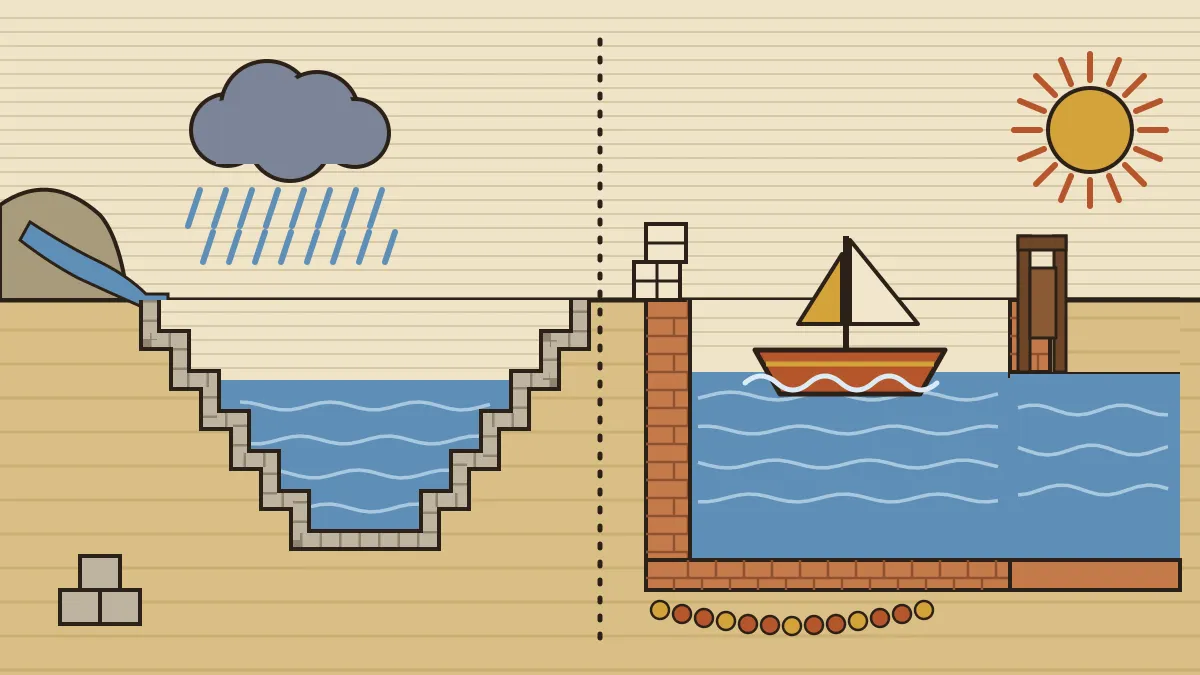
The examiner's favourite line: the large reservoirs and cisterns in the citadel and lower-town areas belong to Dholavira, not to Mohenjodaro. Mohenjodaro stands on the Indus and never needed to harvest rain.
Great Bath = Mohenjodaro. Reservoirs = Dholavira. Dockyard = Lothal (debated). Ploughed field = Kalibangan. If the question asks about storing rainwater, think Dholavira.
The Signboard, the Cemetery and the Trade Links
Dholavira's most talked-about find is a signboard from the north gateway of the city. Ten large signs of the Indus script, set in white gypsum, were fixed on a wooden plank, which had fallen flat in a side room of the gate. Each sign is about 37 cm tall and the board was roughly 3 m long, so it was meant to be read from a distance, like a public notice. The script is still undeciphered, so nobody can say what it announced.
The large Ceremonial Ground beside the castle shows that the planners set aside open space, probably for gatherings that were civic or religious. Beyond the walls, the cemetery to the west is mostly memorial: many funerary structures were built, but only one is reported to have held a skeleton. That is unusual for a Harappan site.
Match each clue with a Gujarat site.
Lothal: Dock, Beads and Fire Altars
Lothal lies near the head of the Gulf of Khambhat in the Bhal region of Gujarat. S.R. Rao of the ASI began excavating it in 1955. In the local language the name is usually glossed as "the mound of the dead", the same meaning commonly given to Mohenjodaro.
The dockyard. The excavators found a large brick-lined basin, trapezoidal in shape, more than 200 m long and about 35 m wide, with an inlet channel and an outlet fitted with a sluice. They identified it as a dockyard linked to an old river course, where ships could be tied up and loaded. This is why Lothal is the standard answer to "which Harappan site shows maritime trade". However, the claim has been challenged. In 1968 the American archaeologist Leshnik argued that the inlet was too small for ocean-going ships and that the basin was an irrigation tank. Microfossils and salt crystals found by the National Institute of Oceanography suggest that seawater once reached it, but critics point out that floods could explain this. Safe statement for the exam: Lothal is traditionally described as having a dockyard, and its function is still debated.
Craft and trade. Lothal was a manufacturing centre. Its bead-making workshop, with a furnace nearby, produced beads of carnelian and other stones, and specialised drills have been found here, as they have at Chanhudaro and, more recently, Dholavira. The raw material was brought from nearby regions: carnelian from Bharuch, steatite from south Rajasthan and north Gujarat, and metal from Rajasthan. Finished products were probably taken to the large urban centres such as Mohenjodaro and Harappa.
Town and food. Lothal's houses were of mud-brick, but its drains were of burnt brick, an odd but useful contrast. Fire altars have been found, in the later phase, at Lothal and at Kalibangan, but no temple was used for them. Rice remains here date to as early as about 1800 BCE, whereas rice is rare at most Harappan sites. The Gujarat sites also produced millets.
The old port is also in the news again. The government is building the National Maritime Heritage Complex near Lothal under the Ministry of Ports, Shipping and Waterways. Our article on Lothal's maritime complex follows its progress.
Surkotada, Rangpur and the Late Harappan Revival
Surkotada, in Rapar taluka of Kutch, was found by J.P. Joshi in 1964. It is a small site, but it has a western citadel and an eastern residential area, each fortified, with gateways and bastions. It was occupied for around 400 years, from roughly 2100 BCE, which is late. The site is famous for the horse bones, reported from the excavation and dated to about 2000 BCE. This matters because the horse is linked with the later Vedic period, so any evidence of horses in the Harappan age is controversial. The excavators reported the bones, but other zoo-archaeologists replied that horse bones are hard to tell from those of the ass and the wild onager. The textbook view is that the horse was not in regular use in Harappan times.
Rangpur and Rojdi, in the Kathiawar peninsula, are Late Harappan sites. The textbooks mark a trend here: by about 1800 BCE the Mature Harappan sites of Cholistan had been abandoned, but at the same time settlement expanded into Gujarat, Haryana and western Uttar Pradesh. In the surviving sites the weights, seals and special beads disappeared, and so did writing, long-distance trade and craft specialisation. The civilisation faded city by city, and Gujarat was one place where village life carried on. The Vedic culture that came after is covered on our Vedic society page.
On 27 July 2021, at the 44th session of the World Heritage Committee, "Dholavira: a Harappan City" was inscribed on the World Heritage List. It was India's 40th site, the first Indus Valley site in India to be listed, and the fourth in Gujarat after Champaner-Pavagadh, Rani ki Vav and the Historic City of Ahmedabad. India sent the nomination in January 2020, and the site had been on the tentative list since 2014. The listing covers the walled city and the cemetery to its west.
How UPSC Has Asked It: Past Papers Solved
UPSC asks about Gujarat's Harappan sites as site and its distinctive feature, or as a news hook.
Why was Dholavira in the news recently?
(a) Skeletons discovered at this site (b) For its conservation effects (c) For the discovery of gold and precious stones at this site (d) It received the UNESCO World Heritage Tag
Answer: (d). The inscription came on 27 July 2021.
In the citadel and lower-town areas of which one of the following Harappan cities, have several large cisterns and reservoirs been found?
(a) Banawali (b) Mohenjodaro (c) Dholavira (d) Rakhigarhi
Answer: (c). Dholavira stored water in stone-cut reservoirs. The tempting wrong option is Mohenjodaro, which is known for its Great Bath and wells, not for reservoirs.
How many of the following pairs is/are correctly matched? (Harappan site : Modern state/region) 1. Bhirrana : Haryana 2. Ganweriwala : Punjab (Pakistan) 3. Dholavira : Gujarat 4. Farmana : Uttar Pradesh
(a) 1 (b) 2 (c) 3 (d) 4
Answer: (c). Bhirrana is in Haryana, Ganweriwala is in Pakistani Punjab (Cholistan) and Dholavira is in Gujarat, so pairs 1, 2 and 3 are correct. Farmana is in Haryana, not Uttar Pradesh, so pair 4 is wrong. The question asks how many: three pairs are correct, and option (c) reads "3".
Which one of the following Harappan sites was a specialised centre for making shell objects?
(a) Lothal (b) Balakot (c) Amri (d) Kot Diji
Answer: (b). Balakot and Nageshwar, both near the coast, were specialised centres for shell objects such as bangles and ladles. Lothal is the bead and carnelian centre, which is why it tempts.
At which among the following Harappan sites are fire altars found?
(a) Kalibangan (b) Harappa (c) Mohenjo-daro (d) Rakhi Garhi
Answer: (a). Fire altars are the textbook feature of Kalibangan and Lothal, and the key for this question is (a). Harappa and Mohenjodaro are not known for them.
Four of these five questions ask "which site has this feature". Learn one signature item per site: Dholavira = reservoirs and stone; Lothal = dock and beads; Kalibangan = ploughed field and fire altars; Balakot = shell; Mohenjodaro = Great Bath. The UNESCO question shows that UPSC also picks up news hooks.
Practice MCQs (with answers)
- Which of the following best distinguishes Dholavira from most other large Harappan cities?
- It had no drainage system
- It was built largely of stone and divided into three fortified parts
- It stood on the bank of the Indus
- It had no citadel
- Dholavira is situated on
- the bank of the Bhogavo river
- the Ghaggar-Hakra channel
- the bank of the Ravi
- Khadir bet in the Great Rann of Kutch
- The excavation of Lothal was begun by
- S.R. Rao
- R.S. Bisht
- Daya Ram Sahni
- R.D. Banerji
- Which statement about the Lothal dock is most accurate?
- It is proved beyond doubt to have been used by sea-going ships
- It was built of stone, as at Dholavira
- Its use as a dock is traditional, but some scholars suggest it was an irrigation tank
- It was found on the bank of the Ravi
- Carnelian for the beads made at Lothal was brought from the region near
- Khetri
- Shortughai
- Bharuch
- Balochistan
- Which pair is correctly matched?
- Surkotada: Kutch, with a fortified citadel and residential area
- Rangpur: Haryana
- Lothal: Rajasthan
- Dholavira: Sindh
- Dholavira was inscribed on the UNESCO World Heritage List in
- 2014, as India's 38th site
- 2019, as India's 38th site
- 2020, as India's 39th site
- 2021, as India's 40th site
- The horse bones reported from Surkotada are
- accepted proof of horse-drawn chariots in the Harappan age
- disputed, because horse remains are hard to tell from ass and onager bones
- older than the Early Harappan phase
- found only in the cemetery
1-b, 2-d, 3-a, 4-c, 5-c, 6-a, 7-d, 8-b. Q4: the word "most accurate" matters. The dock reading is the traditional one, but the irrigation-tank argument is real, so (a) overstates the case. Q5: the textbook line is carnelian from Bharuch, steatite from south Rajasthan and north Gujarat, metal from Rajasthan; Khetri supplied copper and Shortughai lapis lazuli. Q6: Rangpur is in Gujarat, Lothal in Gujarat, Dholavira in Gujarat.
Quick Revision
- Dholavira: Khadir bet, Great Rann of Kutch; found 1967–68 (J.P. Joshi); excavated 1990–2005 (R.S. Bisht). Stone city in three parts: castle (with bailey and ceremonial ground), middle town, lower town. Cemetery to the west, mostly memorial burials.
- Water: dammed seasonal streams (Mansar, Manhar), stone-cut reservoirs on the east and south, rock-cut wells. Signboard: ten signs in gypsum, undeciphered script.
- One of the largest of 1,000+ Harappan sites; occupied about 1,500 years. UNESCO: 27 July 2021, India's 40th.
- Lothal: S.R. Rao from 1955; Gulf of Khambhat; dock (debated, Leshnik irrigation-tank view); bead workshop; carnelian from Bharuch; burnt-brick drains; fire altars; rice about 1800 BCE.
- Surkotada (Kutch, J.P. Joshi 1964): walled citadel and residential area; disputed horse bones. Rangpur, Rojdi: Late Harappan, Kathiawar.
- After about 1900 BCE the big cities faded, but settlement spread into Gujarat, Haryana and western Uttar Pradesh.
Frequently asked questions
Where is Dholavira and why is it famous?
Dholavira lies on Khadir bet, an island in the Great Rann of Kutch in Gujarat. It is famous for its three-part stone city, its large stone-cut water reservoirs and its signboard of ten Harappan signs. UNESCO inscribed it as a World Heritage Site on 27 July 2021, and it was India's 40th.
What is special about the Lothal dockyard?
Lothal has a large brick-lined basin with an inlet channel and sluice, which the excavators, led by S.R. Rao, identified as a dockyard linked to an old river course. Some scholars, such as Leshnik, argued that it was an irrigation tank, so its function is still debated.
How is Dholavira different from Mohenjodaro?
Mohenjodaro had two parts, a citadel and a lower town, and was built of burnt brick on the Indus. Dholavira had three fortified parts (castle, middle town and lower town) and was built largely of stone, on an island with no perennial river.
Were there horses in the Harappan civilisation?
Horse bones were reported from Surkotada in Kutch, dated to about 2000 BCE. Other specialists argued that horse bones are hard to distinguish from those of the ass and the onager, so the evidence is disputed. The textbook view is that the horse was not in regular use in Harappan times.
What are Rangpur and Rojdi?
Rangpur and Rojdi are Late Harappan sites in the Kathiawar peninsula of Gujarat. They show that even after the great cities declined, Harappan-style settlement continued and spread into Gujarat, Haryana and western Uttar Pradesh.
Related CDS / OTA History topics
Ancient India is a steady scorer in the GS paper
Cavalier's CDS/OTA batches teach history site by site, with maps, mnemonics and weekly PYQ tests.