On 13 November 2026 the Ministry of Commerce released the October trade data. India's cumulative exports of goods and services in April-October 2026-27 are estimated at US$ 568.84 billion, against US$ 487.59 billion a year earlier, a growth of 16.66%. Merchandise exports alone were US$ 309.06 billion, up 21.96%. Behind figures like these sit instruments built to raise exports, and the oldest and most debated is the Special Economic Zone. As of 28 February 2026 India has 368 notified SEZs, and the operational ones sent out goods and services worth over ₹11.70 lakh crore in April-December 2025-26, up 32.02% (PIB). This article tells the SEZ story from the first export zone in Asia to the proposed successor law, with the legal terms UPSC likes to test.
From Kandla to the SEZ Act: Four Stages
By Hitendra Deswal · Economics faculty, The Cavalier
The idea is simple. A government marks out a small area and gives it a different set of rules: duty-free imports of machinery and raw material, quick approvals, better infrastructure, and a tax break. If exporters come, the economy gains foreign exchange, jobs and technology. India was among the first Asian countries to try it, and the PIB records that Asia's first Export Processing Zone (EPZ) was set up at Kandla in 1965.
| Year | Step | What changed |
|---|---|---|
| 1965 | Kandla EPZ (Gujarat) | Asia's first export zone; more EPZs followed over the years, including those at Santacruz, Cochin, Chennai, Noida, Falta and Visakhapatnam |
| April 2000 | SEZ Policy | EPZs were converted into SEZs. Zones ran under the Foreign Trade Policy from November 2000 to February 2006 |
| 2005 | SEZ Act, 2005 | A statute replaced policy, so investors no longer worried that incentives could be withdrawn by a notification |
| 10 Feb 2006 | Act and SEZ Rules, 2006 in force | Single-window clearance for Central and State matters |
Why did the EPZ model need replacing? The PIB note lists the reasons: multiple regulatory controls, procedural delays, inadequate infrastructure and an unstable fiscal regime. Zones were small, run by the Centre alone, and did not attract large foreign investors. The 2005 law was meant to fix the last two by writing the rules into an Act.
Kandla is also a port story. It is now called Deendayal Port (renamed in 2017) and sits at the head of the Gulf of Kutch in Gujarat. It is a tidal port, and the oil terminal at Vadinar was built to ease its load. Port locations are a favourite CDS topic; see our transportation page. Many large SEZs sit beside ports for the same reason as Kandla did: export cargo should not travel far.
What Makes a Zone "Special": the Legal Idea
An SEZ is a specifically delineated duty-free enclave, and under the Act it is deemed to be a territory outside the customs territory of India for authorised operations. Think of it as a piece of India that, for customs purposes, behaves like foreign soil. The rest of the country is called the Domestic Tariff Area (DTA). Two sections of the Act decide how the two sides trade.
| Movement | Treated as | Result |
|---|---|---|
| Goods from DTA into an SEZ (Sec 2(m)) | Exports | The Indian supplier gets export benefits |
| Goods or services from an SEZ into the DTA (Sec 30) | Imports | All applicable duties and levies are charged |
| Goods from an SEZ to a foreign buyer | Exports | No duty; this is the zone's purpose |
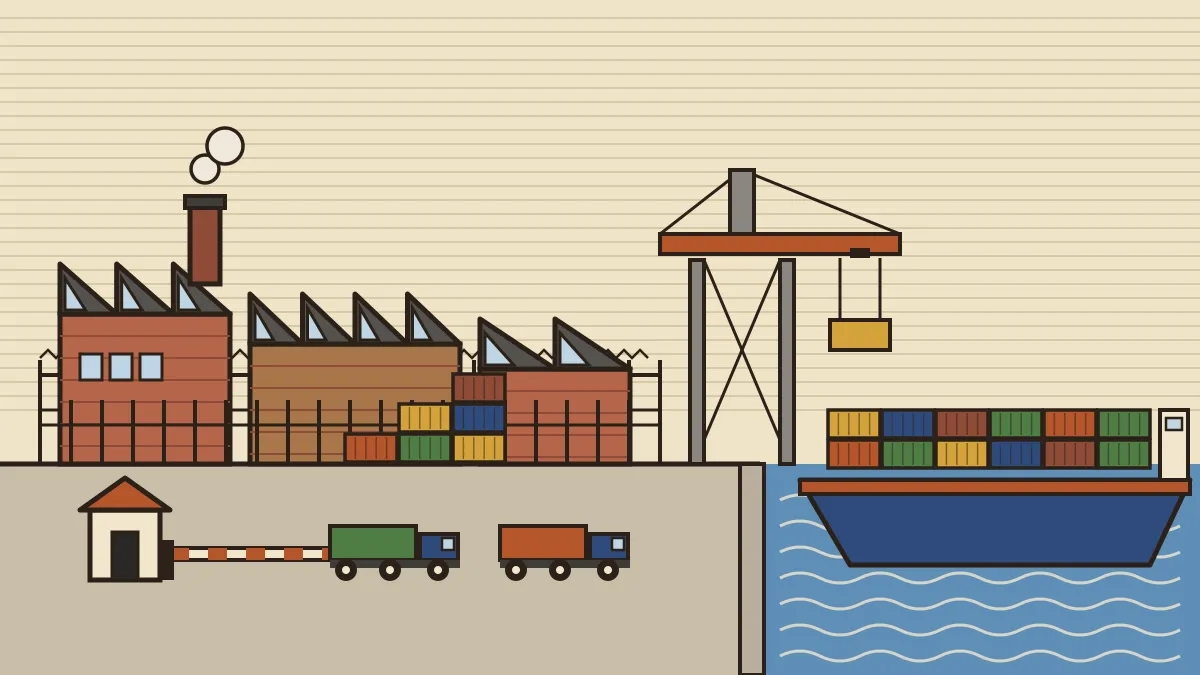
Zones come in several forms: multi-product and sector-specific zones, Free Trade and Warehousing Zones (FTWZ), IT and ITES zones, and the International Financial Services Centre at GIFT City. Units inside may manufacture goods, render services or provide warehousing. The facilities are the ones every textbook lists: reliable power and water, roads and transport, storage, and housing and schools nearby, together with a tax holiday for an initial period.
Who Approves What: Board, Commissioner, Committee
| Body | Role |
|---|---|
| Department of Commerce | Administers the Act and Rules at the Centre |
| Board of Approval (BoA) | The apex, inter-ministerial body headed by the Commerce Secretary; approves new SEZs (formal approval, then notification) and decides on developers' proposals |
| Development Commissioner (DC) | Appointed by the Government as the head of each zone; oversees its functioning, compliance and monthly reporting |
| Unit Approval Committee | Chaired by the Development Commissioner; approves individual units and their import needs |
| Single window | Central and State clearances for a unit sought through one channel |
The flow is developer first, units later. A developer proposes a zone and obtains approval, the Centre notifies it, and the developer builds the infrastructure. Units then apply to the Development Commissioner's committee for a Letter of Approval. Once running, each unit has a performance duty known as NFE positivity.
Over its first five years a unit earns US$ 50 million from exports. It spends US$ 30 million on imported inputs and US$ 5 million on foreign royalty and services. Is it Net Foreign Exchange positive?
Net Foreign Exchange (NFE) is foreign exchange earned minus foreign exchange spent. An SEZ unit must be an NFE earner, with earnings cumulatively exceeding outgo over the period set by the SEZ Rules (five years from the start of production). In June 2025 the Rules were amended so that the value of goods received free of cost counts in the calculation, as part of a package for chip and electronics zones. It is a point that links SEZs to the balance of payments covered on our exchange rate and balance of payments page.
Incentives: What Survives and What Has Gone
The SEZ incentive list has shrunk since 2005. Know each line and its date.
| Incentive | Status |
|---|---|
| Customs duty | Duty-free import or domestic purchase of goods for developing, operating and maintaining units. Still available. |
| GST | Supplies to an SEZ are zero-rated under the IGST Act, 2017. Earlier central sales tax, service tax and State sales tax exemptions were subsumed into GST. Still available. |
| Income tax, Sec 10AA (units) | 100% of export profit exempt for 5 years, 50% for the next 5, and 50% of ploughed-back export profit for 5 more. Sunset: units starting on or after 1 April 2020 get no 10AA benefit. |
| Income tax, Sec 80-IAB (developers) | 10 years of exemption within a 15-year block. Sunset from 1 April 2017. |
| MAT (Minimum Alternate Tax) | Exemption withdrawn from 1 April 2012 |
| DDT (Dividend Distribution Tax) | Exemption withdrawn from 1 June 2011; the tax itself was abolished for all companies from April 2020 |
The 10AA sunset closes the tax holiday to new units. It does not abolish SEZs, and units that began before 1 April 2020 keep their remaining years. The duty-free and zero-rated GST benefits continue.
A unit began exporting in 2018 and earns an export profit of ₹10 crore a year. What is the taxable export profit in year 3 and in year 7?
The tax angle shows why governments cut incentives: exemptions cost revenue, which is the theme of our taxation page. A second pressure came from trade law. Export-linked subsidies attract objections at the WTO, a thread picked up in our article on the RoDTEP extension.
Budget 2026-27 reversed part of the trend. It proposed a one-time measure letting eligible SEZ manufacturing units sell in the DTA at a concessional rate of duty, with the quantity limited to a prescribed proportion of their exports, to improve capacity use. CBIC notified the concession on 1 April 2026: such sales are capped at 30% of the highest annual export value of the three preceding years and need at least 20% value addition in the zone. It also extended tax incentives for cloud and data-centre operations in SEZs. In June 2025 the Government approved two new SEZs, one at Sanand, Gujarat for semiconductors (Micron) and one at Dharwad, Karnataka for electronic components (Aequs); see our article on the Sanand units.
SEZ, EOU, GIFT City and the Rest of India
| Feature | SEZ | EOU (Export Oriented Unit) | GIFT City IFSC |
|---|---|---|---|
| Legal basis | SEZ Act, 2005 | Foreign Trade Policy and customs rules | A zone within an SEZ, regulated under the IFSCA Act, 2019 |
| Location | A delineated enclave, treated as outside the customs territory | A single factory or unit that can be anywhere in India | Gandhinagar, Gujarat |
| What it does | Goods, services and warehousing for export | Manufactures mainly for export, with duty-free inputs under customs bond | Financial services, mostly in foreign currency |
| Regulator | Board of Approval and Development Commissioner | Development Commissioner and customs | IFSCA (set up April 2020) |
GIFT City is India's first operational international financial services centre. It lies inside an SEZ but gets a special layer of financial law: the IFSCA Act of 2019 created one regulator that exercises powers otherwise split among RBI, SEBI, IRDAI and PFRDA for the centre, and transactions inside are in specified foreign currencies. For how industry and services fit into the wider economy, see our industry and services page.
Reform: Kalyani Committee, the DESH Proposal and Old Problems
- Under-use. Many zones have vacant land, and units often sell less abroad than planned. The 2026-27 Budget's concessional DTA sales are a direct answer.
- Land. Zones need large, contiguous plots, and acquiring them has caused disputes with farmers and states.
- Tax sunset. With 10AA closed to new units, a zone's pull now rests on infrastructure, duty-free inputs and speed.
- WTO. Export-linked benefits are legally exposed, which pushes India toward incentives not tied only to exports.
In 2018 the Commerce Ministry set up a committee under industrialist Baba Kalyani to review SEZ policy. It argued for moving beyond an export-only focus. A later proposal, the Development of Enterprise and Service Hubs (DESH) Bill, was announced in Budget 2022-23 and drafted in 2022 to replace the SEZ Act with broader hubs open to all kinds of enterprises, including services. It remains a proposal: the SEZ Act, 2005 is still the law. A related scheme tied to output rather than to location is the production-linked incentive (PLI). The trade data in our April-August 2026-27 trade article shows the goods that zones and other schemes are trying to push abroad.
From the PIB release: exports April-October 2026-27 were US$ 568.84 billion, against US$ 487.59 billion; imports were US$ 662.19 billion. Check the growth and the trade balance.
How UPSC Has Asked It: Past Papers Solved
UPSC rarely asks about SEZ law directly. It tests the surrounding ground: ports, export policy and Make in India. These are real questions.
Deendayal Port was earlier known as:
(a) Paradip Port (b) Tuticorin Port (c) Kandla Port (d) Visakhapatnam Port
Answer: (c). Kandla, site of Asia's first export processing zone (1965), was renamed Deendayal Port in 2017.
Deendayal Port is located at
(a) Kerala (b) Gujarat (c) Maharashtra (d) Goa
Answer: (b). It is in the Gulf of Kutch, Gujarat.
Consider the following statements with reference to location of Major Ports in India: 1. Deendayal Port is situated at the head of Gulf of Khambhat. 2. Cochin Port is situated at the head of Vembanad Kayal. 3. Mormugao Port is situated at the entrance of the Zuari estuary. 4. Paradip Port is situated in the Godavari delta. Which of the statements given above are correct?
(a) 1 and 2 (b) 1 and 3 (c) 2 and 3 (d) 3 and 4
Answer: (c). Statements 2 and 3 are correct. Statement 1 is wrong: Deendayal is at the head of the Gulf of Kutch, not Khambhat. Statement 4 is wrong: Paradip lies on the Mahanadi delta, not the Godavari.
An offshore terminal at Vadinar has been developed to reduce pressure from which of the following major ports in India?
(a) Kandla Port (b) Cochin Port (c) Mormugao Port (d) New Mangalore Port
Answer: (a). Vadinar lies in the Gulf of Kutch, like Kandla, and its offshore terminal was built to relieve crude-oil handling at Kandla. The other ports are on the Kerala and Karnataka-Goa coasts.
Which one among the following statements about the Districts as Export Hubs (DEH) in India is not correct?
(a) DEH was launched in August 2019. (b) The aim of DEH is to boost exports of only selected districts of the country. (c) India's Foreign Trade Policy 2023 reiterated the role of DEH. (d) DEH aims to promote exports by providing financial inclusion and facilitating logistical and infrastructural support.
Answer: (b). The initiative aims to build export capacity in every district, not a chosen few. This is the opposite spirit to a zone, which concentrates incentives in one enclave.
Which of the following statements with regard to the 'Make in India' initiative is/are correct? 1. It was launched in the year 2018. 2. Its objective is to foster innovation.
(a) 1 only (b) 2 only (c) Both 1 and 2 (d) Neither 1 nor 2
Answer: (b). Make in India began in 2014, not 2018, so statement 1 fails. Fostering innovation is one of its stated aims.
Ports and export-policy items are the likely route into this topic. Learn each port's location and old name, and treat any "launched in" date with suspicion: UPSC changes the year.
Practice MCQs (with answers)
- Asia's first Export Processing Zone was set up in 1965 at
- Kandla
- Santacruz
- Cochin
- Noida
- The Special Economic Zones Act was passed in
- 1965
- 2000
- 2005
- 2015
- Under the SEZ Act, goods moving from an SEZ into the Domestic Tariff Area are treated as
- exports
- imports
- transit goods
- re-exports
- The head of an SEZ and chairperson of its Unit Approval Committee is the
- Commerce Secretary
- Finance Secretary
- District Collector
- Development Commissioner
- "NFE positive" for an SEZ unit means that
- foreign exchange earned exceeds foreign exchange spent over the prescribed period
- it exports exactly what it imports
- it pays no tax
- it sells only in India
- Financial services in GIFT City are regulated by the
- RBI alone
- SEBI alone
- Ministry of Commerce
- IFSCA
- The DESH Bill is best described as
- an Act that repealed the SEZ Act in 2022
- a proposal to replace the SEZ Act with broader enterprise hubs
- the law that created the Board of Approval
- a scheme extending the Sec 10AA tax holiday
- The Sec 10AA income-tax benefit is not available to SEZ units that begin operations on or after
- 1 April 2005
- 1 April 2012
- 1 April 2020
- 1 April 2017
1-a, 2-c, 3-b, 4-d, 5-a, 6-d, 7-b, 8-c. Q2: the policy came in 2000 but the Act in 2005. Q3: supplies from the zone to the rest of India are imports, and duty applies. Q4: the Board of Approval sits above, headed by the Commerce Secretary. Q8: 1 April 2012 is the MAT date and 1 April 2017 the developers' 80-IAB date, the two tempting wrong answers.
Quick Revision
- PIB, 13 Nov 2026: exports April-October 2026-27 US$ 568.84 billion (+16.66%); merchandise US$ 309.06 billion (+21.96%); imports US$ 662.19 billion; deficit US$ 93.35 billion.
- SEZs: 368 notified (28 Feb 2026); exports ₹11.70 lakh crore in April-December 2025-26 (+32.02%); 31.73 lakh jobs; ₹7.86 lakh crore invested.
- Kandla EPZ 1965, Asia's first (now Deendayal Port, Gulf of Kutch, Gujarat). SEZ Policy April 2000. SEZ Act 2005; Act and Rules in force 10 Feb 2006.
- SEZ = duty-free enclave, outside the customs territory. DTA to SEZ = exports (Sec 2(m)); SEZ to DTA = imports (Sec 30).
- Board of Approval (Commerce Secretary) approves zones; Development Commissioner heads the zone and its Unit Approval Committee. Units must be NFE positive.
- Duty-free inputs and zero-rated GST remain. 10AA sunset for units from 1 April 2020; 80-IAB sunset 1 April 2017; MAT out 1 April 2012; DDT out 1 June 2011.
- Budget 2026-27: one-time concessional-duty DTA sales; semiconductor and electronics SEZs at Sanand and Dharwad approved June 2025.
- EOU: customs bond, anywhere in India. GIFT City: first IFSC, regulator IFSCA (April 2020). Kalyani Committee 2018; DESH Bill 2022: only a proposal.
Frequently asked questions
What is a Special Economic Zone?
A Special Economic Zone is a delineated, duty-free enclave that is treated as lying outside the customs territory of India for authorised operations. Units inside can make goods, provide services or run warehouses for export, with duty-free inputs and a single-window clearance. The SEZ Act, 2005 is the governing law.
When did India set up its first export zone?
Asia's first Export Processing Zone was set up at Kandla in Gujarat in 1965. The EPZs were converted into SEZs under the policy of April 2000, and the SEZ Act, 2005 later gave the system a statutory base.
Who approves an SEZ and the units inside it?
The Board of Approval, an inter-ministerial body headed by the Commerce Secretary, approves new zones. Each zone has a Development Commissioner, who chairs the Unit Approval Committee that approves individual units.
Is the income tax holiday still available for SEZ units?
Section 10AA, which gave a 100% export-profit exemption for five years and 50% for the next five, is closed to units that start on or after 1 April 2020. Units that began earlier keep their remaining years. Duty-free imports and zero-rated GST continue.
Has the DESH Bill replaced the SEZ Act?
No. The Development of Enterprise and Service Hubs Bill was proposed in a 2022 draft to replace the SEZ Act with broader hubs, but it remains a proposal, and the SEZ Act, 2005 is still in force.
Related CDS / OTA Economics topics
Economy and trade questions appear in every CDS GS paper
Cavalier's CDS/OTA batches teach Indian economy and current affairs together, with weekly PYQ tests.