On 26 November 2026 the Ministry of Panchayati Raj holds the first Regional Workshop on implementing the Sixteenth Finance Commission's recommendations for rural local bodies, in Goa, with officers from Goa, Gujarat, Madhya Pradesh, Maharashtra and Rajasthan. The Commission has recommended ₹4,35,236 crore for Panchayati Raj Institutions across all 28 States for 2026-27 to 2030-31, and the Department of Expenditure issued the Operational Guidelines on 21 May 2026 (PIB). Every such grant traces back to one constitutional body. The Commission appears in both the polity and the economy papers, and examiners like its numbers: shares, weights, years. This article rebuilds those numbers from the logic, so they are easier to hold.
What Article 280 Says and Who Sits on the Commission
By Hitendra Deswal · Economics faculty, The Cavalier
Article 280 requires the President to constitute a Finance Commission every fifth year, or earlier if needed. It has a Chairman and four other members. Parliament fixed the qualifications through the Finance Commission (Miscellaneous Provisions) Act, 1951.
| Seat | Qualification |
|---|---|
| Chairman | Experience in public affairs |
| Member 1 | A High Court judge, or someone qualified to be appointed one |
| Member 2 | Special knowledge of the finances and accounts of Government |
| Member 3 | Wide experience in financial matters and administration |
| Member 4 | Special knowledge of economics |
The judge-seat is a High Court judge or someone qualified to be one. "Supreme Court judge" is the planted wrong option. Also remember that Article 263 is the Inter-State Council, not the Finance Commission.
Under Article 280(3) the Commission advises the President on four things: how the net proceeds of taxes are shared between Union and States and among the States; the principles for grants-in-aid from the Consolidated Fund of India (Article 275); measures to supplement State funds for panchayats and municipalities, on the recommendations of the State Finance Commissions; and any other matter the President refers. The panchayat and municipality limbs (clauses (bb) and (c)) were added by the 73rd and 74th Amendments. The report is laid before Parliament with an explanatory memorandum (Article 281). It is advisory, but by long convention the Union accepts the core tax-sharing recommendation.
The 16th Finance Commission, chaired by Dr Arvind Panagariya, was constituted on 31 December 2023. It submitted its report to the President on 17 November 2025, and the Government laid it before Parliament with the Union Budget on 1 February 2026, for the period 2026-27 to 2030-31. On that day the Union accepted the recommendation to retain the States' share at 41% (PIB, 1 February 2026). Our earlier article on the Commission gives the headline; this one goes into the formula.
The Divisible Pool and the Two Splits
The sums start with a pool. The divisible pool is the Union's gross tax revenue minus the cost of collection and minus cesses and surcharges. Under Article 270 the Union taxes are shared; under Article 271 a surcharge stays wholly with the Union. That is why the Centre's growing use of cesses and surcharges worries the States: a rupee raised as cess never enters the pool. Our taxation page shows which taxes feed it.
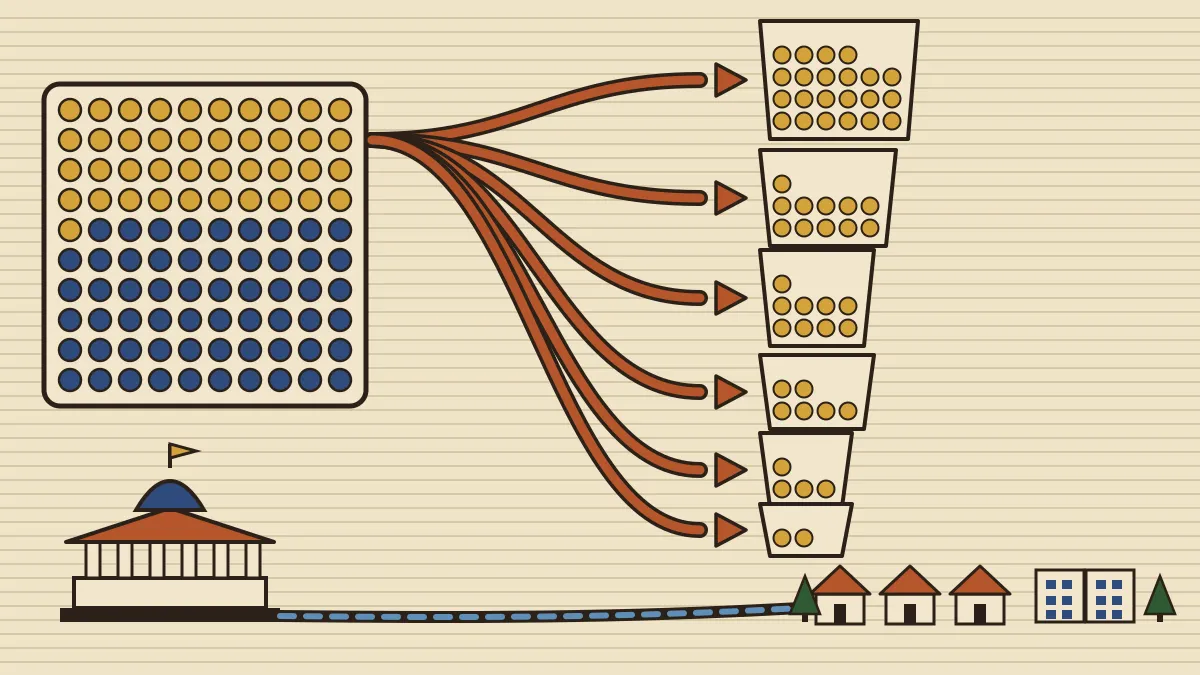
There are two splits, and mixing them up is the commonest error.
- Vertical devolution: the share of the pool that goes to the States as a whole. This is the one percentage that makes headlines. The 13th Commission gave 32%; the 14th raised it to 42%; the 15th set 41%, the one-point fall reflecting the creation of the Union Territories of Jammu and Kashmir and of Ladakh; the 16th kept 41%, though many States had pressed for 50%.
- Horizontal devolution: how that 41% is divided among the States, using weighted criteria.
Suppose, as an illustration only, that the divisible pool in a year is ₹30 lakh crore. A State's horizontal share is 4.13%, the 16th FC figure for Karnataka. What does it receive?
The States' shares, as they stand, are fixed percentages. They do not change year to year. What changes is the size of the pool, which is why a fall in tax collection, or a rise in cesses, hurts every State at once. For how Centre and States divide taxing power in the first place, see our fiscal federalism page.
The Formula, Criterion by Criterion: 14th, 15th, 16th
Each State's horizontal share comes from a weighted score. Each criterion gives each State a percentage, and the weights decide how much each counts. The three Commissions differ as follows.
| Criterion | 14th FC (2015-20) | 15th FC (2021-26) | 16th FC (2026-31) |
|---|---|---|---|
| Income distance | 50% | 45% | 42.5% |
| Population | 17.5% (1971) | 15% (2011) | 17.5% (2011) |
| Area | 15% | 15% | 10% |
| Forest | 7.5% (forest cover) | 10% (forest and ecology) | 10% |
| Demographic change / performance | 10% (demographic change) | 12.5% | 10% |
| Tax and fiscal effort | - | 2.5% | dropped |
| Contribution to GDP | - | - | 10% (new) |
| Total | 100% | 100% | 100% |
Each criterion answers a different question about fairness.
- Income distance is the equity criterion: poorer States get more. The 16th FC measures it as the gap between a State's per-capita GSDP and the average of the top three large States, using the average of 2018-19 to 2023-24 and leaving out the pandemic year 2020-21. It still carries the biggest weight, but it has fallen from 50% to 42.5% over two Commissions.
- Population (2011) measures need: more people, more spending. The 14th FC used 1971 figures, the 15th switched to 2011, and the 16th raised the weight back to 17.5%.
- Demographic performance rewards States that slowed their population growth. The 15th FC used the fall in fertility rate; the 16th redefined it as population growth between 1971 and 2011, so lower growth earns a higher share.
- Forest pays States for the green cover that the whole country benefits from. The 16th counts a State's share of total forest area and its share of the increase in forest between 2015 and 2023, and includes open forest, which the 15th did not.
- Contribution to GDP is the 16th FC's new idea and replaces tax and fiscal effort. It is measured through the square root of each State's GSDP, which softens the advantage of very large economies.
Two States have GSDPs of 100 and 400 (any unit). How do they share the "contribution to GDP" criterion?
A State scores 5% on income distance, 4% on population, 3% on demographic performance, 6% on area, 2% on forest and 4% on contribution to GDP. What is its overall share under the 16th FC weights?
Population year is a favourite trap. 14th FC: 1971 for population, with 2011 used to measure demographic change. 15th and 16th: 2011. The word "first" is risky in options, so check which Commission the question names.
Beyond Tax Sharing: The ₹9.47 Lakh Crore of Grants
Tax devolution is formula money, untied and automatic. Grants-in-aid are conditional and targeted. The 16th FC recommended ₹9,47,409 crore over five years.
| Grant | Amount (₹ crore) |
|---|---|
| Rural local bodies: basic 3,48,188 + performance 87,048 | 4,35,236 |
| Urban local bodies: basic 2,32,125, performance 58,032, special infrastructure 56,100, urbanisation premium 10,000 | 3,56,257 |
| Total, local governments | 7,91,493 |
| Disaster management (the Centre's share of a ₹2,04,401 crore SDRF/SDMF corpus) | 1,55,916 |
The 16th FC discontinued three kinds of grant the 15th had made: revenue deficit grants, sector-specific grants and State-specific grants. The money now runs through local bodies and disaster funds, the two things that the Constitution's 73rd and 74th Amendments tie to Finance Commission support. Our local governance page explains the amendments, and the State Finance Commissions article explains the State-level partner of the Union body.
The local-body grants come with rules, which is what the Goa workshop is about.
- Basic and performance: the grants split 80% basic and 20% performance. Half of the basic grant is untied; the other half is tied to sanitation and solid waste management and/or water management.
- Three entry-level conditions: local bodies must be constituted as the Constitution requires; their provisional and audited accounts must be public; and the State Finance Commission must be constituted on time.
- Performance grants: State performance grants need a minimum benchmark for transfers from the State's own resources to local bodies. Local-body performance grants are linked to targets for own source revenue (OSR), which is why the PIB note pairs the grants with OSR growth.
- Urban extras: special infrastructure money, ₹56,100 crore, is for wastewater systems in cities of 10 to 40 lakh people (2011 Census); the ₹10,000 crore urbanisation premium rewards merging peri-urban villages into city limits.
Two more recommendations round out the report: the Union should bring its fiscal deficit down to 3.5% of GDP by 2030-31; States should keep theirs within 3% of GSDP and bring off-budget borrowings onto their books. On the Commission's projection, as summarised by PRS, the combined debt of Centre and States falls from 77.3% of GDP in 2026-27 to 73.1% in 2030-31. The budget concepts behind these are on our government budget page.
How UPSC Has Asked It: Past Papers Solved
UPSC asks the constitutional basics and the criteria weights. These are real questions.
Which of the following statements with regard to the constitution of Finance Commission is/are correct? 1. The Government of India has recently constituted the Sixteenth Finance Commission under the Chairmanship of Dr. Arvind Panagariya. 2. Finance Commission is constituted in pursuance to Article 263 of the Constitution of India.
(a) 1 only (b) 2 only (c) Both 1 and 2 (d) Neither 1 nor 2
Answer: (a). Statement 1 is true. Statement 2 fails: the Commission arises under Article 280. Article 263 is the Inter-State Council.
The Fourteenth Finance Commission assigned different weights to the following parameters for distribution of tax proceeds to the States: 1. Income distance 2. Population 3. Demographic changes 4. Area. Arrange the aforesaid parameters in descending order in terms of their weights:
(a) 1-2-3-4 (b) 1-2-4-3 (c) 1-3-2-4 (d) 4-3-2-1
Answer: (b). The 14th FC weights were income distance 50%, population 17.5%, area 15% and demographic change 10%. Option (a) puts demographic change above area, the tempting slip.
Which one of the following taxes is not included in the Central Pool to be shared with the States, according to the recommendations of Finance Commission of India?
(a) Personal Income Tax (b) Corporate Profit Tax (c) Surcharge and Cess (d) Excise Duties
Answer: (c). Surcharges and cesses are kept out of the divisible pool, which is why a rising share of them shrinks what the States receive.
Which one of the following is neither a constitutional nor a statutory body?
(a) Finance Commission (b) NITI Aayog (c) National Green Tribunal (d) Union Public Service Commission
Answer: (b). NITI Aayog was set up in 2015 by a Cabinet resolution. The Finance Commission is constitutional (Article 280), the UPSC is constitutional (Article 315) and the NGT is statutory (NGT Act, 2010).
Which one of the following is the correct sequence of formation of the Commissions starting from the earliest?
(a) Finance Commission, Planning Commission, Investment Commission, Election Commission (b) Election Commission, Planning Commission, Finance Commission, Investment Commission (c) Planning Commission, Election Commission, Finance Commission, Investment Commission (d) Investment Commission, Finance Commission, Planning Commission, Election Commission
Answer: (b). Election Commission in January 1950, Planning Commission in March 1950, the first Finance Commission in 1951, the Investment Commission in 2004. Option (c) reverses the first two.
Which of the following are the essential requirements for a person to be appointed as a member of Finance Commission? 1. A Supreme Court judge or one qualified to be appointed as such 2. A person having wide experience in financial matters and administration 3. A person having special knowledge of economics
(a) 1, 2 and 3 (b) 1 and 2 only (c) 2 and 3 only (d) 1 and 3 only
Answer: (c). Statement 1 is wrong: the judge-seat is for a High Court judge or one qualified to be appointed as such, not a Supreme Court judge.
What is the percentage weightage assigned to Forest and Ecology in the devolution formula given by the Fifteenth Finance Commission of India for sharing of Union tax revenue with the States?
(a) 10% (b) 15% (c) 7.5% (d) 2.5%
Answer: (a). The 15th FC gave forest and ecology 10%. The 7.5% in option (c) is the 14th FC's weight for forest cover, and 15% is the weight for area.
Papers test three things: constitutional status (Article 280, not 263; High Court, not Supreme Court), the numbers (41%, 42%, the weights, the year of population) and what is in or out of the pool. Link each weight to its Commission before the exam.
Practice MCQs (with answers)
- The Finance Commission is constituted under
- Article 263
- Article 275
- Article 280
- Article 270
- The share of the States in the divisible pool recommended by the 16th Finance Commission is
- 41%
- 42%
- 43%
- 50%
- Which criterion did the 16th FC introduce in place of tax and fiscal effort?
- Demographic performance
- Area
- Forest
- Contribution to GDP
- The weight of income distance in the 16th FC formula is
- 45%
- 42.5%
- 50%
- 17.5%
- Which of the following grants was discontinued by the 16th FC?
- Rural local body grants
- Disaster management grants
- Urban performance grants
- Revenue deficit grants
- Which of the following is not an entry-level condition for local body grants?
- Local bodies constituted as the Constitution requires
- State fiscal deficit brought to zero
- Provisional and audited accounts made public
- State Finance Commission constituted on time
- The divisible pool excludes
- cesses, surcharges and the cost of collection
- corporation tax
- income tax
- the Union's share of GST
- If the divisible pool is ₹20 lakh crore, the States' total share at 41% is
- ₹7.4 lakh crore
- ₹8.0 lakh crore
- ₹8.2 lakh crore
- ₹9.0 lakh crore
1-c, 2-a, 3-d, 4-b, 5-d, 6-b, 7-a, 8-c. Q1: Article 270 shares taxes, Article 275 gives grants, and Article 263 is the Inter-State Council. Q4: 45% was the 15th FC's weight and 17.5% is the 16th's population weight. Q5: local body and disaster grants continue, but revenue deficit grants do not. Q6: the three real conditions are in the grants section, and the fiscal deficit is a roadmap target, not an entry condition. Q8: 20 × 0.41 = 8.2.
Quick Revision
- PIB, 25 Nov 2026: first Regional Workshop on the 16th FC rural local body grants at Goa on 26 Nov; ₹4,35,236 crore for PRIs across 28 States; guidelines issued 21 May 2026.
- Article 280: every fifth year or earlier; Chairman plus four members; HC judge seat; report with memorandum under Article 281.
- 16th FC: Dr Arvind Panagariya; constituted 31 Dec 2023; report 17 Nov 2025; laid in Parliament with the Budget 1 Feb 2026; award period 2026-27 to 2030-31.
- Vertical share: 32% (13th), 42% (14th), 41% (15th), 41% (16th). Pool excludes cess, surcharge and cost of collection.
- 16th weights: income distance 42.5, population (2011) 17.5, demographic performance 10, area 10, forest 10, contribution to GDP 10 (replaces tax and fiscal effort 2.5).
- 14th: 50, 17.5 (1971), 15, 10, 7.5. 15th: 45, 15, 15, 12.5, 10, 2.5.
- Grants ₹9,47,409 crore: local bodies 7,91,493 (rural 4,35,236; urban 3,56,257); disaster (Union share) 1,55,916. Ended: revenue deficit, sector and State-specific grants.
- Local grants: 80% basic, 20% performance; half of basic tied to sanitation and water; three entry-level conditions. Centre fiscal deficit 3.5% of GDP by 2030-31; States 3% of GSDP.
Frequently asked questions
What does the Finance Commission do?
The Finance Commission is a constitutional body under Article 280 that recommends how the net proceeds of Union taxes are shared between the Centre and the States and among the States, and sets the principles for grants-in-aid. It also advises on measures to supplement State funds for panchayats and municipalities. Its report is advisory, but the Union usually accepts the core tax-sharing recommendation.
What is the difference between vertical and horizontal devolution?
Vertical devolution is the share of the divisible pool that goes to the States as a group, which is 41% under the 16th Finance Commission. Horizontal devolution is how that 41% is divided among individual States using weighted criteria such as income distance, population, area, forest, demographic performance and contribution to GDP.
What did the 16th Finance Commission change?
It kept the States' share at 41%, but reworked the horizontal formula. Income distance fell to 42.5%, population rose to 17.5%, and a 10% weight for contribution to GDP replaced tax and fiscal effort. It also redefined demographic performance using 1971-2011 population growth and counted open forest and forest gain.
What conditions come with local body grants?
Local bodies must be constituted as the Constitution requires, publish provisional and audited accounts, and the State must constitute its State Finance Commission on time. The grants are split into 80% basic and 20% performance, and half of the basic grant is tied to sanitation and water management.
Is the Finance Commission permanent?
No. The President constitutes a new Finance Commission every fifth year or earlier, and it exists for the period needed to report. The 16th Finance Commission's recommendations cover 2026-27 to 2030-31.
Related CDS / OTA Economics topics
Finance Commission questions appear in both polity and economy papers
Cavalier's CDS/OTA batches teach polity and economy together, with weekly PYQ tests.