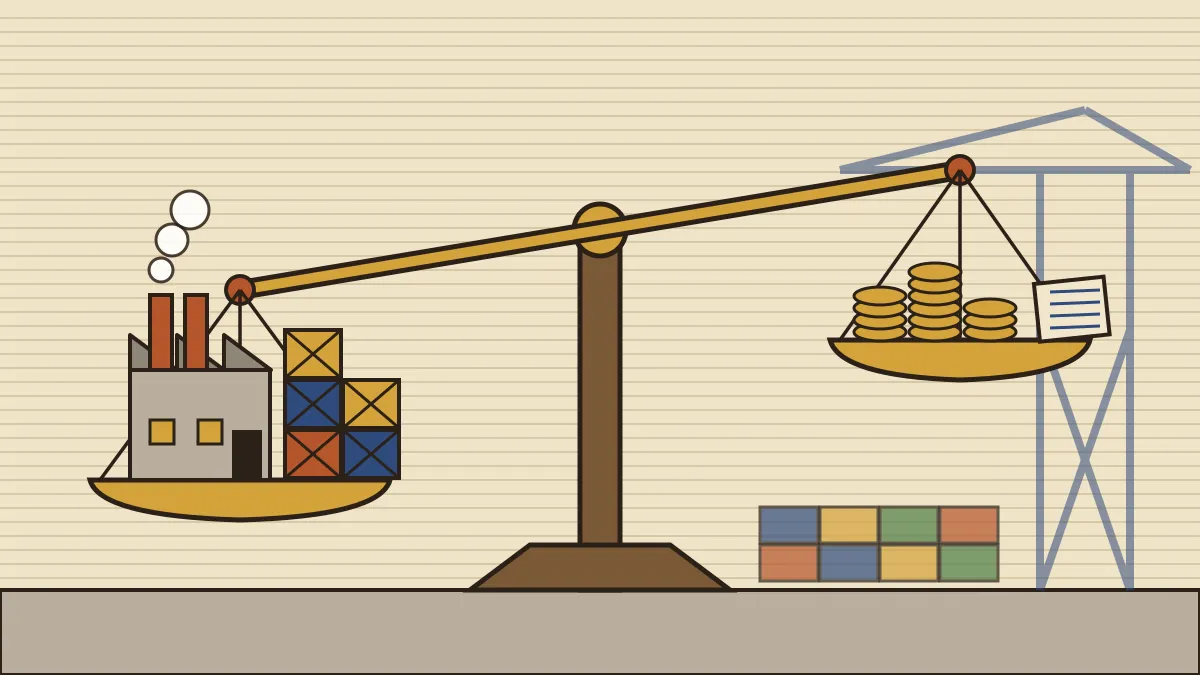
On 25 November 2026, the Ministry of Commerce and Industry issued a short, carefully worded statement. India had "taken note" of a Notice of Determination and Request for Comments from the United States Trade Representative (USTR) in a Section 301 investigation into the "acts, policies and practices" of 14 economies, including India, relating to structural excess capacity and production in manufacturing sectors. The notice, it said, is under examination.
The statement is brief because the matter is delicate. A Section 301 determination is the step that comes before American trade action, such as higher tariffs, and India is at the same time negotiating a trade agreement with the United States. In three paragraphs, the government said it would keep the two tracks separate: it denies the charge, it will study the notice, and it wants any trade concern handled inside the bilateral negotiation.
For the CDS paper this is a useful story because it asks you to know three things at once: a piece of American trade law, the meaning of "excess capacity," and the shape of India's trade diplomacy. We take each in turn and keep to what the government has actually said.
What India's statement says
Taking the PIB release line by line, the government's position has four parts.
- It has noted the USTR's notice. The document is a "Notice of Determination and Request for Comments", so the USTR has reached a determination and is inviting public comment before deciding on any action. The notice is "currently under examination" by India.
- India took part. It "engaged constructively throughout this investigation."
- India denies the charge. In response to the Notice of Initiation and in later proceedings, the Department of Commerce stated that India does not have structural excess capacity in any sector.
- The proper forum is the trade negotiation. India and the US are negotiating a Bilateral Trade Agreement (BTA), and it has been India's position that any trade-related concerns should be addressed within the framework of these negotiations. India remains committed to the early conclusion of the BTA "as announced on 2nd February 2026 and in accordance with the Joint Statement issued on 7th February 2026."
The statement does not describe the contents of the USTR's findings or any proposed action, and this article does not either. That is worth remembering when reading other reports: only the Indian government's response is on the record in this release.
What Section 301 is
Section 301 is a provision of the Trade Act of 1974, the US law that gives the executive branch authority to deal with what it considers unfair foreign trade practices. The investigations are run by the Office of the United States Trade Representative (USTR), a cabinet-level office in the President's executive office that leads US trade negotiations and enforces trade law.
The law works in four steps:
- Initiation. USTR opens an investigation, either on a petition from American industry or on its own initiative.
- Consultation and comment. The foreign government is asked to consult, and the public may submit written comments and testify at hearings.
- Determination. USTR decides whether the foreign practice is actionable. Under the discretionary limb of Section 301, the test is whether the practice is unreasonable or discriminatory and burdens or restricts US commerce.
- Action. If it is actionable, the remedies include tariffs (duties), other import restrictions and the suspension of trade concessions.
A Section 301 finding is therefore a gateway, not a penalty by itself. The 2026 forced-labour probe shows the full path. According to PIB (3 June 2026), the USTR concluded an investigation of 60 economies, including India, on measures to prevent imports of goods made with forced labour, and proposed additional tariffs on 2 June, with public hearings on 7 July. On 23 July 2026 it announced the final measures: an additional 10% duty on imports from India, down from the 12.5% first proposed, which put India in the lower tier. Goods already covered by Section 232 duties, such as steel, aluminium and auto parts, were left out, and the Government of India estimated that about 45% of India's exports to the US stay outside the new duty. The excess-capacity case, covering 14 economies including India according to the Indian statement, is a separate investigation.
What "structural excess capacity" means
Capacity is the amount a country's factories could produce. Excess capacity arises when that is more than the home market, and normal export demand, can absorb. The surplus is sold abroad, often cheaply, and can push down world prices and hurt producers in other countries. Structural is the important word: it means the surplus is not a temporary slump but is built into the system by policy, such as cheap credit, subsidies or protected markets.
The idea is a recurring theme in international economics. Steel, solar panels and chemicals are the usual examples cited in such debates. India's argument, as stated in the release, is that it does not have the problem in any sector. A useful way to see why the claim is plausible: a country with large domestic demand and a still-growing industrial base tends to use its capacity at home, rather than needing to export a surplus.
The question for the student is not who is right but what the term means, and to spot that it concerns production, not tariffs: it is a complaint about how goods are made, brought to a tariff remedy.
Section 301 versus Section 232
Examiners like to put the American trade provisions side by side, because they sound alike.
| Feature | Section 301 | Section 232 |
|---|---|---|
| Law | Trade Act of 1974 | Trade Expansion Act of 1962 |
| Concern | Unfair or discriminatory foreign trade practices | National security effect of imports |
| Run by | USTR | Department of Commerce |
| Usual remedy | Duties and other restrictions on goods from the offending country | Duties on a product from all sources |
| Example for India | The 2020 digital-services probe; the 2026 excess-capacity probe | The additional 25% duty on steel under Section 232, noted in a PIB reply (Lok Sabha, 2025) |
The difference matters to India. A 301 action is directed at a country's practices, so it can be negotiated away with that country. A 232 duty is on a product, whoever makes it.
India has been here before: the equalisation levy
This is not India's first Section 301 case. In 2020, the US opened a Section 301 investigation into digital services taxes adopted by several countries, including India's 2% Equalisation Levy on e-commerce supply of services by non-resident operators. According to PIB (7 January 2021), India submitted comments to the USTR on 15 July 2020 and took part in a bilateral consultation on 5 November 2020, arguing that the levy was not discriminatory, applied prospectively (effective 1 April 2020), and sought a level playing field between resident and non-resident e-commerce operators. On 6 January 2021 the USTR concluded that the levy was discriminatory and restricted US commerce, and the Government of India said it would examine the determination. The 2020 episode shows the standard Indian response: engage, defend the measure on principle, and treat the process as one to be argued in consultations.
Where the trade agreement stands
The statement ties the issue to the India-US Bilateral Trade Agreement. According to the release, the BTA was announced on 2 February 2026, with a Joint Statement on 7 February 2026, and India and the US are still negotiating. Our explainer on the India-US Bilateral Trade Agreement sets out the architecture of such agreements (FTA versus CEPA, interim deals and market access), and the India-EU FTA article shows how India's other major negotiation is built. For the underlying concepts see our notes on international trade.
India's strategy is clear from the statement: a single basket. By saying that trade concerns belong inside the BTA talks, the government avoids treating the Section 301 notice as a separate dispute to be answered on its own terms. It also keeps open the possibility that any American concern is resolved as part of the larger bargain.
The WTO angle
One further point deserves a line. Section 301 is a unilateral tool: the US decides for itself what is unfair and what to do about it. The World Trade Organization (WTO) system, founded on 1 January 1995, expects members to take trade disputes to its dispute settlement process and not to act alone, a rule found in Article 23 of the Dispute Settlement Understanding. That tension is why Section 301 has long been controversial among trading partners.
What to watch
- The comment period. A "Request for Comments" means India and others can file responses to the USTR; India has said the notice is being examined.
- Any proposed action. The determination is not the same as tariffs. What follows, if anything, would be a separate decision.
- The BTA calendar. India wants an "early conclusion"; whether a concluded agreement settles the matter will show in how the two tracks interact.
🔑 Revision block
The statement. 25 November 2026, Ministry of Commerce and Industry: India has taken note of the USTR's Notice of Determination and Request for Comments in the Section 301 investigation on structural excess capacity in manufacturing, covering 14 economies including India; the notice is under examination.
India's position. Engaged constructively; Department of Commerce told the USTR India has no structural excess capacity in any sector; concerns should be addressed within the India-US BTA talks (announced 2 February 2026; Joint Statement 7 February 2026).
Section 301. Trade Act of 1974; run by the USTR; test: practice unreasonable or discriminatory and burdens US commerce; remedies: duties, import restrictions, withdrawal of concessions. Earlier 2026 round (forced labour, 60 economies): final measures 23 July 2026, 10% duty on India (12.5% proposed), about 45% of India's exports outside it. The 301 case on excess capacity covers 14 economies.
Section 232. Trade Expansion Act, 1962; national security; run by the Commerce Department; product-wide duties.
Precedent. 2020 Section 301 probe of digital services taxes; India's 2% Equalisation Levy; comments 15 July 2020; consultation 5 November 2020.
Concepts. Excess capacity = production beyond what the market absorbs; structural = built in by policy. Section 301 is unilateral, in tension with WTO dispute settlement (WTO started 1 January 1995).
🎯 Practice MCQs
Q1. Section 301, used by the United States against foreign trade practices, is part of the:
(a) Trade Expansion Act, 1962
(b) Trade Act, 1974
(c) Smoot-Hawley Tariff Act, 1930
(d) General Agreement on Tariffs and Trade, 1947
→ (b)
Section 301 sits in the Trade Act of 1974. Section 232, the national-security provision, is in the Trade Expansion Act of 1962.
Q2. Section 301 investigations are conducted by:
(a) The US International Trade Commission
(b) The US Department of Commerce
(c) The Office of the US Trade Representative
(d) The US Customs and Border Protection
→ (c)
The USTR leads the process; Section 232 investigations, by contrast, are run by the Commerce Department.
Q3. According to the Government of India's statement of 25 November 2026, the Department of Commerce told the USTR that India:
(a) Has no structural excess capacity in any sector
(b) Has structural excess capacity only in steel
(c) Has structural excess capacity only in solar equipment
(d) Has structural excess capacity in all manufacturing sectors
→ (a)
The statement records that India does not have structural excess capacity in any sector.
Q4. According to the Indian government's statement of 25 November 2026, the USTR's Section 301 investigation on structural excess capacity covers how many economies, including India?
(a) 4
(b) 8
(c) 10
(d) 14
→ (d)
The Ministry of Commerce and Industry release speaks of 14 economies, including India.
Q5. In the Section 301 investigation of 2020, the Indian measure examined was:
(a) Goods and Services Tax on imports
(b) A 2% equalisation levy on e-commerce supply of services by non-residents
(c) A customs duty on electronics
(d) A ban on foreign direct investment in retail
→ (b)
PIB (7 January 2021) records India's comments of 15 July 2020 and consultation of 5 November 2020 on the 2% equalisation levy.
Q6. Section 232 of the US Trade Expansion Act, 1962 concerns:
(a) Anti-dumping duties
(b) Subsidised imports
(c) Emergency protection against import surges
(d) The effect of imports on national security
→ (d)
Section 232 allows duties on products found to threaten national security, as with the steel duty referred to in a PIB reply of April 2025.
Q7. Consider the following statements about Section 301:
1. Remedies can include tariffs and other import restrictions.
2. A USTR determination is the final ruling of a WTO panel.
Which of the statements given above is/are correct?
(a) 1 only
(b) 2 only
(c) Both 1 and 2
(d) Neither 1 nor 2
→ (a)
Statement 1 is correct. Statement 2 is wrong: a USTR determination is a unilateral American decision, not a WTO ruling.
Q8. Consider the following statements about India's position as stated on 25 November 2026:
1. India considers that trade-related concerns should be addressed within the framework of the Bilateral Trade Agreement negotiations.
2. The USTR notice is under examination by the Government of India.
Which of the statements given above is/are correct?
(a) 1 only
(b) 2 only
(c) Both 1 and 2
(d) Neither 1 nor 2
→ (c)
Both statements are directly from the Ministry of Commerce and Industry's release.
📋 How this gets asked (PYQ pattern)
International trade questions in the CDS General Knowledge paper tend to fall into three families.
The first is provision matching: which law or section does what. Section 301 and Section 232 are the obvious pair, and the trap is to swap the agency or the act, as in Q1, Q2 and Q6.
The second is concept definition: dumping, subsidy, safeguard, tariff and non-tariff barrier, and now excess capacity. The options are usually one word apart, so learn the one-line definition of each.
The third is statement-and-institution questions on India's trade diplomacy: who negotiates, in what forum, and what the government's stated position is. The fresh hooks this cycle are the Section 301 notice, the 2 February 2026 announcement of the BTA, India's claim of no excess capacity, and the 10% duty from the July forced-labour case.
Preparing for CDS? Make a table with one row per trade-remedy provision: law, agency, trigger, remedy. Revise with our notes on free trade agreements and rules of origin, follow the daily CDS current affairs, and learn with experienced faculty in the upcoming Cavalier courses in Delhi.
Source: PIB / Ministry of Commerce & Industry, "Statement on USTR Section 301 Determination", 25 November 2026; PIB / Ministry of Commerce & Industry, "India's response to S 301 Report of U.S. on Equalisation Levy", 7 January 2021; PIB reply on steel exports and tariff (Section 232), 1 April 2025. PIB / Ministry of Commerce & Industry, 3 June 2026 and 25 July 2026 (Section 301 forced-labour measures). Section 301 mechanics summarised from the US Trade Act of 1974.
✍️ Written by Aditya Tiwari — Economy & current-affairs faculty at The Cavalier. Reviewed by the Cavalier Faculty Desk.