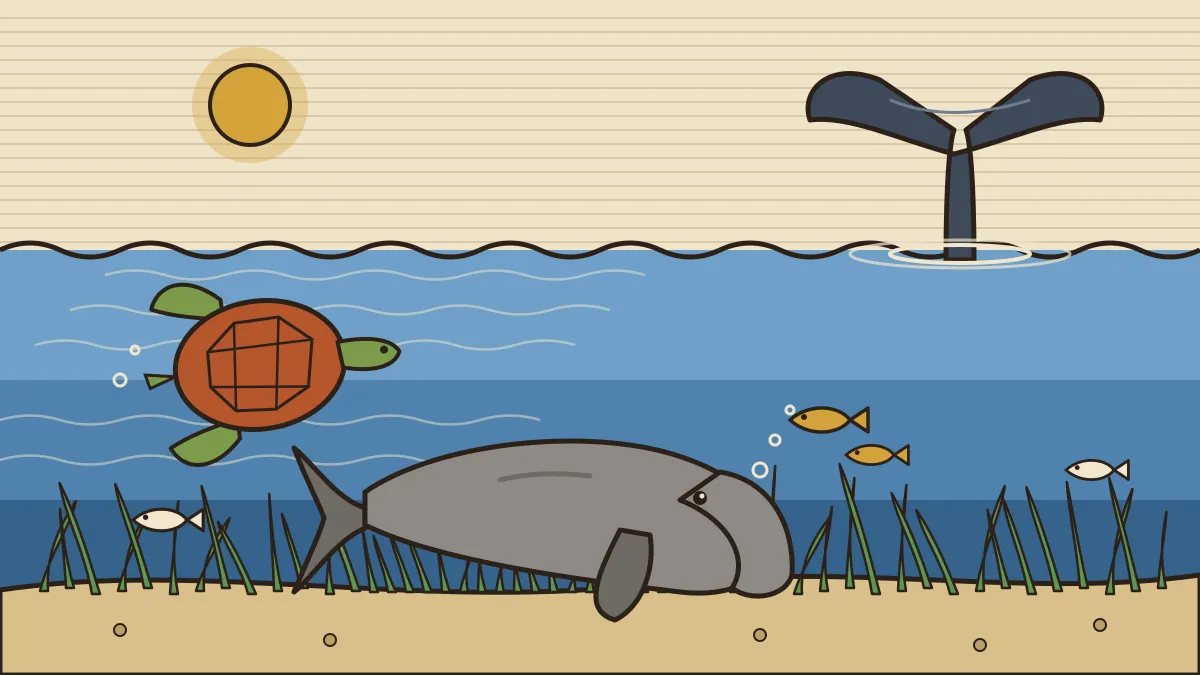
India's coastline is now put at about 11,098 km in recent official releases, yet its protected-area system was designed mostly with forests and grasslands in mind. On 23 November 2026, the Standing Committee of the National Board for Wildlife (SC-NBWL) turned its attention to the sea. Its 92nd meeting, chaired in New Delhi by Environment Minister Bhupender Yadav, was themed on marine conservation. The Wildlife Institute of India (WII) presented findings on marine protected areas, sea turtles and dugongs, and the Minister released a set of publications covering turtles, dugongs, the Arabian Sea humpback whale, small cats and the management of coastal reserves.
The meeting also routinely did its other job: it considered 133 proposals for roads, defence infrastructure, drinking water supply and other works that need wildlife clearance. This article follows the marine reports closely, since they hold the new facts, and then sets out the clearance machinery that surrounds them.
What was on the table
The Ministry's release lists the business in four parts.
1. Wildlife Week 2026. The Committee reviewed the report on Wildlife Week 2026, held under the theme "Connecting Habitats, Thriving Wildlife". The Minister pointed to three field outcomes: the reintroduction of tigers in Buxa, the release of Great Indian Bustards in Rajasthan and the expansion of Project Cheetah to a third site. Our earlier note on Project Cheetah gives the background to the third item.
2. Awards. Frontline forest staff were honoured in two categories (protection and anti-poaching; wildlife monitoring and special skills), along with two community awards: the Mahavir Machchhimar Sahakari Mandali of Mangrol, Gujarat, for whale shark conservation, and the Ponnuruvi Eco-Tourism Management Committee of the Sirumalai Hills, Tamil Nadu. A Mangrol fishermen's cooperative being honoured for protecting the world's largest fish is the sort of detail that fits the meeting's theme.
3. Tiger standards. Nameri Tiger Reserve in Assam was accredited under Conservation Assured | Tiger Standards (CA|TS).
4. The marine theme. Presentations and publications, set out below.
108 reserves: how well are the marine parks run?
The first publication is the Management Effectiveness Evaluation (MEE) of Coastal and Marine Protected Areas. It reports the 2024–26 assessment of 108 coastal and marine protected areas, covering management performance, best practices and priority areas.
An MEE is a scored review of how well a protected area is actually managed, as opposed to whether it exists on paper. It looks at things such as staffing, boundaries, monitoring and community relations. It is a standard tool in protected-area management, and a marine edition matters because most Indian management experience is on land. A reserve can be notified under law and still have no patrol boats, no survey data and no rules on fishing gear.
Turtles: four nesting species, 1,300 km of coast
The second publication is the Pan-India Assessment and Monitoring of Marine Turtles, carried out by WII under the Ministry's Development of Wildlife Habitats scheme. The numbers in the release:
- Three nesting seasons, 2022–25;
- about 1,300 km of coastline and 360 beach stretches; and
- findings on the nesting status of four marine turtle species.
Five species of sea turtle occur in Indian waters; the Ministry has said so in earlier official statements. Four of them come ashore here to nest. Sea turtles are slow breeders: females return to lay eggs on or near the beaches where they hatched, and few hatchlings survive to adulthood. That is why long-run monitoring, rather than a single count, is the real conservation tool.
The best-known Indian nesting event is the mass nesting of Olive Ridley turtles on the Odisha coast. In 2025 the Indian Coast Guard's Operation Olivia protected a record over 6.98 lakh Olive Ridleys nesting at the Rushikulya river mouth, according to the Defence Ministry.
Three knowledge products were released under the Marine Turtle Action Plan (2021–2026):
- Technical Protocol of Marking Marine Turtles;
- Tracking Marine Turtles in Indian Waters; and
- Marine Turtles of India.
The Action Plan itself was launched in January 2021 together with Marine Mega Fauna Stranding Guidelines. Another relevant measure is the Turtle Excluder Device (TED), a grid fitted in a trawl net that lets turtles escape, installed in Indian trawlers to prevent by-catch. The Plan's stated period is 2021–2026; the release does not say what follows it.
Dugongs: a decade of recovery
The third publication, Milestones of Recovery of Dugongs and their Habitats in India (2016–2026), documents ten years of work by WII under a CAMPA-funded programme. CAMPA (the Compensatory Afforestation Fund Management and Planning Authority) manages the money collected when forest land is diverted for non-forest use. The release picks out three milestones.
- The first drone-based dugong population estimate in Tamil Nadu: 270 ± 16. The "± 16" is the margin of the estimate, not a count of individuals. Drones are useful because dugongs are shy, live in shallow water and are hard to count from boats.
- Identification of seagrass habitats. The dugong is the only herbivorous marine mammal in India and feeds almost entirely on seagrass. It is a relative of the manatee, not of whales or dolphins, and is sometimes called the "sea cow". Where seagrass disappears, dugongs go with it. India's main seagrass beds lie in the Gulf of Mannar and Palk Bay (as the Environment Ministry has told Parliament).
- India's first Dugong Conservation Reserve, in Palk Bay. It was notified by Tamil Nadu in September 2022 and covers about 448 sq km of coastal waters off Thanjavur and Pudukkottai districts. A conservation reserve is a category under the Wild Life (Protection) Act, 1972 that lets a government protect land or waters that are not national parks or sanctuaries, usually with local participation.
The dugong is protected under Schedule I of the 1972 Act (the highest protection) and is listed as Vulnerable by the IUCN. The Ministry's earlier descriptions of the programme mention a Task Force for Conservation of Dugongs and India's role in the UNEP/CMS Dugong Memorandum of Understanding, under the Convention on Migratory Species. As in the turtle case, recovery here depends on protecting the habitat; the release ties the animal to the seagrass beds around it, and fishing practice in shallow waters is the obvious point of contact, though the release itself does not list threats to dugongs.
The Arabian Sea humpback whale
The fourth publication is the Status of the Arabian Sea Humpback Whale in India, reporting a WII assessment for 2022–25. It identifies seven potential sighting hotspots and singles out entanglement in fishing gear as the principal threat, with the aim of guiding future conservation steps.
This population is unusual. Our explainer on IWC-70 and India's cetacean policy describes it as the only known humpback population that does not migrate, numbering only about 82 animals in older estimates and listed as Endangered. For such a small population the loss of even a few animals to gear entanglement matters, which is why a map of hotspots, the practical output of the assessment, is useful: it shows where fishing and whales overlap.
Small cats on land
The Minister also released a Field Manual on Small Cats, which is a land publication but arrived at a marine-themed meeting. It covers nine species of small cats found in India and gives practical guidance on identification, surveys and monitoring. It was developed under the Government of India–Global Environment Facility (GEF) Small Cats Conservation Project, implemented by the Ministry with Arunachal Pradesh, Uttar Pradesh and Rajasthan, supported by the UNDP and the Global Tiger Forum.
Small cats rarely draw the attention that tigers and lions do, but they are in the same legal and scientific frame, and the manual is a reminder that conservation data for them is thin.
CA|TS: what Nameri's accreditation means
Conservation Assured | Tiger Standards (CA|TS) is a set of criteria that lets tiger sites check whether their management will lead to successful conservation. It has been agreed as an accreditation tool by the global coalition of tiger range countries, and was developed by tiger and protected-area experts. In July 2021, the Ministry announced that 14 Indian tiger reserves had received global accreditation, among them Manas, Kaziranga and Orang in Assam, Satpura, Kanha and Panna in Madhya Pradesh, Pench in Maharashtra, Valmiki in Bihar, Dudhwa in Uttar Pradesh, the Sundarbans in West Bengal, Parambikulam in Kerala, Bandipur in Karnataka and Mudumalai and Anamalai in Tamil Nadu. Nameri, also in Assam, now joins the list. The NTCA oversees the process. For the legal architecture around it, see our explainer on the National Board for Wildlife and India's conservation bodies.
The 133 proposals
The Committee considered 133 proposals that need clearance under the Wild Life (Protection) Act, 1972: roads, defence infrastructure, drinking water supply and other essential works. The release says proposals are appraised on ecological impact, importance for public welfare and national development, and adequacy of mitigation measures, in the interest of "green growth".
A related presentation, "Mitigating the Impacts of Linear Infrastructure on Wildlife", stressed the need to involve infrastructure planners, builders, environmental consultants, wildlife managers, regulators and policy-makers together. Roads, railways, canals and power lines cut through habitats, and the usual remedies are underpasses, overpasses, viaducts and fencing. Our note on NHAI's wildlife mitigation structures shows what those look like on a highway.
The release does not name a single proposal or a single decision, so it is not possible to say from the Government's summary which projects were cleared.
Why the sea needed its own meeting
- The legal frame is the same, the practice is different. The 1972 Act's reserve categories apply to the sea, but surveys, patrols and enforcement are much harder on water.
- Fisheries are an obvious interface. The release names entanglement in fishing gear as the humpback's chief threat, and a fishermen's cooperative won an award, so conservation and livelihood meet at sea.
- Data is the bottleneck. The 108-reserve evaluation and the multi-year turtle, dugong and whale assessments are all attempts to replace guesswork with numbers.
🔑 Revision block
The meeting. 92nd SC-NBWL, New Delhi, 23 November 2026, chaired by Bhupender Yadav; theme marine conservation; 133 proposals considered under the Wild Life (Protection) Act, 1972.
Wildlife Week 2026. Theme "Connecting Habitats, Thriving Wildlife"; tigers to Buxa, Great Indian Bustards in Rajasthan, Project Cheetah third site.
Reports. MEE of 108 coastal and marine PAs (2024–26); turtles (2022–25, ~1,300 km, 360 beach stretches, 4 nesting species); dugongs (2016–26, CAMPA-funded, drone estimate 270 ± 16 in Tamil Nadu); Arabian Sea humpback (2022–25, 7 hotspots, entanglement the main threat).
Dugong. Herbivorous marine mammal, feeds on seagrass; Schedule I; IUCN Vulnerable; first Dugong Conservation Reserve, Palk Bay, notified September 2022, about 448 sq km.
Turtles. 5 species in Indian waters, 4 nest; Marine Turtle Action Plan (2021–26); TEDs in trawlers; Olive Ridley mass nesting at Rushikulya, Odisha.
Other releases. Field Manual on Small Cats (9 species; GoI–GEF–UNDP; Arunachal, UP, Rajasthan; Global Tiger Forum).
Awards and standards. Whale-shark award to Mangrol (Gujarat) cooperative; Nameri (Assam) accredited under CA|TS (14 reserves accredited in 2021).
🎯 Practice MCQs
Q1. The 92nd meeting of the Standing Committee of the National Board for Wildlife, held on 23 November 2026, was themed on:
(a) Tiger recovery
(b) Wetland restoration
(c) Himalayan ecosystems
(d) Marine conservation
→ (d)
The Wildlife Institute of India presented on coastal and marine protected areas, sea turtles and dugongs, and several marine publications were released.
Q2. India's first Dugong Conservation Reserve is located in:
(a) The Gulf of Kachchh
(b) Palk Bay
(c) Chilika Lake
(d) The Sundarbans
→ (b)
It lies in the coastal waters off Thanjavur and Pudukkottai in Tamil Nadu, notified in September 2022, and protects seagrass beds as well as dugongs.
Q3. The dugong is best described as:
(a) A herbivorous marine mammal that feeds mainly on seagrass
(b) A marine reptile that nests on beaches
(c) A cartilaginous fish that feeds on plankton
(d) A toothed whale found in the Arabian Sea
→ (a)
It is a sirenian, related to manatees rather than whales, and depends on seagrass meadows.
Q4. Consider the following statements about the Wildlife Institute of India's pan-India marine turtle assessment released at the meeting:
1. It covered the nesting status of four marine turtle species.
2. It covered about 1,300 km of coastline over three nesting seasons from 2022 to 2025.
Which of the statements given above is/are correct?
(a) 1 only
(b) 2 only
(c) Both 1 and 2
(d) Neither 1 nor 2
→ (c)
The release also gives 360 beach stretches. Five turtle species occur in Indian waters, of which four nest here.
Q5. The Wildlife Institute of India's 2022–25 assessment of the Arabian Sea humpback whale singles out which threat in particular?
(a) Entanglement in fishing gear
(b) Commercial whaling
(c) Loss of seagrass meadows
(d) Hunting for meat
→ (a)
The assessment also identified seven potential sighting hotspots to guide future conservation.
Q6. CA|TS, under which Nameri Tiger Reserve was accredited, stands for:
(a) Conservation and Tiger Safeguards
(b) Centrally Assured Tiger Scheme
(c) Conservation Assured | Tiger Standards
(d) Core Area Tiger Survey
→ (c)
It is an accreditation tool agreed by the global coalition of tiger range countries; 14 Indian reserves were accredited in 2021.
Q7. Consider the following statements about the Field Manual on Small Cats released at the meeting:
1. It deals only with the tiger and the lion.
2. It was developed under the Government of India–GEF Small Cats Conservation Project.
Which of the statements given above is/are correct?
(a) 1 only
(b) 2 only
(c) Both 1 and 2
(d) Neither 1 nor 2
→ (b)
The manual covers nine species of small cats found in India, with Arunachal Pradesh, Uttar Pradesh and Rajasthan as project states.
Q8. The Wildlife Institute of India's dugong recovery programme (2016–2026) was funded under:
(a) The Swachh Bharat Mission
(b) PM-KUSUM
(c) The National Mission for Clean Ganga
(d) CAMPA
→ (d)
CAMPA, which manages the Compensatory Afforestation Fund, funded dugong and habitat conservation under the Ministry's programmes.
📋 How this gets asked (PYQ pattern)
Environment questions favour who, where and which category over statistics, and a meeting like this gives the raw material in three forms.
The first is species and status: which animal is a herbivorous marine mammal, which is protected in the highest schedule, which reserve is the first of its kind. The Palk Bay Dugong Conservation Reserve and the Odisha Olive Ridley nesting coast are the classic Indian hooks.
The second is bodies and tools: the National Board for Wildlife and its Standing Committee, the Wildlife Institute of India, CAMPA, the NTCA and accreditation schemes like CA|TS. Examiners often swap the parent law or the chairperson.
The third is statement-type questions that attach a scheme to a species or a threat to an animal. The fresh facts for this cycle are 108 marine PAs assessed, four nesting turtle species, the dugong reserve in Palk Bay and fishing-gear entanglement as the humpback's main threat.
Preparing for CDS? Keep a one-page chart of India's protected-area categories, the species each protects and the body that manages them, and add each new report to it. Revise the base in our CDS/OTA study material, follow the daily CDS current affairs, and train with the faculty in the upcoming Cavalier courses in Delhi.
Source: PIB / Ministry of Environment, Forest and Climate Change, "Union Environment Minister chairs 92nd Meeting of the Standing Committee of the National Board for Wildlife", 23 November 2026. Background from PIB releases on conservation of marine species (18 December 2023), the National Marine Turtle Action Plan (28 January 2021), CA|TS accreditation (29 July 2021) and Operation Olivia (19 May 2025). The Palk Bay reserve notification date and area, the dugong's IUCN status and Schedule I listing are from the Tamil Nadu Government notification of September 2022 and published conservation sources; the coastline figure is from recent PIB releases.
✍️ Written by Aditya Tiwari — Economy & current-affairs faculty at The Cavalier. Reviewed by the Cavalier Faculty Desk.