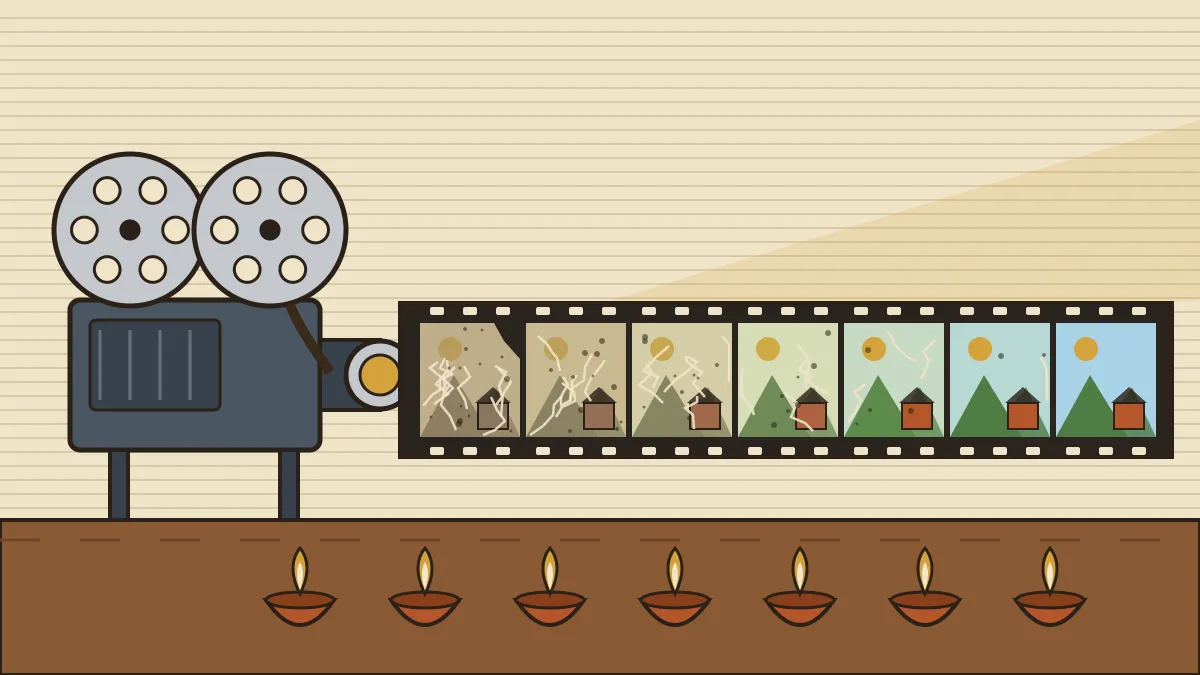
Cinema is the youngest of the arts, yet it is already losing its oldest works. The film stock on which early Indian pictures were shot is chemically unstable, and reels that sit in tin cans for decades warp, shrink and crumble. Many films have been lost for good. That is why one announcement at the 57th International Film Festival of India (IFFI) in Goa on 21 November 2026 matters as much as the red carpet: a set of old classics, restored by the National Film Development Corporation (NFDC), back on the big screen.
PIB reported two linked IFFI stories that day. The first was a set of Centenary Tributes to seven film artists born in 1926, shown through five restored films in four languages. The second was the formal inauguration of Indian Panorama 2026, the festival's showcase of the year's best Indian films, with the juries that chose them honoured on stage. This article puts both in context: who the seven artists are, how film is restored, what the National Film Heritage Mission is, and how Indian Panorama picks its films.
The day at a glance
| Item | Detail |
|---|---|
| Festival | 57th IFFI, Goa, 20 to 28 November 2026; theme "Stories Without Borders" |
| Centenary Tributes | Seven artists born in 1926; five restored films in Hindi, Bengali, Malayalam and Marathi |
| Restored by | NFDC, under the National Film Heritage Mission (NFHM) |
| Indian Panorama 2026 | Inaugurated 21 November 2026 by Chanchal Kumar, Secretary, Ministry of Information and Broadcasting |
| Opening films | Becoming (Ladakhi, non-feature, directed by Leena Yadav); Dhurandhar (Hindi, feature, directed by Aditya Dhar) |
| Juries | Feature: chaired by Madhur Bhandarkar (13 members); Non-Feature: chaired by Himansu Sekhar Khatua (7 members) |
The festival's dates, theme and history were covered in our earlier article on the 57th IFFI curtain-raiser. Here we look at what happened on the festival's second day.
The seven artists of 1926
PIB describes how 1926 produced "seven remarkable personalities" born into different families and cultural traditions, each of whom left a lasting mark on the screen. The table below puts its descriptions side by side with the film chosen for each.
| Artist | Known for | Cinema | Film in the tribute |
|---|---|---|---|
| Uttam Kumar | The "Mahanayak" of Bengali cinema; career from 1948; more than 200 films | Bengali | Chowringhee (1965) |
| Shakti Samanta | Director of 43 features (37 Hindi, 6 Bengali); career from 1948; debut as director with Bahu (1955) | Hindi | Kashmir Ki Kali |
| O.P. Nayyar | Music director; first film Aasmaan (1952); known for horse-trot rhythms and dholak beats | Hindi | Kashmir Ki Kali |
| Suryakant Mandhare | Padma Shri awardee; discovered as a boy by Bhalji Pendharkar; over a hundred films | Marathi | Sadhi Manase (1965) |
| Prem Nazir | Malayalam cinema's "evergreen romantic hero"; Padma Bhushan (1983); two Guinness World Records | Malayalam | Thulabharam |
| Raaj Kumar | Actor with a commanding baritone; debut in Rangili (1952), as PIB spells it | Hindi | Waqt |
| Ravi (Bombay Ravi) | Composer of Chaudhvin Ka Chand, Gumrah, Waqt and Humraaz; National Film Awards for Parinayam and Sukrutham | Hindi and Malayalam | Waqt |
Count the films, not the artists, to see why the numbers come out as seven people and five films. Kashmir Ki Kali carries two artists (Samanta and Nayyar) and Waqt carries two (Raaj Kumar and Ravi). Together with Chowringhee, Sadhi Manase and Thulabharam, that makes five films.
A few details from PIB's notes deserve attention. In Sadhi Manase, Suryakant Mandhare plays Shankar the blacksmith, a figure PIB describes as strength without swagger and the dignity of work. The film's music was composed by Lata Mangeshkar under the pseudonym "Anandghan", a name she used for her work in Marathi cinema. In Thulabharam, Prem Nazir sets aside his romantic image to play Rama, a factory worker and trade union man. PIB records that he holds Guinness World Records for playing the lead in more than 700 films and for 130 films opposite the actress Sheela.
The selection is also a small map of Indian cinema. Bengali, Hindi, Marathi and Malayalam films sit side by side, which fits both the festival's theme of "Stories Without Borders" and the regional breadth that Indian Panorama is meant to show.
What "restored" means
Three different jobs are often lumped together as "saving old films", and each has its own meaning.
Conservation is physical care of the original reels: cleaning, repairing, rehousing in suitable cans, and storing them in cool, dry, controlled rooms so that they decay as slowly as possible. A conserved reel is still a reel.
Digitisation is scanning the film into digital files so that a copy exists and viewers can see it without handling the fragile original. A digitised film has been copied, but not necessarily cleaned.
Restoration goes further. Specialists repair scratches, dirt, tears, flicker and faded colour, frame by frame, and correct the sound, to bring the film as close as possible to how audiences first saw it. The result is a fresh master, often in 4K resolution.
Restoration is expensive and slow, which is why a mission with its own budget is needed.
The National Film Heritage Mission
The National Film Heritage Mission (NFHM) is the Ministry of Information and Broadcasting's flagship programme to preserve, conserve, digitise and restore India's film legacy. PIB releases give the launch year as 2015 in some places and as 2016 (November 2016) in others, so quote it as 2015-16 and do not build a question on one year. Its key milestones, as recorded in PIB releases, are these.
| Date | Milestone |
|---|---|
| 2015-16 | NFHM launched (PIB uses both years) |
| 30 March 2022 | The mandates of the Films Division, the Directorate of Film Festivals, the National Film Archive of India (NFAI) and the Children's Film Society, India are transferred to NFDC, with an allocation of ₹1,304.52 crore to support the film sector up to 2026; NFHM is now implemented by NFDC |
| 5 May 2022 | Of the mission's total outlay of ₹597 crore, ₹363 crore is set aside exclusively for restoration |
| March 2023 | Three projects run at NFDC-NFAI, Pune: digitisation, conservation of film reels and restoration; 1,433 celluloid reels conserved with an international film-conservation agency |
| November 2023 | Seven restored classics screened at IFFI 54; the I&B Minister says over 5,000 films will be restored in 4K |
| 10 December 2025 | In the Lok Sabha, the Minister of State says 1,469 titles, equal to 4.3 lakh minutes of film, have been digitised and are kept by NFAI |
Two cautions apply. First, the figures in the table come from different years and are counted in different ways, such as titles, minutes, features and shorts, so they cannot be added or compared directly. Even the outlay varies: PIB gave ₹597 crore in May 2022, while a November 2023 release spoke of ₹544.82 crore for 2021-22 to 2024-25. A candidate who needs a single number should quote the date with it. Second, "digitised" is not the same as "restored". The 2025 figure counts digitised titles, while the restored films shown in Goa are a smaller, selected group.
The NFDC itself is a public sector enterprise under the Ministry, set up in 1975. The 2022 decision gave it a single mandate for production, festivals, preservation and restoration. PIB explained the reasoning at the time: bringing the activities under one management reduces overlap and uses public money better. The assets of the old units stayed with the Government of India, and the famous brand name "Films Division" was kept for NFDC's documentary production arm.
Indian Panorama 2026
Indian Panorama is the festival's showcase of Indian cinema. At the inauguration on 21 November, the NFDC Chairperson, G. Krishnakumar, recalled that the section has run since 1978. The Festival Director, Ashutosh Gowariker, spoke of how it has become an important showcase of the country's cultural and cinematic diversity.
The numbers from the inauguration show how selective it is:
- 762 feature film entries and 358 non-feature film entries, a total of 1,120 submissions in 18 languages, as the Festival Director told the inauguration. (A separate PIB release on the jury press conference speaks of choosing 25 films from "404 entries" for the feature package. PIB does not reconcile the two figures, so quote 762 and 404 only with their source.)
- A final selection spanning 14 languages, including Hindi, Marathi, Kannada, Tulu, Ladakhi, Kashmiri and English, as well as web series.
- 20 feature films in the Indian Panorama Feature Film section and five in the Mainstream Cinema section, a package of 25 features, plus 20 non-feature films, according to a separate PIB release on the jury's press conference.
The juries. Two juries make the selection. The Feature Film Jury, with thirteen members, is chaired by filmmaker Madhur Bhandarkar. The Non-Feature Film Jury, with seven members, is chaired by documentary filmmaker Himansu Sekhar Khatua. Members come from many crafts, including cinematography, editing, production, direction, animation and criticism, which is how the panel aims to judge a film from several angles.
The opening films. The non-feature section opens with the Ladakhi film Becoming, directed by Leena Yadav, which PIB describes as the spiritual journey of a young boy in Ladakh that crosses time, memory and lifetimes. The feature section opens with the Hindi film Dhurandhar, directed by Aditya Dhar; the actor Rakesh Bedi represented the film at the ceremony.
What the jury said. Members of the Feature Film Jury told a press conference that they looked for originality and for pan-Indian representation. One member compared watching films from different regions to "experiencing international cinema", and another described the process as a virtual tour of India that reflected unity in diversity. Chairperson Bhandarkar said the decisions were collective, and that the criteria for the Mainstream Cinema section differ from those for the Indian Panorama Feature section.
Do not confuse Panorama with the national awards
IFFI's Indian Panorama is a curated showcase, not an award. The National Film Awards, announced separately, are the government's honours for the best films of a year. Our article on the 72nd National Film Awards explains them. Examiners like options that mix the two.
Why this matters
Preservation of film is part of the wider task of protecting cultural heritage. A film is a record of language, clothing, music, labour and landscape. Thulabharam, for example, places a trade unionist at its centre and Chowringhee an ensemble of city characters, and each is therefore also a document of its time. When the original reels are lost, that record goes with them.
The mission also fits a larger pattern. Governments are using digitisation and restoration for monuments, manuscripts and films alike, and the cultural sector is being organised under bodies such as NFDC for films. For the exam, the practical lessons are the vocabulary (conserve, digitise, restore), the institution (NFDC and its units), the year (2015-16 for NFHM, 1975 for NFDC, 1978 for Panorama) and the current-affairs hooks (seven artists, five films, four languages).
🔑 Revision block
The news. 21 November 2026, 57th IFFI, Goa (20 to 28 November; theme "Stories Without Borders"): Centenary Tributes and the inauguration of Indian Panorama 2026.
Centenary Tributes. Seven artists born in 1926: Uttam Kumar, Shakti Samanta, O.P. Nayyar, Suryakant Mandhare, Prem Nazir, Raaj Kumar, Ravi. Five restored films in four languages: Chowringhee (Bengali), Kashmir Ki Kali and Waqt (Hindi), Sadhi Manase (Marathi), Thulabharam (Malayalam).
Restoration. Conservation (physical care), digitisation (scanning), restoration (repairing the image and sound; 4K masters). Done by NFDC under the National Film Heritage Mission (launched 2015-16; outlay ₹597 crore as stated in May 2022, ₹363 crore for restoration).
Institutions. NFDC: public sector enterprise, 1975; since 30 March 2022 also holds the mandates of Films Division, Directorate of Film Festivals, NFAI and Children's Film Society.
Latest count. 1,469 titles (4.3 lakh minutes) digitised, as told to the Lok Sabha on 10 December 2025.
Indian Panorama. Since 1978. 1,120 entries (762 feature + 358 non-feature) in 18 languages; final selection in 14 languages. Juries: Madhur Bhandarkar (Feature, 13 members), Himansu Sekhar Khatua (Non-Feature, 7 members). Opening films: Becoming (Ladakhi) and Dhurandhar (Hindi). Festival Director: Ashutosh Gowariker.
🎯 Practice MCQs
Q1. The Centenary Tributes at the 57th IFFI present how many restored films?
(a) Two
(b) Three
(c) Four
(d) Five
→ (d)
Five restored films were selected, in Hindi, Bengali, Malayalam and Marathi, which makes four languages. Seven artists are honoured because two of the films carry two artists each.
Q2. The National Film Heritage Mission is a flagship initiative of which Ministry?
(a) Ministry of Information and Broadcasting
(b) Ministry of Culture
(c) Ministry of Education
(d) Ministry of Tourism
→ (a)
PIB calls it the Ministry of Information and Broadcasting's flagship initiative to preserve, conserve, digitise and restore India's film legacy. In 2022 its implementation moved to NFDC, along with other film media units.
Q3. Which body now implements the National Film Heritage Mission?
(a) Films Division as an independent unit
(b) Directorate of Film Festivals as an independent unit
(c) National Film Development Corporation
(d) Central Board of Film Certification
→ (c)
The 2022 decision transferred the mandates of Films Division, the Directorate of Film Festivals, NFAI and the Children's Film Society to NFDC. The CBFC certifies films and has no role in preservation.
Q4. The film Thulabharam, shown in the Centenary Tributes with Prem Nazir in the lead, belongs to which language of Indian cinema?
(a) Tamil
(b) Malayalam
(c) Telugu
(d) Kannada
→ (b)
Prem Nazir is described by PIB as Malayalam cinema's evergreen romantic hero, and Thulabharam is a Malayalam film.
Q5. Consider the following statements about Indian Panorama 2026:
1. The section has been part of IFFI since 1978.
2. Its final selection includes films in Hindi only.
Which of the statements given above is/are correct?
(a) 1 only
(b) 2 only
(c) Both 1 and 2
(d) Neither 1 nor 2
→ (a)
The NFDC Chairperson spoke of the section's legacy since 1978. The selection spans 14 languages, including Marathi, Kannada, Tulu, Ladakhi and Kashmiri.
Q6. Who is the Festival Director of the 57th IFFI?
(a) Madhur Bhandarkar
(b) Himansu Sekhar Khatua
(c) Ashutosh Gowariker
(d) G. Krishnakumar
→ (c)
Ashutosh Gowariker is the Festival Director. Bhandarkar chairs the Feature Film Jury, Khatua the Non-Feature Film Jury, and Krishnakumar is Chairperson of NFDC.
Q7. The Feature Film Jury of Indian Panorama 2026 was chaired by:
(a) Ashutosh Gowariker
(b) Madhur Bhandarkar
(c) Aditya Dhar
(d) Rakesh Bedi
→ (b)
Madhur Bhandarkar chairs the thirteen-member Feature Film Jury. Aditya Dhar directed the opening feature, Dhurandhar, and Rakesh Bedi represented it at the ceremony.
Q8. For the film Sadhi Manase, the music was composed by Lata Mangeshkar under the pseudonym:
(a) Sudhir Phadke
(b) Bombay Ravi
(c) Madan Mohan
(d) Anandghan
→ (d)
PIB notes that she used the name "Anandghan" for her work in Marathi cinema. The other options are real music directors, not her pseudonym.
📋 How this gets asked (PYQ pattern)
Art and culture questions in the CDS general knowledge paper are mostly who, what and when, and a story about films and festivals offers all three.
The first pattern is institutions and schemes: which body preserves or promotes a heritage, and under which ministry. NFDC, the Films Division, NFAI and the CBFC are easy to mix up, and the 2022 merger gives the examiner a ready-made trap, as in Q3.
The second is festivals, awards and who is who: the place of a festival, the person who leads it, and the difference between a showcase and an award, as in Q5 to Q7. This cycle's hooks are the Festival Director (Ashutosh Gowariker), the juries' chairpersons and the theme "Stories Without Borders".
The third is people and works: an artist with a work, a language or an honour. Match each of the seven 1926 artists with a film and a cinema, as in Q4 and Q8.
Preparing for CDS? Build a one-page chart of Indian cultural institutions (NFDC, Sahitya Akademi, Sangeet Natak Akademi, Lalit Kala Akademi, ASI) with the founding year and ministry of each, and revise the wider background in our history study notes. Follow the daily CDS current affairs, and learn with experienced faculty in the upcoming Cavalier courses in Delhi.
Source: PIB / Ministry of Information & Broadcasting, "Celebrating a Century of Cinematic Brilliance: IFFI 2026 Honours Seven Stalwarts of Indian Cinema" and "Indian Panorama 2026 Inaugurated at 57th IFFI; Jury Members Felicitated", 21 November 2026; "Beyond Languages and Borders: Indian Panorama Celebrates the Diversity of Indian Cinema at 57th IFFI", 21 November 2026. Background from PIB releases of 30 March 2022 (merger of film media units), 5 May 2022, 12 March 2023, 28 November 2023 and 10 December 2025 (National Film Heritage Mission).
✍️ Written by Hitendra Deswal — Polity & current-affairs faculty at The Cavalier. Reviewed by the Cavalier Faculty Desk.