On 17 November 2026, President Droupadi Murmu inaugurated the year-long Golden Jubilee celebrations of the ICMR-National Institute of Malaria Research (ICMR-NIMR) in New Delhi. The institute, set up in 1977, has spent fifty years studying the parasite, the mosquito and the village in which they meet.
The occasion came with numbers worth remembering. According to the President and the Union Health Minister J.P. Nadda, India's malaria cases and deaths have fallen by nearly 80% between 2015 and 2025, the number of high-burden districts has dropped from 155 to 33, and 160 districts reported zero indigenous cases during 2022-2025. India left the WHO's High Burden to High Impact group in 2024. The stated goals are zero indigenous cases by 2027 and malaria elimination by 2030.
This article explains the disease, how India fought it, what NIMR does, and what still stands in the way.
The disease in one page
Malaria is caused by a single-celled parasite of the genus Plasmodium. It spreads through the bite of an infected female Anopheles mosquito. It does not pass directly from person to person, although it can be transmitted through infected blood or contaminated needles.
- Five species infect humans: P. falciparum, P. vivax, P. malariae, P. ovale and P. knowlesi. In India, falciparum and vivax matter most. Falciparum is the deadliest form and can cause severe illness within a day or so if untreated.
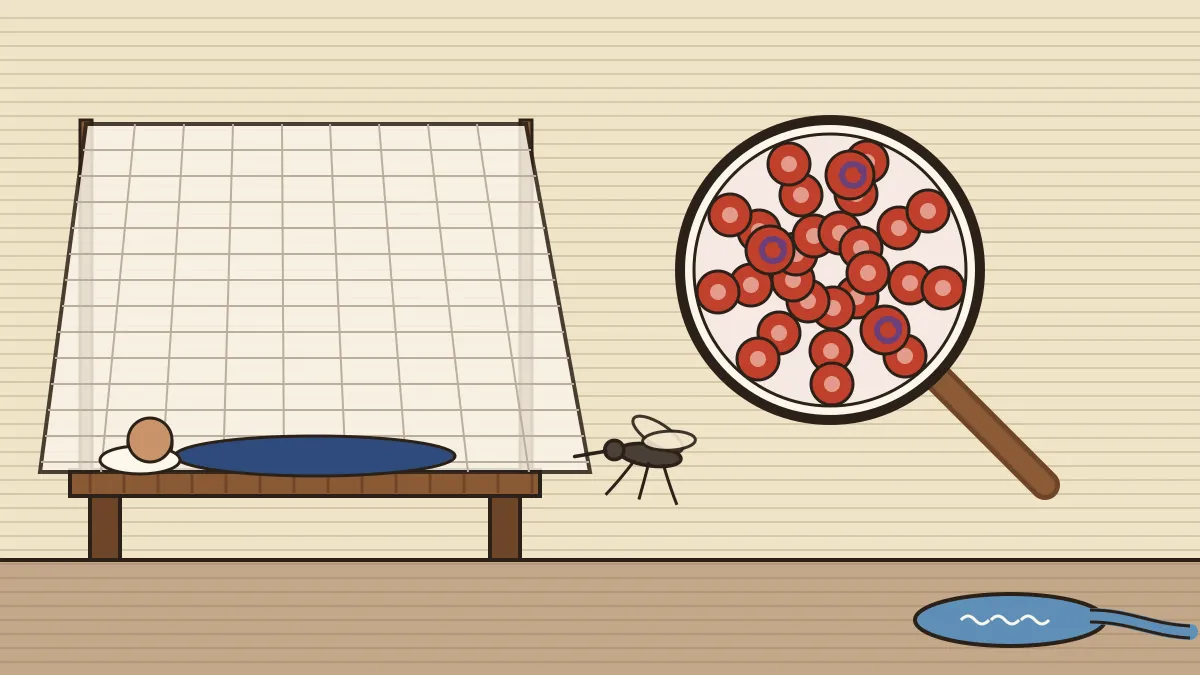
- The life cycle has two hosts. In humans, the parasite first multiplies in the liver, then invades red blood cells, where it multiplies again and bursts them, which produces the fever with chills. In the mosquito, the sexual stage develops after it bites an infected person.
- Symptoms usually begin 10 to 15 days after a bite: fever, headache and chills.
- Treatment depends on the species. Artemisinin-based combination therapy (ACT) is the standard for falciparum malaria, chloroquine is used for vivax where it still works, and primaquine is added to prevent relapses in vivax and ovale malaria. Hence the President's appeal at the event to complete the full course of medicine.
Two historical anchors turn up often in exams. The parasite was first seen in human blood by Alphonse Laveran in 1880. Ronald Ross proved in 1897, working in Secunderabad, that mosquitoes carry it, and won the Nobel Prize in 1902. Our note on viral and bacterial diseases covers the wider disease classification, and malaria falls in the protozoan group.
How big the fall has been
At independence, malaria was among the most serious public health problems. A PIB review in December 2024 gave the estimate for 1947 as about 7.5 crore cases and 8 lakh deaths a year. The recorded numbers in recent years are far smaller:
| Year | Reported cases | Reported deaths |
|---|---|---|
| 2015 | 11,69,261 | 384 |
| 2023 | 2,27,564 | 83 |
That is a drop of about 80.5% in cases and 78% in deaths between 2015 and 2023, as PIB put it in April 2025. The latest statement stretches the comparison to 2025 and says both have fallen by nearly 80%. Do not mix the two kinds of figures: the 1947 numbers are estimates, the others are cases reported through the surveillance system.
Other markers from the event:
- High-burden districts: 155 to 33.
- Zero-case districts: 160 districts reported no indigenous cases during 2022-2025.
- India's share: with about 16% of the world's population, India accounts for roughly 0.7% of global malaria cases and 0.6% of deaths, according to Mr Nadda.
India's programme: from DDT to "Test, Treat, Track"
India has been at this for more than seventy years, and the strategy has changed with the tools available.
- 1950s: National Malaria Control Programme, built around spraying houses with DDT, later turned into a National Malaria Eradication Programme after early success. The eradication effort faltered in later decades.
- 2003: malaria was merged into the National Vector Borne Disease Control Programme (NVBDCP), which also covers dengue, chikungunya, Japanese encephalitis, kala-azar and lymphatic filariasis.
- 2016: National Framework for Malaria Elimination (2016-2030), which set the goal of zero indigenous cases by 2027 and elimination by 2030.
- 2023-2027: National Strategic Plan for Malaria Elimination, with the "Test, Treat, Track" approach and real-time data through the Integrated Health Information Platform (IHIP).
The toolkit is a mix of the very simple and the very scientific: indoor residual spraying, long-lasting insecticidal nets, rapid diagnostic tests and microscopy, ACT for treatment, and special attention to Anopheles stephensi, the invasive mosquito that breeds in urban water tanks and construction sites.
States are placed in categories by their annual parasite incidence (API). Category 1 means fewer than one case per thousand population, and Category 0 means no indigenous cases. In 2015 only 15 States and Union Territories were in Category 1; by 2023, 24 were. Ladakh, Lakshadweep and Puducherry were in Category 0 in 2023.
What NIMR actually does
ICMR itself is old: it began as the Indian Research Fund Association in 1911 and took its present name in 1949. NIMR, one of its institutes, was set up in 1977 as the Malaria Research Centre in Delhi, and is now at Dwarka.
According to the President and the DG ICMR, Dr Rajiv Bahl, its work covers:
- malaria parasite biology and drug resistance;
- mosquito vectors, vector control and insecticide resistance;
- community-based surveillance;
- evidence for policy, such as the Comprehensive Case Management Project in Odisha, done with the State Government, which showed that universal testing, full treatment and stronger surveillance could cut transmission sharply, even in remote communities.
Director Dr Anup Anvikar took the audience through the institute's fifty-year journey, and at the event the President released a commemorative postage stamp sheet, while Mr Nadda released a coffee table book and a book titled ICMR-NIMR Research Journey: Five Decades of Science, Service and Impact.
Exiting "High Burden to High Impact"
The WHO's High Burden to High Impact (HBHI) approach was set up to help the 11 countries that carry the heaviest burden of malaria: ten in Africa, and India, the only one outside Africa. India moved out of the group in 2024, after its case and death numbers fell. This is a recognition of progress, not a certificate of elimination.
Elimination has a formal meaning. The WHO certifies a country malaria-free only after it shows at least three consecutive years of zero indigenous cases, along with a system able to prevent re-introduction. Sri Lanka was certified in 2016. India's target of zero indigenous cases by 2027 would start that three-year clock, which is why the 2030 elimination goal follows it. World Malaria Day is observed on 25 April each year.
The indigenous vaccine
At the event the President expressed satisfaction at NIMR's contribution to the indigenous malaria vaccine being developed in Bhubaneswar. The release does not name the vaccine; it is ICMR's candidate being developed at its Bhubaneswar centre, and the President credited NIMR with a contribution to it. Whatever the final product, a vaccine would target a stage of P. falciparum, such as the liver stage or the transmission stage in the mosquito. For exams, remember only that it is an indigenous candidate under development, not one in public use.
For context, the WHO has recommended two malaria vaccines for children in Africa, RTS,S (2021) and R21 (2023). A vaccine will add to, not replace, nets, spraying, testing and treatment.
The challenges the President named
- Climate change, which can lengthen mosquito breeding seasons and shift where transmission happens.
- Unplanned urbanisation, which creates stagnant water in construction sites and tanks. Anopheles stephensi thrives here.
- Insecticide resistance in mosquitoes, which weakens spraying and nets.
- Community participation: completing treatment, preventing waterlogging and removing breeding sources.
- Dengue as an "emerging public health challenge", for which she called for stronger research and diagnostics.
The President also noted ICMR's wider record: research on tuberculosis, leprosy and kala-azar, the nationwide COVID-19 testing network built in record time, and partnership in India's first indigenous COVID-19 vaccine. She also praised the National One Health Mission, which looks at health risks at the human-animal-environment interface. Mr Nadda highlighted ICMR initiatives such as MedTech Mitra and Patent Mitra.
For the health-financing side of the story, see our piece on National Health Accounts and out-of-pocket spending.
🔑 Revision block
The event. 17 November 2026: President Droupadi Murmu inaugurated the year-long Golden Jubilee of ICMR-NIMR (est. 1977, New Delhi); Union Health Minister J.P. Nadda; DG ICMR Dr Rajiv Bahl; Director NIMR Dr Anup Anvikar.
Progress. Cases and deaths down ~80% (2015 to 2025); high-burden districts 155 to 33; 160 districts with zero indigenous cases (2022-2025); India: ~16% of world population, ~0.7% of cases, ~0.6% of deaths.
Targets. Zero indigenous cases 2027; elimination 2030. WHO certification needs 3 consecutive years of zero indigenous cases.
WHO link. India exited High Burden to High Impact in 2024.
Programmes. National Malaria Control Programme (1950s, DDT) then Eradication Programme; NVBDCP 2003; National Framework 2016-2030; National Strategic Plan 2023-2027 (Test, Treat, Track; IHIP).
Biology. Plasmodium (5 human species); female Anopheles; liver stage then red blood cells; ACT for falciparum; primaquine prevents vivax relapse. Laveran 1880, Ross 1897 (Nobel 1902).
Vaccine. Indigenous candidate being developed in Bhubaneswar, with NIMR's contribution (President); not yet in use. WHO-recommended: RTS,S (2021), R21 (2023).
🎯 Practice MCQs
Q1. The ICMR-National Institute of Malaria Research, whose Golden Jubilee was inaugurated on 17 November 2026, was set up in:
(a) 1953
(b) 1977
(c) 1998
(d) 2005
→ (b)
The DG ICMR traced its 50-year journey to 1977, when it began as the Malaria Research Centre in Delhi. The other years are distractors.
Q2. Malaria in humans is transmitted by the bite of:
(a) Infected male Culex mosquitoes
(b) Infected female Anopheles mosquitoes
(c) Infected female Aedes mosquitoes
(d) Infected sandflies
→ (b)
Plasmodium parasites are carried by female Anopheles mosquitoes. Aedes spreads dengue and chikungunya, and sandflies spread kala-azar.
Q3. India's target for zero indigenous malaria cases and for malaria elimination are, respectively:
(a) 2025 and 2027
(b) 2027 and 2029
(c) 2027 and 2030
(d) 2030 and 2035
→ (c)
The National Framework for Malaria Elimination (2016-2030) and the 2023-27 National Strategic Plan set zero indigenous cases by 2027 and elimination by 2030.
Q4. The number of high-burden malaria districts in India has fallen from 155 to:
(a) 33
(b) 55
(c) 75
(d) 105
→ (a)
This figure was stated by the President and the Health Minister at the NIMR Golden Jubilee.
Q5. Consider the following statements about malaria:
1. The parasite multiplies first in the liver and then in red blood cells.
2. Primaquine is used to prevent relapses of vivax malaria.
Which of the statements given above is/are correct?
(a) 1 only
(b) 2 only
(c) Both 1 and 2
(d) Neither 1 nor 2
→ (c)
Both are correct. The liver stage precedes the blood stage, and primaquine acts on the dormant liver forms that cause relapses.
Q6. Who demonstrated in 1897 that mosquitoes transmit malaria, and received the Nobel Prize in 1902?
(a) Alphonse Laveran
(b) Robert Koch
(c) Louis Pasteur
(d) Ronald Ross
→ (d)
Ross worked in Secunderabad. Laveran had earlier identified the parasite in human blood (1880) and received the Nobel Prize in 1907.
Q7. India moved out of which WHO group in 2024 on the strength of its fall in malaria burden?
(a) High Burden to High Impact
(b) Global Technical Strategy
(c) Roll Back Malaria Partnership
(d) Stop TB Partnership
→ (a)
HBHI is the approach for the 11 highest-burden countries, of which India was the only one outside Africa. Leaving it recognises progress, but elimination needs WHO certification.
Q8. The "Test, Treat, Track" approach to malaria is part of:
(a) The National Vector Borne Disease Control Programme of the 1950s
(b) The Pradhan Mantri Jan Arogya Yojana
(c) The National Health Mission of 2005
(d) The National Strategic Plan for Malaria Elimination (2023-2027)
→ (d)
The 2023-27 plan combines testing, full treatment and tracking, with the IHIP supplying real-time data. NVBDCP was formed in 2003, not in the 1950s.
📋 How this gets asked (PYQ pattern)
Health and disease questions appear in CDS general science papers in three familiar forms.
The first is disease and cause: pair a disease with its pathogen and its vector. Malaria (Plasmodium, female Anopheles), dengue (virus, Aedes), kala-azar (Leishmania, sandfly) are standard pairs, and the options deliberately swap them, as in Q2.
The second is programmes and bodies: which institute or scheme does what, and which year it began. The distractors are usually the nearby years of other health programmes, as in Q1 and Q8.
The third is a recent milestone with a number: a target year, a percentage fall or a count of districts. This cycle's hooks are 2027 for zero indigenous cases, 2030 for elimination, 155 to 33 districts and nearly 80%.
Preparing for CDS? Make a one-line card for each vector-borne disease: pathogen, vector, one control measure. Revise the basics in our notes on viral and bacterial diseases and immunity and vaccination, follow the daily CDS current affairs, and learn with experienced faculty in the upcoming Cavalier courses in Delhi.
Source: PIB / Ministry of Health and Family Welfare, "President of India inaugurates Golden Jubilee celebrations of ICMR-National Institute of Malaria Research" (17 November 2026) and the President's Secretariat release of the same date; "Update on India's Progress in Malaria Elimination" (25 December 2024); "World Malaria Day 2025" (25 April 2025). Laveran and Ross dates, the RTS,S and R21 vaccine years and WHO certification details are standard public-health history.
✍️ Written by Col D.N. Sharma — Science & general-studies faculty at The Cavalier. Reviewed by the Cavalier Faculty Desk.