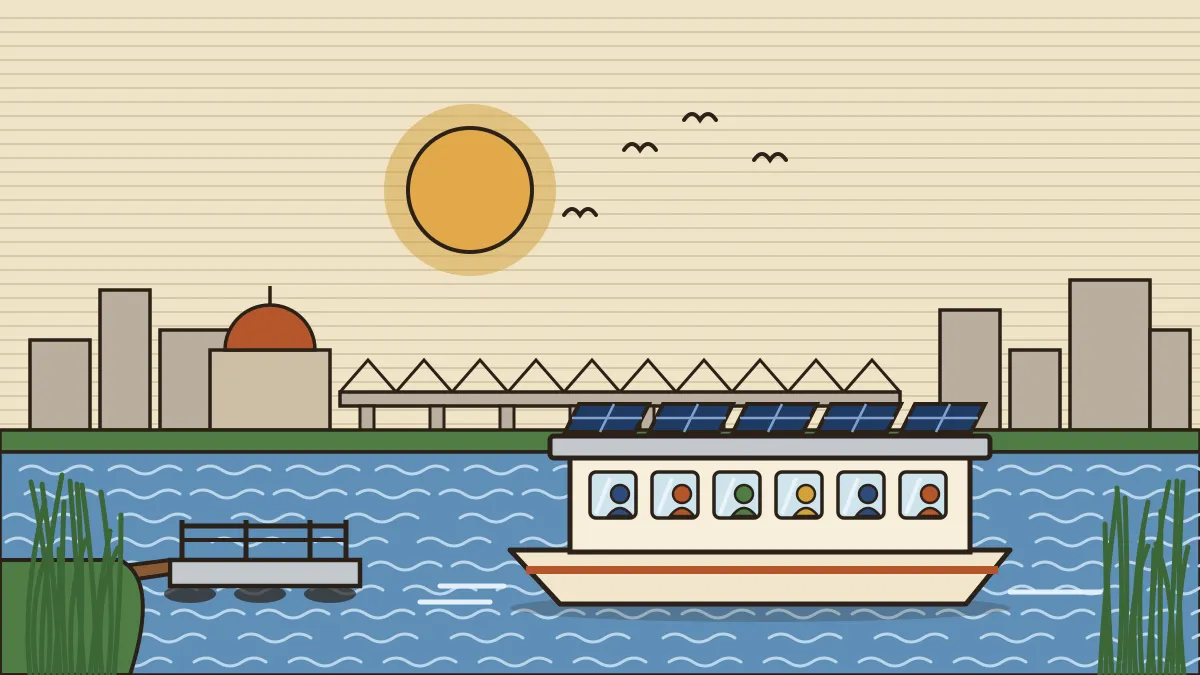
Delhi is about to get a ferry-style river cruise on its own river. On 10 November 2026, Union Minister of Ports, Shipping and Waterways Sarbananda Sonowal is due to inaugurate Delhi's first recreational Yamuna cruise service at Sonia Vihar. Delhi's Lieutenant Governor Taranjit Singh Sandhu and Chief Minister Rekha Gupta will attend. The service runs on the Sonia Vihar to Jagatpur stretch, and trial runs of the vessel were completed last month.
The story is small in scale and large in what it shows. A stretch of the Yamuna in the capital is legally a National Waterway, a category that most people link with cargo barges on the Ganga and the Brahmaputra. This article explains what that status means, who builds and runs it, what is being launched, and how the cruise fits into India's wider push on inland water transport.
The river and the waterway
The Yamuna is a right-bank tributary of the Ganga. It rises at the Yamunotri glacier in Uttarakhand, flows through Himachal Pradesh, Haryana and Delhi and Uttar Pradesh, and joins the Ganga at Prayagraj. Our notes on Himalayan rivers cover its course.
Parliament has declared the stretch from Jagatpur in Delhi to Prayagraj as National Waterway 110 (NW-110). The Ministry's November 2025 release gives its length as 1,080 km, while a March 2025 release said 1,089 km, so quote "about 1,080 km". In the list of operational waterways published in March 2026, NW-110 appears under Uttar Pradesh. The Delhi cruise is therefore not a new waterway but a new use of an old legal label: recreation on a stretch where cargo has never been the main prize.
Where the cruise sits. The project is upstream of the Wazirabad Barrage, between Sonia Vihar and Jagatpur. A barrage holds water back and creates a pool behind it, and a boat needs exactly that: depth and a steady level. The Delhi stretch of the Yamuna is otherwise known for low lean-season flow, because barrages upstream divert most of the river's natural water for irrigation and drinking supply.
The project in brief
| Feature | What the releases say |
|---|---|
| Location | Sonia Vihar to Jagatpur, upstream of Wazirabad Barrage, NW-110 |
| Agency | Inland Waterways Authority of India (IWAI), Ministry of Ports, Shipping and Waterways |
| Delhi partners | DDA, DTTDC, Delhi Jal Board, Irrigation and Flood Control Department |
| Agreement | MoU signed on 11 March 2025 |
| Cost | About ₹20 crore (Nov 2025 release) |
| Corridor length | A 4 km stretch in the MoU; a 6 to 7 km round trip in the Nov 2025 release |
| Vessels | Electric-solar hybrid boats; electric-powered cruise vessel in the Nov 2026 release |
| Capacity | 20 to 30 passengers (Mar 2025); 30 to 40 passengers (Nov 2025) |
| Jetties | Two floating jetties at Sonia Vihar, each for 50 passengers |
| Safety | Life jackets, public announcement systems, bio-toilets |
| Status | Trial runs done in October 2026; inauguration on 10 November |
Look at the rows for length and capacity. The official numbers differ between releases because the plan was refined over time: the MoU described 4 km, later the round trip was put at 6 to 7 km, and the boat's capacity went from 20 to 30 to 30 to 40. For examination purposes, the safe facts are the location, the agency and the electric propulsion, which do not change.
Why IWAI, and what a National Waterway is
The Authority. The Inland Waterways Authority of India (IWAI) was created under the IWAI Act, 1985, enacted on 30 December 1985, and began functioning in 1986. It is the Ministry of Ports, Shipping and Waterways' nodal agency for developing and regulating national waterways. It builds the fairway, the terminals and the navigation aids.
The law. The National Waterways Act, 2016, enacted on 25 March 2016, did two things. It continued the first five National Waterways, which had earlier been declared by separate Acts, and it declared 106 more, making 111 in all. Together they stretch for 20,187 km across 23 States and 4 Union Territories.
The first five are worth knowing as a set:
- NW-1: the Ganga-Bhagirathi-Hooghly system, Haldia to Prayagraj (formerly Allahabad), about 1,620 km, declared in 1986.
- NW-2: the Brahmaputra from Dhubri to Sadiya, about 891 km, declared in 1988. Our article on the Bogibeel-Dibrugarh cargo run is on this waterway.
- NW-3: the West Coast Canal in Kerala, Kollam to Kottapuram, with the Champakara and Udyogmandal canals, about 205 km, declared in 1993.
- NW-4 and NW-5 followed: NW-4 covers the Krishna and Godavari river systems with linked canals, and NW-5 the East Coast Canal with the Brahmani and Mahanadi delta rivers.
Why the label matters. The Constitution makes shipping and navigation on inland waterways declared national by Parliament a Union subject. Declaring a waterway under the Act therefore moves regulatory responsibility to the Centre. That is why a Union ministry, not Delhi's own government, is leading a boat service on a Delhi river, with the state's agencies as partners.
How much of this network is working
The title "national waterway" does not mean traffic. The April 2026 PIB backgrounder is clear that of the 111, 32 were operational in March 2026, spanning 5,155 km, and that the aim is to raise the number to 52 within five years. The Union Budget 2026-27 announced that 20 new national waterways would be made operational over five years.
The numbers that show the direction are these:
| Measure | Figure |
|---|---|
| Cargo on national waterways, 2024-25 | 145.84 million tonnes (a record then) |
| Cargo on national waterways, 2025-26 (to February 2026) | 198 million tonnes |
| Passenger traffic, 2023-24 | 1.61 crore |
| Passenger traffic, 2024-25 | 7.6 crore (about 4.7 times) |
| Waterways with cargo / passenger / cruise operations (Nov 2025) | 29 / 23 / 15 |
| Waterways with all three | 11 |
| Target for inland water transport share of cargo | 2% to 5% by 2030 |
| Target for cargo volume | Over 200 million tonnes by 2030; 500 million by 2047 |
Passenger traffic is the line to notice, because a cruise belongs to that segment. The jump from 1.61 crore to 7.6 crore in one year shows how much of the sector's recent growth is people, not cargo, and that is the part a Yamuna service would join. For a deeper look at the cargo side, see our explainer on inland waterways, navigation and hydrography.
Harit Nauka: why the boats are electric
IWAI has issued Harit Nauka guidelines to push clean propulsion on the waterways. It has introduced electric catamarans in Varanasi and Ayodhya, with more planned elsewhere, and it has tested India's first indigenously built hydrogen fuel-cell vessel. Electric-powered cruise boats on the Yamuna fit that pattern. The Ministry's argument is that a quiet, non-polluting boat in the heart of a city shows what inland waterways can offer for clean mobility.
There is a practical reason as well. A diesel engine on a small, slow city river would add oil and noise exactly where the Government wants people to enjoy the river. An electric boat with a solar roof can work for short trips of a few kilometres, which is all this corridor needs.
The river's other story
A cruise project sits uneasily next to the Yamuna's reputation. The 22 km stretch through Delhi, barely 2% of the river's length, is estimated in our earlier analysis to carry 70 to 80% of its pollution load. Most of that load enters downstream of Wazirabad, through drains such as the Najafgarh drain, and the cruise corridor lies upstream of the barrage. Our explainer on Yamuna rejuvenation and sewage treatment sets out that problem.
That location is both a limit and an opportunity. It is easier to run a pleasant boat service where the water is comparatively better. But a cruise is a visible reminder of the river, and it raises public expectations that the rest of the Yamuna will also be cleaned. A fair reading is that the cruise is a tourism and public-engagement project, and that it does not substitute for the sewage-treatment work.
What to watch
- The inauguration on 10 November, and whether the PIB release gives the fare, the timings and the operator. The earlier releases do not.
- Passenger numbers. The corridor is short, so its value will be judged by use more than by distance.
- Other cities. Whether the same model of cruise, jetty and electric boat is repeated on other national waterways in cities.
- The Budget 2026-27 promise of 20 new operational waterways, which is the larger test of the sector.
🔑 Revision block
The event. Delhi's first recreational Yamuna cruise to be inaugurated on 10 November 2026 at Sonia Vihar by Sarbananda Sonowal, with the Delhi LG and CM present; stretch Sonia Vihar to Jagatpur; trial runs done in October.
The waterway. NW-110 = the Yamuna from Jagatpur (Delhi) to Prayagraj, about 1,080 km; the cruise lies upstream of the Wazirabad Barrage.
Agencies. IWAI (Ministry of Ports, Shipping and Waterways) with DDA, DTTDC, Delhi Jal Board and the Irrigation and Flood Control Department; MoU of 11 March 2025; cost about ₹20 crore; two floating jetties (50 passengers each); electric-solar boats.
The law. IWAI Act, 1985 (enacted 30 December 1985). National Waterways Act, 2016 (enacted 25 March 2016): 111 national waterways (5 continued + 106 new), 20,187 km, 23 States and 4 UTs; shipping and navigation on them is a Union subject.
The first five. NW-1 Ganga (Haldia-Prayagraj, 1,620 km, 1986); NW-2 Brahmaputra (Dhubri-Sadiya, 891 km, 1988); NW-3 West Coast Canal, Kerala (205 km, 1993); NW-4 Krishna-Godavari; NW-5 East Coast Canal.
Progress. 32 operational (5,155 km) in March 2026, target 52 in five years; Budget 2026-27: 20 new waterways; cargo 145.84 MT (2024-25) and 198 MT (to Feb 2026); passengers 1.61 crore to 7.6 crore; modal share target 2% to 5% by 2030.
Clean boats. Harit Nauka guidelines; electric catamarans in Varanasi and Ayodhya; first indigenous hydrogen fuel-cell vessel trialled.
🎯 Practice MCQs
Q1. Which river is notified as National Waterway 110?
(a) Ganga
(b) Brahmaputra
(c) Narmada
(d) Yamuna
→ (d)
NW-110 is the Yamuna from Jagatpur in Delhi to its confluence with the Ganga at Prayagraj. The Ganga is NW-1 and the Brahmaputra NW-2.
Q2. The agency developing the recreational cruise on the Yamuna in Delhi is the:
(a) National Highways Authority of India
(b) Inland Waterways Authority of India
(c) Delhi Development Authority alone
(d) Central Water Commission
→ (b)
IWAI, under the Ministry of Ports, Shipping and Waterways, leads the project, with the DDA, DTTDC, Delhi Jal Board and the Irrigation and Flood Control Department as partners.
Q3. The National Waterways Act, 2016, declared a total of how many national waterways, including the five that already existed?
(a) 5
(b) 106
(c) 111
(d) 150
→ (c)
It continued the first five and declared 106 more, giving 111 national waterways. The figure 106 is the number of new additions.
Q4. The Delhi Yamuna cruise corridor lies upstream of which barrage?
(a) Wazirabad
(b) Okhla
(c) Tajewala
(d) Farakka
→ (a)
The project is upstream of the Wazirabad Barrage, between Sonia Vihar and Jagatpur. Okhla is downstream, and Farakka is on the Ganga.
Q5. National Waterway-2 runs on which river between Dhubri and Sadiya?
(a) Ganga
(b) Barak
(c) Brahmaputra
(d) Godavari
→ (c)
NW-2 is the Brahmaputra stretch of about 891 km in Assam. The Barak is NW-16, and the Godavari is part of NW-4.
Q6. Under IWAI's Harit Nauka initiative, electric catamarans have been introduced in:
(a) Varanasi and Ayodhya
(b) Kochi and Kollam
(c) Mumbai and Goa
(d) Kolkata and Haldia
→ (a)
Electric catamarans run in Varanasi and Ayodhya. The Yamuna cruise uses electric-powered vessels on the same clean-mobility logic.
Q7. Consider the following statements:
1. National waterways are declared by State legislatures.
2. The Inland Waterways Authority of India works under the Ministry of Ports, Shipping and Waterways.
Which of the statements given above is/are correct?
(a) 1 only
(b) 2 only
(c) Both 1 and 2
(d) Neither 1 nor 2
→ (b)
National waterways are declared by Parliament, so statement 1 is wrong. IWAI is the Ministry's nodal agency, so statement 2 is right.
Q8. Passenger traffic on India's national waterways rose from 1.61 crore in 2023-24 to about how much in 2024-25?
(a) 2.4 crore
(b) 3.9 crore
(c) 5.2 crore
(d) 7.6 crore
→ (d)
The April 2026 PIB backgrounder gives 7.6 crore, an increase of about 4.7 times in a year.
📋 How this gets asked (PYQ pattern)
Inland waterway questions in CDS general knowledge are mostly matching and number questions.
The first kind is river to waterway: NW-1 Ganga, NW-2 Brahmaputra, NW-3 Kerala's West Coast Canal, NW-4 Krishna-Godavari and, newly in the news, NW-110 Yamuna. The wrong options are usually other national waterways, as in Q1 and Q5.
The second is law and institution: the National Waterways Act, 2016, and the IWAI Act, 1985, the count of 111, and the fact that Parliament, not a state, declares a national waterway. Q3 and Q7 test it.
The third is news hooks: who is building what and where. This cycle's anchors are NW-110, Sonia Vihar to Jagatpur, IWAI and electric boats. Keep the 111-versus-32 distinction in mind: the number declared is very different from the number working.
Preparing for CDS? Make a one-page table of NW-1 to NW-5 with river, stretch and length, and add NW-16 and NW-110. Revise the geography behind it in our notes on transport geography and the wider CDS study material. Follow the daily CDS current affairs, and learn with experienced faculty in the upcoming Cavalier courses in Delhi.
Source: PIB / Ministry of Ports, Shipping and Waterways, "Delhi Set to Get Its First Recreational Yamuna Cruise Service" (9 November 2026); "Delhi Set for River Cruise Experience on Yamuna; Union Minister Sarbananda Sonowal, LG Review Progress" (18 November 2025); "IWAI, Delhi Govt Ink Pact to boost Cruise Tourism on River Yamuna" (11 March 2025); PIB Backgrounder "A Ride through the Inland Waterways of India" (27 April 2026). Lengths and declaration years of NW-1 to NW-3 from the National Waterways schedule in Parliamentary replies of the Ministry of Ports, Shipping and Waterways.
✍️ Written by Col D.N. Sharma — Science & general-studies faculty at The Cavalier. Reviewed by the Cavalier Faculty Desk.