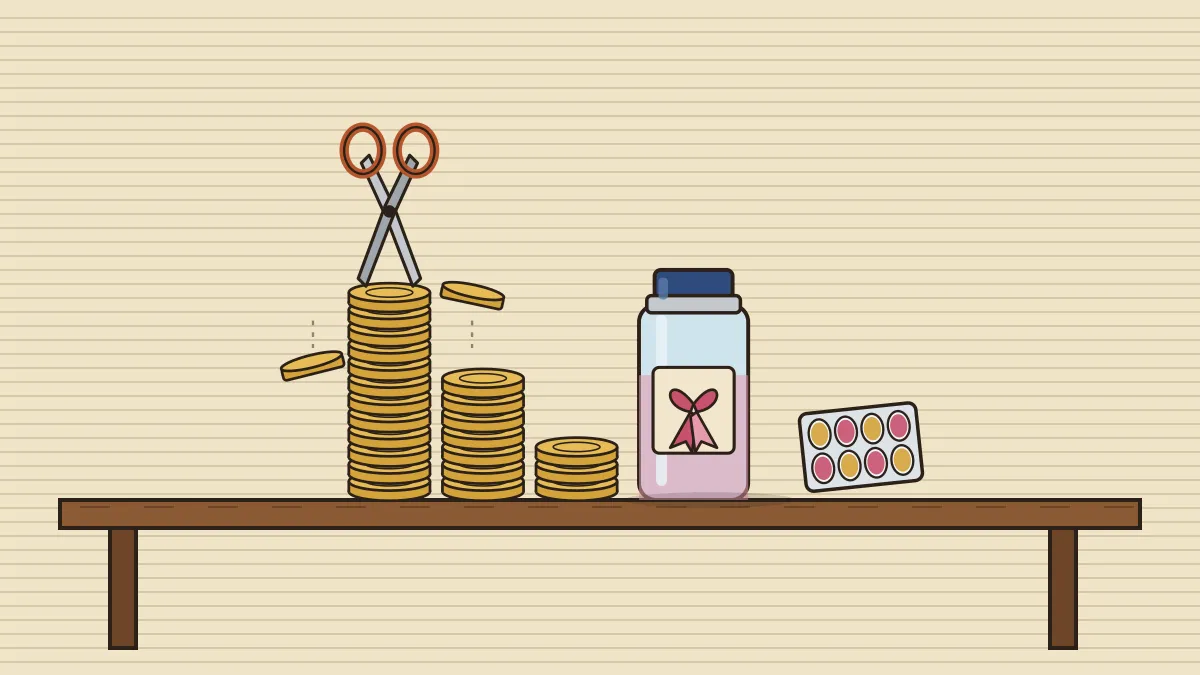
On 9 November 2026, new and lower prices for cancer medicines became the only legal prices. The National Pharmaceutical Pricing Authority (NPPA), which works under the Department of Pharmaceuticals, announced that 85 pharmaceutical companies had reported revised Maximum Retail Prices (MRPs) for 1,364 anti-cancer formulations covering 121 drugs. The reported cuts are estimated to save patients ₹3,540.38 crore a year.
The cuts come from capping the trade margin, the slice of the price that the distributor and the retailer keep, on 137 anti-cancer drugs. The largest cut reported is 96.45%. This article explains how the price of a medicine is built, which legal tool was used this time, why it works only up to a point, and how a patient can check the price at the chemist's counter.
The numbers, two days apart
The Department of Pharmaceuticals published two updates. The first was on 7 November, two days before the prices took effect. The second came on the day itself, with data to 8 November. Comparing them shows how quickly companies were filing their new price lists.
| Item | As reported on 7 Nov | As reported on 9 Nov |
|---|---|---|
| Companies that had reported new MRPs | 76 | 85 |
| Formulations with a revised MRP | 1,225 | 1,364 |
| Drugs covered (out of 137 identified) | 121 | 121 |
| Brands reporting a cut of more than 50% | 600 | 679 |
| Highest reported cut in MRP | 96.45% | 96.45% |
| Estimated annual saving | ₹3,502.31 crore | ₹3,540.38 crore |
Two details deserve notice. First, the estimate rose by about ₹38 crore in two days simply because more companies filed. It is an estimate built from reported prices, and it will keep moving until every company has reported. Second, the notification names 137 drugs but companies have reported on 121. The release says 10 to 15 of the remaining drugs have not yet been launched in India, and that the margin cap will apply to them automatically when they are launched.
How deep the cuts go
The 7 November release listed old and revised MRPs for major brands. A few of them, with the percentage fall calculated by The Cavalier from the published figures, show how uneven the cuts are.
| Formulation (use) | Brand, company | Old MRP (₹) | Revised MRP (₹) | Fall |
|---|---|---|---|---|
| Palbociclib 125 mg capsule (breast cancer) | Palbopro, RPG Life Sciences | 40,421.33 | 2,720.00 | about 93% |
| Abiraterone 250 mg tablet (prostate cancer) | Abirone, Arvincare Pharma | 41,250.00 | 3,218.23 | about 92% |
| Pemetrexed 500 mg vial (lung cancer) | ReliTrexed, Reliance Life Sciences | 9,977.00 | 1,113.00 | about 89% |
| Bevacizumab 100 mg injection (lung, colon, ovary, cervix) | Bryxta, Zydus Lifesciences | 25,995.00 | 3,318.00 | about 87% |
| Pegfilgrastim 6 mg injection (prevents neutropenia) | Pegex, Gennova Biopharmaceuticals | 6,270.45 | 1,527.78 | about 76% |
| Pertuzumab 420 mg injection (breast cancer) | Lupiher 2, Lupin | 83,520.00 | 37,358.35 | about 55% |
| Pertuzumab 420 mg injection (breast cancer) | Womab, Dr Reddy's | 74,992.50 | 53,708.19 | about 28% |
The spread is the real lesson. The same drug can fall by 55% for one brand and 28% for another. A margin cap removes the part of the MRP that was margin, so a brand whose old MRP carried a huge mark-up falls the most, while a brand that was already priced close to cost falls the least. Where a company had priced a drug near the ex-factory cost, the cap changes little.
What changed between 8 October and 9 November
Our explainer on the 8 October decision said the Government had approved a 30% cap on trade margins for non-scheduled anti-cancer drugs, expected to save about ₹2,500 crore a year, but that nothing had been notified yet. That gap has now closed in three steps.
- The list was settled. An expert committee set up by the Directorate General of Health Services (DGHS), under the Ministry of Health and Family Welfare, recommended which medicines to cover. Their number is 137.
- The notification was issued. NPPA's notification S.O. 5690(E) is dated 17 October 2026. It remains in force until further orders.
- Companies filed new prices. The revised MRPs became effective on 9 November, three weeks after the notification.
The estimated saving has risen from the ₹2,500 crore quoted in October to ₹3,540 crore once actual price lists came in. That is a useful reminder for examination answers: a figure announced with a policy is a projection, and the figure that follows implementation is the one to quote.
How the price of a medicine is regulated
India does not control the price of every medicine. It controls prices in layers, and the layer a drug falls in decides which tool applies.
The institution. NPPA was set up in August 1997 and is an attached office of the Department of Pharmaceuticals, Ministry of Chemicals and Fertilizers. Its silver jubilee was marked on 29 August 2022. Its work is governed by the National Pharmaceutical Pricing Policy, 2012, which rests on three principles: the essentiality of drugs, control of prices of formulations, and market-based pricing.
The law. The Drugs (Prices Control) Order, 2013 (DPCO 2013), issued under the Essential Commodities Act, 1955, is the working rule book. Its Schedule I is the National List of Essential Medicines (NLEM), notified by the Ministry of Health and Family Welfare. The 2022 list includes 63 anti-cancer drugs.
| Layer | Which drugs | How the price is controlled |
|---|---|---|
| Scheduled formulations | Those in Schedule I (NLEM) | NPPA fixes a ceiling price. Every manufacturer, branded or generic, must sell within it, plus GST |
| New drugs | A drug new under paragraph 2(1)(u) of DPCO | NPPA fixes the retail price for the applicant company |
| Non-scheduled formulations | Everything else | Manufacturer sets the MRP, but may not raise it by more than 10% in 12 months |
| Public-interest orders | Any drug | Extraordinary powers in paragraph 19 of DPCO allow NPPA to fix a price or cap a margin |
A ceiling price is calculated from market data. NPPA takes the average Price to Retailer (PTR) of every brand with at least 1% market share, then adds a 16% margin. As the Department of Pharmaceuticals has told Parliament, the gap between a company's cost and its MRP is not considered when a ceiling price is fixed. Outside these tools, the margins at each stage of the supply chain are generally a matter of business practice. Trade margin rationalisation is the exception that reaches into that chain. The tools sit in the same family as any other administered price, such as the price-setting behaviour of firms in market structures, where a regulator steps in because the market price does not reflect cost.
Why cap the margin, and what 30% means
Almost every anti-cancer drug that matters to a patient today is a new, often biological, medicine. Most are not on the essential list, so they are non-scheduled and escape ceiling prices. That is why the Government reached for paragraph 19 instead of revising the NLEM, a slow process.
The release says NPPA capped trade margins at a maximum of 30%, and that manufacturers may still take the annual price increase allowed under paragraph 20(1) of DPCO, but only while keeping within that 30% limit. A simple example shows the effect, under the reading used in our October article that the 30% is measured on the MRP. If a drug's MRP is ₹100, the trade may keep at most ₹30, so the price at which the stockist buys must be at least ₹70. From the distributor's side that is a mark-up of about 43% on what it pays (30 divided by 70). Take the Palbopro row in the table above. At the revised MRP of ₹2,720, no more than ₹816 can be margin. The 7 November release does not give the exact base for the 30%, so students should not memorise "of MRP" as settled and should treat the worked example as an illustration of the idea.
What the cap cannot do. It restrains the distributor and the retailer. It does not fix the manufacturer's price. A company that raises its own selling price raises the MRP with it. This is why the cap works where the margin is the problem and does little where the drug is costly because of what its maker charges.
The 2019 pilot and the scale-up
This is the second use of the same tool on cancer drugs. In February 2019 NPPA capped trade margins on 42 non-scheduled anti-cancer medicines at 30%. Official summaries credit that exercise with cutting the MRP of 526 brands by an average of about 50%, and saving patients roughly ₹984 crore a year.
Set side by side, the scale-up is clear.
| 2019 pilot | 2026 notification | |
|---|---|---|
| Drugs covered | 42 | 137 (about 3.3 times) |
| Trade margin ceiling | 30% | 30% |
| Estimated annual saving | about ₹984 crore | ₹3,540.38 crore (about 3.6 times) |
For comparison, re-fixing ceiling prices of 131 scheduled anti-cancer formulations under the 2022 essential list produced estimated yearly savings of about ₹294 crore, a fall of around 21% from the 2015 list prices. The margin cap on non-scheduled drugs is therefore expected to save about twelve times as much as the ceiling prices on the essential list. The reason is simple. Ceiling prices cover cheaper, older drugs. Margin caps reach the expensive new ones, where each percentage point of margin is worth far more rupees.
Taxes, duties and the wider toolkit
Price control is one of several levers the Government has pulled on cancer medicines. The others work on tax, supply and payment.
- Customs duty and GST. In 2024-25, customs duty on three cancer drugs, trastuzumab deruxtecan, osimertinib and durvalumab, was cut to nil, and their GST fell from 12% to 5%. NPPA then ordered manufacturers to pass on the benefit by lowering their MRPs.
- Budget 2025-26. 36 life-saving drugs and medicines for cancer, rare and chronic diseases were fully exempted from basic customs duty, and six others were given a concessional 5% rate.
- Domestic manufacture. The ₹15,000 crore Production Linked Incentive scheme for pharmaceuticals runs till 2027-28, and 54 anti-cancer drugs are being made under it.
- Buying cheaper. Jan Aushadhi Kendras sell generic medicines typically 50% to 80% below branded prices, and AMRIT pharmacies in some hospitals give discounts up to 50% of market rates.
- Insurance. Ayushman Bharat PM-JAY covers up to ₹5 lakh per family a year for hospital care, and the Budget of 2025-26 promised Day Care Cancer Centres in district hospitals. Our note on India's health financing shows how insurance and price control fit together.
The central point is the one made in October: insurance changes who pays the bill, while price control changes how large the bill is. A scheme that reimburses an inflated price transfers the inflation to the public purse, so the two are complements.
What a patient can do
The release is practical about verification and complaint.
- Check the pack. The revised MRP is printed on the medicine pack. No chemist or hospital pharmacy can charge more than the revised MRP.
- Verify the price. Use NPPA's mobile app Pharma Sahi Daam or the website nppa.gov.in.
- Complain. Register a grievance on the Pharma Jan Samadhan portal or call the NPPA helpline on 1800-111-255.
- Display rule. Every retailer, dealer, hospital and institution must prominently display the revised MRP list of anti-cancer medicines on its website.
🔑 Revision block
The event. Revised MRPs of 1,364 anti-cancer formulations (121 drugs, 85 companies) apply from 9 November 2026; estimated saving ₹3,540.38 crore a year; highest cut 96.45%; 679 brands cut by more than 50%.
The legal step. Trade margins capped at 30% on 137 non-scheduled anti-cancer drugs; notification S.O. 5690(E) dated 17 October 2026, in force until further orders; the list was recommended by an expert committee of the DGHS (Ministry of Health and Family Welfare); 10 to 15 drugs are not yet launched, and the cap will apply when they are.
Who and what. NPPA: set up in 1997, attached to the Department of Pharmaceuticals (Ministry of Chemicals and Fertilizers). DPCO 2013 under the Essential Commodities Act, 1955. Schedule I = NLEM; the 2022 list has 63 anti-cancer drugs.
Three layers. Scheduled drugs: ceiling price (average PTR of brands with at least 1% share, plus 16%). New drugs: retail price under paragraph 2(1)(u). Non-scheduled drugs: MRP rise limited to 10% in 12 months. Any drug: paragraph 19 extraordinary powers (the basis of margin caps).
Limits. A margin cap binds the distributor and retailer, not the manufacturer's own price. Savings are an estimate, built from reported prices.
Precedent. February 2019: 42 drugs, 30% cap, 526 brands cut by about 50%, about ₹984 crore saved. Ceiling prices on 131 scheduled formulations saved only about ₹294 crore.
Other levers. Customs duty nil and GST 12% to 5% on three drugs (2024-25); 36 drugs exempt from customs duty (Budget 2025-26); PLI ₹15,000 crore with 54 anti-cancer drugs; Jan Aushadhi (50–80% cheaper); AMRIT; PM-JAY ₹5 lakh.
Redress. Pharma Sahi Daam app; nppa.gov.in; Pharma Jan Samadhan portal; helpline 1800-111-255.
🎯 Practice MCQs
Q1. The Drugs (Prices Control) Order, 2013, under which NPPA acts, is issued under the:
(a) Drugs and Cosmetics Act, 1940
(b) Essential Commodities Act, 1955
(c) Patents Act, 1970
(d) Consumer Protection Act, 2019
→ (b)
DPCO 2013 is made under the Essential Commodities Act, 1955. The Drugs and Cosmetics Act deals with quality and licensing, not prices.
Q2. Schedule I of DPCO 2013 is based on the:
(a) Jan Aushadhi product list
(b) Ayushman Bharat package rates
(c) Pharma Sahi Daam database
(d) National List of Essential Medicines
→ (d)
Scheduled formulations are those in the NLEM notified by the Ministry of Health and Family Welfare, and NPPA fixes their ceiling prices.
Q3. The ceiling price of a scheduled formulation is worked out as the average Price to Retailer of all brands with at least 1% market share, plus a margin of:
(a) 16%
(b) 10%
(c) 30%
(d) 8%
→ (a)
The 16% is a retailer's margin added to the average PTR. The 10% figure is the annual limit on MRP increases for non-scheduled drugs, and 30% is the trade margin cap on the anti-cancer drugs.
Q4. The revised MRPs that took effect on 9 November 2026 were brought about by capping:
(a) The ex-factory price of the drugs
(b) The import duty on the drugs
(c) The trade margin on non-scheduled anti-cancer drugs
(d) The GST on the drugs
→ (c)
Trade Margin Rationalisation caps the margin between the trade's buying price and the MRP. The manufacturer's price, the import duty and the GST rate were not the instrument.
Q5. Which provision of DPCO 2013 allows NPPA to fix the price of any drug, including a non-scheduled one, in the public interest?
(a) Paragraph 2(1)(u)
(b) Paragraph 20(1)
(c) Paragraph 4
(d) Paragraph 19
→ (d)
Paragraph 19 confers the extraordinary powers used for trade margin rationalisation. Paragraph 2(1)(u) defines a "new drug" and paragraph 20(1) deals with the annual price increase.
Q6. The trade margin cap on 42 non-scheduled anti-cancer drugs was first imposed in:
(a) February 2013
(b) February 2019
(c) February 2021
(d) February 2024
→ (b)
The 2019 pilot covered 42 drugs. The 2026 notification extends the same tool to 137 drugs.
Q7. Consider the following statements about the 9 November 2026 price revision:
1. The cap restrains the trade margin and does not fix the manufacturer's own selling price.
2. Its notification, S.O. 5690(E), is dated 17 October 2026.
Which of the statements given above is/are correct?
(a) 1 only
(b) 2 only
(c) Both 1 and 2
(d) Neither 1 nor 2
→ (c)
Statement 1 is right because the cap works on the distributor's and retailer's share, not the maker's price. Statement 2 matches the notification date given in the release.
Q8. A patient suspects that a chemist is charging more than the revised price of an anti-cancer medicine. The NPPA channel for registering this complaint is the:
(a) Pharma Jan Samadhan portal
(b) National Health Authority portal
(c) Jan Aushadhi helpline
(d) CPGRAMS of the Ministry of Health only
→ (a)
The release names the Pharma Jan Samadhan portal and the NPPA helpline 1800-111-255 for pricing complaints.
📋 How this gets asked (PYQ pattern)
Questions on drug pricing are a small but steady part of the CDS economy and general-awareness papers, and they follow three patterns.
The first is institutions and acts: which body fixes drug prices (NPPA, not the Drug Controller General or the Health Ministry), which ministry it sits under, and which law gives it power. The trap is to confuse NPPA with the Central Drugs Standard Control Organisation (CDSCO), which licenses and tests medicines rather than pricing them.
The second is instrument versus target: ceiling price versus trade margin rationalisation, scheduled versus non-scheduled drugs, and NLEM as the basis of Schedule I. Options are built so that each is one step away from the right pairing, as in Q4 and Q5.
The third is current-affairs numbers: the count of formulations, the annual saving, the cap percentage and the notification date. This cycle's anchors are 1,364 formulations, ₹3,540 crore, 30%, 137 drugs and 9 November 2026.
Preparing for CDS? Practise sorting any medicine-price news into the layers shown in the table above; it settles the vocabulary quickly. Revise the economics with our notes on market structures and the wider CDS study material. Follow the daily CDS current affairs, and learn with experienced faculty in the upcoming Cavalier courses in Delhi.
Source: PIB / Department of Pharmaceuticals, "Revised MRPs of 1,364 Anti-Cancer Formulations Come into Effect from Today" (9 November 2026) and "Revised Prices of Anti-Cancer Medicines to Come into Effect from 9th November" (7 November 2026); earlier PIB releases on NPPA, DPCO 2013, ceiling prices, trade margin rationalisation (2019 pilot), customs and GST relief and Budget 2025-26 measures on cancer drugs, 2021-2026. Percentage falls and ratios calculated by The Cavalier from the published figures.
✍️ Written by Aditya Tiwari — Economy & current-affairs faculty at The Cavalier. Reviewed by the Cavalier Faculty Desk.