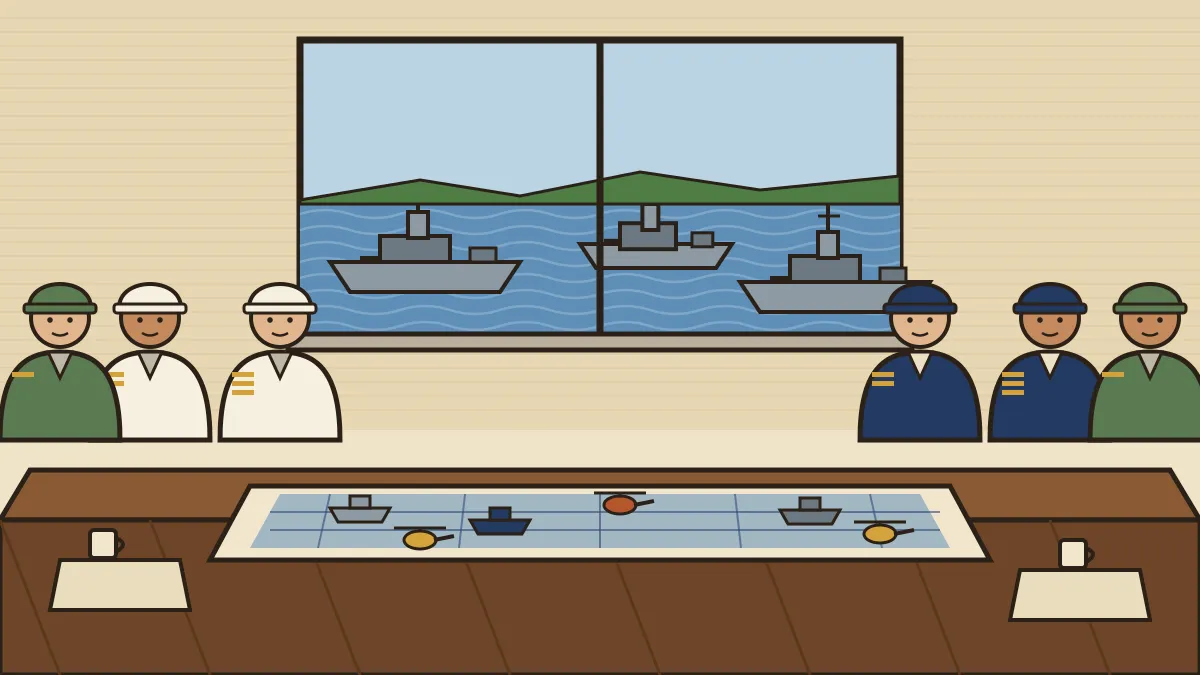
Most military exercises are measured in ships, tanks and aircraft. The one that opened at Visakhapatnam on 2 November 2026 had few of them. It was a gathering of planners around a table, and that is precisely the point of the fifth edition of Exercise Tiger Triumph, the India-US bilateral tri-service exercise on humanitarian assistance and disaster relief (HADR).
PIB reported the opening ceremony on 3 November. This article explains what HADR means in military terms, why the format changed this year, who is taking part, and where the exercise fits in the wider India-US defence relationship.
The facts from the release
| Item | Detail (Ministry of Defence, PIB) |
|---|---|
| Exercise | Tiger Triumph 2026, 5th edition |
| Nature | India-US bilateral tri-service HADR exercise |
| Format in 2026 | Tabletop Exercise (TTX) |
| Opening ceremony | 2 November 2026, Maritime Warfare Centre (MWC), Visakhapatnam |
| Presided over by | RAdm Vishal Bishnoi, Flag Officer Commanding Eastern Fleet, and RAdm Joaquin J Martinez de Pinillos, Vice Commander, US Pacific Fleet |
| Aim | Better coordination, joint planning and interoperability during large-scale HADR operations; to facilitate Combined Joint All-Domain Operations |
| New this year | A team from the National Disaster Response Force (NDRF) joins for the first time |
Indian participants include maritime specialists from the Indian Navy, ground forces from the Army, representatives of various Air Force units and Special Forces personnel from all three Services. The US Joint Force has specialists from the Air Force, Army, Marine Corps and Navy, and in Space, Cyber, Medical and Explosive Ordnance Disposal.
What HADR means
Humanitarian Assistance and Disaster Relief covers the work armed forces do when a cyclone, earthquake, flood or tsunami overwhelms civil authorities, and often when it hits a friendly country. The tasks are practical: search and rescue, airlift and sealift of relief stores, field hospitals and medical teams, engineering work such as clearing roads and ports, and restoring communications.
The armed forces are good at it for a simple reason. Disaster relief demands exactly what militaries have: mobility, logistics, discipline and a command and control system that works when civil systems have failed. A large warship can carry medical facilities, helicopters and landing craft. That is why HADR is called a "soft" role performed with "hard" capability.
HADR is also a form of diplomacy. India calls its Navy the first responder in the Indian Ocean Region. After Cyclone Ditwah struck Sri Lanka in late 2025, INS Vikrant and INS Udaygiri, then at Colombo for a fleet review, were tasked at short notice to relief work under Operation Sagar Bandhu, and more ships carried about 1,000 tons of supplies. After the earthquake in Myanmar on 28 March 2025, the Army sent a 118-member medical team and set up a 60-bed treatment centre under Operation Brahma. PIB tied both to the Neighbourhood First policy and, in Sri Lanka's case, to the MAHASAGAR vision.
The 2004 origin
The idea of militaries cooperating on disaster relief has a clear starting point. After the Indian Ocean tsunami of December 2004, the navies of India, the United States, Japan and Australia formed an informal core group to coordinate relief. The same tsunami led India to enact the Disaster Management Act, 2005, which created the NDMA and the NDRF, as our explainer on the institutions behind disaster management describes. A good examiner's link is: tsunami 2004, then relief cooperation, then Act of 2005.
Why a tabletop exercise
A Tabletop Exercise (TTX) is a discussion-based exercise. Participants gather, are given a scenario (for example, a major cyclone hitting a coast with ports damaged and roads cut) and talk through who does what, who commands whom, how information flows and where plans clash. No troops, ships or aircraft need to move.
It differs from the field exercise in three ways:
- Cost and speed: it needs rooms and experts, not fleets.
- Purpose: it tests plans, procedures and relationships rather than physical skills.
- Outcome: it produces improved Standard Operating Procedures (SOPs) that a later field exercise or a real crisis can use.
PIB does not say why the 2026 edition is a tabletop one, so do not assume a reason. What it does say is that the aim is joint planning and coordination. That is consistent with how the 2025 edition was framed, when one stated goal was to form SOPs for a Combined Coordination Center (CCC) that would link the Indian and US Joint Task Forces.
Comparing the 2025 and 2026 editions
| 2025 (4th edition) | 2026 (5th edition) | |
|---|---|---|
| Format | Field exercise: harbour phase and sea phase, amphibious landing | Tabletop exercise |
| Place | Visakhapatnam and off Kakinada (Andhra Pradesh) | Visakhapatnam (Maritime Warfare Centre) |
| Dates | Scheduled 1 to 13 April 2025 | Opening ceremony 2 November 2026 |
| Indian ships named | INS Jalashwa, Gharial, Mumbai, Shakti | None named in the release |
| Distinctive feature | Joint command and control centre at Kakinada; joint medical camp | NDRF joins for the first time |
| Opening | Aboard INS Jalashwa, 1 April 2025 | Ashore at the Maritime Warfare Centre |
The series began in 2019, with the first joint HADR exercise between the two militaries, and PIB described its purpose in 2025 as strengthening operational synergies, facilitated by logistics exchange under the Logistics Exchange Memorandum of Agreement (LEMOA).
Why the NDRF's entry matters
Until now the exercise has been an affair of the three armed forces. The National Disaster Response Force is the specialist disaster response force under the Ministry of Home Affairs, established under Section 44 of the Disaster Management Act, 2005 and headed by a Director General (an IPS officer). In a real disaster at home, the NDRF is often among the first forces to arrive, with the military supporting it when needed. Bringing it into the planning table is therefore a realism upgrade: an exercise on large-scale HADR that left out the national disaster force would rehearse only half of the response.
It also reflects the "whole of government" approach emphasised in disaster management, in which the military, the central force, State agencies and civil authorities work to a single plan.
The India-US defence relationship
Tiger Triumph is one strand of a defence partnership that has deepened over two decades.
Foundational agreements. Four enabling agreements allow the two militaries to work together:
| Agreement | Year | Purpose |
|---|---|---|
| GSOMIA (General Security of Military Information Agreement) | 2002 | Protects shared classified information |
| LEMOA (Logistics Exchange Memorandum of Agreement) | 2016 | Reciprocal access to each other's logistics, such as fuel and supplies |
| COMCASA (Communications Compatibility and Security Agreement) | 2018 | Secure communications and compatible equipment |
| BECA (Basic Exchange and Cooperation Agreement) | 2020 | Sharing of geospatial data and maps |
The ten-year framework. On 31 October 2025, at Kuala Lumpur on the margins of the 12th ADMM-Plus, Defence Minister Rajnath Singh and US Secretary of War Pete Hegseth signed the Framework for the US-India Major Defence Partnership, intended to give policy direction to defence ties over the next ten years.
Exercises. Each Service has its own bilateral exercise, and Tiger Triumph is the one that brings all three together:
| Exercise | Domain | Note |
|---|---|---|
| Yudh Abhyas | Army | Begun in 2004; the 22nd edition ran in September 2026 at Auli and Mahajan |
| Malabar | Navy | Began in 1992 as an India-US naval exercise; later widened with Japan and Australia |
| Tiger Triumph | Tri-service HADR | First held in 2019; 5th edition in 2026 |
The Army exercise is covered in our NDA piece on the 22nd Yudh Abhyas. The Cebu meeting of defence ministers that preceded this exercise is in our ADMM-Plus explainer.
A second naval story: INS Sahyadri at Busan
In the same news cycle, PIB reported that INS Sahyadri, a Shivalik-class stealth frigate, concluded her participation in the India-Republic of Korea Navy bilateral exercise at Busan on 29 October 2026. The harbour phase had professional discussions, cross-deck visits, operational briefings and subject-matter-expert exchanges. In the sea phase, Sahyadri and the Korean ship ROKS Munmu the Great practised coordinated navigation, helicopter operations and joint manoeuvres. The Ministry linked it to peace, stability and security in the Indo-Pacific.
The two stories show the structure of naval diplomacy. A harbour phase builds understanding between people and a sea phase tests procedures. A tabletop exercise concentrates on the planning side of that first phase.
What to watch
- The follow-on. Whether the planning done now leads to a field exercise with ships and troops, and what SOPs are published.
- The NDRF role. How civilian response forces are linked into military-led operations.
- The wider calendar. How the ten-year framework of October 2025 is reflected in future India-US exercises.
🔑 Revision block
The exercise. Tiger Triumph 2026, 5th edition, India-US bilateral tri-service HADR exercise; opening ceremony 2 November 2026, Maritime Warfare Centre, Visakhapatnam; format: Tabletop Exercise (TTX).
Who. Presided over by RAdm Vishal Bishnoi (FOC Eastern Fleet) and RAdm Joaquin J Martinez de Pinillos (Vice Commander, US Pacific Fleet). Indian Navy, Army, Air Force and Special Forces; NDRF for the first time. US Air Force, Army, Marine Corps, Navy, plus Space, Cyber, Medical and EOD specialists.
Aim. Interoperability and joint planning for large-scale HADR; Combined Joint All-Domain Operations.
History. First held 2019; 4th edition 1 to 13 April 2025, Visakhapatnam and Kakinada (INS Jalashwa, Gharial, Mumbai, Shakti), aim of SOPs for a Combined Coordination Center.
Law and bodies. Disaster Management Act, 2005 (after the December 2004 tsunami); NDRF under Section 44, MHA.
India-US framework. GSOMIA 2002, LEMOA 2016, COMCASA 2018, BECA 2020; 10-year Framework signed 31 October 2025, Kuala Lumpur (Rajnath Singh, Pete Hegseth). Yudh Abhyas (Army, 2004), Malabar (Navy, 1992).
Related. INS Sahyadri concluded the IN-RoKN exercise at Busan on 29 October 2026; ship ROKS Munmu the Great. Operation Brahma (Myanmar, March 2025); Operation Sagar Bandhu (Sri Lanka, Cyclone Ditwah, late 2025).
🎯 Practice MCQs
Q1. Exercise Tiger Triumph is best described as an India-US:
(a) Army-only exercise on mountain warfare
(b) Navy-only exercise on anti-submarine warfare
(c) Tri-service exercise on humanitarian assistance and disaster relief
(d) Air Force exercise on air combat
→ (c)
Tiger Triumph is the bilateral tri-service HADR exercise. Yudh Abhyas is the Army exercise and Malabar the naval one.
Q2. The 5th edition of Tiger Triumph, opened on 2 November 2026, is being conducted as a:
(a) Field exercise with ships at sea off Kakinada
(b) Tabletop Exercise
(c) Live-fire amphibious assault
(d) Long-range maritime patrol exercise
→ (b)
The format this year is a Tabletop Exercise aimed at joint planning, coordination and interoperability. The field-and-sea format was that of the 2025 edition.
Q3. Which force participates in Tiger Triumph for the first time in 2026?
(a) Assam Rifles
(b) Indian Coast Guard
(c) National Security Guard
(d) National Disaster Response Force
→ (d)
PIB records that an NDRF team will join for the first time in the 5th edition.
Q4. The opening ceremony of Tiger Triumph 2026 was held at:
(a) Maritime Warfare Centre, Visakhapatnam
(b) Kakinada Naval Enclave
(c) Naval Base, Kochi
(d) Port Blair
→ (a)
The ceremony was at the Maritime Warfare Centre, Visakhapatnam, on 2 November 2026. Kakinada was the site of the 2025 sea phase.
Q5. Exercise Tiger Triumph was first held in:
(a) 2019
(b) 2021
(c) 2023
(d) 2025
→ (a)
The series began in 2019. The 2025 edition was the fourth, and 2026 is the fifth.
Q6. The Logistics Exchange Memorandum of Agreement (LEMOA) between India and the United States was signed in:
(a) 2002
(b) 2012
(c) 2016
(d) 2018
→ (c)
LEMOA dates from 2016. GSOMIA is of 2002, COMCASA of 2018 and BECA of 2020.
Q7. Consider the following statements about Tiger Triumph 2026:
1. Only the naval forces of the two countries are taking part.
2. The US side includes no Space or Cyber specialists.
Which of the statements given above is/are correct?
(a) 1 only
(b) 2 only
(c) Both 1 and 2
(d) Neither 1 nor 2
→ (d)
The Indian side includes the Navy, Army, Air Force and Special Forces, and the US Joint Force includes specialists in Space, Cyber, Medical and Explosive Ordnance Disposal.
Q8. Consider the following statements:
1. HADR stands for Humanitarian Aid and Defence Response.
2. India's naval relief to Sri Lanka after Cyclone Ditwah was conducted under Operation Sagar Bandhu.
Which of the statements given above is/are correct?
(a) 1 only
(b) 2 only
(c) Both 1 and 2
(d) Neither 1 nor 2
→ (b)
HADR means Humanitarian Assistance and Disaster Relief. Operation Sagar Bandhu was the relief effort for Sri Lanka.
📋 How this gets asked (PYQ pattern)
Defence and international relations items on exercises tend to come in three forms.
The first is matching exercise to partner and domain: Yudh Abhyas (India-US Army), Malabar (Navy, now with Japan and Australia), Tiger Triumph (India-US tri-service HADR). The examiner swaps the domain or the partner and offers the right pair among three wrong ones.
The second is abbreviations and concepts: HADR, TTX, SOP, LEMOA, COMCASA, BECA, interoperability. These are one-line recall items, and the foundational agreements recur often.
The third is statement-type items on the latest edition: which force joined for the first time, where it was held, what format it took. The fresh hooks this cycle are 5th edition, tabletop format, Visakhapatnam, NDRF first time, and the ten-year framework of 31 October 2025.
Preparing for CDS? Build your background with the CDS/OTA study material, and follow the daily CDS current affairs for each exercise and defence agreement as it happens. Learn with experienced faculty in the upcoming Cavalier courses in Delhi.
Source: PIB / Ministry of Defence, "Opening Ceremony of Exercise Tiger Triumph 2026" (3 November 2026) and "INS Sahyadri concludes India-Republic of Korea Navy bilateral exercise at Busan" (3 November 2026). Background from PIB: Tiger Triumph 2025 curtain raiser (31 March 2025), opening joint statement (2 April 2025) and culmination release (12 April 2025); Raksha Mantri meeting with the US Secretary of War (31 October 2025); Operation Brahma (29 March 2025); Operation Sagar Bandhu (2 and 8 December 2025). Dates of the foundational agreements from published government and think-tank records.
✍️ Written by Maj Sunil Chopra — Veteran, Indian Army; defence-studies & current-affairs faculty at The Cavalier. Reviewed by the Cavalier Faculty Desk.