The President attended Bastar Dussehra at Jagdalpur, Chhattisgarh, on 23 October 2026. She offered prayers at the Maa Danteshwari temple, met the traditional community leaders — the Manjhi and Chalki — at the Muria Darbar, and visited the festival's exhibition. In her address she called the festival a symbol of Chhattisgarh's cultural pride and urged the country to learn from the nature-nurturing way of life of tribal communities.
Bastar Dussehra is one of the most distinctive festivals in India, and it differs from the Dussehra most of the country knows in almost every respect: its length, its deity, its rituals and the role it gives to tribal institutions.
A Dussehra without Ravana
Across most of northern India, Dussehra marks Rama's victory over Ravana, and the day ends with effigies burning. Bastar Dussehra is different in its central devotion.
- The deity is Danteshwari, the presiding goddess of Bastar, regarded as the protector of the region and the family deity of its former rulers. The festival is her celebration, not Rama's.
- It lasts about 75 days, which makes it the longest Dussehra festival in India. In 2026 it opened with Pat Jatra on 12 August, Hariyali Amavasya in the month of Shravan.
- The whole region takes part. Deities of villages across Bastar are brought to Jagdalpur, and different communities hold hereditary responsibilities in the rituals — cutting the timber, building the chariots, pulling them, serving the goddess.
The sequence of rituals
The festival follows the lunar calendar, so dates shift slightly each year, but the order is fixed.
| Ritual | What happens |
|---|---|
| Pat Jatra | The opening rite, on Hariyali Amavasya: worship of the wood from which the festival chariots will be built |
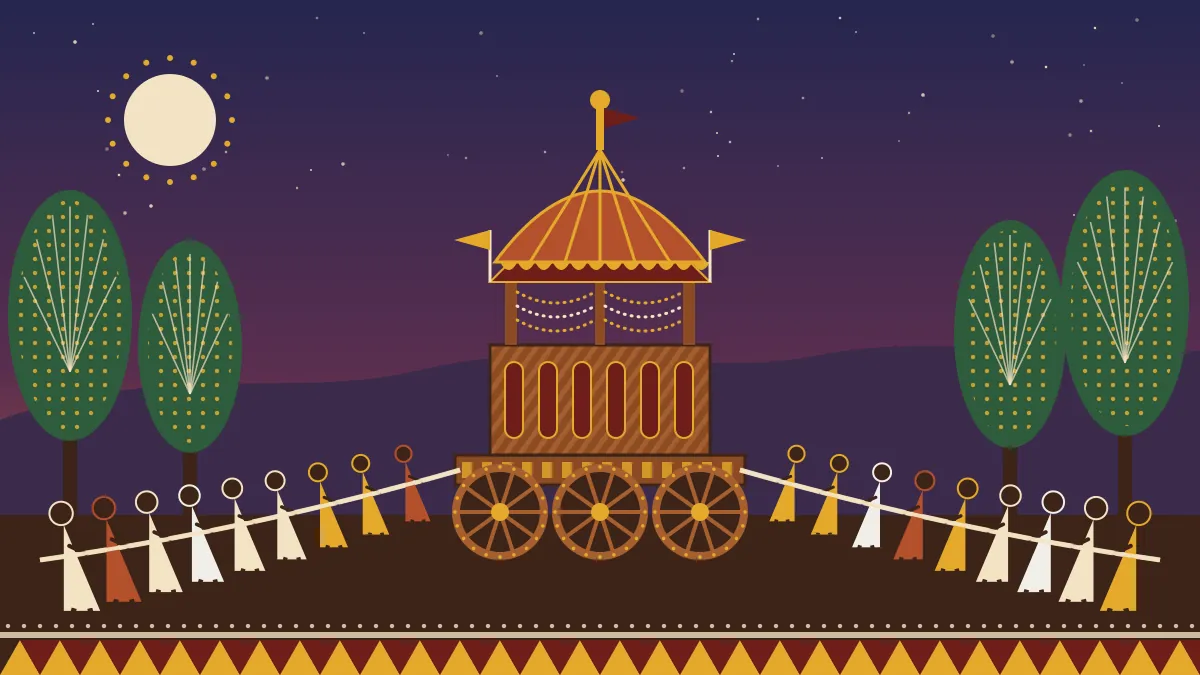
| Chariot building | Twin wooden chariots — one with four wheels, one with eight — built afresh each year without nails or metal fittings |
| Kachan Gadi | A young girl, believed to embody a goddess, gives formal permission for the festival to proceed |
| Rath Parikrama | The chariots, carrying the goddess's emblem, are pulled through Jagdalpur by devotees |
| Bahar Raini | The chariot is taken away at night and hidden at Kumdakot, from where it is ceremonially brought back |
| Muria Darbar | A gathering at which tribal leaders meet those in authority and raise local concerns |
| Farewell | The visiting deities are given a formal farewell and return to their villages |
The chariots and the Kakatiya link
Tradition traces the chariot custom to Purushottam Dev, a ruler of Bastar's Kakatiya line, around the fifteenth century. He is said to have made a pilgrimage to the Jagannath temple at Puri, where his offerings earned him the title Rathpati — "lord of the chariot" — and on his return the chariot procession became part of Bastar's festival. Bastar's rulers traced their descent from the Kakatiyas of Warangal, which is why a dynasty associated with the Deccan appears in the history of central India's forests.
The Muria Darbar
The Muria Darbar is the festival's most unusual institution. Historically, it was a council at which the ruler heard the concerns of the tribal communities of his kingdom. After the merger of princely states, the practice continued with elected representatives and administrators in the ruler's place. It survives as a forum where traditional leaders speak to the state — which is why the President's interaction with the Manjhi and Chalki there carries symbolic weight.
The people of Bastar
Bastar is one of India's major tribal regions, and the festival is a collective expression of its communities.
- Gond groups, including the Muria and the Maria (Madia) — among them the Abujhmaria of the Abujhmarh hills and the Bison-horn Maria, named for their ceremonial headdress.
- Halba, Bhatra and Dhurwa, among others.
- The ghotul, the youth dormitory of the Muria, is a well-known institution in anthropology and in exam questions on tribal life.
The region is equally known for its crafts — above all Dhokra, the lost-wax metal casting that Bastar's artisans have practised for generations, which featured in an October article on Dhokra and Chhattisgarh's crafts — along with wrought iron, terracotta and bamboo work.
The geography behind the festival
- Bastar lies on a plateau in southern Chhattisgarh, densely forested and drained by the Indravati, a tributary of the Godavari.
- Chitrakote Falls on the Indravati, near Jagdalpur, is the widest waterfall in India and is often called the "Niagara of India".
- Kanger Valley National Park, near Jagdalpur, is known for its limestone caves and the Tirathgarh falls.
- Jagdalpur is the headquarters of Bastar district and the festival's centre.
Development and the end of the insurgency
The President spoke of a region that had long endured Naxal violence and is, through Central and State efforts, now "freed from the menace of Naxal violence" and advancing on the path of development. Bastar was for decades one of the core areas of the Left-Wing Extremist insurgency, and the government's account of how it ended is set out in our explainer on Naxal-free India. She also noted that financial support and market links for tribal entrepreneurs had been accelerated — the economic side of the same transition.
How India celebrates Dussehra — the comparison examiners use
Dussehra takes very different forms across the country, and a matching question is the usual way the topic is examined.
| Celebration | Place | Distinctive feature |
|---|---|---|
| Bastar Dussehra | Jagdalpur, Chhattisgarh | About 75 days; goddess Danteshwari; tribal participation; Muria Darbar |
| Mysuru Dasara | Karnataka | Goddess Chamundeshwari; tradition of the Wodeyar dynasty; the Jamboo Savari elephant procession |
| Kullu Dussehra | Himachal Pradesh | Begins on Vijayadashami and lasts a week; deities from across the valley gather around Raghunath |
| Durga Puja | West Bengal | Goddess Durga; inscribed on UNESCO's list of Intangible Cultural Heritage in 2021 |
| Ramlila | Northern India | Dramatic enactment of the Ramayana; inscribed by UNESCO in 2008 |
🔑 Revision block
- The event: the President at Bastar Dussehra, Jagdalpur, 23 October 2026 — prayers at the Danteshwari temple, meeting with Manjhi and Chalki at the Muria Darbar.
- Duration: about 75 days — the longest Dussehra in India; 2026 began with Pat Jatra on 12 August (Hariyali Amavasya, Shravan).
- Deity: Danteshwari, presiding goddess of Bastar — not centred on Rama and Ravana.
- Rituals: Pat Jatra → chariot building (twin chariots, 4 and 8 wheels, no nails) → Kachan Gadi (permission) → Rath Parikrama → Bahar Raini (chariot hidden at Kumdakot) → Muria Darbar → farewell.
- Origin: Purushottam Dev of the Kakatiya line (~15th century), title Rathpati after a pilgrimage to Puri.
- Tribes: Gond (Muria, Maria/Madia incl. Abujhmaria, Bison-horn Maria), Halba, Bhatra, Dhurwa; ghotul = Muria youth dormitory.
- Geography: Indravati (tributary of the Godavari); Chitrakote Falls ("Niagara of India"); Kanger Valley National Park.
- Other Dussehras: Mysuru (Chamundeshwari, Wodeyars, Jamboo Savari), Kullu (Raghunath, begins on Vijayadashami); Durga Puja UNESCO 2021; Ramlila UNESCO 2008.
🎯 Practice MCQs
Q1. Bastar Dussehra is primarily dedicated to: (a) Lord Rama (b) Goddess Chamundeshwari (c) Goddess Danteshwari (d) Lord Raghunath
→ (c) Danteshwari is the presiding goddess of Bastar; Chamundeshwari is the deity of Mysuru Dasara and Raghunath of Kullu Dussehra.
Q2. Bastar Dussehra is notable for lasting about: (a) 75 days (b) 10 days (c) 7 days (d) 30 days
→ (a) It begins with Pat Jatra in Shravan and continues until the farewell of the deities after Vijayadashami.
Q3. The Muria Darbar held during Bastar Dussehra is: (a) a wrestling competition among tribal youth (b) a gathering at which tribal leaders raise their concerns with those in authority (c) the ritual of building the festival chariots (d) the closing fireworks display
→ (b) Historically a council held by the ruler, it now brings traditional leaders together with elected representatives and administrators.
Q4. The river that flows through the Bastar region and forms the Chitrakote Falls is the: (a) Mahanadi (b) Narmada (c) Son (d) Indravati
→ (d) The Indravati is a tributary of the Godavari; Chitrakote, near Jagdalpur, is the widest waterfall in India.
Q5. The chariot procession of Bastar Dussehra is traditionally traced to a ruler of which dynasty? (a) Kakatiya (b) Chalukya (c) Wodeyar (d) Gajapati
→ (a) Tradition credits Purushottam Dev of Bastar's Kakatiya line, after a pilgrimage to Puri earned him the title Rathpati.
Q6. The ghotul, a well-known tribal institution of the Bastar region, is: (a) a sacred grove (b) a youth dormitory of the Muria (c) a village council of elders (d) a form of shifting cultivation
→ (b) The ghotul is the Muria youth dormitory, widely studied in Indian anthropology.
Q7. Which Dussehra celebration begins on Vijayadashami itself and continues for a week, with deities from across the valley gathering around Raghunath? (a) Mysuru Dasara (b) Bastar Dussehra (c) Kullu Dussehra (d) Kota Dussehra
→ (c) Kullu Dussehra starts on the day the festival ends elsewhere.
Q8. Durga Puja in Kolkata was inscribed on UNESCO's Representative List of the Intangible Cultural Heritage of Humanity in: (a) 2021 (b) 2008 (c) 2016 (d) 2023
→ (a) Ramlila was inscribed in 2008; Durga Puja followed in 2021.
Q9. The lost-wax metal casting craft for which Bastar is especially known is: (a) Bidriware (b) Pattachitra (c) Madhubani (d) Dhokra
→ (d) Bidriware is a metal craft of Bidar, Pattachitra a painting style of Odisha and Bengal, and Madhubani a painting style of Bihar.
Q10. Which of the following communities is associated with the Abujhmarh hills of the Bastar region? (a) Bhil (b) Maria (Abujhmaria) (c) Santhal (d) Toda
→ (b) The Abujhmaria are a Maria (Madia) Gond group; the Bhil are of western India, the Santhal of the east and the Toda of the Nilgiris.
📋 How this gets asked (PYQ pattern)
Festivals are a staple of CDS Art and Culture, and the questions overwhelmingly take one form: match the festival to its state, deity or distinctive feature.
The first form is the state-festival pairing: Bastar Dussehra with Chhattisgarh, Kullu Dussehra with Himachal Pradesh, Mysuru Dasara with Karnataka. A distractor will often list Bastar under Odisha or Jharkhand, which also have large tribal populations.
The second is the deity question: which goddess is honoured at Bastar Dussehra. Danteshwari is the answer; Chamundeshwari (Mysuru) and Durga (Bengal) are the natural distractors.
The third is the UNESCO question: which Indian festivals and traditions are on the Intangible Cultural Heritage list, and when. Ramlila (2008), Durga Puja (2021), Kumbh Mela (2017), Garba (2023) and Navroz (2016) are the items that recur.
A fourth, which links culture to geography, is the tribe-and-region question: the Muria and Maria with Bastar, the Toda with the Nilgiris, the Bhil with western India.
For a written answer on cultural diversity, Bastar Dussehra is a strong example of how a pan-Indian festival takes a distinctly local form. Its deity is regional, its rituals give hereditary roles to tribal communities, and its Muria Darbar preserves a forum between people and the state. The point to make is that India's festivals are not one tradition copied everywhere but many traditions sharing a name.
Preparing for CDS/OTA? For festivals, learn a table of festival, state, deity and one distinctive feature — matching questions come straight from it. Start with our CDS/OTA study material, follow the daily CDS current affairs, and prepare with our faculty in the upcoming Cavalier courses in Delhi.
✍️ Written by Aditya Tiwari — History, culture & current-affairs faculty at The Cavalier. Reviewed by the Cavalier Faculty Desk.